Why Teberda Nature Reserve stands out
Teberda is best known for its exceptional alpine landscapes and biodiversity within the Caucasus Mountains, one of the world's most significant centers of plant and animal endemism. The reserve protects critical populations of the Caucasian ibex, a mountain ungulate renowned for its impressive saber horns that can reach one meter in length on mature males. The near-threatened Caucasian black grouse, a bird species endemic to the Caucasus region, makes its home in the reserve's coniferous forests and alpine meadows. The dramatic glaciated peaks, including the iconic Dombay mountain, create a spectacular high-altitude environment where 109 glaciers descend into tight mountain valleys. The reserve also preserves successful conservation stories, including the reintroduction of European bison to the region after their local extermination in 1926.
Teberda Nature Reserve history and protected-area timeline
Teberda Nature Reserve was established in 1936 as part of the Soviet Union's network of zapovedniks, strict nature reserves designed to preserve representative ecosystems and scientific biodiversity. The reserve was created to protect the exceptional natural landscapes and endemic species of the western Caucasus, a region recognized for its remarkable biological diversity. Initially covering the Tebardinsky section, the reserve was later expanded to include the Arkhyz sector, creating the two-component structure that exists today. A significant development occurred in 2010 when the two sections were connected through the establishment of a biosphere polygon linking Teberda with the Caucasus State Nature Reserve, forming a larger conservation landscape. The reserve has also played a critical role in wildlife recovery, particularly with the reintroduction of European bison (wisent) after the species was exterminated in the region in 1926. As of 2015, the reserve's wild bison population had grown to 32 individuals. The reserve operates under the management of Russia's Ministry of Natural Resources and Environment, maintaining its strict protection status while accommodating managed ecotourism.
Teberda Nature Reserve landscape and geographic character
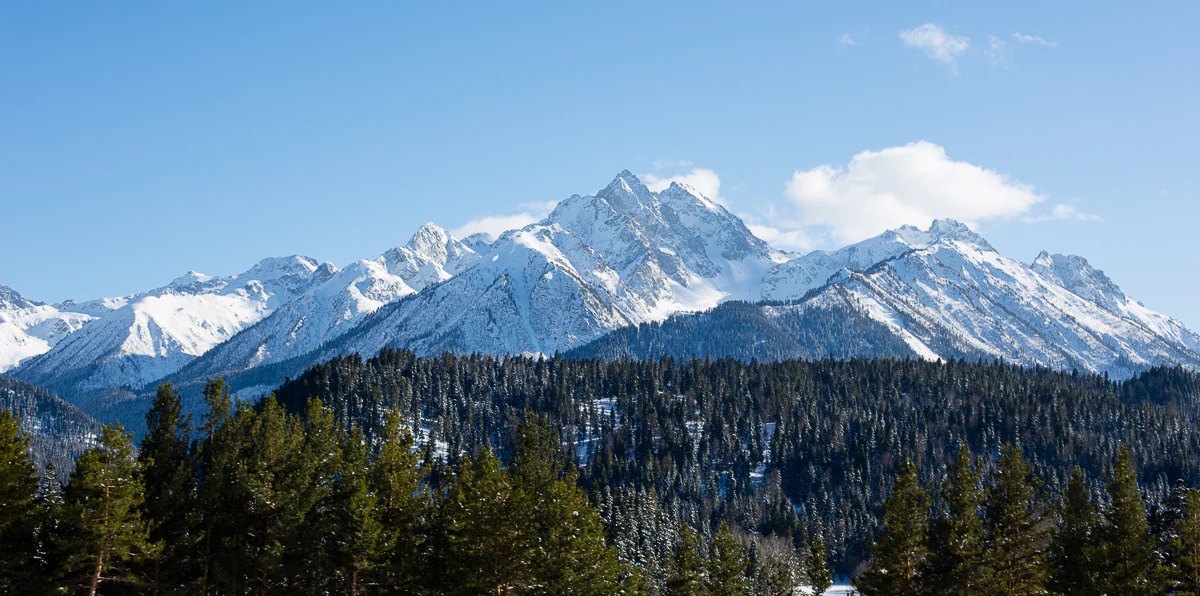
The landscape of Teberda Nature Reserve is defined by the dramatic terrain of the western Caucasus Mountains, where tectonic forces created rugged peaks and glacial valleys that descend from elevations exceeding 4,000 meters down to forest-covered slopes at around 1,260 meters. The southern border follows the Main Caucasus ridge between the Klukhori and Herzog peaks, while the two main sections occupy distinct river valleys: the Tebardinsky sector follows the Teberda River headwaters in the east, and the Arkhyz section follows the Kyzgych River valley in the west. The terrain is characterized by extreme variation, with approximately 38.4% covered in rock and scree, 31.7% in forests, 20% in meadows, and 8.5% in glaciers. The reserve contains 109 glaciers with a combined area of 74.3 square kilometers, along with extensive snowfields that feed steep mountain streams forming powerful rapids and waterfalls. There are 157 lakes on the reserve, most situated above 2,000 meters with maximum depths of 30 to 50 meters. The highest peaks include Dombay-Ulgen at 4,042 meters, Boo-Ulgen at 3,915 meters, Dzhalovchat at 3,870 meters, and Bela Kaya at 3,861 meters, creating an impressive alpine skyline.
Teberda Nature Reserve ecosystems, habitats, and plant life
Teberda Nature Reserve lies within the Caucasus mixed forests ecoregion, one of the world's most significant biodiversity hotspots situated between the Black Sea and Caspian Sea. The reserve exhibits remarkable altitude zoning that creates five distinct ecological bands: forest zone, sub-alpine zone between 2,000 and 2,500 meters, alpine zone between 2,500 and 3,000 meters, sub-nival zone, and the nival zone of permanent snow and rock. The forest zone, covering approximately 34% of the reserve, is dominated by pine forests with an understory of juniper and rhododendron. The southern areas feature coniferous forest, while the lower floodplains of the Teberda River contain distinctive stands of alder. The alpine zones support characteristic heath communities and meadows adapted to harsh high-altitude conditions. The ecoregion's global significance is underscored by exceptional endemism rates: 23% of vascular plant species and 10% of vertebrate species are found nowhere else on Earth, making the Caucasus one of the highest-biodiversity mountainous regions globally.
Teberda Nature Reserve wildlife and species highlights
The wildlife of Teberda Nature Reserve reflects the exceptional biodiversity of the Caucasus Mountains, with 46 mammal species and 226 bird species recorded within its boundaries. The reserve supports a significant population of Caucasian ibex, with an estimated 1,300 to 1,600 individuals, a species distinguished by the large saber horns that can reach one meter in length on mature males. European bison have been successfully reintroduced to the reserve after local extinction in 1926, with the population growing to 32 individuals by 2015, representing an important conservation success. The reserve provides crucial habitat for the Caucasian black grouse, a near-threatened bird species that is endemic to the Caucasus region and serves as a symbol of the region's unique avifauna. Other notable wildlife includes the recently expanded jackal population, which has become the most common predator in the reserve. The streams support three fish species: brown trout, common minnow, and European loach. The diversity of habitats from forest through sub-alpine and alpine zones supports this rich faunal community.
Teberda Nature Reserve conservation status and protection priorities
Teberda Nature Reserve holds IUCN Category Ia status as a strict nature reserve, representing the highest level of protection within the international protected area classification system. The reserve is an integral component of a UNESCO World Biosphere Reserve, recognizing its dual role in biodiversity conservation and sustainable use. The 2010 establishment of the biosphere polygon connecting Teberda with the broader Caucasus State Nature Reserve created a larger conservation landscape that facilitates ecological connectivity across the western Caucasus. The reserve protects one of the world's most significant centers of endemism, with the Caucasus Mountains hosting 23% endemic vascular plant species and 10% endemic vertebrates. Conservation efforts have focused on protecting core habitat areas with strict access restrictions while maintaining carefully managed ecotourism routes that allow controlled visitor access without compromising ecological integrity. The successful bison reintroduction program demonstrates the reserve's capacity for active species recovery, while ongoing monitoring supports management decisions for the diverse flora and fauna dependent on this mountainous protected area.
Teberda Nature Reserve cultural meaning and human context
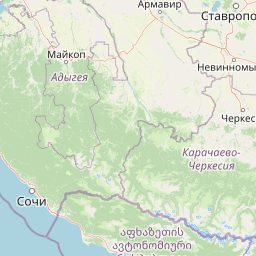
Teberda Nature Reserve is located within the Karachay-Cherkess Republic, a region in southern Russia with a complex ethnic history and diverse cultural heritage. The reserve takes its name from the Teberda River and the nearby settlement of Teberda, which has developed as a gateway community for visitors accessing the reserve and surrounding resort areas. The Dombay tourist complex at the reserve's entrance represents the long-standing relationship between human settlement and the mountain environment, providing visitor infrastructure while the reserve maintains its strict protection status. The region's history involves the indigenous peoples of the Caucasus, including Turkic and Circassian groups whose traditional land use practices shaped the cultural landscape before Soviet-era protected area establishment. While the reserve itself operates under strict protection protocols, the surrounding Karachay-Cherkess Republic maintains strong connections to the mountain environments that define the region's identity and continue to support local communities and traditional land use patterns outside the core protected zones.
Top sights and standout views in Teberda Nature Reserve
Teberda Nature Reserve stands out as Russia's most visited nature reserve, offering access to some of the most spectacular alpine landscapes in the Caucasus Mountains while maintaining strict conservation through its IUCN Category Ia status. The reserve protects critical populations of endemic species including the Caucasian ibex with its impressive curved horns and the near-threatened Caucasian black grouse, a bird found nowhere else on Earth. The dramatic glaciated peaks, including the iconic Dombay-Ulgen at over 4,000 meters, create a stunning backdrop for visitors accessing the reserve's carefully managed ecotourism routes. The successful reintroduction of European bison represents an important conservation achievement, demonstrating the reserve's commitment to species recovery. The integration into a larger UNESCO World Biosphere Reserve connected through the Caucasus State Nature Reserve polygon ensures landscape-level conservation that extends protection beyond the reserve's core boundaries.
Best time to visit Teberda Nature Reserve
Teberda Nature Reserve can be visited year-round, though the most popular season occurs during the summer months when the weather is most stable and the alpine meadows display their full floral diversity. The reserve's humid continental climate brings cool summers with average July temperatures of 15.5°C, making it a refreshing escape from lowland heat. Winter visits offer the opportunity to experience the dramatic winter mountain landscape, though access to higher-elevation routes is limited by snow cover that typically lasts from 21 to 122 days annually. The shoulder seasons of spring and autumn provide different experiences, with spring bringing snowmelt and waterfall flows at their peak, while autumn showcases the sub-alpine and forest zones in fall coloration. The average frost-free period of 126 days guides the practical visitor season, with the reserve's tourist infrastructure at Dombay providing access and permits for the various ecotourism routes throughout the accessible periods.