

Mori Atlas logo
National parkMountain Zebra National Park

Discover the mapped boundaries and regional context of this South African national park.

Mountain Zebra National Park: Protected Landscape and Geographic Atlas Entry

Mountain Zebra National Park represents a significant protected landscape within the Eastern Cape region of South Africa. As a designated national park, its mapped boundaries define a unique area for geographic exploration. MoriAtlas provides an atlas-style view, helping users understand the park's place within the regional geography and its distinct natural terrain, offering detailed context for map-based discovery and understanding protected land distribution.

National ParkEastern CapeCape Mountain ZebraKaroo BiomePredator ConservationBig Five

Mountain Zebra National Park

National park

Park overview

Structured park overview, official facts, and landscape profile for Mountain Zebra National Park

Mountain Zebra National Park park facts, protected area profile, and essential visitor context
Review the core facts for Mountain Zebra National Park, including designation, size, terrain, visitor scale, habitats, and operating context in one park-focused overview.

About Mountain Zebra National Park

Mountain Zebra National Park represents one of South Africa's oldest national parks and one of the earliest dedicated conservation efforts for a single species. The park is situated in the Camdeboo box, a mountain basin region characterized by sandstone and dolerite formations, rolling plateaus, and deeply dissected valleys. The landscape transitions from open plains to mountainous terrain, creating diverse habitats that support the park's varied wildlife. The park's establishment in 1937 marked a pivotal moment in South African conservation history, demonstrating a commitment to preserving native species before they vanished entirely. Today, the park serves as a anchor for the broader Mountain Zebra-Camdeboo Protected Environment, which encompasses nearly 900,000 hectares of surrounding conservation land, creating a significant contiguous protected area that supports ecological processes across a wide region.

Quick facts and research context for Mountain Zebra National Park

Mountain Zebra National Park covers 284 square kilometers in the Eastern Cape, South Africa, near the town of Cradock. Established on July 2, 1937, it began as a 17 square kilometer reserve for the endangered Cape mountain zebra. The park is IUCN Category II and managed by South African National Parks. The original zebra population consisted of just five stallions and one mare, growing to over 700 animals today. The park contains around 39 kilometers of hiking trails and offers accommodation through cottages, a guest house, and camping facilities.

Park context

Deeper park guide and search-rich context for Mountain Zebra National Park

Mountain Zebra National Park history, landscape, wildlife, and travel context
Explore Mountain Zebra National Park through its history, landscape character, ecosystems, wildlife, conservation priorities, cultural context, and seasonal travel timing in a structured park guide built for atlas discovery and search intent.

Why Mountain Zebra National Park stands out

Mountain Zebra National Park is best known as a conservation stronghold for the Cape mountain zebra, a species that was teetering on the edge of extinction in the early 20th century. The park's primary purpose was to save this endangered subspecies from vanishing, and it has become one of the most successful zebra conservation stories in Africa. The park is also notable for its predator reintroduction program, having brought back cheetahs in 2007 and lions in 2013 to restore the natural predator balance. The dramatic Karoo mountain scenery, with its rugged terrain and scenic drives, provides a distinctive backdrop for wildlife viewing.

Mountain Zebra National Park history and protected-area timeline

The establishment of Mountain Zebra National Park emerged from a conservation crisis in the 1930s when the Cape mountain zebra faced imminent extinction. The species had been decimated by hunting and habitat loss, leaving only scattered populations in the wild. In 1937, the National Parks Board of Trustees purchased the farm Babylons Toren near Cradock, and in 1938 proclaimed a 17.12 square kilometer area for zebra preservation. The initial captive population numbered just five stallions and one mare, an dangerously small genetic pool. By 1950, only two stallions remained, prompting intervention through a neighboring farmer, Mr H L Lombard, who donated eleven additional zebra to bolster the breeding population. The park expanded to 65.36 square kilometers in 1964, and through careful management, the zebra population grew to approximately 140 animals by the mid-1970s. In 1975, the park achieved a milestone by translocating zebras to De Hoop Nature Reserve in the Western Cape, beginning the restoration of the species across its historic range. Since 1978, annual captures and relocations have become routine, with over 700 zebra now resident in the park and roughly 20 animals relocated annually to establish new populations.

Mountain Zebra National Park landscape and geographic character

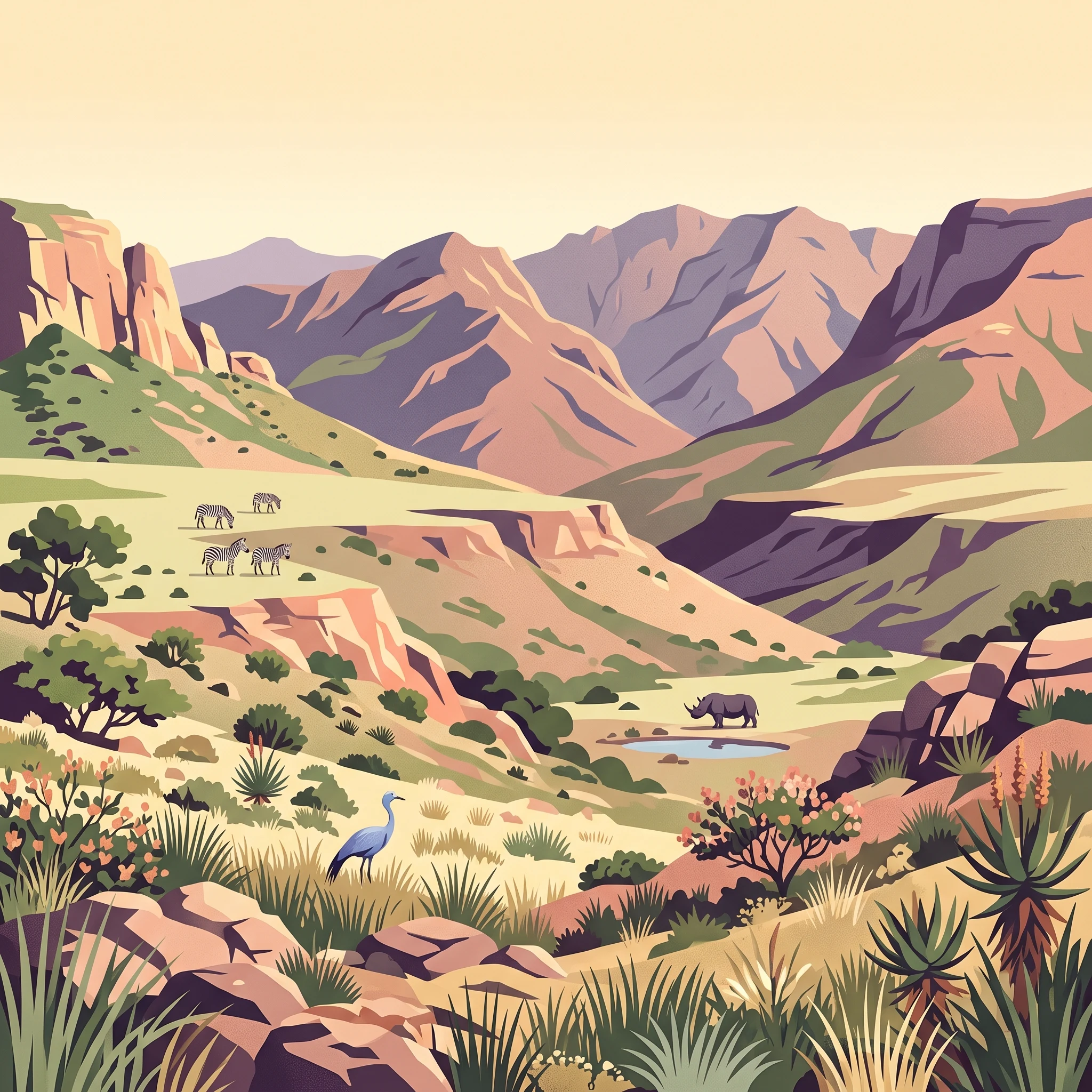
The park occupies a distinctive Karoo mountain landscape characterized by rugged sandstone and dolerite formations, elevated plateaus, and deeply incised valleys. The terrain rises from lower-lying plains to mountainous areas reaching higher elevations, creating a varied topography that defines the park's visual character. The underlying geology consists primarily of sedimentary rocks of the Karoo Supergroup, with scattered dolerite intrusions forming prominent ridges and cliffs. Seasonal watercourses drain the landscape, supporting riparian vegetation along water channels that cut through the otherwise semi-arid terrain. The vegetation is typical of the Karoo, featuring sparse grass cover, succulent shrubs, and scattered trees in protected valleys. This dramatic mountain scenery, with its sweeping vistas and rugged rock formations, provides a striking counterpoint to the wildlife that inhabits the plains and slopes.

Mountain Zebra National Park ecosystems, habitats, and plant life

The ecological character of Mountain Zebra National Park reflects the semi-arid Karoo biome, a region of exceptional botanical diversity despite its harsh conditions. The park encompasses multiple habitat types, from open grasslands on the plateaus to denser vegetation in the river valleys and sheltered gorges. The flora includes species adapted to periodic drought and extreme temperature variations, with many plants exhibiting succulent or waxy leaf surfaces to conserve water. Tree species such as Cape beech, Karee, olive, and Ouhout provide shade and shelter in certain areas, while the more open terrain supports a rich variety of shrubs and grasses. This vegetation diversity forms the foundation for the park's mammal and bird communities, creating a functional ecosystem where species have adapted to the seasonal cycles of the Karoo.

Mountain Zebra National Park wildlife and species highlights

Mountain Zebra National Park protects an impressive array of mammalian species beyond its flagship zebra population. The park supports healthy populations of large herbivores including Cape buffalo, eland, black wildebeest, red hartebeest, gemsbok, and grey rhebok, creating diverse grazing and browsing communities. Smaller mammals such as caracal, ground squirrels, and meerkats add to the mammal diversity. The predator program has reintroduced cheetahs and lions, restoring ecological balance that had been lost for decades, though a predator-proof fence keeps these large predators contained within the park to prevent conflict with neighboring farms. Black rhinoceros also inhabit the park, representing another conservation success story for this endangered species. The bird community includes notable species such as the blue crane, South Africa's national bird, along with blue korhaan, pale chanting goshawk, ostrich, and brown-hooded kingfisher, adding avian richness to the safari experience.

Mountain Zebra National Park conservation status and protection priorities

Mountain Zebra National Park represents a landmark success in species-specific conservation, having brought the Cape mountain zebra back from the brink of extinction through dedicated protection and management. The park's original mission to save this subspecies has evolved into a broader conservation mandate that protects a suite of species and habitats within the larger Mountain Zebra-Camdeboo Protected Environment. The annual relocation program demonstrates how the park functions as a source population for establishing new zebra herds across suitable protected areas, contributing to the species' recovery beyond park boundaries. The reintroduction of apex predators like cheetahs and lions restores natural ecological processes that had been disrupted for generations, allowing for predator-prey dynamics to function once again. The surrounding protected environment of nearly 900,000 hectares creates a conservation matrix that supports wildlife movement and ecosystem connectivity beyond the park's formal boundaries.

Mountain Zebra National Park cultural meaning and human context

The park is situated in a region with historical significance in South Africa's interior, lying near the town of Cradock which developed as an agricultural center in the 19th century. The landscape bears evidence of human interaction over extended periods, though the primary focus of the park remains ecological conservation rather than cultural heritage. The property names associated with the park's establishment, such as Babylons Toren, reflect the region's colonial-era naming conventions. The broader Eastern Cape province holds particular significance in South African history as the birthplace of many prominent figures in the anti-apartheid movement and as traditionally the homeland of Xhosa-speaking peoples. The park's conservation success story has become a model for species recovery programs elsewhere in Africa, demonstrating how protected areas can serve dual purposes of biodiversity preservation and ecological restoration.

Top sights and standout views in Mountain Zebra National Park

The park offers exceptional Cape mountain zebra viewing, with herds regularly encountered throughout the reserve and the opportunity to observe these distinctive animals in their natural mountain habitat. The predator reintroduction program has created exciting wildlife viewing opportunities, with lion and cheetah sightings increasingly common. The 39 kilometers of hiking trails provide access to the park's scenic uplands and valleys, offering a different perspective than game drives. The varied terrain, from open plains to rugged mountain slopes, creates diverse safari experiences within a relatively compact park. The proximity to Cradock makes the park accessible for day visits while also supporting overnight stays in the various accommodation options. The park's position within the larger Mountain Zebra-Camdeboo Protected Environment connects it to an extensive conservation landscape that extends the wildlife experience beyond the formal park boundaries.

Best time to visit Mountain Zebra National Park

The park can be visited year-round, though the cooler winter months from May to September typically offer more comfortable conditions for outdoor activities and wildlife viewing. Summer temperatures in the Karoo can be extremely hot, particularly in January and February, making early morning and late afternoon activities more pleasant. The dry winter season often concentrates wildlife around water sources, improving viewing opportunities, while the summer months bring greener vegetation and more vibrant landscapes at the cost of potentially more difficult animal spotting. The shoulder seasons of spring and autumn provide a balance of favorable weather and good wildlife viewing, with spring bringing wildflower blooms that add color to the landscape.
Park location guide

Geography guide, regional context, and park location map for Mountain Zebra National Park

Mountain Zebra National Park park geography, regions, and map view in South Africa
Understand where Mountain Zebra National Park sits in South Africa through a broader geographic reading of the surrounding landscape, nearby location context, and its mapped position within the national park landscape.

How Mountain Zebra National Park fits into South Africa

South Africa is the southernmost country in Africa, spanning 1.22 million km² with a population of over 63 million. The country operates with three capital cities, Pretoria (executive), Cape Town (legislative), and Bloemfontein (judicial), and is renowned for its biodiversity, national parks, and multicultural society.

Wider geography shaping Mountain Zebra National Park in South Africa

South Africa occupies the southernmost region of Africa, with coastline along both the Atlantic Ocean to the west and the Indian Ocean to the east. The interior features elevated plateaus including the Highveld, with the Drakensberg escarpment marking the eastern highlands. The country shares borders with Namibia, Botswana, Zimbabwe, Mozambique, Eswatini, and Lesotho.

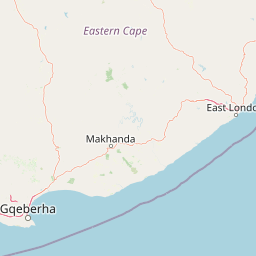
Map view of Mountain Zebra National Park

Use this park location map to pinpoint Mountain Zebra National Park in South Africa, understand its exact geographic position, and read its mapped placement within the surrounding landscape more clearly.

Pigeon | © OpenStreetMap contributors

Location context for Mountain Zebra National Park

Eastern Cape
Park atlas

Trace Regional Protected Landscapes and Compare National Parks Around Mountain Zebra National Park

Explore More National Parks Near Mountain Zebra National Park in the Karoo Landscape
Explore a curated list of national parks and protected areas geographically connected to Mountain Zebra National Park, spanning South Africa's distinctive Karoo mountain landscapes. Users can browse adjacent conservation areas to understand broader regional context and compare their unique protected features.
National parkEastern Cape

Camdeboo National Park: Protected Landscape Atlas and Eastern Cape Geographic Context

Discover the mapped geography and protected area identity of this Eastern Cape national park.

Camdeboo National Park represents a key protected landscape within the Eastern Cape province of South Africa. This entry provides essential details for understanding its protected-area status, geographic footprint, and its role within the regional atlas. Examine its mapped boundaries and explore the unique natural terrain it encompasses, gaining specific insight into its protected landscape characteristics.

Area
194.05 km²
Established
2005
Relief
Mountain
Climate
Arid
National parkEastern Cape

Addo Elephant National Park: South African National Park with Diverse Protected Landscapes

Explore its geographic context and unique Big Seven megafauna habitats.

Addo Elephant National Park is a crucial protected landscape within South Africa's Eastern Cape, covering approximately 1,640 square kilometers of varied terrain including karoo plains, coastal dunes, and marine protected areas. Its identity is deeply tied to the successful recovery of elephant populations and its distinction as the only African national park where all Big Seven megafauna can be observed in their natural surroundings. Discover the park's geographic spread, landscape diversity, and its role as a premier conservation area.

Area
1,640 km²
Established
1931
IUCN
II
Visitors
305.5K annual
National parkSouth Africa

Tsitsikamma National Park: South Africa's Protected Coastal Forest and Terrain

Explore the unique mapped landscape and protected area boundaries.

Tsitsikamma National Park in South Africa is defined by its striking coastal geography, where ancient indigenous forests descend towards rugged shores. This national park is a prime example of a protected landscape that showcases the dynamic interface between land and sea, featuring dramatic cliffs and iconic river mouths. Understanding its mapped boundaries and diverse terrain provides critical context for regional geographic exploration and the study of conservation areas within South Africa.

Established
2009
IUCN
II
Relief
Mixed relief
Climate
Mediterranean
National parkEastern Cape

Grassland National Park National Park: Exploring Protected Landscapes and Regional Geography

Mapped boundaries and natural terrain context for an Eastern Cape protected area.

Grassland National Park represents a crucial protected area within South Africa's Eastern Cape province. As a national park, it offers significant insights into the region's natural landscapes and geographic character. This atlas perspective focuses on understanding the park's mapped scope, its terrain features, and its place within the broader provincial geography. Discover the unique protected landscape identity of Grassland National Park and how it contributes to the mapped natural heritage of the Eastern Cape.

Area
102.25 km²
Established
2025
IUCN
II
Relief
Mountain
National parkSouth Africa

Garden Route National Park: South Africa's Protected Landscape and Forest Atlas

Explore indigenous forests, coastal cliffs, and lake systems.

Garden Route National Park is a key national park in South Africa, celebrated for its rich indigenous forests and dramatic coastline. As a protected landscape, it offers a unique geographic profile, blending ancient woodlands with rugged coastal terrain and interconnected lake systems. This page serves as an atlas entry, detailing the park's spatial extent and its significance as a conservation area within the broader geography of South Africa.

Area
1,210 km²
Established
2009
IUCN
II
Relief
Mixed relief
National parkWestern Cape

Wilderness National Park: National Park in Western Cape Province, South Africa

Explore mapped protected areas and regional geography.

Wilderness National Park stands as a significant protected area within the Western Cape province of South Africa. This page provides a detailed view of its role as a national park, emphasizing its geographic placement and mapped boundaries. Understand the park's contribution to the region's natural landscape and its significance within the broader atlas of protected lands.

Area
1,210 km²
Established
2009
Relief
Lowland
Access
Easy access
Wildlife reserveWestern Cape

Karoo National Park Wildlife Reserve: Mapped Boundaries and Geographic Context

Explore the protected landscape of this Western Cape wildlife reserve.

Karoo National Park stands as a protected wildlife reserve, offering insights into the natural geography of South Africa's Western Cape. This detail page provides an atlas view of its protected landscape, mapping its boundaries and situating it within its regional context. Engage with the park's identity as a conservation area and understand its geographic significance for dedicated exploration.

Area
767.9 km²
Established
1979
Relief
Mountain
Climate
Arid
National parkQacha's Nek District

Sehlabathebe National Park: Mapped Protected Landscape in Lesotho's Maloti Mountains

Explore high-altitude terrain, waterfalls, and ancient rock art sites.

Sehlabathebe National Park stands as a protected national park within the rugged Maloti Mountains of Lesotho's Qacha's Nek District. This destination is vital for understanding the geographic context of protected areas, featuring dramatic cliffs, iconic waterfalls like Tsoelikana, and numerous rock art sites that speak to its cultural and historical significance. Its high-altitude Afro-Alpine and sub-alpine ecosystems offer unique landscape characteristics and support notable biodiversity, making it a key point of interest for atlas-driven exploration of natural and protected terrains.

Area
69.5 km²
Established
1969
IUCN
IV
Relief
Mountain

Common questions about visiting, size, designation, and location context for Mountain Zebra National Park

Mountain Zebra National Park FAQs for park facts, access, geography, and protected area context
Find quick answers about Mountain Zebra National Park, including protected-area facts, park geography, trail and visitor context, and how the park fits into its surrounding country and regional landscape.
MoriAtlas Explorer

Continue Your Protected Areas Search Across the Global Atlas

Deepen your exploration by continuing the structured search for national parks and protected areas worldwide. Utilize the comprehensive filtering capabilities to compare different conservation landscapes and refine your understanding of global park geography. Discover more about the distribution and characteristics of protected natural areas.

Global natural geography