Why Kui Buri National Park stands out
Kui Buri National Park is best known for its significant population of Asian elephants and other large mammals including gaur, tigers, and leopards. The park contains the only harvestable sandalwood resource in Thailand, reserved exclusively for royal cremation purposes, with trees over 100 years old selected by royal Brahmins for this sacred purpose. Its position within the Tenasserim Hills makes it a critical wildlife corridor, while the dry and moist evergreen forest ecosystem supports remarkable biodiversity in central Thailand.
Kui Buri National Park history and protected-area timeline
Kui Buri National Park was established in March 1999 as the 90th national park in Thailand's system of protected areas, administered by the Department of National Parks, Wildlife and Plant Conservation. The park was created to protect the forest ecosystems of the Tenasserim Hills region and the wildlife populations they support, particularly large mammals including Asian elephants and tigers. The selection of the area for national park status reflected growing awareness of the ecological importance of the Tenasserim corridor and the need to connect fragmented protected lands across the Thai-Malay peninsula. The park's subsequent designation as part of the Kaeng Krachan Forest Complex World Heritage Site in 2021 represented the culmination of decades of conservation efforts in the region.
Kui Buri National Park landscape and geographic character
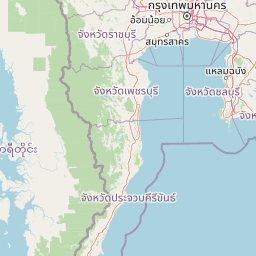
The landscape of Kui Buri National Park is defined by the forested slopes and ridges of the Tenasserim Hills, a range that forms part of the greater mountain system extending through mainland Southeast Asia. The terrain consists of rolling to steep hillsides covered in evergreen forest, with elevation changes creating diverse microhabitats throughout the reserve. The forest cover transitions between dry evergreen and moist evergreen types depending on aspect and elevation, with the vegetation forming a contiguous green mantle across the mountainous terrain. The park's location in Prachuap Khiri Khan Province places it within a broader landscape of coastal plains to the east and additional protected areas to the north and west.
Kui Buri National Park ecosystems, habitats, and plant life
The forests of Kui Buri National Park are characterized by dry evergreen and moist evergreen forest types typical of the Tenasserim region. Key tree species include Dipterocarpus tuberculatus, Hopea odorata, and Terminalia chebula, along with various palm species. The park holds exceptional significance for sandalwood (Santalum), with more than 200,000 trees documented within the reserve. This sandalwood population represents the only source in Thailand approved for harvesting for royal cremation ceremonies, a tradition that requires trees to be dead and over 100 years old. Nine trees from the park were selected for the royal cremation of King Bhumibol Adulyadej, demonstrating the park's unique cultural and ecological role.
Kui Buri National Park wildlife and species highlights
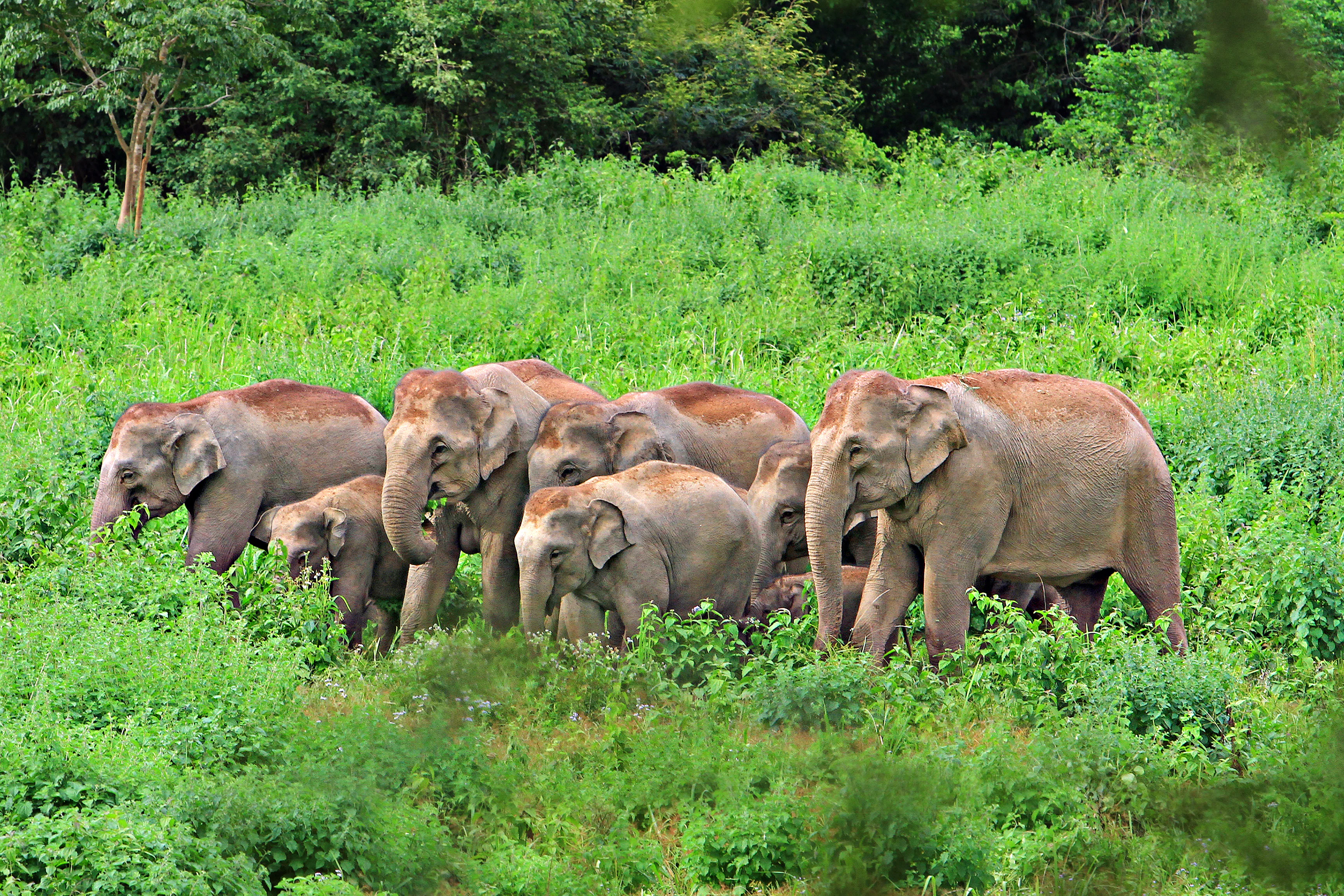
Kui Buri National Park supports a notable assemblage of large mammals characteristic of mainland Southeast Asian forests. Asian elephants move through the park in significant numbers, while gaur, the largest wild cattle species in the region, inhabit the forest clearings and slopes. Predators present include tigers and leopards, both of which rely on the park's forest corridors for movement and hunting. The park also supports Malayan tapir, a distinctive species recognizable by its black and white markings, along with serow, a mountain-dwelling goat-antelope. Primates including gibbons, macaques, and langurs are found throughout the canopy, while deer species such as sambar deer and barking deer occupy forest understories. Smaller mammals include Fea's muntjac, lesser mouse deer, wild pig, and Asiatic black bear. This diversity positions the park as an important conservation area for Thailand's forest-dependent fauna.
Kui Buri National Park conservation status and protection priorities
Kui Buri National Park serves as a critical component of the Kaeng Krachan Forest Complex, recognized in 2021 as a UNESCO World Heritage Site of outstanding universal value. The park's role in connecting fragmented forest habitats along the Tenasserim corridor makes it essential for maintaining ecological processes across the Thai-Malay peninsula. The protection of Asian elephant populations is particularly significant, as these animals require large contiguous territories and face increasing pressure from habitat fragmentation throughout their range. The sandalwood resource represents both a conservation challenge and a unique cultural asset, with the park's status as the sole source for royal cremation ceremonies creating strong incentives for protection of these ancient trees.
Kui Buri National Park cultural meaning and human context
The cultural significance of Kui Buri National Park extends beyond its ecological value through its role in Thailand's royal traditions. The sandalwood trees within the park are the only ones in Thailand permitted for use in royal cremation ceremonies, a practice requiring selection by royal Brahmins who spend months identifying trees meeting specific criteria. Nine trees from Kui Buri were harvested for the cremation of King Bhumibol Adulyadej, Thailand's long-reigning monarch. This royal connection provides the park with a unique cultural identity and reinforces the importance of protecting these ancient trees for future generations.
Top sights and standout views in Kui Buri National Park
Kui Buri National Park stands out as a critical elephant habitat within Thailand's protected area network, supporting viable populations of these endangered megaherbivores alongside tigers and leopards. The park's UNESCO World Heritage Site status reflects its importance as a biodiversity corridor in the Tenasserim region. The ancient sandalwood forest, reserved exclusively for royal ceremonial use, represents a living link between Thailand's natural heritage and monarchical traditions. The combination of dry and moist evergreen forests creates a visually diverse landscape that supports the country's largest national park complex designation.
Best time to visit Kui Buri National Park
Kui Buri National Park can be visited throughout the year, though the cool dry season from November to February typically offers the most comfortable conditions for exploration. The forest environment remains lush during the wet season from May to October, when rainfall contributes to the evergreen character of the park's vegetation. Wildlife viewing opportunities exist year-round, though dry conditions may concentrate animals more visibly around water sources during the hotter months from March to April.