Why Rose Atoll National Wildlife Refuge stands out
Rose Atoll is best known for its extraordinary marine biodiversity and the unusual abundance of rose-colored corals that give the atoll its name. The surrounding waters contain the largest populations of giant clams and nesting seabirds in all of American Samoa, with nearly 270 fish species recorded in recent decades. The atoll supports an unusual ecological character with a high concentration of carnivorous fish and notably low numbers of herbivorous fish, creating a distinctive marine food web. It is also recognized as an Important Bird Area supporting approximately 400,000 sooty terns, representing about 97 percent of American Samoa's entire seabird population. The site's significance is further underscored by its status as critical nesting habitat for both green turtles and endangered hawksbill turtles.
Rose Atoll National Wildlife Refuge history and protected-area timeline
Rose Atoll's history reflects the broader narrative of Pacific exploration and American territorial expansion. The first Western sighting occurred on June 13, 1722, when Dutch explorer Jacob Roggeveen encountered the atoll and dismissively named it Vuil Eiland, meaning useless island. The more enduring name came in 1819 when French explorer Louis de Freycinet arrived and named the island after his wife Rose de Freycinet, who was herself notable as the second woman to circumnavigate the globe and the first to publish an account of her journey. The atoll was seen again in 1824 by Otto von Kotzebue's expedition, which named it Kordinkov after the explorer's first lieutenant. In more recent history, Rose Atoll gained unexpected prominence when Apollo 10 returned to Earth near the atoll on May 26, 1969, with astronauts being warmly welcomed at Pago Pago International Airport before transport to Hawaii. The formal protection of Rose Atoll began in 1973 when it was established as a National Wildlife Refuge, covering approximately 39,000 acres. This was significantly expanded in 2009 with the creation of the Rose Atoll Marine National Monument, which extended protection to the surrounding marine waters.
Rose Atoll National Wildlife Refuge landscape and geographic character
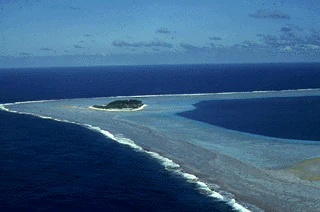
Rose Atoll presents a classic atoll landscape defined by its ring-shaped reef surrounding a central lagoon. The atoll measures approximately 2.6 kilometers by 2.7 kilometers, making it nearly square and among the smallest atolls globally. Two islets occupy the northeastern rim of the reef: Rose Island, which reaches about 3.5 meters above sea level and supports vegetation including the only remaining Pisonia forest in all of Samoa, and the smaller, non-vegetated Sand Island rising just 1.5 meters high. A narrow channel approximately 80 meters wide provides access to the lagoon from the west. The reef flat and lagoon together cover about 6.33 square kilometers, while the broader marine environment protected by the monument extends to over 8.5 million acres. The surrounding ocean waters feature diverse coral formations, with the rose-colored corals that give the atoll its name being particularly notable. The isolation of Rose Atoll is pronounced, with the nearest island, Ta'ū, located 140 kilometers to the west-northwest.
Rose Atoll National Wildlife Refuge ecosystems, habitats, and plant life
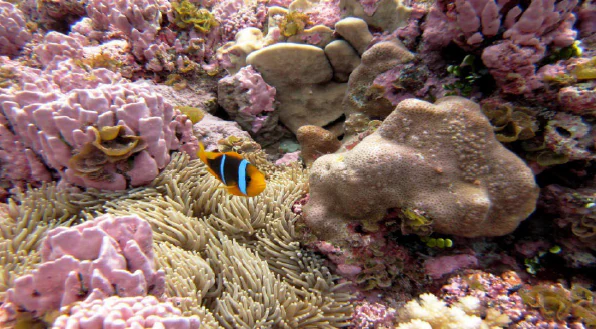
The ecological character of Rose Atoll is defined by the remarkable biodiversity concentrated in its relatively small footprint. The marine environment hosts the largest populations of giant clams and rare reef fish found anywhere in American Samoa, with nearly 270 fish species recorded in the past fifteen years. The fish community exhibits a distinctive structure with an unusually high concentration of carnivorous fish and notably low numbers of herbivorous fish, creating an atypical reef ecosystem. The surrounding waters support tuna, mahi-mahi, billfish, barracuda, and sharks in the open waters beyond the lagoon, while deeper waters have revealed tunicates and stalked crinoids observed by scuba expeditions. Rose Atoll's terrestrial nature is characterized by the Pisonia forest, which represents the only remaining example of this forest type in all of Samoa. The pink coralline algae that carpets the reef adds another distinctive element to the atoll's natural character.
Rose Atoll National Wildlife Refuge wildlife and species highlights
Rose Atoll supports extraordinary wildlife populations that justify its designation as a critical conservation area. The atoll serves as the primary nesting habitat for threatened green turtles and endangered hawksbill turtles, which migrate between American Samoa and other Pacific island nations during the nesting season from August through February. The bird populations are particularly remarkable, with approximately 97 percent of American Samoa's entire seabird population concentrated on the atoll. Twelve federally protected bird species nest here, including red-footed boobies, greater and lesser frigate birds, black noddies, white terns, Pacific reef herons, and red-tailed tropic birds. The Pisonia forest provides crucial nesting habitat for these species, while the surrounding waters support sea mammals including endangered humpback whales and dolphins of the genus Stenella. The fish diversity is exceptional, with the unusual abundance of rose-colored corals providing habitat for nearly 270 recorded fish species.
Rose Atoll National Wildlife Refuge conservation status and protection priorities
Rose Atoll's conservation significance is reflected in its multiple protected area designations and the international recognition it has received. The site was originally protected as a National Wildlife Refuge in 1973, with the marine environment later receiving enhanced protection through the 2009 establishment of the Rose Atoll Marine National Monument. This designation was specifically cited for the presence of rare species including giant clams and reef sharks, as well as the unusual abundance of rose-colored corals. BirdLife International has recognized the atoll as an Important Bird Area due to its support of approximately 400,000 breeding sooty terns. The cooperative management arrangement between the U.S. Fish and Wildlife Service, American Samoa, and NOAA's Office of National Marine Sanctuaries demonstrates the multi-jurisdictional approach needed to effectively protect both the terrestrial and marine components of this ecosystem. The integration of the monument's marine areas into the National Marine Sanctuary of American Samoa in 2014 further strengthened the conservation framework.
Rose Atoll National Wildlife Refuge cultural meaning and human context
Rose Atoll holds cultural significance for the people of the Manu'a Islands, who have traditionally referred to the atoll as Motu O Manu, meaning Bird Island. This name reflects the overwhelming presence of seabirds that nest on the atoll and represents the historical connection between local communities and this remote natural landmark. While the atoll itself is uninhabited today, the Manu'a Islands lying to the west maintain cultural and historical ties to this easternmost point of American Samoa. The establishment of the Rose Atoll Marine National Monument in 2009 reflected a partnership between the federal government and the territory of American Samoa, acknowledging both the ecological importance of the site and its regional significance within Samoan cultural context.
Top sights and standout views in Rose Atoll National Wildlife Refuge
Rose Atoll National Wildlife Refuge represents the convergence of several extraordinary conservation values within a single, compact geographic unit. The atoll is distinguished by its status as the southernmost point of the United States and the only atoll in the Samoan Islands chain. Its marine waters contain exceptional biodiversity including the largest giant clam populations in American Samoa and nearly 270 fish species. The site supports approximately 400,000 nesting seabirds, representing 97 percent of the territory's bird population. The presence of rose-colored corals is unusual in the Pacific and gives the atoll its distinctive character. Both green turtles and endangered hawksbill turtles rely on Rose Atoll for nesting, while the surrounding waters provide habitat for endangered humpback whales.
Best time to visit Rose Atoll National Wildlife Refuge
Rose Atoll's remote location and protected status mean that visitor access is limited and carefully managed. The turtle nesting season from August through February represents the period when the atoll's terrestrial wildlife is most active, with green and hawksbill turtles coming ashore to nest. This period also coincides with the seabird breeding season, offering opportunities to observe the extraordinary bird populations that concentrate on the atoll. However, as a National Wildlife Refuge and Marine National Monument, access requires careful coordination with the U.S. Fish and Wildlife Service, and the focus remains on protection rather than tourism.