
Why Khirganga National Park stands out
Khirganga National Park is best known for its exceptional altitudinal range and the resulting ecological stratification, which creates distinct habitat zones within a single protected area. The park is particularly recognized for harboring viable populations of snow leopards and Himalayan black bears, two of the region's most iconic and endangered large mammals. Its diverse avian fauna, including over 200 bird species such as the Western tragopan and Himalayan monal, makes it significant for birdwatching and ornithological study. The dramatic alpine scenery, with snow-capped peaks rising above forested slopes and flower-strewn meadows, provides the visual identity that defines this Himalayan wilderness.
Khirganga National Park history and protected-area timeline
Khirganga National Park was formally designated as a protected area in 2010, making it one of the more recent additions to India's national park system. The creation of the park reflected growing recognition of the ecological importance of the Himalayan region and the need to establish protected zones that could conserve both biodiversity and watershed functions. Prior to formal protection, the area had been subject to varying degrees of local use and management, with communities living in and around what are now park boundaries having traditional relationships with the land. The park was established under India's national park framework and classified as Category II under the IUCN protected area categories, indicating its primary purpose of protecting natural ecosystems while allowing for limited compatible human use. The establishment came during a period of expanded conservation attention for India's Himalayan states, with Himachal Pradesh adding several new protected areas to strengthen conservation coverage across its mountain landscapes.
Khirganga National Park landscape and geographic character
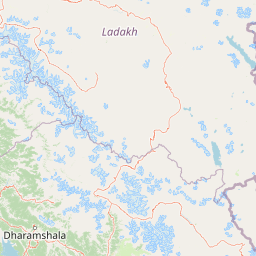
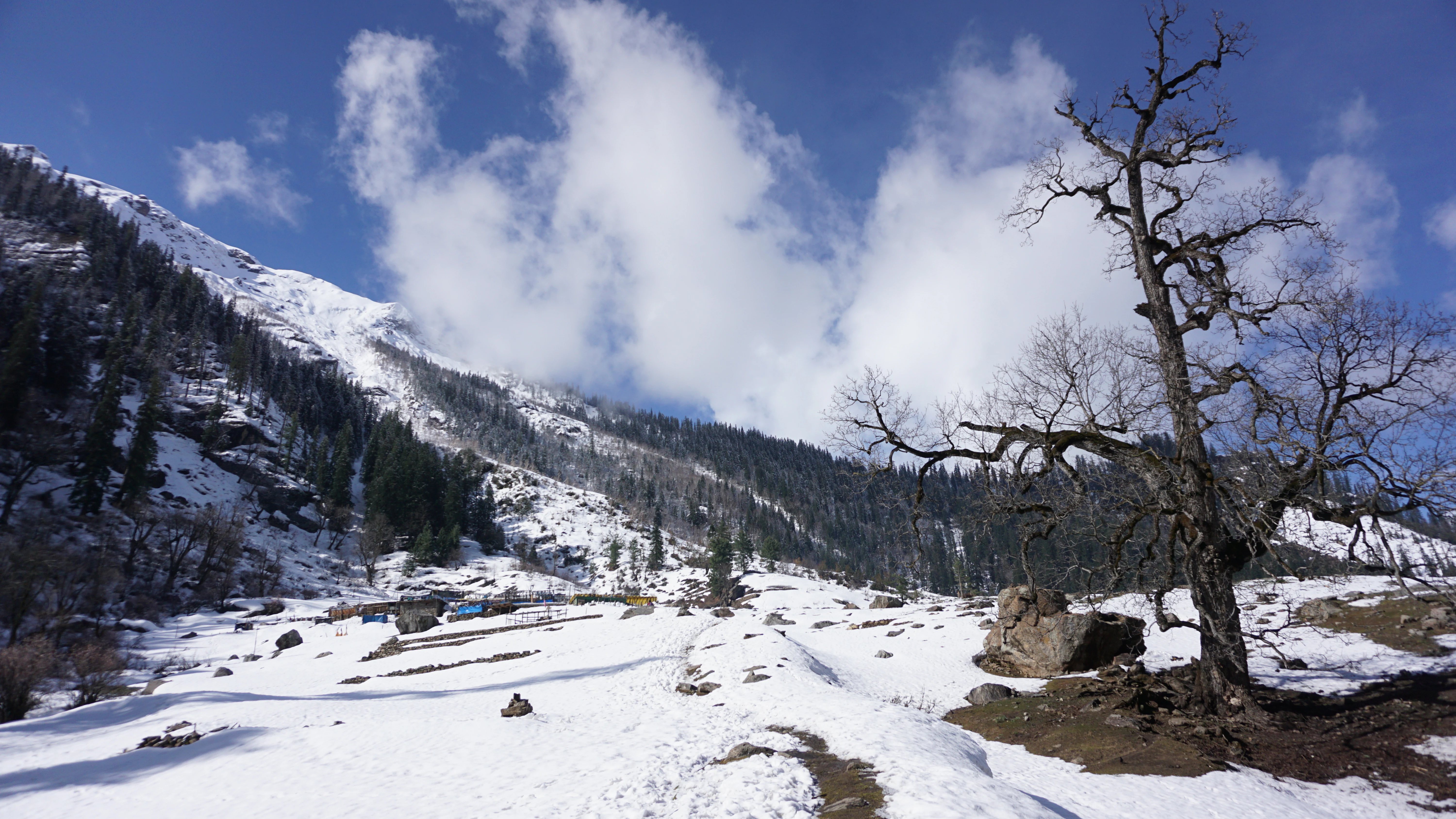
The landscape of Khirganga National Park exemplifies the dramatic topography characteristic of the central Himalayas. The terrain is dominated by steep-walled valleys, towering ridgelines, and massive peaks, with Parvati Parbat standing as the supreme summit at 6,632 meters. The elevation gradient from 2,000 meters to over 5,500 meters creates striking visual transitions as one moves through the park, with lower slopes covered in dense vegetation giving way to rocky outcrops and eventually to permanent snow and ice at the highest elevations. The park encompasses alpine meadows that bloom with wildflowers during the brief summer season, providing vivid contrast against the gray rock and white snow. The Parvati River carves through the landscape, serving as both a scenic and ecological corridor through the protected area. The combination of steep terrain, high elevations, and active geological processes gives the landscape a dynamic quality, with seasonal snow cover, glacial features, and the ever-present possibility of landslides shaping the visual character of the park.
Khirganga National Park ecosystems, habitats, and plant life
The ecological diversity of Khirganga National Park is defined by its extraordinary altitudinal range, which supports multiple distinct vegetation zones within a relatively compact protected area. At lower elevations ranging from 2,000 to approximately 2,500 meters, subtropical broadleaf forests thrive, featuring species of oak and maple that create dense, deciduous canopy in the warmer valley bottoms. As elevation increases, the vegetation transitions to coniferous forests dominated by pine and deodar cedar, which form extensive forests across the mid-elevation slopes. Above the tree line, typically around 3,500 to 4,000 meters depending on local conditions, alpine meadows appear where grasses and herbaceous plants tolerate the harsh conditions of high altitude. The park's position in the central Himalayas places it within a globally significant biodiversity region, and the vertical stratification of habitats ensures that a wide variety of species can find suitable conditions within the protected boundaries.
Khirganga National Park wildlife and species highlights
Khirganga National Park supports a notable assembly of Himalayan wildlife, including several species of significant conservation concern. The park provides habitat for the snow leopard, one of the rarest and most elusive big cats in the world, whose presence in the higher elevations reflects the park's importance for this endangered species. The Himalayan black bear inhabits the forested slopes at middle elevations, while the Himalayan tahr, a goat-antelope specialized for steep terrain, can be found navigating the rocky cliffs and ridges. The musk deer, valued for its fragrant secretion, inhabits the dense forest understory and represents another species of conservation interest. Smaller mammals including the yellow-throated marten also occur throughout the park. The avian fauna is particularly diverse, with over 200 bird species recorded including the Western tragopan, a striking pheasant considered near-threatened, the colorful Himalayan monal which is the national bird of Nepal, and the powerful golden eagle that patrols the skies above the alpine zones.
Khirganga National Park conservation status and protection priorities
Khirganga National Park plays an important role in conserving Himalayan biodiversity and ecosystem function within a region that faces multiple environmental pressures. The protected status helps safeguard habitat for species of global conservation concern, most notably the snow leopard, which remains endangered due to poaching, habitat loss, and conflict with livestock farmers. By encompassing a complete altitudinal gradient from valley forests to alpine zones, the park protects representative examples of Himalayan ecosystems that might otherwise be degraded by human activity. The watershed function of the park, serving the Parvati River, provides downstream ecological benefits that extend beyond the protected boundaries, supporting both natural systems and human communities that depend on clean water. The park's establishment as a Category II protected area reflects a management approach that balances conservation with limited sustainable use, allowing the region to maintain its ecological integrity while accommodating traditional uses that have shaped the landscape over generations.
Khirganga National Park cultural meaning and human context
While the Wikipedia source does not provide extensive detail about human cultural associations with Khirganga National Park, the broader Himachal Pradesh region has a rich cultural heritage tied to its Himalayan landscapes. The Parvati River that flows through or near the park holds religious significance in Hindu tradition, as the name Parvati relates to the goddess associated with mountain wilderness. Local communities in the surrounding areas have traditionally practiced transhumance, moving their livestock between seasonal grazing areas in response to altitude and forage availability. These communities have maintained connections to the mountain environment that predate formal protected area establishment, and the park's management must consider these ongoing relationships with the landscape.
Top sights and standout views in Khirganga National Park
Khirganga National Park stands out for its exceptional combination of high-altitude habitat protection, endangered species conservation, and scenic Himalayan grandeur. The park's population of snow leopards represents one of the most significant conservation values, offering the possibility of encountering this elusive cat in its natural mountain environment. The diversity of habitats, spanning from subtropical forests through coniferous zones to alpine meadows, creates a compressed ecological experience that rewards visitors with changing landscapes across relatively short distances. The presence of over 200 bird species, including the spectacular Himalayan monal with its iridescent plumage, makes the park particularly appealing for ornithological interest. The watershed function of the Parvati River adds ecological significance beyond the park's boundaries, connecting conservation in the highlands to downstream ecosystems and communities.
Best time to visit Khirganga National Park
The most favorable season for visiting Khirganga National Park aligns with the summer and autumn months, typically from May through October, when weather conditions in the Himalayan mountains are most stable and temperatures are suitable for outdoor exploration. During these months, the higher elevations become accessible as snow recedes, and the alpine meadows display their full complement of wildflowers. Summer brings warm conditions in the lower valleys while higher elevations remain cool, creating a pleasant climate for trekking and wildlife observation. Autumn often offers clear skies and good visibility, making it an excellent time for viewing the mountain scenery and potentially spotting wildlife as animals become more active in preparation for winter. Winter conditions are harsh, with heavy snowfall and extreme cold rendering much of the park inaccessible and potentially dangerous for unprepared visitors.