Why Mont Sângbé National Park stands out
Mont Sângbé National Park is distinguished by its remarkable altitudinal range and the presence of both forest and savanna habitats within a single protected area. The park supports significant populations of western chimpanzees, with surveys documenting densities of 5.7 individuals per square kilometer in sampled areas. It has been designated an Important Bird Area by BirdLife International, recognizing its role in protecting significant bird populations including species such as Baumann's olive greenbul and emerald starling. The combination of granitic inselberg formations, gallery forests, and diverse savanna woodlands creates a visually striking landscape unique among West African protected areas.
Mont Sângbé National Park history and protected-area timeline
Mont Sângbé National Park was established in 1976, acquiring formal national park status as part of Ivory Coast's expanding protected area network during the latter decades of the twentieth century. The park's designation reflected growing recognition of the ecological significance of the Monts du Toura region, which represents one of the more mountainous areas of Ivory Coast. During the early 2000s, scientific surveys conducted by Herbinger and Lia in 2001 provided important baseline data on western chimpanzee populations within the park, documenting densities that indicate healthy primate communities exist within the protected area. The park has maintained its IUCN Category II designation throughout its history, reflecting its primary objective of preserving natural ecosystems while allowing for controlled sustainable use in appropriate zones.
Mont Sângbé National Park landscape and geographic character
The landscape of Mont Sângbé National Park is dominated by the Monts du Toura, a range of mountains characterized by numerous granitic inselbergs and dramatic peaks that exceed 700 meters above sea level. These ancient rock formations create a distinctive silhouette against the West African sky and provide crucial habitat for specialized species adapted to rocky environments. The terrain is rugged and broken, with valleys and ridgelines creating diverse microhabitats throughout the park. The area lies at the eastern end of a highland chain that extends westward through Guinea and into northern Liberia, positioning the park within a mountainous corridor that has historically provided refugia for species during periods of climatic change. Annual rainfall of approximately 1,350 millimeters supports substantial vegetation cover, though the mountainous terrain creates variations in moisture and exposure that influence local vegetation patterns.
Mont Sângbé National Park ecosystems, habitats, and plant life
The vegetation of Mont Sângbé National Park exhibits considerable diversity, reflecting the park's transition between different ecological zones. The dominant habitat is dense savanna woodland, interspersed with patches of deciduous forest that occur either as isolated forest islands or as gallery forest along watercourses. In the southern portions of the park, two distinct savanna types occur based on soil drainage conditions. Well-drained soils support grasslands dominated by Brachiaria serrata and Andropogon macrophyllus grasses, with the trees Daniellia oliveri and Lophira lanceloata as principal woody species. Seasonally waterlogged soils in this area support fewer woody species and are characterized by Loudetia phragmitoides grass. The northern regions of the park experience drier conditions and support Sudanian woodland where Isoberlinia doka becomes a dominant tree species. This mosaic of habitats creates considerable ecological complexity within a relatively limited area.
Mont Sângbé National Park wildlife and species highlights
Mont Sângbé National Park supports remarkable mammalian diversity, with numerous species of conservation concern documented within its boundaries. The western chimpanzee represents perhaps the most significant primate species, with surveys indicating population densities of approximately 5.7 individuals per square kilometer in sampled areas. Other primates include the king colobus, sooty mangabey, and Diana monkey. The park supports diverse ungulate populations including African buffalo, bongo, several duiker species including Maxwell's, red-flanked, black, yellow-backed, and bay duikers, as well as royal antelope, oribi, bohor reedbuck, kob, waterbuck, western hartebeest, and roan antelope. Larger mammals include the African bush elephant and water chevrotain. Two crocodile species of conservation concern occur within the park: the slender-snouted crocodile and dwarf crocodile. The bird fauna, while incompletely surveyed, includes species such as Baumann's olive greenbul and emerald starling, and the park's designation as an Important Bird Area by BirdLife International reflects its significance for avian conservation.
Mont Sângbé National Park conservation status and protection priorities
Mont Sângbé National Park plays a crucial conservation role in West Africa as a protected area encompassing both highland forest and savanna ecosystems. The park's designation as an Important Bird Area by BirdLife International acknowledges its significance for bird conservation, with the area supporting significant populations of numerous species. The western chimpanzee population documented within the park represents an important conservation value, as this subspecies faces considerable pressure throughout its range across West Africa. The presence of multiple duiker species, African bush elephants, and other large mammals indicates a relatively intact mammalian community. The park's location within the Monts du Toura, at the eastern end of a highland chain extending through Guinea and Liberia, gives it particular importance as a protected area within a biogeographically significant mountainous corridor.
Mont Sângbé National Park cultural meaning and human context
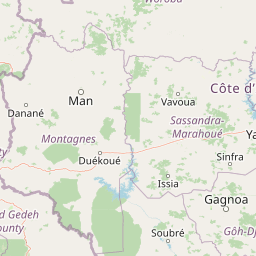
The Mont Sângbé area lies within the traditional territory of several ethnic groups in western Ivory Coast, in a region characterized by mountainous terrain and relative geographic isolation. The park is situated between the towns of Man, Biankouma, and Touba in a region where traditional agricultural practices and community land management systems have historically shaped the landscape. While the park itself is now a protected area, surrounding communities maintain connections to the land and resources of the broader region.
Top sights and standout views in Mont Sângbé National Park
Mont Sângbé National Park stands out for its dramatic mountain scenery featuring granitic inselbergs and peaks rising above 700 meters, creating one of the most visually distinctive landscapes among West African protected areas. The park's ecological diversity is remarkable, supporting both forest and savanna habitats within a single protected area and serving as an Important Bird Area. The documented western chimpanzee population, with densities reaching 5.7 individuals per square kilometer, represents a significant conservation asset. The park's position at the eastern end of a highland chain extending through Guinea and northern Liberia gives it particular biogeographic significance, while its inclusion among the principal national parks of the world by Encyclopædia Britannica reflects its international recognition.
Best time to visit Mont Sângbé National Park
The optimal period for visiting Mont Sângbé National Park corresponds to the dry season, which typically runs from November to March in this region of West Africa. During this period, reduced rainfall improves accessibility and visibility within the park, making it easier to explore the mountainous terrain and observe wildlife. The dry season also concentrates animals around remaining water sources, potentially improving wildlife viewing opportunities. However, visitors should be prepared for conditions that can still include significant rainfall, as the climate in this mountainous region can be unpredictable. The wet season from April to October brings higher rainfall and more challenging conditions for exploration but offers the advantage of lush green landscapes and full watercourses.