Why Khaudum National Park stands out
Khaudum National Park is best known for its significant predator population, particularly lions and spotted hyenas, which thrive in the dry forest environment. The park also supports substantial herds of African bush elephants, estimated at more than 500 individuals, along with impressive populations of Angolan giraffes and various antelope species including roan antelope, kudu, common eland, and reedbuck. The birdlife is exceptionally diverse, with over 320 species documented, including numerous parrots and more than 50 species of birds of prey. Since 2005, the park has been recognized as a Lion Conservation Unit, highlighting its importance for the preservation of this apex predator in the Kalahari ecosystem.
Khaudum National Park history and protected-area timeline
Khaudum National Park was established as a protected area in Namibia's northeastern Kalahari region, designed to conserve the unique dry forest ecosystem and the wildlife populations it supports. The park gained particular recognition in 2005 when it was designated as a Lion Conservation Unit, acknowledging its importance for lion population sustainability in the region alongside the adjacent Caprivi Game Park. Tourism infrastructure initially developed with two visitor camps, though the entire park was closed to visitors in May 2013 for a period of reorganization. In 2015, the Khaudum campsite was privatized and underwent complete renovation, reopening with improved facilities including six shaded camping areas near the Xaudum Lodge, restoring visitor access to this remote wilderness area.
Khaudum National Park landscape and geographic character
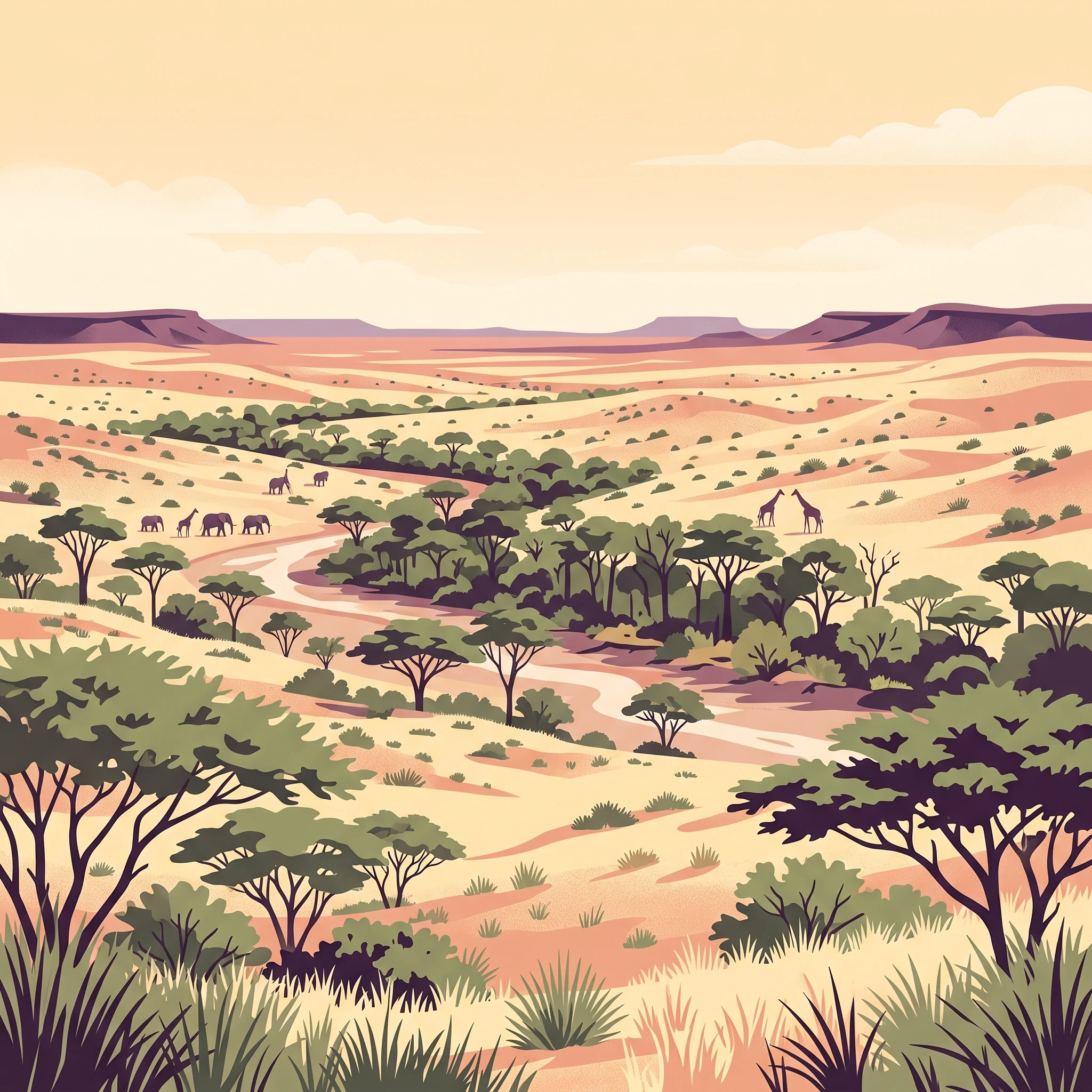
The landscape of Khaudum National Park is defined by the flat to gently undulating terrain typical of the Kalahari Desert, characterized by deep sandy soils and sparse exposed rock. The three major dry river systems known as Omuramba, including the Nhoma, Cwiba, and Khaudum Rivers, traverse the park from northwest to southeast, carrying seasonal floodwaters during the rainy season that transform the landscape temporarily. The river beds support denser vegetation corridors, particularly dense acacia dry forest with thorny species including Acacia erioloba, Acacia fleckii, Acacia hebeclada, and Acacia tortilis, interspersed with occasional Combretum imberbe and Combretum hereroense. The Omuramba floodplains feature peaty-boggy conditions supporting dense reed beds with Phragmites and water lilies, creating stark contrast to the surrounding xeric woodland. The general park terrain supports two distinct forest types: a higher dry forest where trees reach up to 10 meters with relatively dense undergrowth, and a lower forest where tree height remains below 5 meters.
Khaudum National Park ecosystems, habitats, and plant life
The ecological character of Khaudum is defined by its semi-arid Kalahari environment, which supports a surprisingly diverse array of plant species despite the challenging climate. The dominant vegetation consists of species-rich dry forest and acacia woodland, with canopy trees including Pterocarpus angolensis, Baikiaea plurijuga, Burkea africana, and Guibourtia coleosperma reaching heights of up to 10 meters. The understory is relatively dense in the higher forest areas, while lower forest zones feature species such as Lonchocarpus neisii and Terminalia sericea, interspersed with Faidherbia albida and Grewia. The riverine corridors along the Omuramba support distinct ecological communities, with denser acacia woodland and characteristic Terminalia prunioides, also known as blood fruit trees, dominating the floodplain areas. The park's biodiversity extends beyond its flora to include significant populations of large mammals and exceptional bird diversity, making it one of the more biologically significant protected areas in Namibia's arid zones.
Khaudum National Park wildlife and species highlights
Khaudum National Park supports a rich mammalian fauna adapted to the Kalahari's seasonal extremes. The park is particularly noted for its predator populations, with lions and spotted hyenas being common residents, along with African leopards, jackals, and occasional cheetahs and African wild dogs. Large herbivore populations include more than 500 African bush elephants, substantial numbers of Angolan giraffes, and various antelope species such as roan antelope, kudu, lyre antelope, common eland, and reedbuck. The birdlife is exceptionally diverse, with more than 320 species recorded, particularly during the wet season from November to March when migratory species arrive. The avifauna includes numerous parrot species and more than 50 species of birds of prey, making the park significant for ornithological diversity in the region. The ideal wildlife viewing period runs from June to October when vegetation is sparser and animals concentrate around remaining water sources.
Khaudum National Park conservation status and protection priorities
Khaudum National Park serves as a critical conservation area within Namibia's protected area network, particularly for its role as a Lion Conservation Unit since 2005, working in conjunction with the adjacent Caprivi Game Park to support viable populations of this apex predator. The park protects the Kalahari's dry forest ecosystem, which is structurally and ecologically distinct from the more famous savanna systems of southern Africa. The Omuramba river systems provide ecological connectivity and serve as biological corridors, while the seasonal flooding events support ecological processes essential to maintaining biodiversity in this semi-arid environment. The designation as a Lion Conservation Unit acknowledges that Khaudum provides essential habitat for maintaining genetic diversity and population viability for lions in the broader Kavango-Zambezi transfrontier conservation area. Conservation challenges in the park include managing the interface between wildlife and any human activities while maintaining the park's wilderness character.
Khaudum National Park cultural meaning and human context
Khaudum National Park is situated in a region inhabited by various indigenous communities whose traditional territories overlap with the park's boundaries, though the Wikipedia source provides limited specific information about cultural heritage or historical human use of the area. The nearest settlement of Tsumkwe lies approximately 65 kilometers from the park and represents one of the local communities in this remote corner of Namibia. The park's name derives from the Khaudum River, one of the three Omuramba that traverse the protected area, reflecting the indigenous toponymy of the region.
Top sights and standout views in Khaudum National Park
Khaudum National Park offers exceptional wildlife viewing opportunities in a truly remote Kalahari setting, with the dry season from June to October providing optimal conditions for observing lions, elephants, giraffes, and diverse antelope species congregating around remaining water sources. The birdwatching is outstanding, with over 320 species including numerous raptors and parrots present during the wet season. The park's three Omuramba river systems create linear oases of denser vegetation that provide striking contrast to the surrounding acacia woodland. The Xaudum Lodge and privatized campsite offer comfortable base for exploration while maintaining a sense of wilderness isolation that distinguishes Khaudum from more accessible Namibian parks.
Best time to visit Khaudum National Park
The optimal time to visit Khaudum National Park is during the dry season from June to October, when reduced vegetation makes wildlife easier to spot and animals concentrate around the remaining water sources in the riverbeds. Daytime temperatures during the Namibian winter are pleasant, typically above 25°C, though nighttime temperatures can drop to around 12°C and occasionally lower. The wet season from December to March brings higher humidity and daily temperatures between 30-40°C, but this period sees the park come alive with migrant bird species, with over 320 species present including many parrots and birds of prey. The rainy season transforms the landscape temporarily as the Omuramba rivers flood, creating a different but equally compelling visitor experience, though some roads may become difficult to navigate.