Why Bwabwata National Park stands out
Bwabwata National Park is best known as a transboundary wildlife corridor connecting Angola, Botswana, Namibia and Zambia within the Kavango-Zambezi Transfrontier Conservation Area. The park supports one of the most significant elephant migration routes in southern Africa, with herds regularly moving between Namibia, Angola, Botswana and Zambia. It is also notable for its integrated community conservation model, where approximately 5,500 residents, primarily from the Khwe San minority group, participate in park management and benefit from tourism revenue. The Mahango Area and Kavango River corridor have been recognized as an Important Bird Area supporting globally threatened species and exceptional avian diversity.
Bwabwata National Park history and protected-area timeline
The area that now comprises Bwabwata National Park has undergone several transformations in its protection status and management since the mid-twentieth century. It was first proclaimed as Caprivi Nature Park in 1963, subsequently becoming Caprivi Game Reserve in 1966 and upgraded to Caprivi Game Park in 1968. During Namibia's war of independence from South African rule, the South African Defence Force occupied the area and conservation officials were prohibited from entering or managing the park. Following Namibia's independence in 1990, the new Namibian government commissioned studies to assess the fauna and flora and developed plans to accommodate both biodiversity protection and the existing resident population of approximately 5,500 people. Mahango Game Reserve to the west of the park was proclaimed in 1989. In 2007, the Caprivi Game Park, Mahango Game Reserve and an unproclaimed area along the Cuando River were united to form Bwabwata National Park. The park also gained tragic notoriety in November 2013 when LAM Mozambique Airlines Flight 470 was deliberately crashed by its captain in the park, resulting in the deaths of all 33 passengers and crew on board.
Bwabwata National Park landscape and geographic character
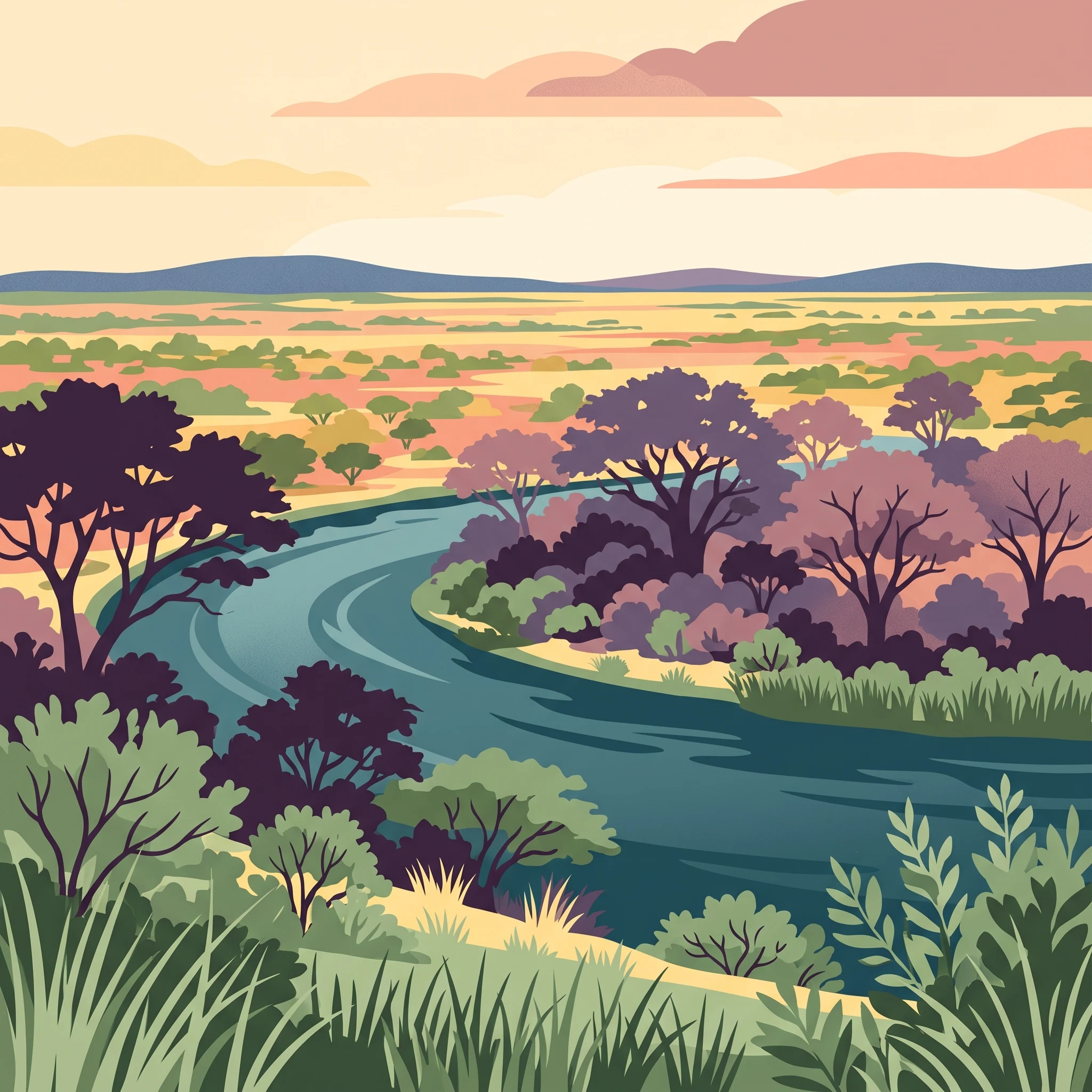
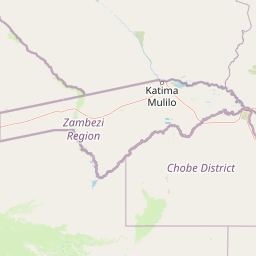
Bwabwata National Park encompasses a diverse landscape characterized by low vegetated sand dunes interspersed with ancient drainage lines known as omiramba. The terrain extends across the Caprivi Strip, a narrow eastern extension of Namibia that runs between Angola and Botswana. The park is bounded to the west by the Okavango River and to the east by the Kwando River, both of which create riparian corridors and seasonal floodplains that contrast with the surrounding woodland habitats. The park measures approximately 40 kilometers from north to south and 190 kilometers from west to east, creating an elongated protected area that follows the orientation of the Caprivi Strip. The landscape includes North-eastern Kalahari Woodland, Caprivi Mopane Woodland, Riverine Woodlands along the major rivers, Okavango Valley areas, and the Caprivi Floodplains. The southern boundary with Botswana features three veterinary standard fences designed to prevent the spread of cattle diseases such as foot-and-mouth disease, while the remainder of the park remains largely unfenced to permit wildlife movement.
Bwabwata National Park ecosystems, habitats, and plant life
Bwabwata National Park is located within the Tree and Shrub Savanna biome and supports a complex mosaic of vegetation types that reflect the interplay of moisture gradients from the major river systems and the underlying Kalahari sand substrates. The park's vegetation includes North-eastern Kalahari Woodland dominated by species such as Zambezi teak and wild seringa, Caprivi Mopane Woodland featuring false mopane and mopane species, Riverine Woodlands along the Okavango and Kwando rivers, Okavango Valley ecosystems, and the Caprivi Floodplains that experience seasonal inundation. The vegetation supports the park's role as a crucial trans-boundary link for wildlife movement between Angola, Botswana, Namibia and Zambia, particularly for elephants that migrate between these countries. However, research has documented biodiversity losses in the park between 1996 and 2019 attributed to woody plant encroachment, a regional phenomenon affecting savanna ecosystems across southern Africa.
Bwabwata National Park wildlife and species highlights
Bwabwata National Park supports significant populations of large mammals and represents an important corridor for regional wildlife migrations. African elephants regularly move between Namibia, Angola, Botswana and Zambia through the park, making it a critical link in the transboundary conservation network. The park sustains populations of Cape buffalo, hippopotamus, roan antelope, sable antelope, tsessebe, Chapman's zebra, blue wildebeest, common reedbuck, red lechwe, sitatunga and Nile crocodile. Main predators include lion, leopard, cheetah and spotted hyena. The Mahango Area and Kavango River in western Bwabwata have been designated as an internationally Important Bird Area, supporting globally threatened bird species and exceptional avian diversity. Notable bird species include black-winged pratincole, slaty egret, wattled crane, African skimmer, African pygmy-goose, coppery-tailed coucal, white-backed night heron, rufous-bellied heron, Allen's gallinule, Dickinson's kestrel, southern ground hornbill, and various warblers and cisticolas.
Bwabwata National Park conservation status and protection priorities
Bwabwata National Park plays a central role in the Kavango-Zambezi Transfrontier Conservation Area, a massive transboundary conservation initiative involving Angola, Botswana, Namibia, Zambia and Zimbabwe. The park forms a critical corridor for elephant movement from Botswana into Angola and Zambia, supporting regional wildlife migration patterns that would otherwise be fragmented by human settlement and agricultural development. The park's integrated management approach, which accommodates both biodiversity conservation and the livelihoods of approximately 5,500 resident people, represents an innovative model for conservation in populated landscapes. Management priorities include conserving important habitats, safeguarding wildlife corridors, providing income for rural residents, and developing sustainable tourism. The park is zoned into core conservation areas, special protection zones, and a multiple-use area, with specific designations for Kwando, Buffalo and Mahango as special protection areas. Fire management is employed as an ecological tool, though challenges have been noted in achieving effective fire regime outcomes.
Bwabwata National Park cultural meaning and human context
Bwabwata National Park is notable for its resident population of approximately 5,500 people, primarily from the Khwe San bushmen minority group, who live within the park boundaries and participate actively in its management. Most residents live in Omega village in the central part of the park alongside several smaller settlements. The resident communities have formed the Kyaramacan Association to represent their interests and manage income from tourism operations, including the Ngoabaca campsite and a small lodge, as well as revenue from trophy hunting and the sale of devil's claw, a medicinal plant sold internationally. This community-integrated approach reflects Namibia's broader conservation philosophy that recognizes the rights and contributions of indigenous communities in protected area management. The park lies along the historic Caprivi Strip, named after German colonial administrator Leo von Caprivi, and the area has been inhabited by San peoples for generations before the establishment of formal protected area boundaries.
Top sights and standout views in Bwabwata National Park
Bwabwata National Park stands out as one of Namibia's few protected areas that successfully integrates resident communities into conservation management while maintaining significant wildlife populations and transboundary ecological connectivity. The park's position at the heart of the Kavango-Zambezi Transfrontier Conservation Area makes it a vital corridor for elephant migrations between Botswana, Angola and Zambia. The Mahango Area supports exceptional bird diversity with species such as wattled crane, slaty egret and southern ground hornbill. Visitors can experience the park through community-operated campsites including Ngoabaca, Nambwa and Bum Hill, which provide direct economic benefits to local conservancies. The landscape features a striking contrast between riverine environments along the Okavango and Kwando and the surrounding Kalahari woodland savanna.
Best time to visit Bwabwata National Park
The optimal time to visit Bwabwata National Park is during the dry season from May to October, when wildlife congregates around the permanent water sources along the Okavango and Kwando rivers, making animal sightings more predictable. The wet season from November to April brings green vegetation and migratory bird species but animals become more dispersed across the landscape. The park can be accessed via the Trans-Caprivi Highway that runs between Rundu and Katima Mulilo, with minor roads including the C48 that connects to Botswana. Visitors traveling off the main road require permits and must use designated routes, with all-wheel drive vehicles recommended for the sandy roads near the river areas. The community-operated campsites offer opportunities for immersive experiences with local Khwe communities.