

Mori Atlas logo
National parkMaze National Park

Discover the unique montane terrain and critical Swayne's hartebeest habitat within Ethiopia's national park system.

Maze National Park: Ethiopia's Protected Savanna Landscape and Geothermal Features

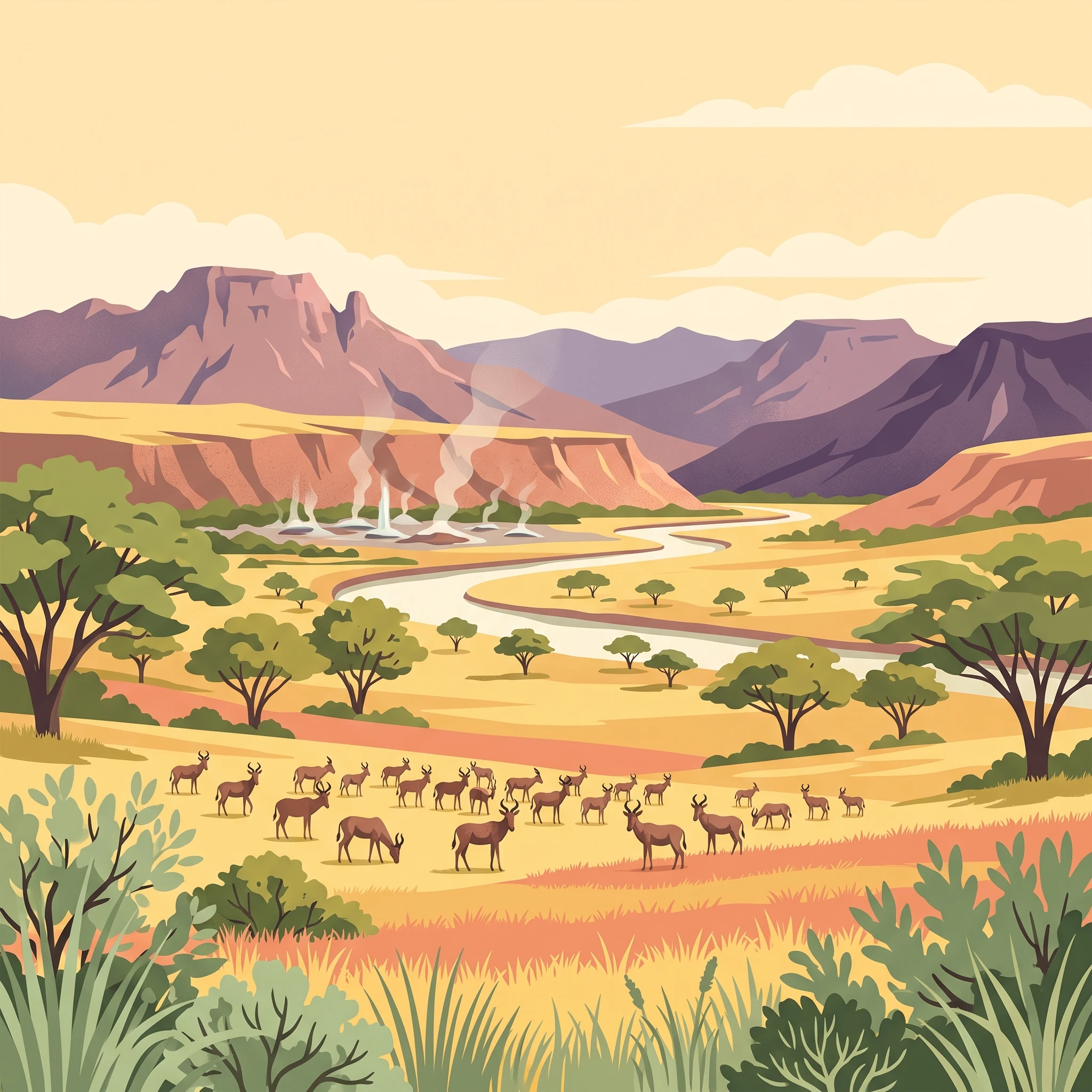
Maze National Park, a designated national park in Ethiopia, offers a unique atlas perspective on protected landscapes. Situated in the Gamo Gofa Zone, it safeguards vital savanna ecosystems and supports a significant population of the endangered Swayne's hartebeest. The park's terrain features distinct montane geography, ranging from 1,000 to 1,200 meters in elevation, and showcases remarkable geothermal activity with natural geysers near the Maze River.

National ParkWildlife ConservationEndangered SpeciesSavanna EcosystemMontane ForestSwayne's Hartebeest

Maze National Park

National park

Park overview

Structured park overview, official facts, and landscape profile for Maze National Park

Maze National Park park facts, protected area profile, and essential visitor context
Review the core facts for Maze National Park, including designation, size, terrain, visitor scale, habitats, and operating context in one park-focused overview.

About Maze National Park

Maze National Park occupies a strategically important position in Ethiopia's protected area network, representing a blend of highland and lowland ecological zones in the southern part of the country. The park's establishment in 2005 reflected Ethiopia's growing commitment to conserving its unique biodiversity, particularly species with restricted ranges. The Maze River traverses the park throughout its length, providing essential water resources for wildlife and creating diverse habitats along its riparian corridor. Beyond its ecological significance, the park offers notable geological attractions including Bilbo hot springs located in the upper reaches of the Maze River in the southern sector, where geysers periodically spout steam into the air. The Wonja stone caves represent another distinctive feature, capable of sheltering up to 300 people and demonstrating the site's historical significance to local communities. The park's position approximately 460 kilometers from Addis Ababa and 248 kilometers from Hawassa places it within reach for visitors exploring southern Ethiopia's natural attractions.

Quick facts and research context for Maze National Park

Maze National Park spans approximately 210 square kilometers in the Gamo Gofa Zone of southern Ethiopia. The park was established in 2005 and is managed by the Ethiopian Wildlife Conservation Authority. It is located at elevations between 1,000 and 1,200 meters above sea level, with Mount Gughe rising to 4,200 meters on the park's boundary. The area experiences a rainy season from March to September with annual rainfall between 800 and 1,600 millimeters. Notable geological features include Bilbo hot springs with active geysers and the Wonja stone caves capable of accommodating up to 300 people. The park supports 37 mammal species and 196 bird species.

Park context

Deeper park guide and search-rich context for Maze National Park

Maze National Park history, landscape, wildlife, and travel context
Explore Maze National Park through its history, landscape character, ecosystems, wildlife, conservation priorities, cultural context, and seasonal travel timing in a structured park guide built for atlas discovery and search intent.

Why Maze National Park stands out

Maze National Park is most notably recognized for its population of Swayne's hartebeest, an endangered subspecies of the alcelaphine antelope found only in Ethiopia. The park holds approximately 300 individuals of this species, making it second in importance only to the Senkelle Swayne's Hartebeest Sanctuary for the conservation of this threatened antelope. The park's savanna landscapes with scattered deciduous broadleaf trees provide ideal habitat for this species, while the presence of Bilbo hot springs with steaming geysers adds a distinctive geological attraction that sets Maze apart from Ethiopia's other protected areas.

Maze National Park history and protected-area timeline

Maze National Park was officially established in 2005 through the Ethiopian Wildlife Conservation Authority, representing a relatively recent addition to Ethiopia's national park system. The park derives its name from the Maze River, which flows through the protected area and has historically served as a vital water source for both wildlife and local communities. Prior to its formal designation as a national park, the Maze area functioned as a hunting ground for Swayne's hartebeest and African buffalo, reflecting the region's long history of human-wildlife interaction. The transition to full protected area status marked a shift from extractive use toward conservation-focused management, aligning with Ethiopia's broader environmental protection objectives. The park's establishment also acknowledged the importance of the Maze River basin and the surrounding montane and savanna ecosystems.

Maze National Park landscape and geographic character

The terrain of Maze National Park encompasses a variety of landforms and ecological zones shaped by its position in the Ethiopian highlands. Elevations within the park range from approximately 1,000 to 1,200 meters above sea level, creating a montane setting that differs from the更低 altitude parks found in Ethiopia's rift valley regions. Mount Gughe, rising to 4,200 meters above sea level, forms a dramatic backdrop on the boundary of the park and influences local climate and hydrology. The landscape features savanna grasslands with scattered deciduous broadleaf trees, particularly in the lower elevations, while the park's name-sake Maze River and its tributaries create riparian corridors lined with riverine forest. In the southern parts of the park, Bilbo hot springs emerge from the upper reaches of the Maze River, with geysers that actively vent steam, adding a volcanic dimension to the park's scenery. Natural stone caves, known as Wonja stone caves, punctuate the terrain and provide shelter and historical interest.

Maze National Park ecosystems, habitats, and plant life

The ecological character of Maze National Park reflects its position in a transitional zone between Ethiopia's highland and lowland ecosystems. The vegetation cover exhibits altitudinal variation, with bushland vegetation dominating lower slopes, woodland vegetation in mid-elevation areas, savanna grassland with scattered trees across much of the protected area, and riverine forest following water courses. This mosaic of habitats supports considerable biodiversity despite the park's relatively modest size. The savanna grasslands, characterized by scattered deciduous broadleaf trees, provide the signature landscape of the park and support the herbivore communities that depend on these resources. The rainy season extending from March to September brings annual precipitation estimated between 800 and 1,600 millimeters, sustaining the vegetation and providing water for the park's wildlife throughout most of the year.

Maze National Park wildlife and species highlights

Maze National Park supports a remarkable diversity of wildlife, with 37 mammal species and 196 bird species documented within its boundaries. The park's most significant conservation priority is Swayne's hartebeest, an endangered subspecies endemic to Ethiopia that finds in Maze one of its most important remaining strongholds. The park holds approximately 300 individuals of this distinctive antelope, second only to the Senkelle Swayne's Hartebeest Sanctuary in importance for the subspecies. The large mammal community includes African buffalo, regularly observed throughout the park, as well as predators such as lions and leopards. Primates are well represented with olive baboons and vervet monkeys common, while smaller antelope species include oribi, bohor reedbuck, waterbuck, and Cape bushbuck. The kudu species are present, with both lesser kudu and greater kudu found in the park, and Northeast African cheetahs occur as a notable predator. Other species include warthogs, servals, and bushpigs.

Maze National Park conservation status and protection priorities

Maze National Park plays a crucial role in Ethiopia's conservation landscape, particularly for the protection of Swayne's hartebeest. The park's designation as an IUCN Category II protected area reflects its primary objective of conserving natural ecosystems while allowing for sustainable visitor use. The population of approximately 300 Swayne's hartebeest represents a significant proportion of the global population of this endangered subspecies, making the park's continued protection essential for the species' survival. Management by the Ethiopian Wildlife Conservation Authority provides the institutional framework for anti-poaching efforts, habitat management, and visitor services. The park's diverse habitats, from savanna to riverine forest, support multiple species of conservation concern and contribute to the broader conservation network in southern Ethiopia.

Maze National Park cultural meaning and human context

The Maze River has historically served as a vital resource for local communities in the Gamo Gofa Zone, and the park area has traditional connections to the indigenous Gamo people. Prior to national park establishment, the area functioned as a hunting ground, reflecting historical patterns of human use and interaction with the landscape. The Wonja stone caves hold cultural significance, having served as shelter and gathering places for local communities. The park's name derives directly from the Maze River, demonstrating the enduring connection between the landscape and local toponymic traditions. While the park is now managed primarily for conservation, the surrounding communities maintain traditional relationships with the broader landscape beyond the protected area boundaries.

Top sights and standout views in Maze National Park

Maze National Park offers several standout features that distinguish it within Ethiopia's protected area network. The opportunity to observe Swayne's hartebeest in their natural savanna habitat represents the park's premier wildlife experience, with the approximately 300 individuals providing reliable sighting opportunities. The Bilbo hot springs with active geysers provide a unique geological attraction not found in most African parks, offering visitors the chance to witness steam vents in a montane setting. The Wonja stone caves, capable of holding up to 300 people, combine natural wonder with cultural history. The park's location in the Gamo Gofa Zone places it within a region of outstanding natural beauty, with Mount Gughe on the boundary adding dramatic highland scenery to the landscape.

Best time to visit Maze National Park

The optimal period to explore Maze National Park coincides with the latter part of the dry season and the beginning of the short rainy season, typically from October through April. During this timeframe, vegetation is less dense, wildlife congregates more visibly around remaining water sources, and trails are generally more accessible for walking safaris and game viewing. The main rainy season from March to September brings heavier vegetation that can make wildlife observation more challenging, though the landscape becomes lush and rivers flow strongly. The period immediately following the rains, from May to June, offers a green and vibrant park environment, though afternoon thunderstorms may occur. Visitors interested specifically in observing Swayne's hartebeest should note that the dry season months generally provide the best viewing opportunities as animals concentrate around water sources.
Park location guide

Geography guide, regional context, and park location map for Maze National Park

Maze National Park park geography, regions, and map view in Ethiopia
Understand where Maze National Park sits in Ethiopia through a broader geographic reading of the surrounding landscape, nearby location context, and its mapped position within the national park landscape.

How Maze National Park fits into Ethiopia

Ethiopia is a landlocked federal parliamentary republic located in the Horn of Africa. With a population of approximately 135 million people, it is the 14th-most populous country in the world and the most populous landlocked country. The country is known for its ancient history, diverse ethnic groups, and the capital Addis Ababa, which lies near the East African Rift.

Wider geography shaping Maze National Park in Ethiopia

Ethiopia is located in the Horn of Africa, bordered by Eritrea to the north, Djibouti to the northeast, Somalia to the east, Kenya to the south, South Sudan to the west, and Sudan to the northwest. The country sits on the African and Somali tectonic plates, with the East African Rift running through it. The terrain includes highlands, valleys, and lowlands.

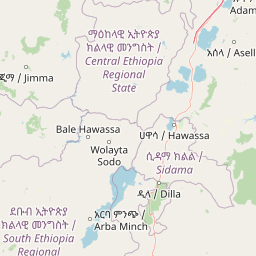
Map view of Maze National Park

Use this park location map to pinpoint Maze National Park in Ethiopia, understand its exact geographic position, and read its mapped placement within the surrounding landscape more clearly.

Pigeon | © OpenStreetMap contributors

Location context for Maze National Park

Gamo Gofa ZoneSouth Ethiopia Regional State
Park atlas

Explore the Diverse Protected Landscapes and Regional Geography Surrounding Maze National Park

Discover Other National Parks and Protected Areas Near Maze National Park, Ethiopia
After exploring Maze National Park, continue your discovery by browsing other national parks and protected areas within the Gamo Gofa Zone and across Ethiopia's diverse highland plateau. Compare varied landscapes, from savanna grasslands and montane forests to unique geothermal features, to trace the wider regional conservation geography.
National parkSouth Ethiopia Regional State

Mago National Park: Protected Savanna and Riverine Ecosystems in South Ethiopia

Discover the unique landscapes and wildlife habitats mapped within this national park.

Mago National Park stands as a critical protected landscape within the South Ethiopia Regional State, characterized by its significant riverine forests, acacia savanna, and wetland environments along the Mago and Omo rivers. This national park is integral for understanding the distribution of wildlife and the geographic context of Ethiopia's natural heritage. Its mapped terrain offers insights into a landscape that supports both diverse ecosystems and unique cultural traditions, making it a vital component of the country's conservation network.

Area
2,220 km²
Established
1979
IUCN
II
National parkEthiopia

Omo National Park: Ethiopia's Remote Protected Landscape with Rich Wildlife Spectacles

Mapped boundaries, savannah plains, and Maji Mountains terrain.

Omo National Park is a remote protected area in Ethiopia renowned for its expansive savannah, riverine woodlands, and remarkable wildlife concentrations. Covering over 4,000 square kilometers, this national park presents a landscape of sweeping plains, the vital Omo River corridor, and the dramatic Maji Mountains. The park's protected status safeguards exceptional populations of large mammals, offering a glimpse into an untamed African wilderness. Explore the mapped geography and the unique ecological zones that contribute to its significant conservation value.

Area
4,068 km²
Established
1980
IUCN
II
National parkEthiopia

Didessa National Park: Protected River Valley Landscape in Ethiopia's Western Highlands

Discover dramatic escarpments, forested terrain, and waterfalls.

Explore Didessa National Park, a protected area in western Ethiopia notable for its dramatic topographical features. This national park showcases a striking landscape of steep escarpments flanking the Didessa River valley, supporting lush forest ecosystems. Key features include numerous waterfalls that contribute to the park's distinctive terrain and ecological significance. Understanding Didessa National Park offers insight into Ethiopia's protected lands and their unique geographic attributes.

Area
1,300 km²
Established
2017
IUCN
II
Relief
Lowland
National parkArsi Zone

Arsi Mountains National Park: Protected Ethiopian Highlands Landscape & Geography

Mapped protected terrain and endemic species habitat within the Arsi Zone.

Arsi Mountains National Park is a vast protected area celebrated for its significant biodiversity and distinctive Afro-alpine ecosystems. Situated in the Arsi Zone, this national park encompasses a dramatic mountain landscape central to the Ethiopian Highlands. It serves as a crucial refuge for endangered endemic species, including the mountain nyala and Ethiopian wolf, within its varied ecological zones and protected park boundaries, offering rich context for geographic exploration.

Area
10,876 km²
Established
2011
IUCN
II
National parkEthiopia

Awash National Park: Mapped Protected Boundaries and Ethiopian Regional Geography

Discover the protected landscape of this Ethiopian National Park.

Awash National Park represents a significant protected area within Ethiopia, offering a rich focus for geographic discovery. This page illuminates the park's specific mapped boundaries and its positioning within the surrounding regional geography. It serves as a detailed entry point for understanding the park's landscape character and its role as a national park in East Africa.

Area
850 km²
Established
1966
IUCN
II
National parkMandera County

Malka Mari National Park: Remote Frontier Protected Landscape and Dawa River Ecosystem

Explore the semi-arid bushland and riparian woodland geography.

Malka Mari National Park offers a profound wilderness experience as Kenya's most remote national park, situated along the Dawa River in Mandera County. This protected area features striking contrasts between arid bushland and verdant riparian woodlands, supporting unique plant species and wildlife adapted to the semi-arid environment. Its vast, undeveloped character makes it a significant site for frontier conservation and a unique destination for atlas-style landscape exploration.

Area
1,500 km²
Established
1989
IUCN
II
National parkAfar Region

Yangudi Rassa National Park: Protected Semi-Desert National Park in Afar Region

Mapped landscape and dryland ecosystems.

Yangudi Rassa National Park represents a critical protected area within Ethiopia's Afar Region, covering extensive semi-desert and grassland terrains. The park's geography is marked by Mount Yangudi and the broad Rassa Plains, with the Awash River shaping its riverine forests and marshes. This national park offers a unique insight into dryland ecosystems and their conservation, providing a distinct mapped landscape for geographic study and exploration.

Area
4,731 km²
Established
1969
IUCN
II
National parkUganda

Mount Elgon National Park: Uganda's Transboundary Volcano and Mapped Protected Area

Explore volcanic terrain, unique cave systems, and diverse montane landscapes.

Mount Elgon National Park offers a rich tapestry of protected landscapes, centered on a dormant shield volcano straddling the Uganda-Kenya border. This park is recognized for its extraordinary botanical diversity and spectacular cave systems, such as Kitum Cave, where wildlife congregates to lick salt. The elevation gradient supports distinct vegetation zones, from dense montane forests to high-altitude heath and moorland, providing crucial habitat and watershed protection. Understanding Mount Elgon National Park through its mapped boundaries and geographic context reveals a unique protected area in East Africa.

Area
1,279 km²
Established
1968
IUCN
II

Common questions about visiting, size, designation, and location context for Maze National Park

Maze National Park FAQs for park facts, access, geography, and protected area context
Find quick answers about Maze National Park, including protected-area facts, park geography, trail and visitor context, and how the park fits into its surrounding country and regional landscape.
MoriAtlas Explorer

Continue Your Protected Areas Search Across the Global Atlas

Deepen your exploration by continuing the structured search for national parks and protected areas worldwide. Utilize the comprehensive filtering capabilities to compare different conservation landscapes and refine your understanding of global park geography. Discover more about the distribution and characteristics of protected natural areas.

Global natural geography