Why Serengeti National Park stands out
The Serengeti is world-famous for the great migration, the largest annual overland wildlife movement in the world. Each year, roughly 1.5 million western white-bearded wildebeest, 250,000 Grant's zebra, and hundreds of thousands of Thomson's gazelle traverse the plains in a continuous cycle of migration driven by seasonal rainfall patterns. This spectacular journey spans approximately 800 kilometers and includes dramatic river crossings where crocodiles lie in wait. Beyond the migration, the park is distinguished by having the largest lion population in Africa, with more than 3,000 lions inhabiting the ecosystem. The park also supports significant populations of African elephants, giraffes, cheetahs, and spotted hyenas, making it one of the most wildlife-dense protected areas on the planet.
Serengeti National Park history and protected-area timeline
The protection of the Serengeti area began in 1930 when an area of 2,286 square kilometers was designated as a game reserve in the southern and eastern regions. The concept of establishing a national park was proposed in 1930 by Major Richard Hingdston, visiting Tanganyika on a mission from the Society for the Preservation of the Fauna of the Empire, who recognized the area's exceptional natural value and the need to protect it from increasing developmental pressures. The park was formally established as a national park in 1940, and in 1948 it received strict protection under the Serengeti National Park Board of Trustees. During this period, the government restricted the movements of the resident Maasai people, and the park's boundaries were finalized in 1951. In 1959, an area of 8,300 square kilometers was split from the eastern portion of the park and re-established as the Ngorongoro Conservation Area to accommodate the traditional land use interests of the Maasai in a multiple-use conservation model. The Serengeti gained international prominence through the work of Bernhard Grzimek and his son Michael, whose 1959 book and documentary titled Serengeti Shall Not Die brought worldwide attention to the park's ecological significance. The Serengeti Research Institute was established at Seronera in 1966 to conduct long-term ecological monitoring and research.
Serengeti National Park landscape and geographic character
The Serengeti's physical landscape is remarkably diverse, shaped by ancient geological processes and ongoing ecological forces. The park spans the Serengeti Plain, a vast expanse of grassland that stretches to the horizon, interrupted only by distinctive granite koppies that serve as elevated observation points for predators. The underlying geology comprises ancient Archaean greenstones, granite-gneiss plutons dating back 2.8 to 2.5 billion years, and Neoproterozoic quartzite and granite formations that have been uplifted over geological time to create the characteristic hills and ridges. The southeastern portion of the park contains volcanic soils derived from ash deposits from the Kerimasi and Oldoinyo Lengai volcanoes, with the latter being an active volcano that produces unique natrocarbonatite lava. The park is drained by several rivers flowing westward toward Lake Victoria, including the Grumeti, Mara, Mbalageti, and Orangi rivers, with the Mara River being the only permanently flowing watercourse in the ecosystem. The landscape varies significantly across three main regions: the southern plains feature treeless grassland with scattered koppies, the western corridor contains riverine forests and denser vegetation around the Grumeti and Mbalageti rivers, and the northern region is characterized by open Commiphora woodlands and rolling hills.
Serengeti National Park ecosystems, habitats, and plant life
The Serengeti exemplifies the African savanna ecosystem, supporting a complex web of interactions between grasses, wildlife, and the seasonal rhythm of rainfall. The park's vegetation is adapted to the semi-arid climate, with the grasslands dominated by species that thrive on the nutrient-rich volcanic soils of the eastern plains. The riverine forests along the Grumeti and Mara rivers provide critical habitat for primates including yellow baboons, olive baboons, vervet monkeys, and mantled guereza, while also supporting diverse bird communities. The woodlands, particularly in the northern region, feature Commiphora species adapted to the variable rainfall patterns. The ecosystem's productivity is driven by the seasonal movement of the migration, which transfers nutrients across the landscape as herds move between grazing areas. This natural process sustains the predator populations that depend on the concentration of prey animals during specific times of year. The ecological integrity of the Serengeti depends on the connectivity of the broader ecosystem, which includes adjacent protected areas that allow wildlife to move freely in response to seasonal conditions.
Serengeti National Park wildlife and species highlights
Serengeti National Park supports one of the most impressive assemblages of wildlife in Africa, with the great migration being its most renowned feature. The park hosts approximately 1.5 million western white-bearded wildebeest, 250,000 Grant's zebra, and between 400,000 and 500,000 Thomson's gazelle, along with herds of common eland that join the migration. The lion population exceeds 3,000 individuals, representing the largest concentration of lions in Africa, and the park forms a Lion Conservation Unit with the adjacent Maasai Mara. Other major predators include cheetahs, approximately 3,500 spotted hyenas, African leopards, African wild dogs (returned to the area in 2012 after disappearing in 1991), and jackals. Large herbivores include African bush elephants, which have recovered from poaching-induced declines to number over 5,000 individuals, African buffalo, Masai giraffes, and critically endangered eastern black rhinos, with fewer than 70 individuals surviving in the park. The bird diversity is exceptional, with more than 500 species recorded including Masai ostrich, kori bustard, secretarybird, various storks, herons, eagles, and vultures. Reptiles include Nile crocodiles, multiple snake species, and various lizards.
Serengeti National Park conservation status and protection priorities
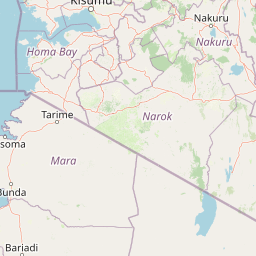
Serengeti National Park holds significant conservation importance as a UNESCO World Heritage Site and one of Africa's most effective protected areas. The park's IUCN Category II designation reflects its primary objective of protecting ecosystem integrity and natural processes. Conservation efforts have included intensive anti-poaching operations, which brought rampant poaching under control under the leadership of early park wardens like Myles Turner. The park is integrated into a broader conservation landscape that includes the Ngorongoro Conservation Area, Maswa Game Reserve, and the Ikorongo and Grumeti Game Reserves, as well as the transboundary Maasai Mara ecosystem in Kenya. However, the park faces serious threats including deforestation in the Mau Forest region affecting Mara River hydrology, invasive plant species such as Siam weed, population growth and expansion of livestock ranching in surrounding areas, and persistent poaching, with an estimated 200,000 animals killed annually. A proposed highway through the park, considered between 2005 and 2012 and revived in 2024, has sparked significant controversy over potential impacts on wildlife migration and ecosystem integrity.
Serengeti National Park cultural meaning and human context
The Serengeti landscape has been inhabited for centuries by Maasai pastoralists, whose traditional seasonal movements across the ecosystem preceded the establishment of protected area boundaries. The name Serengeti derives from the Maasai word siringet, interpreted as meaning the place where the land runs on forever or endless plains, capturing the vast scale of the landscape that defines the park. While human habitation is now forbidden within the park except for park staff, researchers, and tourism personnel, the Maasai maintain strong cultural connections to the surrounding lands, particularly in the Ngorongoro Conservation Area where a multiple-use approach accommodates both wildlife conservation and traditional pastoralist livelihoods. The establishment of the park in the mid-twentieth century involved restrictions on Maasai movements within the protected area, a legacy that continues to shape relationships between conservation authorities and local communities.
Top sights and standout views in Serengeti National Park
The Serengeti offers visitors access to Africa's most extraordinary wildlife spectacle, where the great migration unfolds across endless savanna plains with a cast of millions of herbivores and the predators that follow them. The river crossings at the Grumeti and Mara rivers provide some of the most dramatic wildlife viewing opportunities in Africa, as herds of wildebeest confront crocodiles in their path. The park supports the largest lion population on the continent, offering excellent opportunities to observe big cat behavior in their natural environment. The landscape itself is visually stunning, from the golden grasslands of the southern plains to the rugged koppies that provide panoramic viewpoints and serve as lion resting spots. The diversity of habitats, from riverine forests to open woodlands, ensures varied wildlife viewing experiences across different regions of the park.
Best time to visit Serengeti National Park
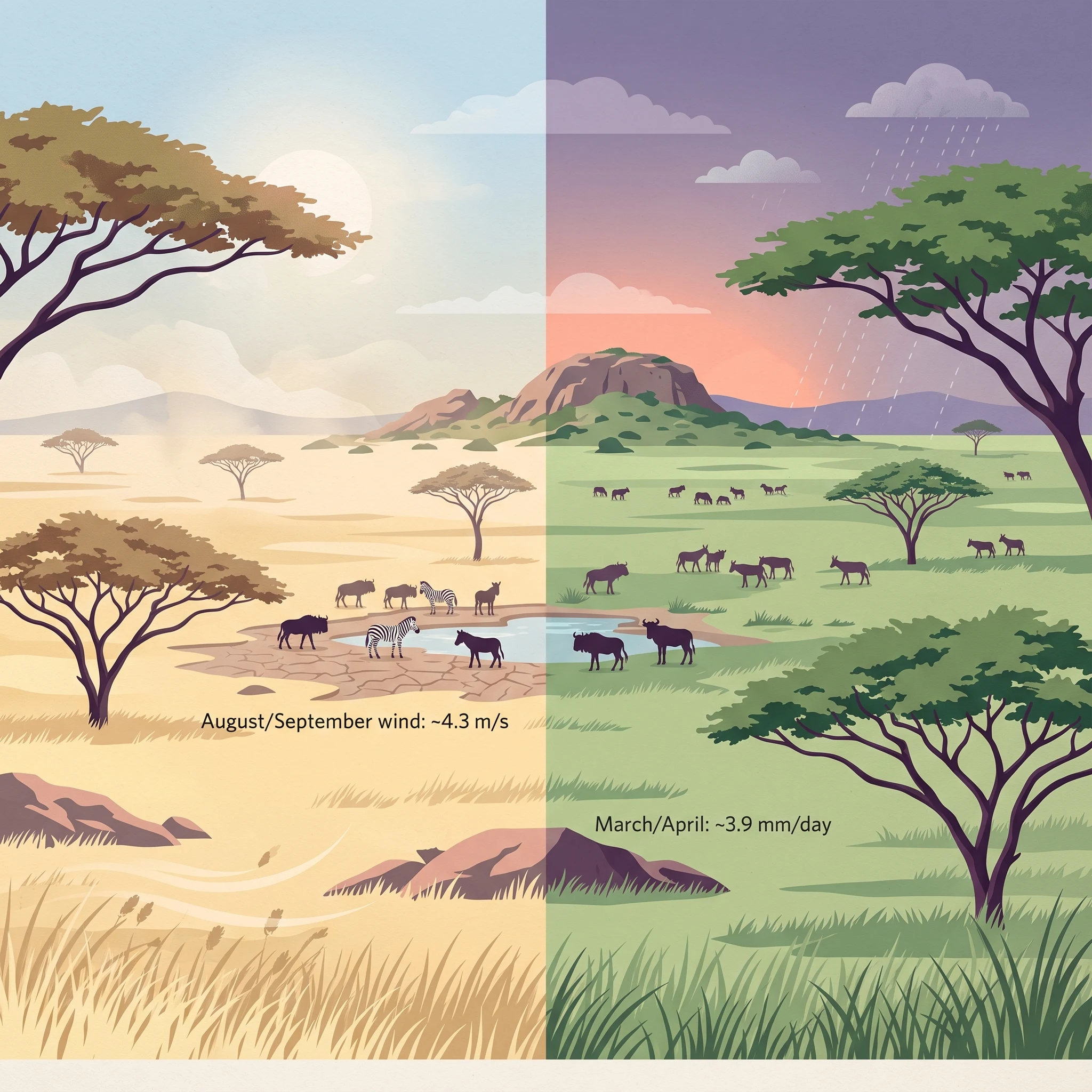
The Serengeti can be visited year-round, though the experience varies significantly with the seasons. The dry season from June to October offers excellent wildlife viewing as animals concentrate around remaining water sources, and this period coincides with the dramatic river crossings when the migrating herds cross the Grumeti and Mara rivers, typically from May through July in the western corridor and July through October near the Mara River. The wet season from November to May brings new growth and the calving season, when approximately 500,000 wildebeest are born between January and March in the Ngorongoro Conservation Area, creating exceptional predator viewing opportunities. The short rains typically arrive in November and December, followed by the long rains from March to May, when some roads may become difficult to navigate. The park receives around 350,000 visitors annually, with peak season typically during the dry months when wildlife viewing is most reliable.