Mori Atlas logo
National parkAugrabies Falls National Park

Discover the mapped geography and protected landscape of Augrabies Falls National Park.

Augrabies Falls National Park: South Africa's Dramatic Waterfall National Park in Northern Cape

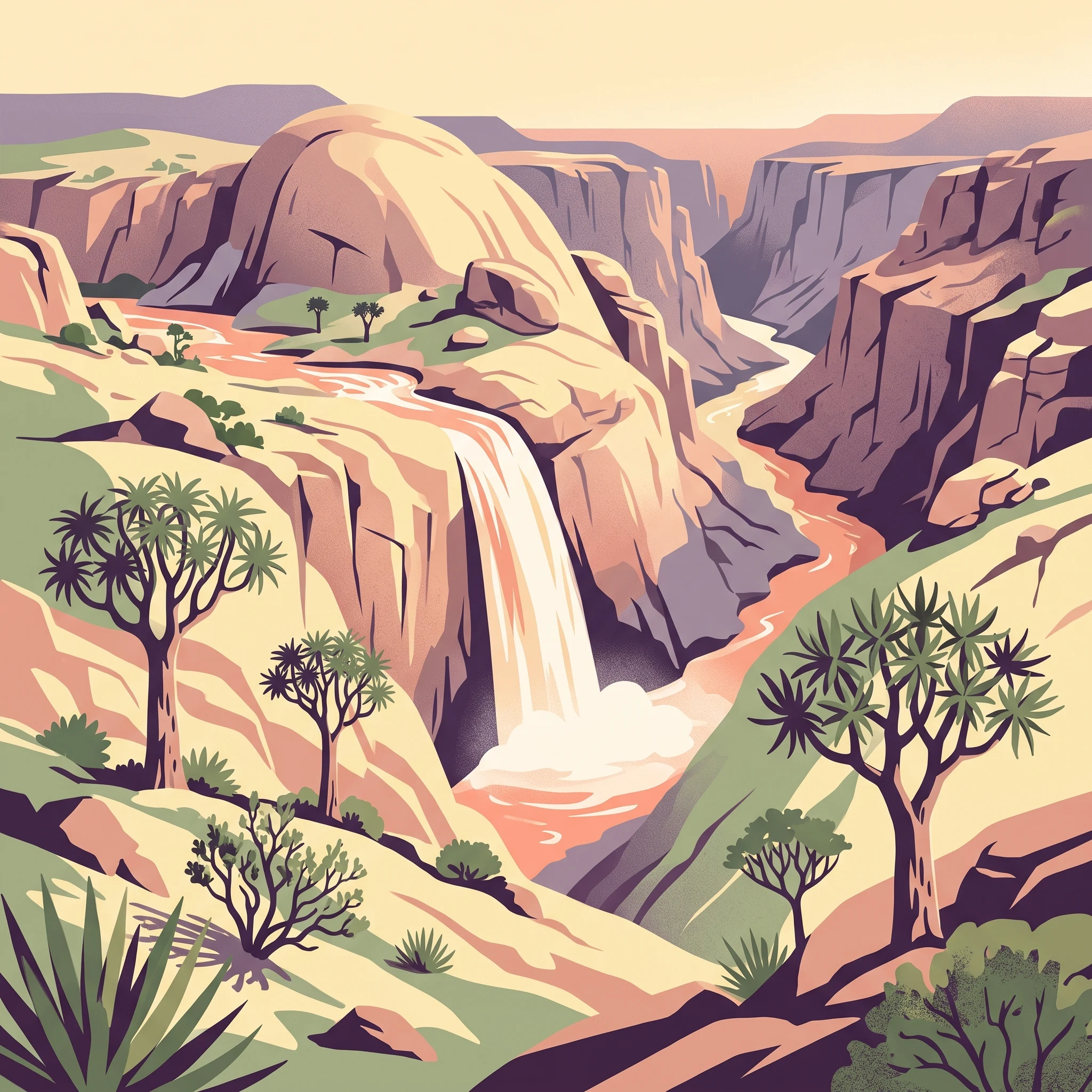
Augrabies Falls National Park represents a significant protected area within South Africa's Northern Cape Province, celebrated for its powerful Orange River waterfall cascading into a deeply eroded granite gorge. This national park offers a unique glimpse into the stark beauty of the Nama-Karoo semi-desert, defined by its dramatic geological formations, including the iconic Moon Rock and striking quiver trees. Users can explore the park's mapped boundaries and understand its place within the regional geography, experiencing a landscape shaped by arid conditions and the powerful flow of the Orange River.

waterfallOrange Riversemi-desertgranite gorgeNama-Karooriparian ecosystem

Augrabies Falls National Park

National park

Park overview

Structured park overview, official facts, and landscape profile for Augrabies Falls National Park

Augrabies Falls National Park park facts, protected area profile, and essential visitor context
Review the core facts for Augrabies Falls National Park, including designation, size, terrain, visitor scale, habitats, and operating context in one park-focused overview.

About Augrabies Falls National Park

Augrabies Falls National Park occupies a unique position in South Africa's protected area network as an example of riparian ecosystems thriving within an otherwise arid continental interior. The park's defining feature is the waterfall where the Orange River, the region's major watercourse flowing from the Lesotho Highlands to the Atlantic Ocean, descends abruptly over a granite shelf in a region of minimal rainfall. The resulting gorge represents millions of years of erosional work, exposing ancient crystalline basement rocks and creating a deep incision through the surrounding Karoo landscape. The Orange River corridor provides critical habitat in this parched environment, supporting vegetation communities that would otherwise be impossible in the surrounding semi-desert. The park offers visitors access to this dramatic landscape through a network of trails including the Dassie Trail, a 5-kilometer route, and the Klipspringer Trail, a more extensive 3-day hike covering 14.4 kilometers. Night drives during peak season allow visitors to experience the nocturnal wildlife activity patterns characteristic of this environment.

Quick facts and research context for Augrabies Falls National Park

Augrabies Falls National Park lies in the Northern Cape Province, roughly 120 kilometers west of Upington along the Orange River. Established in 1966, the park encompasses 820 square kilometers of semi-desert Karoo terrain surrounding a dramatic 60-meter waterfall. The granite gorge below the falls reaches depths of about 240 meters and stretches for 18 kilometers, showcasing powerful erosion processes into ancient basement rock. The region experiences extremely hot summers and mild winters, with the rainy season concentrated between January and April.

Park context

Deeper park guide and search-rich context for Augrabies Falls National Park

Augrabies Falls National Park history, landscape, wildlife, and travel context
Explore Augrabies Falls National Park through its history, landscape character, ecosystems, wildlife, conservation priorities, cultural context, and seasonal travel timing in a structured park guide built for atlas discovery and search intent.

Why Augrabies Falls National Park stands out

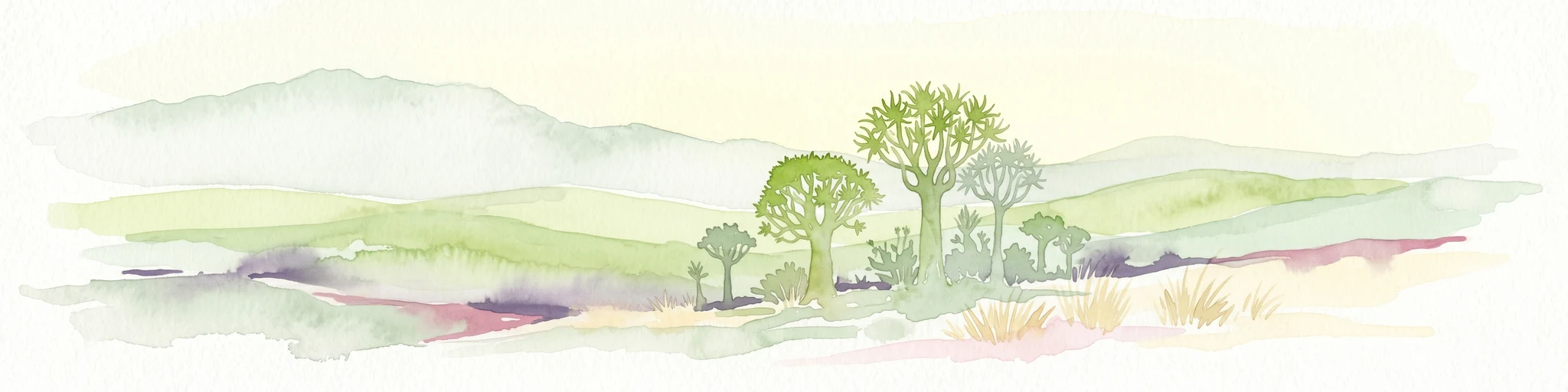
The park is most renowned for the Augrabies Falls themselves, a thundering cascade that achieves particular majesty during flood periods when the Orange River swells with seasonal rains. Beyond the waterfall, the park is celebrated for its starkly beautiful semi-desert landscape of granite domes, deep gorges, and sparse but distinctive vegetation adapted to extreme aridity. The iconic quiver tree, a giant aloe reaching five meters in height, dominates the scenery with its striking silhouette, while the remarkable Moon Rock formation, an enormous exfoliation dome measuring approximately 700 meters in length, stands as a geological landmark within the park.

Augrabies Falls National Park history and protected-area timeline

The area has deep human heritage extending back to the Khoekhoe peoples who originally inhabited the region and gave the waterfall its evocative Khoikhoi name Ankoerebis, translating to the place of great noise, a reference to the thunderous sound of water crashing over the falls. The Khoekhoe and San communities constructed distinctive domed huts known as matjiehuise, mat houses, engineered to adapt to the extreme temperature variations of the desert environment. These traditional structures utilize plant stems that contract in heat to create cooling ventilation gaps and expand in cold weather to seal out chill. Following the arrival of Trekboer settlers in the region, the name evolved into Augrabies, with occasional spelling as Aughrabies. The park was formally established in 1966, creating the protected area that safeguards this remarkable desert waterfall and its surrounding ecosystem.

Augrabies Falls National Park landscape and geographic character

The park showcases a distinctive semi-desert landscape characteristic of the Nama-Karoo biome, dominated by vast open spaces of rocky terrain interspersed with sparse vegetation. The granite basement rock forms prominent features throughout the park, from the dramatic waterfall ledge to the impressive Moon Rock, a massive rounded exfoliation dome rising about 30 meters high and extending roughly 700 meters in length. The deeply incised gorge below the falls provides the most dramatic topographic relief, with sheer rock walls descending to the river below. The Orange River corridor creates a linear oasis through the otherwise arid terrain, with riverine vegetation contrasting sharply against the surrounding Karoo plains. The landscape achieves particular intensity during flood seasons when the falls become a powerful torrent, and the gorge carries the immense volume of water downstream.

Augrabies Falls National Park ecosystems, habitats, and plant life

The park's ecological character is defined by the tension between extreme aridity and the life-giving presence of the Orange River. The Nama-Karoo environment supports specialized vegetation adapted to high temperatures, low rainfall, and nutrient-poor soils. The quiver tree, Aloidendron dichotomum, stands as the park's most characteristic plant, reaching heights of up to five meters with its distinctive branching pattern. This remarkable aloe gets its name from the traditional use of its soft branches by San people to make quivers for their arrows. During winter flowering, the trees attract numerous bird species seeking nectar, while baboons are commonly observed feeding on the flowers. The shepherd's tree represents another culturally significant species, held in reverence by local Khoikhoi and San communities who traditionally forbade its destruction.

Augrabies Falls National Park wildlife and species highlights

Despite the harsh environment, Augrabies Falls National Park supports a surprising diversity of wildlife adapted to semi-desert conditions. Large mammals include springbok, gemsbok, and the endangered south-central black rhinoceros, the latter representing a significant conservation priority for the park. Smaller predators such as the black-backed jackal, caracal, bat-eared fox, and African wildcat inhabit the rocky terrain, while the Cape clawless otter maintains populations along the Orange River. The river also supports the Nile monitor, Africa's largest lizard species, while birdlife includes both double-banded and Namaqua sandgrouse. The park's 28,000 hectares provide crucial habitat for these species within the broader arid landscape.

Augrabies Falls National Park conservation status and protection priorities

The park plays a vital role in protecting both the unique waterfall ecosystem and the surrounding semi-desert environment of the Nama-Karoo biome. Conservation efforts focus on maintaining viable populations of the endangered south-central black rhinoceros alongside other species characteristic of this arid environment. The riparian corridor along the Orange River represents a critical conservation asset, preserving biodiversity in an otherwise harsh landscape. The protection of the granite gorge and surrounding terrain also safeguards geological features of scientific and scenic significance.

Augrabies Falls National Park cultural meaning and human context

The park encompasses cultural heritage of the indigenous Khoekhoe and San peoples who historically inhabited this region. The original Khoekhoe name for the waterfall, Ankoerebis meaning place of great noise, reflects the powerful impression the falls made on these communities. Traditional dome-shaped matjiehuise buildings constructed by these peoples demonstrate sophisticated adaptation to the extreme temperature variations of the desert environment. Local legend speaks of alluvial diamond deposits along the Orange River, with folklore suggesting that the largest cache of diamonds in the world lies within the swirl-holes eroded into the granite at the base of the falls.

Top sights and standout views in Augrabies Falls National Park

The thundering Augrabies Falls themselves represent the park's primary attraction, particularly impressive during flood periods when the Orange River swells with seasonal rains. The deep granite gorge extending 18 kilometers downstream offers one of the most dramatic canyon landscapes in South Africa. Moon Rock provides an accessible geological landmark, its massive exfoliated dome visible from within the park. The distinctive silhouette of quiver trees against the arid landscape has become emblematic of the Northern Cape environment. The night drives offer opportunities to experience the park's wildlife in the nocturnal hours when many species become active.

Best time to visit Augrabies Falls National Park

The park can be visited throughout the year, though the experience varies significantly with seasons. The rainy season from January to April brings the Orange River to higher levels, making the falls more impressive but also potentially affecting some access routes. The winter months from May to August offer milder daytime temperatures more comfortable for hiking, while summer temperatures can be extremely hot. The best overall conditions for most visitors typically occur during the cooler dry season months when daytime temperatures are moderate and wildlife viewing along the river corridor remains productive.
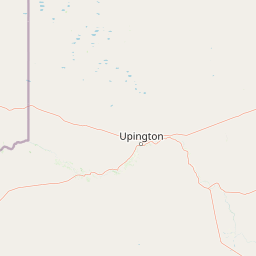
Park location guide

Geography guide, regional context, and park location map for Augrabies Falls National Park

Augrabies Falls National Park park geography, regions, and map view in South Africa
Understand where Augrabies Falls National Park sits in South Africa through a broader geographic reading of the surrounding landscape, nearby location context, and its mapped position within the national park landscape.

How Augrabies Falls National Park fits into South Africa

South Africa is the southernmost country in Africa, spanning 1.22 million km² with a population of over 63 million. The country operates with three capital cities, Pretoria (executive), Cape Town (legislative), and Bloemfontein (judicial), and is renowned for its biodiversity, national parks, and multicultural society.

Wider geography shaping Augrabies Falls National Park in South Africa

South Africa occupies the southernmost region of Africa, with coastline along both the Atlantic Ocean to the west and the Indian Ocean to the east. The interior features elevated plateaus including the Highveld, with the Drakensberg escarpment marking the eastern highlands. The country shares borders with Namibia, Botswana, Zimbabwe, Mozambique, Eswatini, and Lesotho.

Map view of Augrabies Falls National Park

Use this park location map to pinpoint Augrabies Falls National Park in South Africa, understand its exact geographic position, and read its mapped placement within the surrounding landscape more clearly.

Pigeon | © OpenStreetMap contributors

Location context for Augrabies Falls National Park

Northern Cape
Park atlas

Explore the surrounding Nama-Karoo landscapes and Orange River riparian zones with nearby protected areas

Discover Other National Parks and Protected Areas Near Augrabies Falls National Park
Browse a curated list of national parks and protected areas located in the vicinity of Augrabies Falls National Park. Compare their distinct Nama-Karoo biomes, granite formations, and riverine ecosystems to understand the broader conservation landscape of South Africa's Northern Cape Province.
National parkKgalagadi District

Kgalagadi Transfrontier Park National Park: Explore Its Mapped Protected Landscape

Discover the desert geography and unique terrain of the southern Kalahari.

Kgalagadi Transfrontier Park is a monumental protected area within the Kgalagadi District, embodying the vastness and stark beauty of the Kalahari Desert. This national park page offers an atlas-centric view of its sweeping red dunes, sparse vegetation, and the crucial dry river systems that shape its arid environment. Understand the geographic scope and the protected landscape character of this significant cross-border conservation area, perfect for detailed map exploration and understanding regional desert ecosystems.

Area
38,000 km²
Established
2000
IUCN
II
National parkWestern Cape

Bontebok National Park: A Unique Protected Landscape in South Africa's Western Cape

Mapping the endemic bontebok's habitat and diverse fynbos.

Bontebok National Park represents a singular achievement in conservation, dedicated to protecting the rare bontebok antelope and showcasing the extraordinary biodiversity of the Cape Floristic Region. Located in the Western Cape, this smallest of South Africa's national parks features a landscape of fynbos-covered foothills beneath the Langeberg Mountains, with the Breede River defining its southern edge. Explore its mapped boundaries and unique ecosystems, offering a concentrated natural discovery experience within a UNESCO World Heritage Site.

Area
27.86 km²
Established
1931
IUCN
II
National parkEastern Cape

Mountain Zebra National Park: A National Park within Eastern Cape's Geography

Explore its mapped protected boundaries and regional landscape context.

Mountain Zebra National Park serves as a key protected area within South Africa's Eastern Cape region. This page offers an atlas-driven perspective, detailing the park's geographic scope and mapped boundaries. Understand its role as a national park and its contribution to the regional landscape context, providing structured data for those interested in protected land distribution and natural terrain.

Area
284 km²
Established
1937
IUCN
II
National parkSouth Africa

Garden Route National Park: South Africa's Protected Landscape and Forest Atlas

Explore indigenous forests, coastal cliffs, and lake systems.

Garden Route National Park is a key national park in South Africa, celebrated for its rich indigenous forests and dramatic coastline. As a protected landscape, it offers a unique geographic profile, blending ancient woodlands with rugged coastal terrain and interconnected lake systems. This page serves as an atlas entry, detailing the park's spatial extent and its significance as a conservation area within the broader geography of South Africa.

Area
1,210 km²
Established
2009
IUCN
II
National parkNamibia

Namib-Naukluft National Park: Namibia's Iconic Desert Landscape and Protected Terrain

Explore its ancient dunes, Naukluft mountains, and coastal geography.

Namib-Naukluft National Park is a colossal protected area in Namibia, holding the distinction of being Africa's largest national park. This park is renowned for its iconic sand dunes, particularly at Sossusvlei, which are among the highest in the world and display dramatic colors due to iron oxidation. The landscape also features the rugged Naukluft Mountains and vital coastal fog zones, creating a diverse arid environment. Delve into the mapped geography and unique terrain of this ancient desert setting, understanding its protected landscape significance within Namibia's atlas.

Area
49,768 km²
Established
1907
IUCN
II
National parkSouth Africa

Tsitsikamma National Park: South Africa's Protected Coastal Forest and Terrain

Explore the unique mapped landscape and protected area boundaries.

Tsitsikamma National Park in South Africa is defined by its striking coastal geography, where ancient indigenous forests descend towards rugged shores. This national park is a prime example of a protected landscape that showcases the dynamic interface between land and sea, featuring dramatic cliffs and iconic river mouths. Understanding its mapped boundaries and diverse terrain provides critical context for regional geographic exploration and the study of conservation areas within South Africa.

Established
2009
IUCN
II
National parkEastern Cape

Addo Elephant National Park: South African National Park with Diverse Protected Landscapes

Explore its geographic context and unique Big Seven megafauna habitats.

Addo Elephant National Park is a crucial protected landscape within South Africa's Eastern Cape, covering approximately 1,640 square kilometers of varied terrain including karoo plains, coastal dunes, and marine protected areas. Its identity is deeply tied to the successful recovery of elephant populations and its distinction as the only African national park where all Big Seven megafauna can be observed in their natural surroundings. Discover the park's geographic spread, landscape diversity, and its role as a premier conservation area.

Area
1,640 km²
Established
1931
IUCN
II
National parkLeribe District

Ts'ehlanyane National Park: Indigenous Forest & Maloti Mountain Protected Landscape

Explore unique terrain and endemic plant habitats.

Ts'ehlanyane National Park is a vital protected area in Lesotho's Leribe District, distinguished by its rare indigenous forest and the prevalence of berg bamboo. This national park offers insight into unique altitudinal landscapes and botanically significant ecosystems, situated within the expansive Maloti Mountains. Its protected status makes it a key destination for understanding the regional geography and the conservation of specialized natural habitats.

IUCN
II

Common questions about visiting, size, designation, and location context for Augrabies Falls National Park

Augrabies Falls National Park FAQs for park facts, access, geography, and protected area context
Find quick answers about Augrabies Falls National Park, including protected-area facts, park geography, trail and visitor context, and how the park fits into its surrounding country and regional landscape.
MoriAtlas Explorer

Continue Your Protected Areas Search Across the Global Atlas

Deepen your exploration by continuing the structured search for national parks and protected areas worldwide. Utilize the comprehensive filtering capabilities to compare different conservation landscapes and refine your understanding of global park geography. Discover more about the distribution and characteristics of protected natural areas.

Global natural geography