Why Dharawal National Park stands out
Dharawal National Park is best known for its extraordinary biodiversity and the global significance of its upland swamp ecosystems, which are recognized as the most species-rich shrub and sedge vegetation communities anywhere on Earth. The park preserves the largest remaining koala population in southern Sydney, centered around Wedderburn, with breeding habitat along the O'Hares Creek and Georges River corridor. The area holds exceptional indigenous heritage significance, with the Dharawal people maintaining continuous connection to Country for over 15,000 years and more than 230 documented archaeological sites containing rock art created using charcoal, clay, and ochre. The park also represents a successful conservation outcome where former coal mining land has been protected to the centre of the earth, preventing future mining activities.
Dharawal National Park history and protected-area timeline
The formal protection history of Dharawal began in 1927 when the O'Hares Creek Catchment was proclaimed as a water catchment area to supply the Sydney metropolitan region. The Sydney Metropolitan Water Sewerage and Drainage Board determined in 1978 that the catchment would not be needed for water supply, prompting the New South Wales Government to propose creating a state recreation area. Political and governmental conflicts delayed action until 1996 when the catchment was finally declared a nature reserve and state recreation area. The passage of the National Parks and Wildlife Act 2001 transformed state recreation areas into state conservation areas, with the key distinction being that coal mining was permitted in the conservation area while prohibited in the nature reserve. On 26 March 2012, most of the Dharawal State Conservation Area was upgraded to national park status, with small remnants of state conservation area retained on the western side to allow ongoing mining operations. The government waited for BHP's final mining exploration licence to expire before announcing the national park declaration, which provides protection to the centre of the earth, theoretically preventing future mining activities within the park boundaries.
Dharawal National Park landscape and geographic character
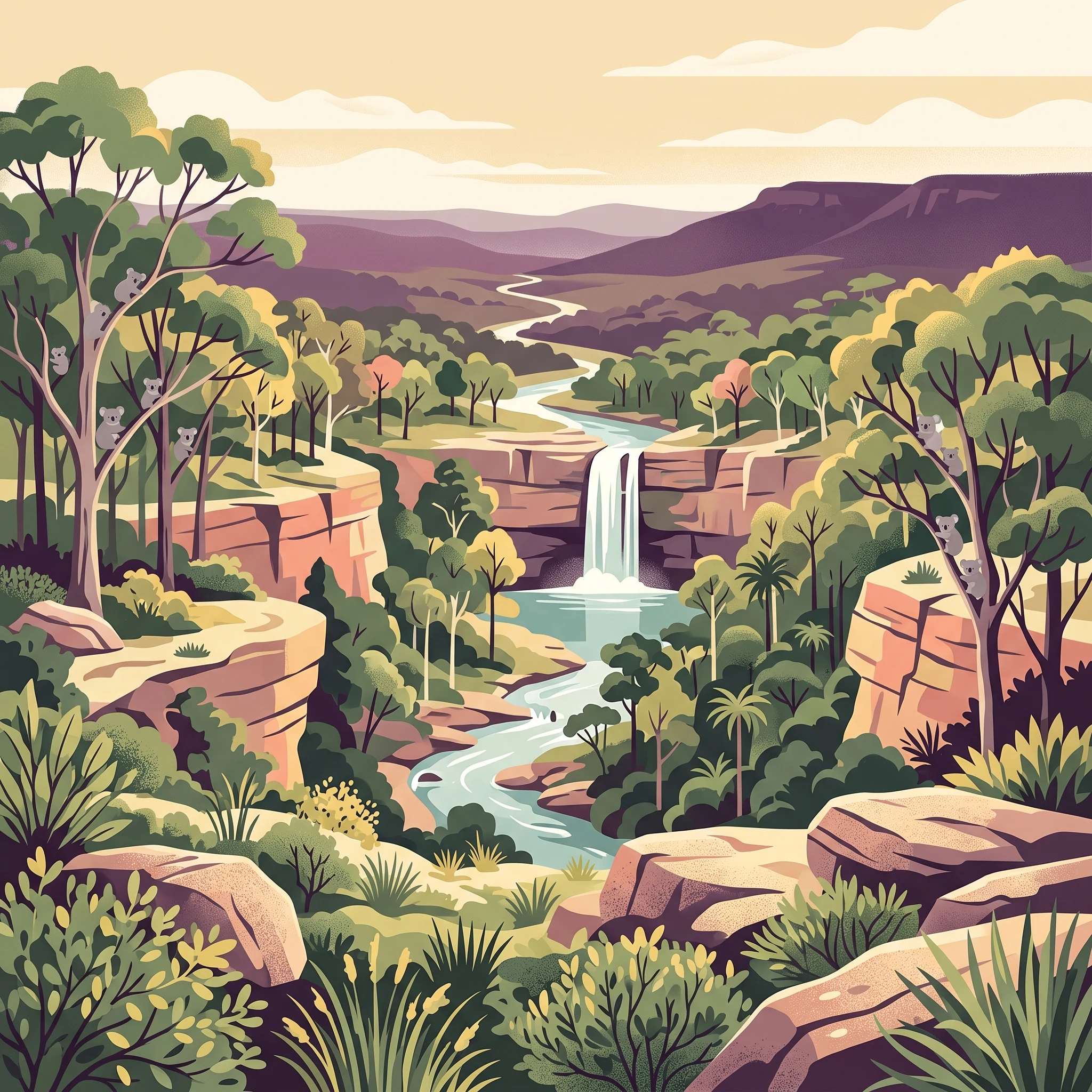
The physical landscape of Dharawal National Park is defined by the Woronora Plateau, a gently undulating sandstone terrain that slopes northwest toward the Cumberland Plain. The plateau is composed predominantly of Triassic Hawkesbury Sandstone, primarily quartzose sandstone with occasional shale and ironstone inclusions. The park encompasses the catchments of O'Hares and Stokes Creeks, containing over 200 kilometres of waterways and 26 distinct swamps that drain toward the Nepean and Georges Rivers. The terrain varies from steep gorges and dramatic waterfall locations to expansive sandstone plateaus and valley floors. The soil throughout the park is characteristically shallow, sandy, and of low fertility, creating challenging conditions for vegetation and contributing to high erosion vulnerability. The landscape transitions through distinct zones from the more elevated plateau areas through the valley systems to the creek systems themselves, with elevation changes creating diverse microhabitats and aesthetic variety.
Dharawal National Park ecosystems, habitats, and plant life
The ecological character of Dharawal National Park is distinguished by remarkable biodiversity and the presence of globally significant vegetation communities. The upland swamps of the park are considered the most species-rich shrub and sedge communities in the world, containing over 140 plant species and representing an endangered ecological community that has remained essentially unchanged for 17,000 years. The two dominant vegetation communities, sandstone woodland and eastern gully forest, contain species compositions distinct from similar communities elsewhere in New South Wales. The dry sclerophyll forests, woodlands, and heathlands of the region exhibit greater species richness than equivalent coastal communities in the state. The park supports 510 recorded vascular plant species, including the endangered Persoonia hirsuta and Acacia bynoeana, five vulnerable species, and 14 additional rare or threatened native plants. The O'Hares Creek Shale Forest and the disconnected black cypress pine populations of the Woronora Plateau are classified as endangered plant communities. The park is also significant as the southernmost habitat for eleven plant species within the region.
Dharawal National Park wildlife and species highlights
Dharawal National Park supports exceptional vertebrate biodiversity with 128 bird species, 39 reptile species, 32 mammal species, 23 frog species, 5 fish species, 2 crayfish species, 1 shrimp species, 1 freshwater mussel species, and 273 invertebrate species recorded. Of these, 23 vertebrate species are listed as threatened. The park contains the largest koala population in southern Sydney, centered around Wedderburn, with breeding habitat extending along the creek lines from the Stokes Creek junction to north of Kentlyn. This endangered marsupial faces population decline across its range, making this population critically important for regional conservation. The eastern pygmy possum, found in the park, is listed as vulnerable, while other significant mammals include the greater glider, red-necked pademelon, wallaroo, eastern grey kangaroo, and wombat. The park provides crucial habitat for the broad-headed snake and red-crowned toadlet, species that depend on exfoliated sandstone rock habitats that have been dramatically degraded in other Sydney regions but remain relatively undisturbed here. Freshwater fish species include the threatened Macquarie perch, along with Cox's gudgeon, long-finned eel, and climbing galaxias.
Dharawal National Park conservation status and protection priorities
Dharawal National Park holds high conservation significance within the Sydney region due to its relatively low disturbance levels and limited public access, which have allowed ecosystems to persist in near-natural condition while surrounding landscapes have been significantly modified. The upland swamps are protected as an endangered ecological community and designated as Priority Fauna Habitat due to their global rarity and exceptional species richness. Stokes and O'Hares Creeks are classified as protected waters, with the waters connected to O'Hares Weir designated as Specially Protected Waters, meaning virtually no discharges are permitted. The park preserves local and diverse ecosystems and habitats that have been damaged or destroyed throughout the surrounding region. Twenty-three threatened vertebrate species depend on the park's habitats, while the protection of the O'Hares Creek Shale Forest community and the Woronora Plateau black cypress pine represents conservation of endangered plant communities. The 2012 national park declaration provided stronger protection against coal mining activities, which had previously caused physical damage to creek beds and altered stream flows.
Dharawal National Park cultural meaning and human context
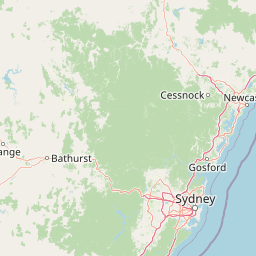
The Dharawal National Park is deeply intertwined with the cultural heritage of the Dharawal people, an Aboriginal community whose traditional lands extended from the southern shores of Botany Bay south to the Shoalhaven River and northwest to Camden. The park lies within the Tharawal and Illawarra Aboriginal Land Council areas, and the Dharawal connection to Country spans more than 15,000 years. Archaeological surveys have identified over 230 sites within the national park, while the broader Woronora Plateau region contains an estimated 15,000 archaeological sites. The rock art found at these sites includes drawings, paintings, and stencils created using black charcoal, white clay, and red, yellow, or orange ochre, representing a significant cultural archive of Indigenous artistic tradition. The park's establishment represents a process of reconciliation between government and Aboriginal stakeholders, though the retention of some state conservation areas for ongoing mining reflects ongoing tensions between conservation and resource extraction priorities.
Top sights and standout views in Dharawal National Park
The outstanding features of Dharawal National Park include its globally significant upland swamp ecosystems, which represent the most species-rich shrub and sedge communities on Earth and have persisted essentially unchanged for 17,000 years. The park protects the largest koala population in southern Sydney, an endangered species whose breeding habitat follows the O'Hares Creek and Georges River corridors. The exceptional indigenous heritage with over 230 documented archaeological sites containing rock art traditions spanning thousands of years. The diverse landscape ranging from dramatic gorges and waterfalls through sandstone woodland to subtropical rainforest valleys. The remarkable biodiversity supporting 23 threatened vertebrate species and hundreds of plant and invertebrate species. The park forms part of one of the largest connected protected area networks in New South Wales, linking to Royal National Park, Morton National Park, Budderoo National Park, and the Greater Blue Mountains Area World Heritage Site.
Best time to visit Dharawal National Park
The temperate climate of the Dharawal region makes the park suitable for visits throughout the year, though spring and autumn typically offer the most comfortable conditions for bushwalking and wildlife observation. Summer months can bring hot conditions on the exposed sandstone plateaus, while winter temperatures may be cool, particularly in the upland swamp areas. The upland swamps are most accessible during drier periods when track conditions are better. Wildlife viewing is generally productive year-round, though koala activity may be more observable during the breeding season. The waterfall flows will be most impressive following periods of rainfall. Visitors should be aware that the park has limited public access by design, with management prioritizing conservation over high visitor numbers. The three entry points at Darkes Forest, Wedderburn, and Appin provide different access experiences to the park's various landscapes.