

Mori Atlas logo
National parkKalamunda National Park

Discover the geographic setting and natural terrain of this significant national park in Western Australia.

Kalamunda National Park: Protected Darling Scarp Woodland & Mapped Landscape Identity

Kalamunda National Park represents a vital protected woodland area situated on the western slopes of the Darling Scarp in Western Australia. Covering 3.75 square kilometres, this national park offers a distinct geographic perspective, showcasing characteristic eucalypt forests and a rich understorey typical of southwestern Australia's unique ecosystems. Its position within the greater Perth region provides a clear landscape context, highlighting the natural terrain that defines this important conservation area and contributes to regional water catchments.

Australian national parksDarling RangeEucalypt woodlandBird conservationWestern AustraliaSouthwest Australia Floristic Region

Kalamunda National Park

National park

Park overview

Structured park overview, official facts, and landscape profile for Kalamunda National Park

Kalamunda National Park park facts, protected area profile, and essential visitor context
Review the core facts for Kalamunda National Park, including designation, size, terrain, visitor scale, habitats, and operating context in one park-focused overview.

About Kalamunda National Park

Kalamunda National Park represents an important protected area within the Perth metropolitan region's eastern fringe, providing a natural backdrop for local communities and visitors seeking accessible wilderness experiences. The park's position along the Darling Scarp places it within a landscape of significant ecological and topographical character, where the gentle slopes and valleys support distinctive woodland communities that differ from the more flat or gently undulating terrain of the adjacent Swan Coastal Plain. The park's protection since 1964 has ensured the preservation of these woodland ecosystems against the pressures of urban expansion that have transformed much of the surrounding landscape. Visitor facilities and walking trails make the park an popular destination for day visitors, while its inclusion as part of the broader Mundaring-Kalamunda Important Bird Area underscores its significance beyond its relatively modest size. The park's drainage network, centred on Piesse Brook, connects it to the Helena River catchment and ultimately to the Swan River system, establishing ecological linkages that extend beyond the protected area's boundaries.

Quick facts and research context for Kalamunda National Park

Kalamunda National Park occupies 3.75 square kilometres of Darling Scarp woodland in Western Australia, approximately 23 kilometres east of Perth. The park was established in 1964 and protects a representative sample of the region's characteristic eucalypt forest ecosystems. Piesse Brook flows through the park as it makes its way to join the Helena River, establishing the area as an important catchment for regional water systems. The park forms part of the Mundaring-Kalamunda Important Bird Area identified by BirdLife International, with particular significance as a roosting and foraging site for long-billed black cockatoos. The Bibbulmun Track, one of Australia's famous long-distance walking trails, passes through the northern section of the park.

Park context

Deeper park guide and search-rich context for Kalamunda National Park

Kalamunda National Park history, landscape, wildlife, and travel context
Explore Kalamunda National Park through its history, landscape character, ecosystems, wildlife, conservation priorities, cultural context, and seasonal travel timing in a structured park guide built for atlas discovery and search intent.

Why Kalamunda National Park stands out

Kalamunda National Park is best known for its intact Darling Scarp woodland ecosystems and its role in protecting habitat for long-billed black cockatoos. The park provides important foraging and roosting grounds for these distinctive Australian birds during their non-breeding season, contributing to the broader conservation of southwestern Australia's unique avifauna. The Bibbulmun Track's passage through the northern end of the park also makes it a popular destination for bushwalkers and outdoor enthusiasts exploring the Perth region.
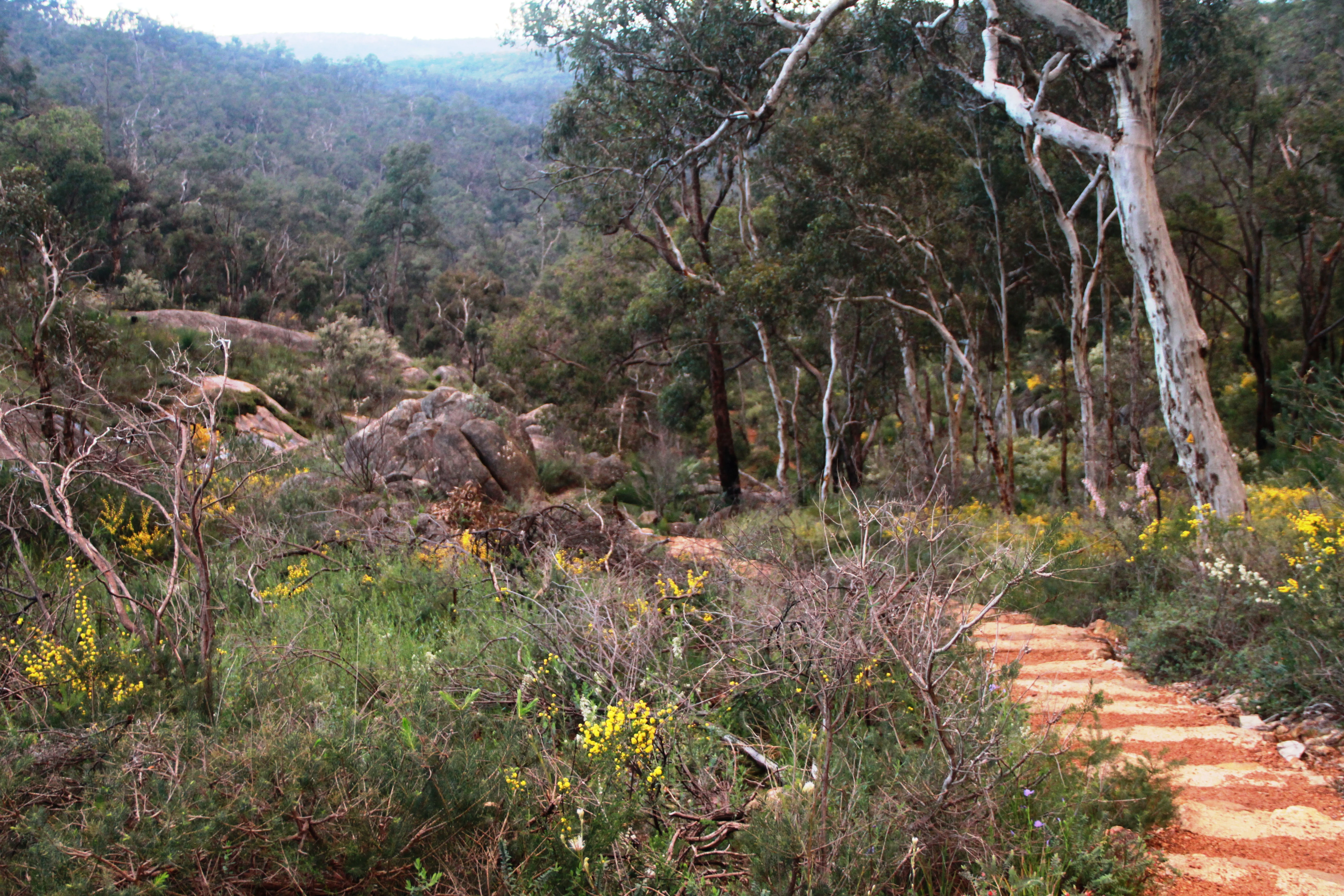
Bibbulmun Track, Rocky Pool, Kalamunda National Park
Bibbulmun Track section near Rocky Pool within Kalamunda National Park

Kalamunda National Park history and protected-area timeline

Kalamunda National Park was established in 1964, representing a mid-twentieth century effort by Western Australian conservation authorities to protect representative examples of the state's natural landscapes. The creation of the park reflected growing recognition during the 1950s and 1960s of the need to preserve bushland areas near Perth as urban development accelerated in the post-war period. The park was assigned IUCN Category II status, recognising its national park designation and primary purpose of ecosystem conservation. Management responsibility has rested with the Western Australian Department of Environment and Conservation, the state agency responsible for managing Western Australia's protected area network. The park's establishment also coincided with broader initiatives to develop recreation infrastructure in the Perth hills region, including the identification of the Bibbulmun Track as a significant long-distance walking route that would eventually incorporate the northern sections of Kalamunda National Park.

Kalamunda National Park landscape and geographic character

The landscape of Kalamunda National Park is defined by its position on the western slopes of the Darling Scarp, a steep escarpment that marks the eastern edge of the Swan Coastal Plain. The terrain within the park features gentle to moderate slopes and shallow valleys carved by small streams, with elevations varying modestly across the protected area. The underlying geology contributes to the soil conditions that support the park's woodland character, while the slope position influences drainage patterns and vegetation structure. Piesse Brook, the principal watercourse flowing through the park, follows a valley floor course before exiting to join the Helena River downstream. The woodland canopy of marri, jarrah, and wandoo creates a park-like appearance typical of the Darling Range, with the distinctive smooth-barked trunks of jarrah and the large-leaved appearance of marri providing visual character throughout the year. The understorey varies in density but typically includes shrubs and grasses that reflect the park's position within the Southwest Australia Floristic Region, one of the world's biodiversity hotspots.

Kalamunda National Park ecosystems, habitats, and plant life

Kalamunda National Park protects representative examples of the Darling Scarp woodland ecosystem, a plant community characterised by tall eucalypt trees forming a relatively open canopy over a diverse understorey. The three dominant tree species, marri, jarrah, and wandoo, each bring distinct characteristics to the woodland. Marri, also known as Corymbia calophylla, is recognised for its large cream flowers and distinctive gumnuts, while jarrah provides the characteristic rough, stringy bark and leathery leaves typical of the species. Wandoo, a smooth-barked eucalypt, adds further structural diversity to the woodland. The understorey supports a range of shrub species and, notably, a variety of wildflowers that bloom seasonally, contributing to the park's appeal during spring months. The park's location within the Southwest Australia Floristic Region places it within one of the world's 36 biodiversity hotspots, reflecting the exceptional plant endemism found in this part of Australia.

Kalamunda National Park wildlife and species highlights

The park's wildlife significance is most notably expressed through its designation as part of the Mundaring-Kalamunda Important Bird Area, recognised by BirdLife International because of its importance to long-billed black cockatoos. These distinctive parrots use the park as a non-breeding season roost site and foraging base, finding food resources within the woodland and surrounding forested areas. The park's woodland and understorey habitats support a variety of bird species typical of the southwestern Australian forests, while the presence of dead trees and hollows provides nesting habitat for cockatoos and other hollow-nesting birds. Mammals, reptiles, and invertebrates also inhabit the park, though the Wikipedia source does not provide detailed species inventories. The watercourse corridors may support additional wildlife diversity, particularly for species associated with riparian habitats.

Kalamunda National Park conservation status and protection priorities

Kalamunda National Park contributes to regional conservation outcomes through its protected status and its role within the broader network of conservation areas in the Perth hills region. The park's inclusion in the Mundaring-Kalamunda Important Bird Area highlights its significance for bird conservation, particularly for long-billed black cockatoos whose populations face pressures from habitat loss and fragmentation across their range in southwestern Australia. The park's protection of the Piesse Brook catchment also provides downstream water quality benefits for the Helena and Swan Rivers, establishing ecological services that extend beyond the protected area itself. As a representative example of Darling Scarp woodland, the park contributes to the conservation of a vegetation system that has been extensively cleared for agriculture and urban development in the Perth region.

Kalamunda National Park cultural meaning and human context

The park is situated in the Perth hills region, an area with European settlement history dating to the early colonial period of Western Australia. The town of Kalamunda, which lies adjacent to the park, developed as a small settlement serving the surrounding agricultural and timber-getting activities. The Bibbulmun Track, which traverses the northern section of the park, follows a route of significance to the Bibbulmun people, an Aboriginal group whose traditional lands encompass the Perth region and nearby areas. The track name itself derives from the Noongar language, reflecting the ongoing cultural connections to Country that persist in the landscape. The park provides a natural setting that contrasts with the suburban development that now dominates much of the Perth metropolitan area, offering visitors a sense of connection to the landscape that existed before European colonisation.

Top sights and standout views in Kalamunda National Park

The park's combination of accessible woodland, walking trails including the Bibbulmun Track, and proximity to Perth makes it a popular destination for nature-based recreation. The spring wildflower display provides a seasonal highlight, while the possibility of spotting long-billed black cockatoos adds wildlife viewing appeal. The network of walking tracks, ranging from short loops to longer through-routes, accommodates visitors with different fitness levels and time constraints. The park's role as a water catchment area for the Helena River adds ecological significance to its recreational and conservation values.

Best time to visit Kalamunda National Park

The park can be visited throughout the year, though spring and autumn typically offer the most comfortable conditions for walking and outdoor activities. Spring, from September to November, brings wildflower displays as the understorey plants bloom, adding colour to the woodland and creating attractive scenery for visitors. Autumn provides mild temperatures and generally stable weather, making it another suitable season for walking and exploring the park's trails. Summer months in the Perth region can be hot, though the woodland canopy provides some shade. Winter brings cooler temperatures and occasional rain, which can make tracks muddy but also contributes to the lush appearance of the vegetation. The long-billed black cockatoos are most reliably observed during their non-breeding season presence in the area, typically during autumn and winter months.
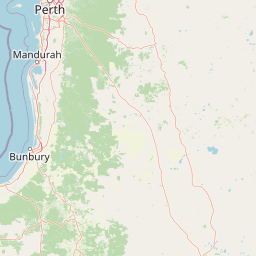
Park location guide

Geography guide, regional context, and park location map for Kalamunda National Park

Kalamunda National Park park geography, regions, and map view in Australia
Understand where Kalamunda National Park sits in Australia through a broader geographic reading of the surrounding landscape, nearby location context, and its mapped position within the national park landscape.

How Kalamunda National Park fits into Australia

Australia is a constitutional monarchy and federal parliamentary democracy comprising six states and ten territories. With a population of nearly 28 million, it is one of the world's most urbanised countries, with most people concentrated on the eastern seaboard. The country has a high Human Development Index and is known for its cultural diversity, ancient Aboriginal heritage, and unique wildlife.

Wider geography shaping Kalamunda National Park in Australia

Australia occupies the entire Australian continent, the island of Tasmania, and numerous smaller islands. It is the world's flattest and driest inhabited continent, featuring vast deserts in the interior (the Outback), tropical rainforests along the eastern coast, and a coastline bordering the Indian and Pacific Oceans.

Map view of Kalamunda National Park

Use this park location map to pinpoint Kalamunda National Park in Australia, understand its exact geographic position, and read its mapped placement within the surrounding landscape more clearly.

Pigeon | © OpenStreetMap contributors

Location context for Kalamunda National Park

Western Australia
Park atlas

Compare Western Australian Protected Landscapes and Regional Park Geography Beyond Kalamunda

Explore Nearby National Parks and Protected Areas Around Kalamunda National Park
Discover other national parks and protected areas situated within the Darling Scarp and surrounding Perth region, offering diverse woodland ecosystems and conservation landscapes. Broaden your exploration beyond Kalamunda National Park to compare regional park geography, terrain variations, and shared conservation efforts across Western Australia.
National parkWestern Australia

Beelu National Park: Exploring Western Australia's Protected Jarrah-Marri Forest Landscape

Mapped Geographic Context & Natural Terrain Discovery

Beelu National Park, situated in Western Australia's Darling Range, offers an immersive experience within old-growth jarrah-marri forests. This protected area provides a vital glimpse into the region's natural landscapes, characterized by rolling hills and the Helena River valley. Users can explore the park's geographic setting, its mapped boundaries, and the unique ecological context it preserves. It stands as a significant natural reserve contributing to the understanding of Western Australia's conservation efforts and diverse terrain.

Area
46.17 km²
Established
1995
IUCN
II
National parkWestern Australia

Korung National Park: Protected Landscape and Map Context in Western Australia

Discover its unique dual bioregion geography.

Korung National Park is a protected national park in Western Australia, noted for its position along the Darling Scarp overlooking the Swan Coastal Plain. This reserve provides accessible natural experiences and showcases the ecological transition between two major southwest Australian bioregions. Its mapped landscapes offer a clear example of regional protected area planning and its importance for biodiversity conservation in the Perth metropolitan area.

Area
63.54 km²
Established
2004
IUCN
II
National parkPerth metropolitan region

Midgegooroo National Park: Jarrah Forest Protected Landscape and Regional Geography

Explore its mapped boundaries and terrain near Perth.

Midgegooroo National Park offers a distinct protected landscape characterized by its expansive jarrah forest terrain within the Perth metropolitan region. This national park provides valuable context for understanding regional geography, mapped natural features, and the distribution of protected lands. Explore the park's unique topography and conservation boundaries, vital for comprehensive atlas-based geographic discovery.

Area
24.92 km²
Established
2004
IUCN
II
National parkWestern Australia

Serpentine National Park: Waterfall & Wildflower Protected Landscape in Western Australia

Mapped geography, waterfall terrain, and spring bloom discovery.

Serpentine National Park is a protected national park located in Western Australia, approximately 55 kilometers southeast of Perth. It is celebrated for its prominent Serpentine Falls, a multi-tiered cascade that forms a popular natural pool, and its stunning spring wildflower season. The park showcases the undulating terrain of the Darling Scarp, featuring jarrah and marri woodlands. This park offers a distinct opportunity for atlas-based exploration of protected landscapes, with a focus on its unique waterfall features and vibrant botanical displays.

Area
43.87 km²
Established
1957
IUCN
II
National parkWestern Australia

Yanchep National Park: Explore Its Unique Limestone Caves and Protected Bushland Geography

Discover the subterranean formations and coastal plain landscapes.

Yanchep National Park offers a singular opportunity for atlas-driven exploration of Western Australia's natural and cultural heritage. Situated on the Swan Coastal Plain, this national park is celebrated for its extensive network of limestone caves, including the notable Crystal Cave, providing a rare glimpse into subterranean geological processes. Beyond its underground wonders, the park encompasses diverse native bushland, supporting iconic koala colonies and offering insights into the region's ecological distinctiveness. Its deep Nyoongar heritage further enriches the understanding of this mapped protected landscape.

Area
28.76 km²
Established
1957
IUCN
II
National parkWestern Australia

Wellington National Park: Protected Jarrah Forest & Collie River Landscape

Explore the mapped boundaries and regional geography.

Wellington National Park offers a deep dive into Western Australia's protected landscapes, characterized by extensive old-growth jarrah forests and the scenic Collie River valley. This national park provides a vital study of the region's unique geography, mapped terrain, and ecological significance within the Yilgarn craton. Understand the park's protected area identity and its place in the wider natural context of Western Australia through its detailed landscape features.

Area
170 km²
Established
2000
IUCN
II
National parkSouth West

Yelverton National Park: South West Australia's Biodiversity Conservation Area

Mapped protected lands and regional landscape context.

Yelverton National Park offers a focused look at a protected area in Western Australia's South West, distinguished by its commitment to rare species and varied vegetation. Established from former timber reserve lands, it serves as a crucial habitat refuge. The park's geography exemplifies the ecological richness of the South-West Australian forest region, providing valuable context for understanding protected landscape distribution and conservation efforts within the mapped terrain.

Area
7.29 km²
Established
2004
IUCN
II
National parkWestern Australia

Wooditjup National Park: Protected Forest Landscape and Regional Geographic Context

Explore mapped boundaries of this Western Australia national park.

Wooditjup National Park stands as a testament to Western Australia's unique forest ecosystems, specifically within the Jarrah Forest bioregion. This protected area offers a distinct natural landscape contrasting with the nearby coastal attractions of Margaret River. Delve into the park's mapped geography, understand its role as a national park, and appreciate its position within the broader South West Australian landscape and its traditional Wardandi Country heritage.

Area
38.92 km²
Established
2004
IUCN
II

Common questions about visiting, size, designation, and location context for Kalamunda National Park

Kalamunda National Park FAQs for park facts, access, geography, and protected area context
Find quick answers about Kalamunda National Park, including protected-area facts, park geography, trail and visitor context, and how the park fits into its surrounding country and regional landscape.
MoriAtlas Explorer

Continue Your Protected Areas Search Across the Global Atlas

Deepen your exploration by continuing the structured search for national parks and protected areas worldwide. Utilize the comprehensive filtering capabilities to compare different conservation landscapes and refine your understanding of global park geography. Discover more about the distribution and characteristics of protected natural areas.

Global natural geography