Why Kruger National Park stands out
Kruger National Park is world-famous as one of Africa's premier safari destinations and the only protected area supporting all members of the Big Five: African bush elephant, lion, leopard, rhinoceros, and buffalo. The park contains the highest diversity of large mammals of any African game reserve, with 147 species recorded. It is particularly renowned for its substantial populations of endangered African wild dogs and both white and black rhinos. The park's savanna landscapes, characterised by sweeping grasslands beneath acacia and mopane woodlands, provide iconic African scenery. Kruger is also distinguished by its pioneering conservation history as South Africa's first national park and its role in the transfrontier peace park movement connecting three southern African nations.
Kruger National Park history and protected-area timeline
The origins of Kruger National Park trace to the late nineteenth century, when individual farmers in the eastern Transvaal began establishing private game preserves to protect diminishing wildlife populations. One notable pioneer was Alexander Marsh Robertson, who created an early game camp on his farms Rolfontein and Elandsberg near Wakkerstroom in 1867, fencing approximately 500 morgen to protect ground game. President Paul Kruger, who regularly toured the rural areas to visit his constituents, learned of Robertson's success and visited his property in 1892. Impressed by the results, Kruger began advocating publicly for the establishment of a formal game reserve along the Sabi River to protect the larger mammals requiring extensive habitats. In 1898, the Sabi Game Reserve was officially proclaimed by the government of the South African Republic, becoming the first government-protected wildlife area in southern Africa. James Stevenson-Hamilton was appointed as the first warden in 1902, and the adjacent Shingwedzi Reserve was added in 1903. During the following decades, native tribes were gradually removed from the reserve, with the Makuleke people being forcibly relocated from the Pafuri triangle in the 1960s. A significant political shift occurred in 1923 when Minister Deneys Reitz devised a scheme to expand the reserve by exchanging state land for privately held land within the proposed park boundaries. Following a change of government in 1924, the new Lands Minister Piet Grobler introduced the National Parks Bill, which passed on 11 June 1926, formally establishing the Kruger National Park. The park was named after Paul Kruger, with Judge J.A.J. de Villiers proposing the name at the National Monuments Commission. The Makuleke people successfully submitted a land claim in 1996 for the Pafuri region, and rather than resettling, they chose to partner with private operators to develop tourism facilities, earning royalties from several game lodges. In the late 1990s, fences between Kruger and adjacent private reserves were removed to create the Greater Kruger, adding approximately 400,000 hectares to the protected landscape.
Kruger National Park landscape and geographic character
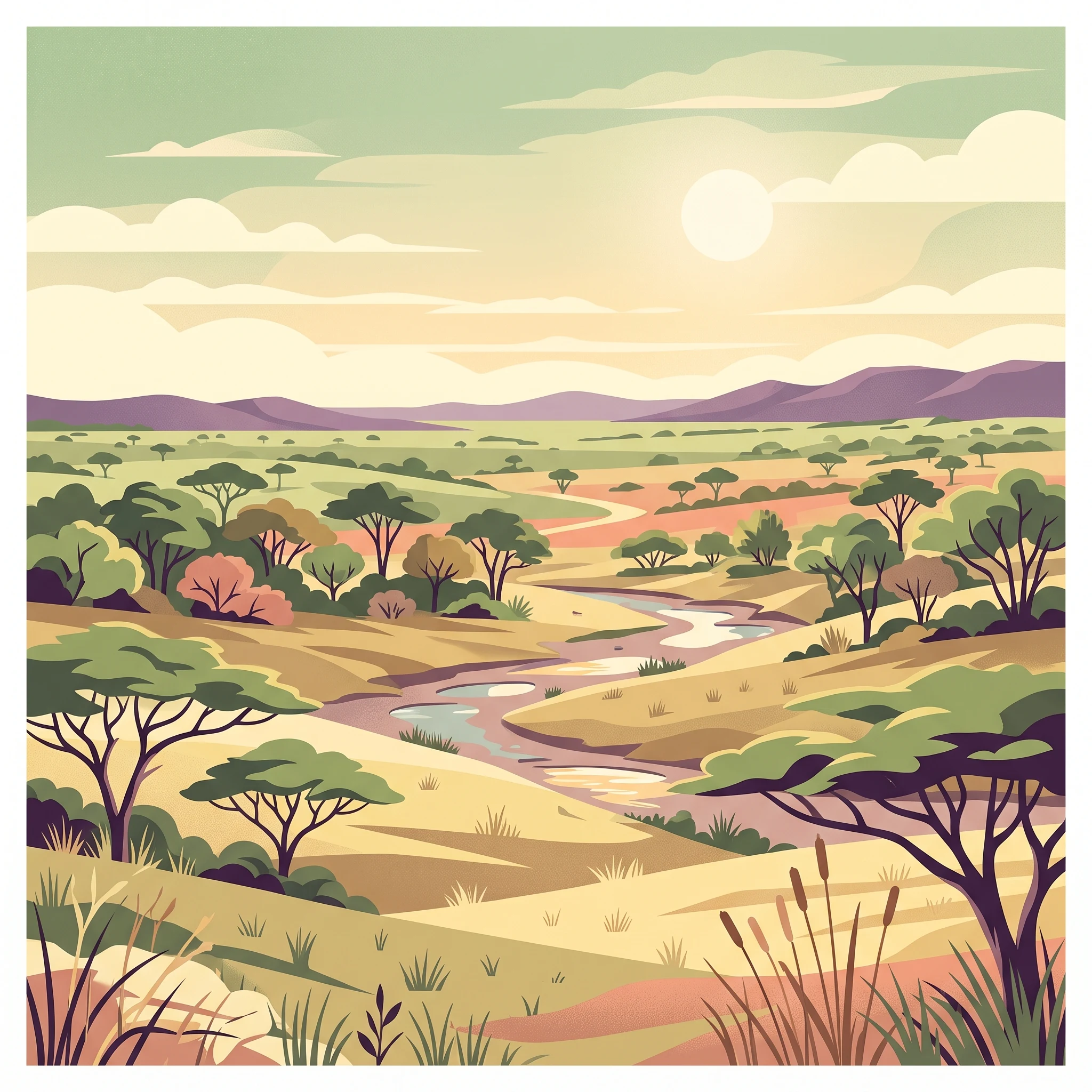
Kruger National Park occupies a diverse terrain of savanna, woodland, and riverine ecosystems across the South African Lowveld. The park stretches approximately 360 kilometres north to south and averages 65 kilometres in width, covering portions of Limpopo and Mpumalanga provinces. The eastern boundary follows the Lebombo Mountains, a low range of hills separating the park from Mozambique, while the western boundary runs roughly parallel to this range about 65 kilometres inland. The landscape varies in altitude from around 200 metres in the eastern portions near the Lebombo foothills to 840 metres in the southwestern area near Berg-en-Dal. Several major rivers traverse the park from west to east, including the Sabie, Olifants, Letaba, and Luvuvhu, while the Crocodile River forms the southern boundary and the Limpopo River marks the northern edge. The park's geology is dominated by a variety of substrates including granite in the southwest, basalt in the southeast, and various sedimentary formations in other areas. These different geological substrates, combined with a rainfall gradient ranging from about 400 to 750 millimetres annually, give rise to distinct vegetation communities across the park's extent.
Kruger National Park ecosystems, habitats, and plant life
The vegetation of Kruger National Park is organised into several distinct veld types that correspond broadly to the park's four quadrants and reflect the combined influence of rainfall patterns and underlying geology. The northeastern portion of the park is dominated by shrub mopane veld, where the mopane tree forms extensive almost pure stands across the flat terrain. In the western half north of the Olifants River, red bush-willow and mopane veld features both Combretum apiculatum and Colophospermum mopane as the predominant species. The central-western area south of the Olifants River supports thorn trees and red bush-willow veld, with various Acacia species dominant along watercourses and marula trees scattered throughout. The eastern half south of the Olifants River contains the knob-thorn and marula veld, which provides the most important grazing land in the park, supporting red grass and buffalo grass among the trees. Several smaller areas carry distinctive vegetation communities, including the relatively high-rainfall Pretoriuskop sourveld and Malelane mountain bushveld in the south, and the sandveld communities in the northeast near Punda Maria. The riparian areas along rivers support distinctive thicket and forest habitats that harbour specialised species. The climate is classified as hot semi-arid, with a summer rainy season from September to May and dry winters, though the park's north-south extent means temperatures and rainfall vary significantly between different regions.
Kruger National Park wildlife and species highlights
Kruger National Park supports an extraordinary concentration of wildlife, with 147 species of large mammals recorded, the highest diversity of any African protected area. All members of the Big Five are present in substantial populations: African bush elephants number approximately 13,750 individuals, lions comprise an estimated 1,620 to 1,720 animals, African leopards total around 1,000 individuals, and both white and black rhinoceros are found throughout the park. The park also maintains significant populations of African buffalo, estimated at over 37,000 individuals, as well as giraffes, zebras, wildebeest, and numerous antelope species including impala, kudu, eland, and waterbuck. Kruger is particularly important for the endangered African wild dog, with approximately 120 individuals forming packs throughout the park, representing a significant portion of South Africa's total population of roughly 400 individuals. The birdlife is equally impressive, with species richness varying across the park's different habitats. The southern Lowveld avifauna has tropical affinities, featuring species such as the African openbill, hooded vulture, Dickinson's kestrel, and various hornbills. Rivers and associated wetlands support waterbirds including the African finfoot and saddle-billed stork, while the park's larger birds of prey include the martial eagle, lappet-faced vulture, and the secretive Pel's fishing owl. Reptile diversity includes 114 species, with black mambas, African rock pythons, and approximately 4,420 Nile crocodiles present. The park also supports 34 amphibian species, 49 fish species, and a remarkable diversity of invertebrates including 219 butterfly species and numerous termite species.
Kruger National Park conservation status and protection priorities
Kruger National Park plays a pivotal role in regional and continental conservation, protecting substantial populations of keystone species and functioning as an anchor for broader ecosystem management across the Greater Kruger landscape. The park is part of the Kruger to Canyons Biosphere Reserve, recognised by UNESCO for its importance in maintaining ecological processes and sustainable development. The establishment of the Great Limpopo Transfrontier Park in 2002 created one of Africa's largest transboundary protected areas, linking Kruger with Gonarezhou National Park in Zimbabwe and Limpopo National Park in Mozambique to facilitate migration and ecological processes that transcend national boundaries. However, the park faces significant conservation challenges, most notably intensive poaching that has decimated rhinoceros populations and increasingly targeted elephants for their ivory. Rhino poaching escalated dramatically in the twenty-first century, with over 520 animals killed in 2013 alone, and Kruger holds approximately 12,000 of South Africa's 22,000 rhinos, representing 93 percent of global populations. The park's anti-poaching operations involve 650 game rangers supported by police and military forces, aerial surveillance, drone technology, and specialist dog units. Conservation efforts also address broader threats including climate change, drought, and development pressure at park boundaries, with initiatives such as the Mega Living Landscapes programme working to establish durable financing for landscape-level conservation.
Kruger National Park cultural meaning and human context
The lands now comprising Kruger National Park have a complex human history that intersects with the park's conservation narrative. Before and during the establishment of the Sabi Game Reserve, various indigenous communities inhabited the region, including the Makuleke people who occupied the fertile Pafuri triangle in the northernmost portion of the park. Throughout the early to mid-twentieth century, these communities were progressively removed from the reserve, with the Makuleke forcibly relocated in 1969 to make way for the park's expansion. In 1996, the Makuleke tribe successfully submitted a land claim for the Pafuri region, and after regaining ownership of approximately 198 square kilometres, they chose not to resettle but instead to partner with private tourism operators to develop luxury lodges from which they receive royalty income. This model represents a significant precedent for community-based conservation and benefit-sharing in South African protected areas. The park's name honours President Paul Kruger, who championed early conservation efforts and visited pioneering game ranches in the late nineteenth century. In 2025, proposals emerged to rename the park Skukuza National Park, reflecting both the legacy concerns associated with Paul Kruger and the historical preference of local communities for the name that had been used before national park establishment.
Top sights and standout views in Kruger National Park
Kruger National Park offers exceptional wildlife viewing across its vast savanna landscapes, with self-drive safaris along its network of well-maintained roads providing access to the Big Five and numerous other species. The park contains diverse habitats from riverine forests along the Sabie and Olifants rivers to open grasslands and dense mopane woodlands, each supporting distinct communities of wildlife. Visitors can explore numerous rest camps including Skukuza, Satara, and Olifants, each offering different access to the park's varied ecosystems. The northern Pafuri region near the Makuleke concession features spectacular river confluences and productive wildlife viewing, while the southern sections around Skukuza provide accessible Big Five encounters. The park's position as part of the Great Limpopo Transfrontier Park enables cross-border safari experiences extending into Zimbabwe and Mozambique. Kruger's well-developed tourism infrastructure, including the famous sunset drives and bush walks, accommodates visitors seeking both independent exploration and guided wildlife experiences.
Best time to visit Kruger National Park
The optimal time to visit Kruger National Park depends on what visitors hope to experience, with each season offering distinct advantages. The dry winter months from May to September concentrate wildlife around remaining water sources, making animals easier to spot as vegetation thins and animals congregate at rivers and watering holes. This period also offers cooler daytime temperatures and reduced malaria risk. The hot summer months from October to April coincide with the rainy season, when the park transforms with fresh green vegetation and abundant birdlife, though wildlife becomes more dispersed and harder to locate. The shoulder seasons of April and October offer a balance, with some late or early rains producing attractive scenery while retaining reasonable wildlife visibility. September and October are typically the driest months, culminating in the onset of the rainy season late in October. The park spans 360 kilometres north to south, creating significant climate variation, with the southern area around Skukuza approximately two to three degrees cooler throughout the year and receiving more rainfall than the northern Pafuri region. Visitors should note that while the park is accessible year-round, some roads may become difficult during the peak summer rains, and extreme heat during October and November can be challenging.