Mori Atlas logo
National parkMorne Trois Pitons National Park

Discover the mapped boundaries and unique terrain of this Caribbean national park.

Morne Trois Pitons National Park: Dominica's Volcanic Protected Landscape

Morne Trois Pitons National Park stands as Dominica's foremost protected landscape, a testament to its intense geothermal activity and vibrant volcanic geology. Covering a significant portion of the island's interior, this national park offers an unparalleled atlas-style exploration of dramatic mountain terrain, steaming fumaroles, and lush rainforest ecosystems. Users can delve into the park's precise geographic contours, understand its role as a vital protected area, and visualize its unique natural features within the context of Dominica's captivating geography.

Volcanic LandscapeTropical RainforestWorld Heritage SiteGeothermal FeaturesEndemic SpeciesCaribbean Protected Area

Morne Trois Pitons National Park

National park

Park overview

Structured park overview, official facts, and landscape profile for Morne Trois Pitons National Park

Morne Trois Pitons National Park park facts, protected area profile, and essential visitor context
Review the core facts for Morne Trois Pitons National Park, including designation, size, terrain, visitor scale, habitats, and operating context in one park-focused overview.

About Morne Trois Pitons National Park

Morne Trois Pitons National Park represents the volcanic heart of Dominica, an island nation in the Lesser Antilles archipelago known for its mountainous terrain and geothermal activity. The park was established in 1975 as the inaugural protected area in Dominica's national park system and remains the country's most significant conservation landscape. Its designation as a UNESCO World Heritage Site in 1997 acknowledged both its exceptional natural beauty and its scientific importance as an active volcanic environment. The park encompasses the drainage basins of most major rivers in the southern half of the island, with water flowing from the central highlands through steep canyons to create numerous waterfalls, pools, and streams. The terrain remains largely undeveloped due to its rugged character, with no human settlements within the park boundaries. Management responsibility falls to the Division of Forestry, Wildlife and National Parks within the Ministry of Agriculture and Fisheries, balancing conservation objectives with sustainable use of the island's natural resources. The park's elevation gradient from lowland rainforest to cloud forest and elfin woodland creates diverse ecological zones that support both common Caribbean species and those found nowhere else on Earth.

Quick facts and research context for Morne Trois Pitons National Park

Morne Trois Pitons National Park occupies the central volcanic highlands of Dominica, spanning roughly 7,000 hectares of mountainous terrain. Established in 1975, it was the first national park legally protected in Dominica and became a World Heritage Site in 1997. The park's defining landmark is Morne Trois Pitons, a three-peaked mountain rising to 1,342 meters. The area features continuous volcanic activity demonstrated by the famous Boiling Lake, a geothermal hot spring reaching temperatures of 82 to 92 degrees Celsius, along with geysers, mud pools, and sulfur vents in the Valley of Desolation. The park contains multiple vegetation zones from tropical rainforest to montane forest and dwarf forest at highest elevations, supporting significant biodiversity including endemic bird species such as the imperial amazon and red-necked amazon.

Park context

Deeper park guide and search-rich context for Morne Trois Pitons National Park

Morne Trois Pitons National Park history, landscape, wildlife, and travel context
Explore Morne Trois Pitons National Park through its history, landscape character, ecosystems, wildlife, conservation priorities, cultural context, and seasonal travel timing in a structured park guide built for atlas discovery and search intent.

Why Morne Trois Pitons National Park stands out

Morne Trois Pitons National Park is best known for its dramatic volcanic landscapes and geothermal features. The Boiling Lake, one of the world's largest hot springs, sits within a fumarole and reaches near-boiling temperatures, creating an iconic geothermal wonder. The Valley of Desolation presents an otherworldly terrain of steaming vents, bubbling mud ponds, and sulfur deposits. The park also protects Emerald Pool, a cascading waterfall set within rainforest, and Middleham Falls, one of the tallest waterfalls in Dominica. Beyond its geothermal attractions, the park harbors important populations of endemic Caribbean wildlife, particularly the endangered imperial amazon and red-necked amazon parrots that nest within its forest canopy. The combination of accessible volcanic phenomena, endemic biodiversity, and well-preserved tropical rainforest makes this park a flagship conservation area for the Lesser Antilles.

Morne Trois Pitons National Park history and protected-area timeline

Morne Trois Pitons National Park was formally established in July 1975, becoming the first national park to be legally protected in Dominica. This designation came during a period when the newly independent island nation was developing its environmental conservation framework to preserve remaining natural landscapes. The park was nominated for UNESCO World Heritage status and received inscription in 1997 during the 21st session of the World Heritage Committee, becoming one of the first Caribbean natural sites to achieve this international recognition. The park has faced significant natural challenges from hurricanes, with Hurricane David in 1979 and Hurricane Allen in 1980 causing substantial damage to forest cover and infrastructure. These cyclonic events highlighted the vulnerability of Caribbean ecosystems and reinforced the importance of protected areas in maintaining ecological resilience. Ongoing volcanic activity continues to shape the landscape, with the Boiling Lake and Valley of Desolation areas demonstrating the dynamic geological processes that created the island. Management efforts have focused on preserving biodiversity while allowing sustainable use of park resources, including limited areas designated for hydropower and geothermal energy exploration.

Morne Trois Pitons National Park landscape and geographic character

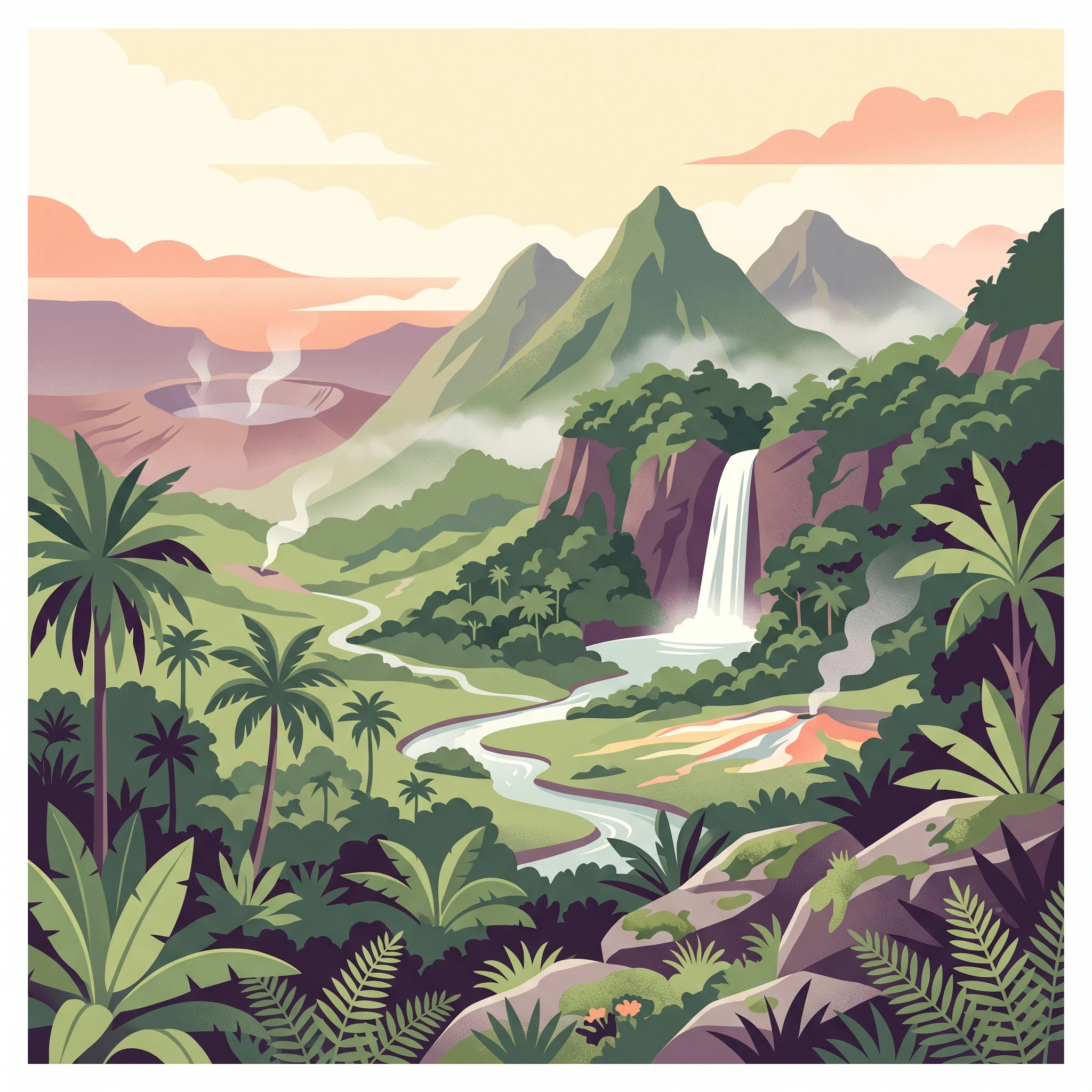
The landscape of Morne Trois Pitons National Park is defined by volcanic geology and the dramatic terrain created by ancient and ongoing volcanic activity. The park occupies a mountainous interior where steep-sided volcanic cones rise above deep, narrow canyons carved by streams descending from the central highlands. Three principal geological formations characterize the area: volcanic cones forming the prominent peaks, glacis slopes creating gradual transitions between elevations, and soufrières displaying sulfur deposits and geothermal activity. The most visually striking feature is the Valley of Desolation, where acidic thermal waters have created a barren landscape of boiling mud ponds, hissing steam vents, and bright yellow sulfur deposits contrasting sharply with the surrounding green vegetation. The Boiling Lake occupies a collapsed volcanic crater filled with superheated water, its surface perpetually agitated by upwelling from geothermal sources below. Throughout the park, water cascades over rock faces to form waterfalls, collects in natural pools, and flows through rivers lined with lush vegetation. The highest peaks support dwarf forest where wind-shaped trees grow among moss-covered rocks, creating an almost alpine character unusual in the Caribbean.

Morne Trois Pitons National Park ecosystems, habitats, and plant life

The ecological diversity of Morne Trois Pitons National Park reflects its elevation range and variety of microhabitats created by volcanic terrain. The park contains five distinct vegetation zones: tropical rainforest in the lower elevations, secondary forest in areas recovering from disturbance, deciduous forest on certain slopes, montane rainforest in the cloud zone, and dwarf forest near the summits. The tropical rainforest features towering trees reaching 30 to 40 meters with expansive buttress roots, forming a dense canopy that shelter epiphytic orchids, bromeliads, and tree ferns. The dominant tree species Amanoa caribaea forms extensive forests, while Symphonia globulifera and Cecropia peltata contribute distinctive structural elements with their prominent prop roots. As elevation increases, vegetation transitions through zones of decreasing tree height and increasing prevalence of ferns, mosses, and epiphytic plants that thrive in the persistent moisture of the cloud forest. The Valley of Desolation represents an extreme environment where volcanic gases limit plant growth to heat-tolerant species including Clusia and specialized bromeliads capable of surviving in acidic, geothermally active soils.

Morne Trois Pitons National Park wildlife and species highlights

The wildlife community of Morne Trois Pitons National Park includes both common Caribbean species and several endemics found only in Dominica. Mammalian fauna includes agoutis, wild pigs, common opossums, various small rodents, and several bat species, though larger mammals are absent from the island. The park's avifauna is particularly significant, with the forest supporting abundant birdlife often more easily heard than seen in the dense canopy. Four hummingbird species occur in the park, along with the rufous-throated solitaire and two endemic parrots of particular conservation importance: the imperial amazon and the red-necked amazon. BirdLife International has designated the park an Important Bird Area because it supports breeding populations of restricted-range species. Reptiles include the endemic Dominican anole, a species of Anolis found throughout the island's forests. Amphibians are represented by numerous tree frog species, many of which breed in the streams and pools scattered throughout the park. Feral invasive species including cats, pigs, and rats pose ongoing threats to native wildlife through predation and competition.

Morne Trois Pitons National Park conservation status and protection priorities

Morne Trois Pitons National Park serves as the cornerstone of Dominica's protected area system and represents one of the most significant conservation landscapes in the Eastern Caribbean. Its UNESCO World Heritage designation reflects the international recognition of its outstanding natural value, particularly as an example of active volcanic landscapes with ongoing geological processes. The park protects critical watersheds that supply water to the southern half of the island, making it essential for downstream water resources. Conservation challenges include pressure from invasive species such as feral cats, pigs, and rats that threaten native wildlife populations, as well as the inherent vulnerability of Caribbean ecosystems to hurricane damage. The steep and rugged terrain has naturally limited human development within the park, and management policies aim to maintain this relatively pristine condition while allowing sustainable use of certain resources. The presence of endemic species including two endangered amazon parrots elevates the park's conservation significance beyond local boundaries to regional and global importance.

Morne Trois Pitons National Park cultural meaning and human context

Morne Trois Pitons holds cultural significance in Dominican history and identity, with the mountain's three peaks features in local naming and folklore. The park lies in the interior highlands traditionally considered the spiritual heart of the island, though the steep terrain discouraged permanent settlement. The area has been used historically for limited agriculture and more recently for hydropower generation, reflecting the ongoing relationship between local communities and the island's natural resources. The park's establishment in 1975 represented a milestone in Dominica's post-independence development of national identity, asserting the value of natural heritage alongside cultural traditions. Indigenous Carib peoples likely utilized resources from the island's interior before European colonization, though archaeological evidence specific to the park area remains limited. The park's continued management by the Division of Forestry reflects government commitment to balancing conservation with sustainable development aspirations for the island.

Top sights and standout views in Morne Trois Pitons National Park

Morne Trois Pitons National Park offers visitors accessible encounters with volcanic power, rainforest splendor, and endemic Caribbean wildlife. The hike to Boiling Lake leads through changing forest zones to one of the world's most impressive geothermal features, a constantly churning hot spring set in volcanic rock. The Valley of Desolation provides an accessible introduction to geothermal activity with its mud pots, steam vents, and vivid mineral deposits. Emerald Pool delivers a classic rainforest waterfall experience where water cascades into a clear pool surrounded by verdant vegetation. The park's trail network traverses multiple vegetation zones, offering opportunities to observe endemic birds including the Sisserou imperial amazon and Red-necked amazon that represent national symbols of Dominica. The network of waterfalls including Middleham Falls showcases the hydrological wealth of the island's central mountains. The experience of walking through cloud forest with epiphytic orchids overhead and the sound of streams rushing through canyons captures the essence of Caribbean wilderness at its most pristine.

Best time to visit Morne Trois Pitons National Park

The optimal time to explore Morne Trois Pitons National Park corresponds to Dominica's dry season from approximately October to April, when rainfall is reduced and trails are more easily navigable. The park's tropical rainforest environment experiences rainfall throughout the year, but the drier months typically offer better conditions for hiking to remote features like Boiling Lake. The temperature remains warm at lower elevations but cools noticeably at higher elevations where cloud forest conditions create persistent mist and moisture. Hurricane season from June to November brings the risk of tropical storms that can temporarily close trails and damage infrastructure. The period immediately following rains can enhance waterfall flow, making the landscape particularly verdant, though some trails may become more challenging. Visitors interested in wildlife viewing should consider early morning hours when bird activity peaks, though the endemic parrots remain challenging to observe due to their canopy-dwelling habits and wariness.
Park location guide

Geography guide, regional context, and park location map for Morne Trois Pitons National Park

Morne Trois Pitons National Park park geography, regions, and map view in Dominica
Understand where Morne Trois Pitons National Park sits in Dominica through a broader geographic reading of the surrounding landscape, nearby location context, and its mapped position within the national park landscape.

How Morne Trois Pitons National Park fits into Dominica

Dominica is an island nation in the Caribbean Sea, part of the Lesser Antilles. It achieved independence from Britain in 1978 and is renowned for its mountainous rainforests, geothermal-volcanic activity, and the Boiling Lake hot spring. The capital is Roseau.

Wider geography shaping Morne Trois Pitons National Park in Dominica

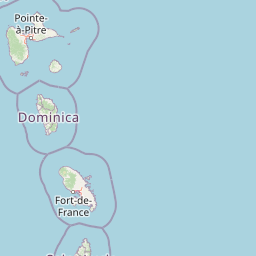
Dominica is situated in the Caribbean Sea, part of the Windward Islands in the Lesser Antilles archipelago. The island lies between Guadeloupe to the northwest and Martinique to the southeast. It has mountainous terrain with the highest point being Morne Diablotins at 1,448 meters.

Map view of Morne Trois Pitons National Park

Use this park location map to pinpoint Morne Trois Pitons National Park in Dominica, understand its exact geographic position, and read its mapped placement within the surrounding landscape more clearly.

Pigeon | © OpenStreetMap contributors
Park atlas

Map surrounding protected landscapes, comparing volcanic terrain and diverse tropical rainforests.

Nearby National Parks and Protected Areas to Explore Beyond Morne Trois Pitons National Park
Browse other national parks and protected areas near Morne Trois Pitons National Park, discovering similar volcanic landscapes, geothermal activity, or adjacent tropical rainforests. Compare these conservation areas to trace regional protected-area patterns and understand the spread of unique Caribbean ecosystems across mapped geography.
National parkGuadeloupe

Guadeloupe National Park: Volcanic Rainforest and Protected Landscape Identity

Explore mapped boundaries and regional geography.

Guadeloupe National Park stands as a significant protected landscape, primarily defined by the dramatic volcanic terrain of Basse-Terre. This atlas entry focuses on the park's vital role in preserving one of the Caribbean's most extensive tropical rainforest ecosystems, centered around the active La Soufrière volcano. Understand its mapped boundaries, unique geographic setting within the Lesser Antilles, and its importance as a national park and UNESCO biosphere reserve.

Area
173 km²
Established
1989
IUCN
II
Relief
Mountain
National parkSaint John

Virgin Islands National Park: National Park Atlas and Mapped Landscape

Discover its protected boundaries and regional geographic context.

Virgin Islands National Park represents a significant protected landscape within the geography of Saint John. This detailed entry provides insights into its mapped boundaries and contribution to the region's natural terrain. Users can explore the park's national park designation and its place within a broader atlas of protected areas, offering a foundation for understanding its landscape identity.

Area
59.64 km²
Established
1956
IUCN
V
National parkVenezuela

El Ávila National Park: Venezuela's Premier Coastal Mountain National Park Exploration

Discover diverse terrain, mapped boundaries, and unique geographic context.

El Ávila National Park offers an exceptional gateway into Venezuela's mountainous protected landscapes. This national park features a dramatic rise from the Caribbean coast into varied terrain, including unique cloud forest and alpine zones. Its mapped geography showcases steep slopes, deep ravines, and remarkable elevation changes, providing a significant atlas-style study of coastal mountain environments. Exploring El Ávila National Park reveals a vital natural barrier and a rich ecosystem supporting diverse flora and fauna, making it a key destination for understanding regional protected areas.

Area
819 km²
Established
1958
IUCN
II
National parkVenezuela

Henri Pittier National Park: Venezuela's Oldest National Park, Coastal Range Geography

Explore protected landscapes, cloud forests, and birdwatching geography.

Henri Pittier National Park is Venezuela's foundational protected area, established in 1937 and spanning over 107,800 hectares within the Venezuelan Coastal Range. This national park is renowned for its exceptional biodiversity, particularly its over 500 bird species and its distinctive cloud forest ecosystems, which include the iconic Gyranthera caribensis tree. The park's geography extends from rugged mountain terrain to coastal bays and beaches, with the Paso de Portachuelo serving as a significant migratory bird corridor. Its mapped boundaries enclose a rich mosaic of natural landscapes vital for understanding regional conservation and protected area geography in northern South America.

Area
1,078 km²
Established
1937
IUCN
II
Relief
Mountain
National parkDominican Republic

Cueva de las Maravillas National Park: Dominican Republic National Park Protected Landscape and Geography

Explore the mapped features and natural terrain of this Dominican national park.

Cueva de las Maravillas National Park is a key protected entity within the Dominican Republic, offering rich geographic context for atlas exploration. This entry focuses on the park's identity as a national park, detailing its mapped boundaries and natural landscape features. Understand its specific role within the Dominican Republic's broader geography and its significance as a conservation area, providing essential context for landscape discovery.

Area
4.5 km²
Established
1997
IUCN
II
National parkVenezuela

Morrocoy National Park: Venezuela's Coastal National Park with Distinct Protected Geography

Explore the mapped protected landscape and regional context.

Morrocoy National Park stands as a key protected area within Venezuela, offering a distinct focus for geographic exploration. As a national park, its mapped boundaries delineate a significant natural landscape critical for understanding regional conservation and the country's broader atlas of protected lands. Discover the unique geographic characteristics and the atlas-driven context of this important Venezuelan protected area.

Area
320.9 km²
Established
1974
IUCN
II
National parkCuracao

Christoffelpark National Park: Curacao's Volcanic Terrain and Protected Landscape Atlas

Explore mapped boundaries and unique dry forest ecosystems.

Christoffelpark represents Curacao's most vital protected natural area, offering a deep dive into its unique geography and landscape. This national park preserves the island's highest peak, Christoffelberg, alongside distinctive dry forest ecosystems, endemic species, and the remnants of colonial plantations. Explore the mapped terrain, understand the regional context, and appreciate the rich natural and cultural heritage that defines this important protected landscape on Curacao.

Area
10.4 km²
Established
1978
IUCN
II
Relief
Mixed relief
National parkCarabobo

San Esteban National Park: Discover Carabobo's Protected Caribbean Forest Landscape

Mapped protected area and natural terrain in Venezuela.

San Esteban National Park represents a significant protected area within Venezuela's Carabobo region, offering a unique exploration of Caribbean forest ecosystems and historical cultural sites. Covering approximately 445 square kilometers, the park's terrain spans coastal areas to mountainous interiors, presenting a diverse natural landscape shaped by its position in the coastal mountain ranges. This national park is notable for its archaeological petroglyphs, colonial roads, and fortifications, providing a rich cultural heritage context alongside its natural ecosystems. Its status as a protected national park makes it a key destination for understanding the intersection of natural conservation and historical geography in Venezuela.

Area
445 km²
Established
1987
IUCN
II

Common questions about visiting, size, designation, and location context for Morne Trois Pitons National Park

Morne Trois Pitons National Park FAQs for park facts, access, geography, and protected area context
Find quick answers about Morne Trois Pitons National Park, including protected-area facts, park geography, trail and visitor context, and how the park fits into its surrounding country and regional landscape.
MoriAtlas Explorer

Continue Your Protected Areas Search Across the Global Atlas

Deepen your exploration by continuing the structured search for national parks and protected areas worldwide. Utilize the comprehensive filtering capabilities to compare different conservation landscapes and refine your understanding of global park geography. Discover more about the distribution and characteristics of protected natural areas.

Global natural geography