Mori Atlas logo
National parkTorotoro National Park

Discover the paleontological wonders and dramatic canyon systems of this protected Andean landscape.

Torotoro National Park: Cretaceous Dinosaur Footprints and Andean Karst Geography

(Parque Nacional Torotoro)

Torotoro National Park, situated in Bolivia's Potosí Department, preserves a remarkable semi-arid mountain landscape shaped by deep canyons and karst topography. This national park is internationally recognized for its exceptional record of Cretaceous dinosaur footprints, offering a unique window into prehistoric life etched into its striking geological formations and canyon walls.

National ParksBoliviaDinosaur FossilsCretaceous PeriodKarst LandscapeAndean Mountains

Torotoro National Park

National park

Park overview

Structured park overview, official facts, and landscape profile for Torotoro National Park

Torotoro National Park park facts, protected area profile, and essential visitor context
Review the core facts for Torotoro National Park, including designation, size, terrain, visitor scale, habitats, and operating context in one park-focused overview.

About Torotoro National Park

Torotoro National Park occupies a unique position in Bolivia's protected area system as a site where remarkable paleontological discoveries continue to emerge from its canyon walls and geological formations. The park is situated in the northern Potosí Department, within the eastern mountain ranges of the Andes, approximately 140 kilometers south of Cochabamba. Established in 1989, the park encompasses 165 square kilometers of semi-arid terrain characterized by altitudes between 2000 and 3500 meters above sea level. The landscape is dominated by deep canyons, some reaching 300 meters in depth, which have been carved by water and wind erosion over geological time. These canyons expose layers of Paleozoic and Cretaceous calcitic deposits, providing scientists with windows into ancient marine and terrestrial environments. The karst topography throughout the park includes numerous caves and dolines, adding to the geological complexity and visual drama of the region. Beyond its scientific value, the park provides habitat for representative Andean ecosystems and serves as an important conservation area for the semi-arid mountain environments of southern Bolivia. The town of Torotoro, located within the park boundaries, was founded approximately 250 years ago by communities of Quechua descent and Spanish settlers, creating a human dimension to this landscape of deep geological and paleontological significance.

Quick facts and research context for Torotoro National Park

Torotoro National Park is located in the northern Potosí Department of Bolivia, approximately 140 kilometers south of Cochabamba. The protected area spans 165 square kilometers of semi-arid Andean terrain at altitudes ranging from 2000 to 3500 meters. The landscape features deep canyons reaching 300 meters, karst caves and dolines, and fossil-rich sedimentary deposits. The park contains over 3500 documented dinosaur footprints from the Cretaceous period, representing one of the most significant paleontological sites in Bolivia. The town of Torotoro serves as the park's gateway and was established around 250 years ago by Quechua and Spanish communities.

Park context

Deeper park guide and search-rich context for Torotoro National Park

Torotoro National Park history, landscape, wildlife, and travel context
Explore Torotoro National Park through its history, landscape character, ecosystems, wildlife, conservation priorities, cultural context, and seasonal travel timing in a structured park guide built for atlas discovery and search intent.

Why Torotoro National Park stands out

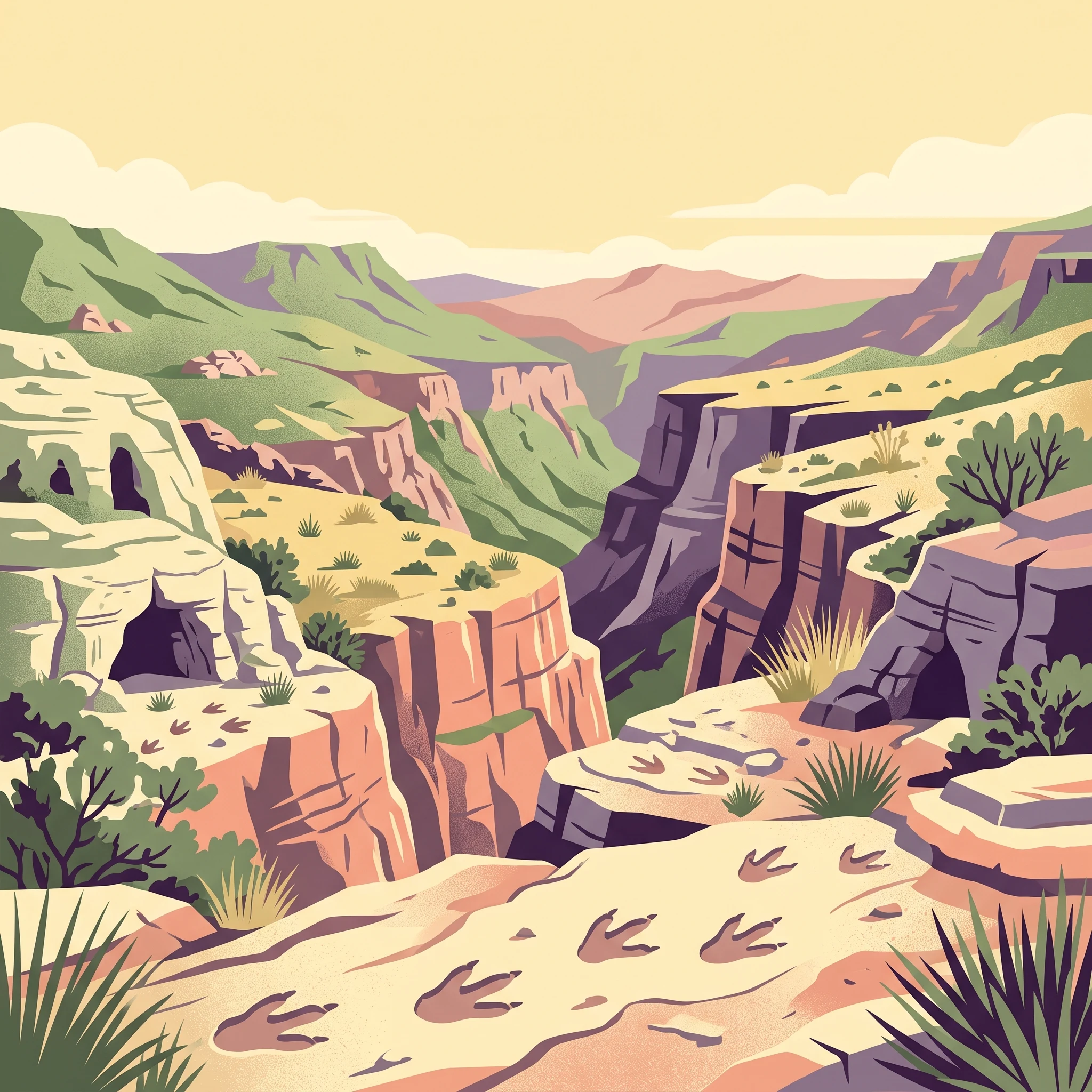
Torotoro National Park is best known for its exceptional dinosaur fossil record, including more than 3500 dinosaur footprints preserved in the park's canyon walls and rock formations. These footprints represent both bipedal and quadrupedal dinosaurs, including theropods and sauropods dating back approximately 120 million years to the Cretaceous period. The park's karst landscape, with its network of caves and sinkholes, provides another distinctive feature, while the dramatic canyon systems up to 300 meters deep create a striking visual landscape that contrasts with the semi-arid Andean terrain surrounding them.

Torotoro National Park history and protected-area timeline

Torotoro National Park was established in 1989 as part of Bolivia's expanding national park system designed to protect the country's most significant natural and cultural landscapes. The creation of the park recognized both the extraordinary paleontological resources of the region and the need to preserve the distinctive semi-arid Andean environment found in the Potosí Department. Prior to formal protection, the area had long been known to local communities for its dramatic landscapes and the curious fossil impressions preserved in the rock formations surrounding the town of Torotoro. The town itself has a history spanning approximately 250 years, founded during the colonial period by Quechua indigenous people and Spanish settlers who recognized the agricultural potential of the valley settings amid the harsher surrounding terrain. Archaeological investigation at the Llama Chaki site, located southeast of the town, has revealed remnants of Quechua cultural presence, indicating that the area has supported human communities for centuries beyond the colonial founding period. The formal designation as a national park provided institutional recognition of the area's international scientific significance, particularly for the dinosaur trackways that represent some of the most extensive and well-preserved Cretaceous dinosaur footprints in South America.

Torotoro National Park landscape and geographic character

The landscape of Torotoro National Park is defined by its position in the eastern cordilleras of the Andes, where semi-arid conditions create a distinctive environment quite different from the wetter highland regions to the north. The terrain is characterized by a series of deep canyons that have been carved through limestone and sedimentary rock, with some canyon walls reaching depths of 300 meters. These dramatic gorges expose cross-sections of geological history, revealing layers of Paleozoic and Cretaceous age that contain calcitic deposits and fossil material. The karst topography throughout the park includes numerous sinkholes and caves formed through the dissolution of limestone, adding to the geological complexity of the terrain. Between the canyon systems, the landscape consists of semi-arid mountain terrain with sparse vegetation adapted to the dry conditions and high altitude. Wind and water erosion have sculpted the rock formations into varied and often striking shapes, creating the rock formations that characterize many parts of the park. The overall impression is one of rugged, arid beauty where the exposed geological layers tell the story of ancient seas and the prehistoric creatures that once walked these landscapes.

Torotoro National Park ecosystems, habitats, and plant life

The natural environment of Torotoro National Park represents the semi-arid mountain ecosystems of the southern Bolivian Andes, adapted to the dry conditions and temperature extremes that occur at elevations between 2000 and 3500 meters. The vegetation throughout the park reflects the semi-arid climate, consisting primarily of drought-resistant grasses, shrubs, and thorny vegetation typical of Andean dry valleys. The park's ecological significance extends beyond the visible vegetation to include the hidden cave systems and karst formations that provide habitat for specialized organisms adapted to dark, humid underground environments. The geological formations, particularly the sedimentary layers exposed in canyon walls, preserve evidence of ancient marine environments from the Paleozoic era when much of this region was covered by seas, as well as the terrestrial environments of the Cretaceous period when dinosaurs walked the area. This combination of present-day semi-arid Andean ecosystems and the deep-time paleontological record makes the park important for understanding both contemporary biodiversity patterns and prehistoric life.

Torotoro National Park wildlife and species highlights

While the Wikipedia source emphasizes the paleontological rather than contemporary wildlife of Torotoro National Park, the semi-arid Andean environment supports characteristic fauna adapted to the dry, high-altitude conditions. The park provides habitat for representative species of the Potosí mountain regions, including various bird species adapted to the canyon and cliff environments. The cactus and shrub communities in the lower elevations support small mammals and reptile species typical of Andean dry habitats. The cave systems within the karst terrain may harbor specialized bat species and other organisms adapted to underground environments. However, the source material does not provide extensive detail on contemporary wildlife populations, so this section focuses on the general ecological context rather than specific species lists. The extraordinary dinosaur footprint record preserved in the park provides the most significant faunal connection, with footprints representing theropod and sauropod dinosaurs from the Cretaceous period offering insight into the ancient ecosystems that once thrived in this region.

Torotoro National Park conservation status and protection priorities

Torotoro National Park was established in 1989 with the dual purpose of protecting the region's exceptional paleontological resources and preserving the semi-arid Andean mountain environment found in the Potosí Department. The park's conservation significance derives primarily from the extraordinary dinosaur trackways preserved in its canyon walls and rock formations, representing one of the most extensive and accessible Cretaceous dinosaur fossil sites in South America. These footprints, numbering more than 3500 documented examples, provide invaluable scientific information about dinosaur behavior, diversity, and the ecosystems of the Cretaceous period in this region of ancient Gondwana. The karst landscape with its caves and dolines also represents a significant geological feature requiring protection, as these formations contain both paleontological material and represent important groundwater systems. The semi-arid mountain environment, while not as biodiverse as wetter Andean regions, contains specialized adapted species that benefit from protected area status. The establishment of the park provided a framework for managing these resources while allowing controlled scientific research and environmental education activities.

Torotoro National Park cultural meaning and human context

The human dimension of Torotoro National Park centers on the town of Torotoro, which was founded approximately 250 years ago during the Spanish colonial period by communities of Quechua indigenous descent and Spanish settlers. The founding of the town reflects the historical pattern of Spanish colonial expansion into Andean regions, establishing settlements in areas with agricultural potential even in challenging mountain environments. The Quechua presence in the region predates the colonial founding, as evidenced by the archaeological site of Llama Chaki, located southeast of the town, which contains remnants of Quechua cultural activity. This archaeological site demonstrates that the landscape around Torotoro has supported human communities for centuries, with the valley settings providing more favorable conditions for agriculture and settlement than the exposed surrounding terrain. The integration of the town within the national park boundaries creates a unique situation where contemporary human community and protected natural landscape coexist, requiring management approaches that balance conservation objectives with the needs of resident communities.

Top sights and standout views in Torotoro National Park

The most compelling highlight of Torotoro National Park is its extraordinary paleontological legacy, with over 3500 dinosaur footprints preserved in the park's canyon formations representing theropods and sauropods from the Cretaceous period. The dramatic canyon landscape, with walls plunging 300 meters deep, creates a visually striking environment unlike typical Andean protected areas. The karst terrain with its caves and sinkholes adds geological complexity and exploration opportunities. The cultural heritage of the Quechua-founded town provides human context to the natural landscape. The semi-arid mountain environment offers a different Andean experience from wetter highland parks, with distinctive vegetation adapted to dry conditions. The combination of deep geological time preserved in fossil footprints with the living cultural heritage of the Quechua-founded community creates a park of remarkable interdisciplinary significance.

Best time to visit Torotoro National Park

The best time to visit Torotoro National Park coincides with the drier winter months from May through September, when visitor access is easier and the semi-arid landscape is most stable. During these months, precipitation is minimal and trail conditions are generally favorable for exploring the canyon trails and geological sites. The dry season offers clearer skies and more comfortable temperatures for hiking, though evenings can be cold at the park's high elevations. The wet summer months from November through March bring increased precipitation that can affect trail accessibility, particularly in canyon areas where flash flooding may occur. However, the wet season also brings greener vegetation to the landscape, which some visitors find more visually appealing. Temperature extremes occur year-round due to the altitude, with warm days and cold nights requiring layered clothing regardless of when one visits.
Park location guide

Geography guide, regional context, and park location map for Torotoro National Park

Torotoro National Park park geography, regions, and map view in Bolivia
Understand where Torotoro National Park sits in Bolivia through a broader geographic reading of the surrounding landscape, nearby location context, and its mapped position within the national park landscape.

How Torotoro National Park fits into Bolivia

Bolivia, officially the Plurinational State of Bolivia, is a landlocked country in central South America. It features diverse geography including the Andean mountain range, Amazonian plains, Gran Chaco, and the Pantanal wetland. The country has a population of approximately 11.4 million and is administratively divided into nine departments, with La Paz as the seat of government and Sucre as the constitutional capital.

Wider geography shaping Torotoro National Park in Bolivia

Bolivia is located in central South America, bordered by Brazil to the north and east, Paraguay to the southeast, Argentina to the south, Chile to the southwest, and Peru to the west. The country is divided between a western Andean region and tropical lowlands to the east and north. It includes the Amazonian plain, Gran Chaco, temperate valleys, the high-altitude Altiplano plateau, and part of the Pantanal wetland along its eastern border.

Map view of Torotoro National Park

Use this park location map to pinpoint Torotoro National Park in Bolivia, understand its exact geographic position, and read its mapped placement within the surrounding landscape more clearly.

Pigeon | © OpenStreetMap contributors

Location context for Torotoro National Park

Potosí Department
Park atlas

Trace the broader geographic spread of conservation areas in Bolivia's Andean region, comparing diverse protected landscapes.

Discover Other Protected Areas and National Parks Near Torotoro National Park, Bolivia
After exploring the unique dinosaur fossils and karst canyons of Torotoro National Park, browse other national parks and protected areas across Bolivia's distinct Andean landscapes. Compare varied conservation efforts, regional terrain, and geographic features, tracing broader patterns of protected areas within the South American continent.
National parkChuquisaca Department

Iñao National Park and Integrated Management Natural Area: Bolivia National Park and Protected Landscape

Explore the Serranía del Iñao's geography and conservation role.

Iñao National Park and Integrated Management Natural Area is a protected territory located within Chuquisaca Department, Bolivia, centered on the prominent Serranía del Iñao mountain range. This page offers detailed geographic context and an atlas perspective on the park's landscape, its role as a national park, and its contribution to regional conservation efforts in the Andean foothills.

Area
2,630.9 km²
Established
2004
IUCN
II
National parkArica-Parinacota Region

Lauca National Park: Mapped Volcanic Terrain and High-Altitude Protected Landscapes

Explore the geography of this Arica-Parinacota Region national park.

Lauca National Park is a significant protected area in Chile's Arica-Parinacota Region, offering a unique glimpse into the dramatic geography of the high Andes. Its landscape is characterized by imposing volcanic formations, including Parinacota Volcano, and expansive altiplano terrain. This national park serves as a vital protected landscape, inviting detailed exploration of its mapped boundaries, diverse ecosystems, and remarkable natural features for those interested in geographic context and conservation.

Area
1,379 km²
Established
1970
IUCN
II
Protected areaGran Chaco Province

Aguaragüe National Park and Integrated Management Natural Area: Bolivia's Easternmost Sub-Andean Protected Landscape

Explore its mapped mountain geography and ecological diversity.

Aguaragüe National Park and Integrated Management Natural Area is a crucial protected area in Bolivia's Gran Chaco Province, defined by the Serranía del Aguaragüe mountain range. This landscape offers a unique opportunity to explore a geographic transition zone where Southern Andean Yungas montane forests converge with Dry Chaco ecosystems. The park's protected boundaries encompass a rugged mountain backbone rising from the lowlands, representing a vital segment of Bolivia's Sub-Andean geography and protected natural areas.

Area
1,083.07 km²
Established
2000
IUCN
II
National parkPeru

Bahuaja-Sonene National Park: A Major Amazon Frontier National Park in Peru's Geography

Explore its mapped protected landscape and diverse terrain.

Bahuaja-Sonene National Park is an extensive national park situated on the Amazon frontier in southern Peru, encompassing a crucial transition zone between lowland rainforest and higher-elevation forest ecosystems. Its diverse topography, from river valleys to mountainous slopes, creates varied natural landscapes. The park's protected boundaries are integral to the regional conservation strategy, offering a unique lens through which to study the mapped geography and ecological significance of this vast Amazonian protected area.

Area
10,914.2 km²
Established
1996
IUCN
II
National parkAntofagasta Region

Llullaillaco National Park: Mapped Volcanic Terrain and Protected Andean Landscape

Explore the high-altitude desert ecosystem and national park boundaries.

Llullaillaco National Park is a significant protected area in the Antofagasta Region, characterized by its striking volcanic landscape and high-altitude desert environment. The park's geography includes the towering Llullaillaco volcano, ancient ravines, and expansive semi-desert plains, forming a unique segment of the Central Andean dry puna ecoregion. Discover the mapped terrain and protected area context of this remarkable Chilean national park, offering insights into its arid-adapted biodiversity and geological significance.

Area
2,687 km²
IUCN
II
National parkSantiago del Estero Province

Copo National Park: A Vital Dry Chaco Protected Landscape in Argentina

Explore its mapped boundaries and endemic forest ecosystems.

Copo National Park represents a significant conservation effort within Santiago del Estero Province, protecting a representative segment of the Dry Chaco biome. This national park preserves the iconic quebracho scrubland, a habitat that has been drastically reduced province-wide, serving as a critical refuge for endangered species like the jaguar and maned wolf. The park's landscape features warm climate conditions and characteristic forest formations dominated by the Santiago red quebracho, offering a unique opportunity to study and appreciate a vital, yet vulnerable, regional ecosystem. Its protected status underscores its importance for understanding Argentine protected areas and landscape ecology.

Area
1,181.18 km²
Established
2000
IUCN
II
National parkTucumán Province

Aconquija National Park: Southern Andean Yungas Protected Landscape in Tucumán Province

Explore its montane forest and mapped geographic context.

Aconquija National Park is a significant federal protected area located in Tucumán Province, Argentina. This national park is dedicated to conserving the diverse Southern Andean Yungas montane forest ecosystem, characterized by a dramatic elevational gradient. Its landscapes transition from cloud forest to high alpine terrain, offering a unique opportunity to study and appreciate a well-preserved montane environment within a critical geographic region. Discover the mapped extent and ecological importance of this protected area.

Area
499.94 km²
Established
1995
IUCN
II
National parkFormosa Province

Río Pilcomayo National Park: Protected Humid Chaco Wetland Landscape & Geography

Explore mapped boundaries and unique floodplain terrain in Formosa Province.

Río Pilcomayo National Park represents a significant protected natural area within Argentina's Formosa Province, characterized by the unique ecosystems of the Humid Chaco. The park's landscape is defined by extensive floodplains, marshes, lakes, and forests, all influenced by the Pilcomayo River's dynamic hydrological cycle. As a Ramsar site, it safeguards crucial habitats, including those for the endangered jaguar, and showcases iconic Caranday palm savannas. This detailed atlas entry provides insights into its mapped geography and the vital protected landscape it preserves.

Area
518.89 km²
Established
1951
IUCN
II

Common questions about visiting, size, designation, and location context for Torotoro National Park

Torotoro National Park FAQs for park facts, access, geography, and protected area context
Find quick answers about Torotoro National Park, including protected-area facts, park geography, trail and visitor context, and how the park fits into its surrounding country and regional landscape.
MoriAtlas Explorer

Continue Your Protected Areas Search Across the Global Atlas

Deepen your exploration by continuing the structured search for national parks and protected areas worldwide. Utilize the comprehensive filtering capabilities to compare different conservation landscapes and refine your understanding of global park geography. Discover more about the distribution and characteristics of protected natural areas.

Global natural geography