
Mori Atlas logo
National parkLauca National Park

Discover mapped volcanic terrain, altiplano wetlands, and iconic peaks of this Chilean National Park.

Lauca National Park: A Dramatic Protected Landscape in Chile's Arica-Parinacota Region

Lauca National Park offers a profound geographic discovery experience within the Andean range of Chile's Arica-Parinacota Region. This national park, covering over 1,300 square kilometers, presents a breathtaking panorama of stark beauty, defined by towering volcanic peaks such as Parinacota Volcano and ancient, high-altitude plateaus. Explore the mapped boundaries and natural terrain that characterize this protected wilderness, renowned for its striking landscape and critical role in conservation.

volcanic landscapeshigh-altitude wetlandsbirdwatchingAndean ecosystemprotected areawildlife conservation

Lauca National Park

National park

Park overview

Structured park overview, official facts, and landscape profile for Lauca National Park

Lauca National Park park facts, protected area profile, and essential visitor context
Review the core facts for Lauca National Park, including designation, size, terrain, visitor scale, habitats, and operating context in one park-focused overview.

About Lauca National Park

Lauca National Park represents one of Chile's most significant protected wilderness areas, encompassing a remarkable slice of the Andean altiplano where extreme altitude and volcanic forces have shaped an extraordinary landscape. The park lies within the Central Andean dry puna ecoregion, a region characterized by sparse vegetation, vast plains, and some of the highest active volcanoes in the world. The landscape is dominated by the Payachata volcanic group, a cluster of dormant and active stratovolcanoes that includes Parinacota, Guallatiri, and Acotango, their snow-capped peaks providing a dramatic backdrop to the stark high-altitude terrain below. The heart of the park features a distinctive lacustrine system centered on Chungará Lake and Laguna de Cotacotani, bodies of water fed by glacial melt and volcanic springs that create vital wetland habitats in this otherwise arid environment. Within the park boundaries sits the small town of Parinacota, notable for its well-preserved colonial church that anchors the human history of this landscape. The international Chile Route 11 traverses the protected area, connecting the Pacific coast near Arica with the high-altitude border crossing at Tambo Quemado Pass, making Lauca one of the more accessible high-altitude parks in Chile's Far North.

Quick facts and research context for Lauca National Park

Lauca National Park is located in Chile's Arica-Parinacota Region, roughly 145 kilometers east of Arica and 12 kilometers west of the town of Putre. The protected area spans 1,379 square kilometers of high-altitude terrain in the Central Andean dry puna ecoregion. The park is centered on the Chungará and Cotacotani lake system at the foot of the Payachata volcanic group, which includes the iconic Parinacota and Sajama volcanoes. The area is managed by Chile's National Forest Corporation (CONAF). Key wildlife includes vicuñas, llamas, alpacas, guanacos, and cougars, while the park supports over 140 bird species including Andean condors and Chilean flamingos. Chile Route 11 passes through the park, providing access from Arica to the Tambo Quemado Pass on the Bolivian border.

Park context

Deeper park guide and search-rich context for Lauca National Park

Lauca National Park history, landscape, wildlife, and travel context
Explore Lauca National Park through its history, landscape character, ecosystems, wildlife, conservation priorities, cultural context, and seasonal travel timing in a structured park guide built for atlas discovery and search intent.

Why Lauca National Park stands out

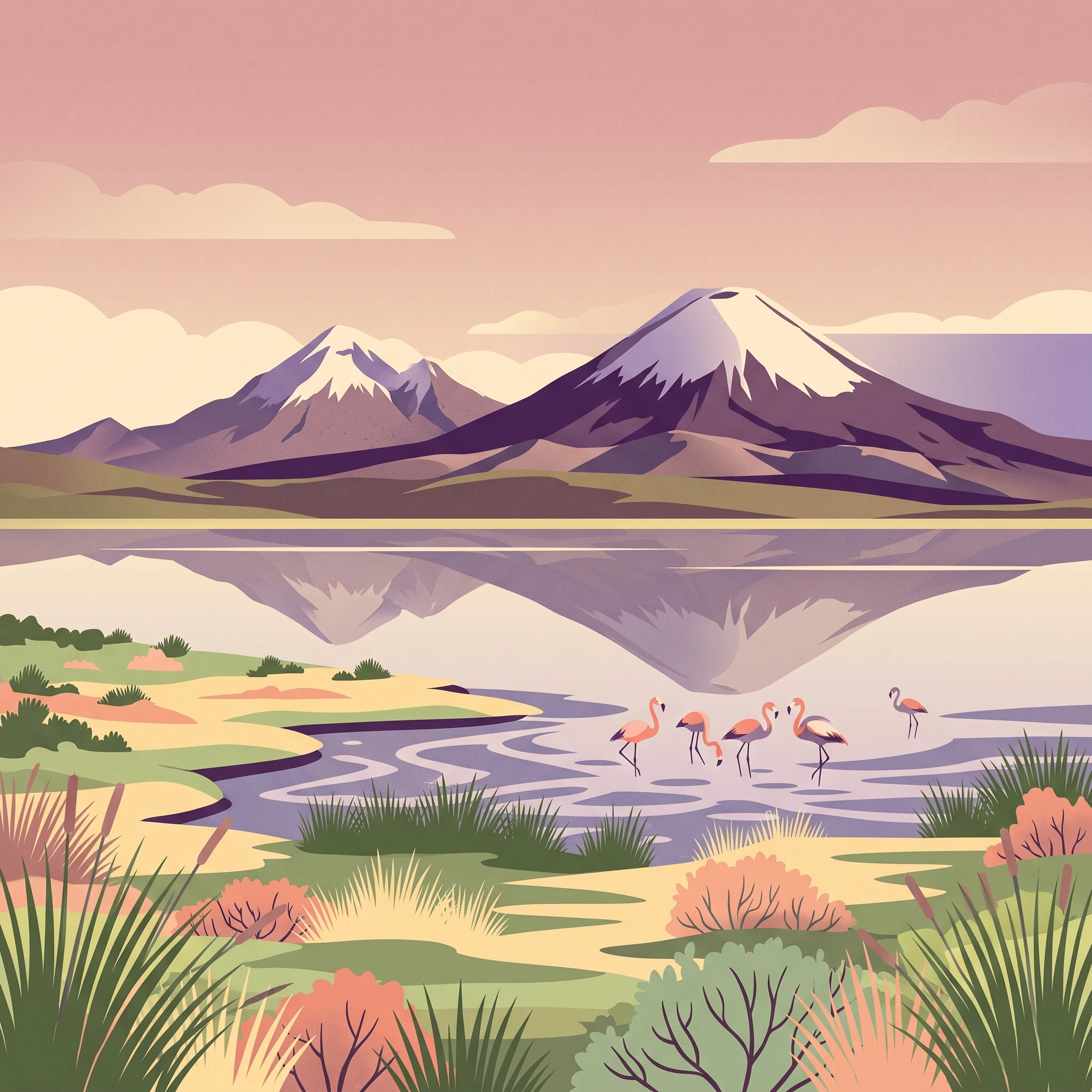
Lauca National Park is best known for its dramatic volcanic landscape featuring the perfectly conical Parinacota Volcano and the twin-peaked Sajama, both rising dramatically from the altiplano. The park's gem is Chungará Lake, a striking high-altitude lake set against this volcanic backdrop, together with the adjacent Laguna de Cotacotani. The area is also renowned for its exceptional birdwatching, with one of the highest concentrations of bird species in Chile's protected areas, including the distinctive puna ibis, Andean goose, giant coot, and Chilean flamingo. The protected population of vicuñas,恢复了 from near-extinction through conservation efforts, represents one of the park's most iconic wildlife spectacles.

Lauca National Park history and protected-area timeline

Lauca National Park was established in 1970 as part of Chile's expanding protected area network during a period when conservation awareness was growing across South America. The creation of the park came at a critical time for the region's wildlife, particularly the vicuña, which had been driven to near-extinction by poaching for its valuable wool. The establishment of protected status enabled recovery programs that have since brought vicuña populations back from the brink, transforming the park into a conservation success story. In subsequent decades, Lauca was integrated into the broader Lauca Biosphere Reserve, designated under UNESCO's Man and the Biosphere Programme, which connected the national park with Las Vicuñas National Reserve and Salar de Surire Natural Monument into a cohesive conservation landscape. The park's management under the National Forest Corporation (CONAF) has focused on balancing ecological protection with sustainable tourism, maintaining the delicate equilibrium between preserving this fragile Andean ecosystem and allowing controlled access for visitors seeking to experience its singular beauty.

Lauca National Park landscape and geographic character

The landscape of Lauca National Park is defined by the collision of volcanic forces and extreme altitude, creating one of the most visually striking environments in Chile's protected area system. The terrain rises from the flat altiplano plains at around 3,200 meters to the towering volcanic peaks that exceed 6,300 meters, with the perfect conical form of Parinacota Volcano serving as the park's most recognizable landmark. The Payachata volcanic group dominates the eastern horizon, while additional volcanoes including Guallatiri and Acotango add to the dramatic skyline. Between these volcanic masses lie the park's signature water bodies: Chungará Lake, a deep blue lake set in a dramatic volcanic crater-like basin, and the smaller Laguna de Cotacotani with its series of interconnected ponds. The surrounding terrain features extensive lava fields, volcanic calderas, and the occasional archaeological site, while the river systems of the Lauca and Lluta have their headwaters within or adjacent to the park boundaries. The interplay of deep blue lakes, snow-capped peaks, and the rusty reds and browns of volcanic rock creates a color palette that is uniquely Andean.

Lauca National Park ecosystems, habitats, and plant life

The ecological character of Lauca National Park is shaped by its position within the Central Andean dry puna, a harsh environment where extreme altitude, thin air, intense solar radiation, and limited precipitation combine to test the limits of life. Despite these challenging conditions, the park supports remarkable biodiversity, with over 400 species of vascular plants recorded within its boundaries. The vegetation is adapted to the puna environment, featuring distinctive plant communities including bofedales (high-altitude wetlands dominated by cushion plants), llaretales (stands of the iconic yareta, a slow-growing cushion plant that forms distinctive blue-green mounds), and the sparse coverage of Andean steppe grasses. The wetland areas around Chungará Lake and Cotacotani represent the most biologically productive zones, supporting dense stands of wetland vegetation that in turn sustain the park's rich animal communities. These habitats form a critical refuge in an otherwise arid landscape, illustrating how water availability drives ecological patterns across the altiplano.

Lauca National Park wildlife and species highlights

Lauca National Park supports a diverse mammalian fauna adapted to the demanding conditions of the high Andes. The most iconic resident is the vicuña, whose recovery from near-extinction represents one of Chile's conservation success stories; these elegant camelids now roam the park in healthy populations, their fine wool having long been prized. They share the landscape with their domestic relatives, llamas and alpacas, introduced by pre-Columbian cultures and still maintained by local communities. Guanacos, the wild ancestor of llamas, also persist in the park, while the smaller taruca (a type of deer) and the agile vizcacha (a rabbit-like rodent) represent additional mammalian diversity. The park's apex predator, the cougar, maintains a presence in the more remote areas. The birdlife is particularly remarkable, with over 140 species recorded, making Lauca one of the premier birdwatching destinations in Chile. The wetland areas support spectacular congregations of waterfowl including the puna ibis, Andean goose, giant coot, silvery grebe, crested duck, and puna teal, while the Chilean flamingo adds its distinctive pink coloration to the lake margins. The Andean condor, South America's most iconic raptor, soar on the thermals generated by the volcanic slopes.

Lauca National Park conservation status and protection priorities

Lauca National Park plays a crucial role in conserving one of the world's most distinctive high-altitude ecosystems within the Central Andean dry puna ecoregion. The park's significance is underscored by its inclusion in the Lauca Biosphere Reserve, a UNESCO-designated protected area network that connects multiple protected zones into a coherent conservation landscape spanning international boundaries. The recovery of vicuña populations within the park demonstrates the effectiveness of protected area status in enabling the recovery of endangered species, transforming what was once a population in decline into a thriving herd that contributes to both ecological balance and sustainable harvest programs. The wetland systems centered on Chungará Lake and Cotacotani represent critical habitats in an arid region, making their protection essential for maintaining biodiversity and supporting the birdlife for which the park is renowned. Management by Chile's National Forest Corporation focuses on integrated conservation that recognizes the connections between the park's volcanic landscapes, its wildlife populations, and the traditional communities that have inhabited this region for generations.

Lauca National Park cultural meaning and human context

The human dimension of Lauca National Park centers on the small town of Parinacota, whose colonial church stands as a testament to the area's long history of human presence in this harsh high-altitude environment. This stone church, built during the Spanish colonial period, represents the intersection of indigenous Andean culture and European religious traditions that characterized much of the Chilean altiplano. The region has been inhabited for millennia by Aymara communities, whose traditional pastoralist lifestyle involving llamas, alpacas, and the cultivation of the altiplano's unique agricultural products shaped the landscape long before formal protection was established. The presence of archaeological sites within the park speaks to this deeper human history, revealing the long relationship between Andean peoples and this dramatic volcanic landscape. Chile Route 11, the international road that passes through the park, follows ancient routes that connected Pacific coastal communities with highland and Altiplano destinations, underscoring the historical importance of this corridor.

Top sights and standout views in Lauca National Park

The volcanic skyline of Lauca, dominated by the perfect cone of Parinacota and the twin peaks of Sajama, ranks among Chile's most photographed landscapes. Chungará Lake, set at over 4,500 meters in the shadow of these volcanoes, offers one of the most spectacular high-altitude lake views in South America. The parks' vicuña populations, recovered from near-extinction, provide unforgettable wildlife viewing opportunities in a landscape where these elegant camelids graze against a backdrop of volcanic peaks. The wetland system supports extraordinary bird concentrations, with flocks of Chilean flamingos painting the lake margins pink and Andean condors circling on thermal currents rising from the volcanic slopes. The colonial church at Parinacota village provides cultural context within the natural grandeur, while the accessibility of the park from Arica makes it one of the most visited high-altitude protected areas in Chile's Far North.

Best time to visit Lauca National Park

The park can be visited year-round, though the austral summer months from November through March tend to offer the most stable weather conditions and clearer skies for photography and landscape viewing. During these months, daytime temperatures are milder and precipitation is lower, making the high-altitude conditions more comfortable for visitors. The winter months (June through August) can bring snow to the higher elevations and colder conditions, but also offer dramatic landscapes with snow-capped volcanoes and the possibility of seeing wildlife against a white backdrop. The shoulder seasons of spring and autumn provide intermediate conditions and can offer good wildlife viewing as the park's animal populations are active across the changing seasons. Regardless of when you visit, the extreme altitude demands respect, and visitors should plan accordingly for thin air, strong sun, and the possibility of rapid weather changes that are characteristic of the high Andes.
Park location guide

Geography guide, regional context, and park location map for Lauca National Park

Lauca National Park park geography, regions, and map view in Chile
Understand where Lauca National Park sits in Chile through a broader geographic reading of the surrounding landscape, nearby location context, and its mapped position within the national park landscape.

How Lauca National Park fits into Chile

Chile is a presidential republic in western South America, extending as a narrow strip along the western edge of the continent between the Andes Mountains and the Pacific Ocean. It is the southernmost country in the world and the closest to Antarctica. The country is bordered by Peru, Bolivia, and Argentina, and administers several Pacific islands including Easter Island. Chile is a major copper producer and has a population of approximately 19.6 million.

Wider geography shaping Lauca National Park in Chile

Chile occupies a narrow strip of land along the western edge of South America, extending approximately 4,300 km north to south but only about 350 km east to west at its widest point. The country is sandwiched between the Andes Mountains to the east and the Pacific Ocean to the west. It shares borders with Peru to the north, Bolivia to the northeast, and Argentina to the east. Southern Chile borders the Drake Passage. Chile also administers several Pacific islands including Juan Fernández Islands, Isla Salas y Gómez, Desventuradas Islands, and Easter Island, plus the Chilean Antarctic Territory.

Map view of Lauca National Park

Use this park location map to pinpoint Lauca National Park in Chile, understand its exact geographic position, and read its mapped placement within the surrounding landscape more clearly.

Pigeon | © OpenStreetMap contributors

Location context for Lauca National Park

Arica-Parinacota Region
Park atlas

Map the surrounding regional park geography, tracing other protected areas within Chile's Far North.

Compare Protected Areas Near Lauca National Park, Tracing Andean Volcanic Geography
Browse other national parks and protected areas situated in the high-altitude Andean region of Chile's Far North, expanding your exploration beyond Lauca National Park into adjacent conservation landscapes. Comparing these protected areas provides valuable geographic context for understanding the broader altiplano ecosystem, its dramatic volcanic terrain, and the spread of critical wildlife habitats.
National parkPotosí Department

Torotoro National Park: Paleontology and Karst Landscape Exploration in Bolivia

Discover prehistoric footprints within dramatic Andean canyon geography.

Torotoro National Park in the Potosí Department is a protected area distinguished by its rich paleontological significance and unique semi-arid mountain terrain. Featuring dramatic canyon systems plunging hundreds of meters deep, the park showcases thousands of Cretaceous dinosaur footprints alongside its complex karst topography, complete with caves and sinkholes, offering a profound glimpse into both ancient life and sculpted natural geography.

Area
165 km²
Established
1989
IUCN
II
National parkPeru

Bahuaja-Sonene National Park: A Major Amazon Frontier National Park in Peru's Geography

Explore its mapped protected landscape and diverse terrain.

Bahuaja-Sonene National Park is an extensive national park situated on the Amazon frontier in southern Peru, encompassing a crucial transition zone between lowland rainforest and higher-elevation forest ecosystems. Its diverse topography, from river valleys to mountainous slopes, creates varied natural landscapes. The park's protected boundaries are integral to the regional conservation strategy, offering a unique lens through which to study the mapped geography and ecological significance of this vast Amazonian protected area.

Area
10,914.2 km²
Established
1996
IUCN
II
National parkChuquisaca Department

Iñao National Park and Integrated Management Natural Area: Bolivia National Park and Protected Landscape

Explore the Serranía del Iñao's geography and conservation role.

Iñao National Park and Integrated Management Natural Area is a protected territory located within Chuquisaca Department, Bolivia, centered on the prominent Serranía del Iñao mountain range. This page offers detailed geographic context and an atlas perspective on the park's landscape, its role as a national park, and its contribution to regional conservation efforts in the Andean foothills.

Area
2,630.9 km²
Established
2004
IUCN
II
Protected areaGran Chaco Province

Aguaragüe National Park and Integrated Management Natural Area: Bolivia's Easternmost Sub-Andean Protected Landscape

Explore its mapped mountain geography and ecological diversity.

Aguaragüe National Park and Integrated Management Natural Area is a crucial protected area in Bolivia's Gran Chaco Province, defined by the Serranía del Aguaragüe mountain range. This landscape offers a unique opportunity to explore a geographic transition zone where Southern Andean Yungas montane forests converge with Dry Chaco ecosystems. The park's protected boundaries encompass a rugged mountain backbone rising from the lowlands, representing a vital segment of Bolivia's Sub-Andean geography and protected natural areas.

Area
1,083.07 km²
Established
2000
IUCN
II
National parkAntofagasta Region

Llullaillaco National Park: Mapped Volcanic Terrain and Protected Andean Landscape

Explore the high-altitude desert ecosystem and national park boundaries.

Llullaillaco National Park is a significant protected area in the Antofagasta Region, characterized by its striking volcanic landscape and high-altitude desert environment. The park's geography includes the towering Llullaillaco volcano, ancient ravines, and expansive semi-desert plains, forming a unique segment of the Central Andean dry puna ecoregion. Discover the mapped terrain and protected area context of this remarkable Chilean national park, offering insights into its arid-adapted biodiversity and geological significance.

Area
2,687 km²
IUCN
II
National parkTucumán Province

Aconquija National Park: Southern Andean Yungas Protected Landscape in Tucumán Province

Explore its montane forest and mapped geographic context.

Aconquija National Park is a significant federal protected area located in Tucumán Province, Argentina. This national park is dedicated to conserving the diverse Southern Andean Yungas montane forest ecosystem, characterized by a dramatic elevational gradient. Its landscapes transition from cloud forest to high alpine terrain, offering a unique opportunity to study and appreciate a well-preserved montane environment within a critical geographic region. Discover the mapped extent and ecological importance of this protected area.

Area
499.94 km²
Established
1995
IUCN
II
National parkPasco Region

Yanachaga, Chemillén National Park: Protected Area in Pasco Region, Peru

Mapped terrain, Pleistocene refuge, and rich biodiversity.

Yanachaga, Chemillén National Park, a national park situated in Peru's Pasco Region, preserves over 122,000 hectares of mountainous cloud forest and rainforest ecosystems. Its landscape is characterized by dramatic canyons and steep forested slopes, creating significant altitudinal variation from 460 to 3,643 meters. Recognized as a Pleistocene refuge, the park shelters ancient forest remnants and harbors exceptional biodiversity, including hundreds of bird species and iconic mammals, offering rich context for geographic and protected-area exploration.

Area
1,220 km²
Established
1986
IUCN
II
National parkAtacama Region

Llanos de Challe National Park: Unique Coastal Desert and Lomas Ecosystem

Atacama Region National Park with Dramatic Terrain and Wildlife

Llanos de Challe National Park presents a rare protected coastal desert environment within the Atacama Region. Its unique lomas ecosystem, sustained by coastal fog, supports a surprising diversity of life. The park encompasses striking geographic features, from unspoiled white-sand beaches to rugged mountainous terrain, offering a clear example of a vital protected landscape with significant guanaco populations and unique flora, all mapped within its regional context.

IUCN
II

Common questions about visiting, size, designation, and location context for Lauca National Park

Lauca National Park FAQs for park facts, access, geography, and protected area context
Find quick answers about Lauca National Park, including protected-area facts, park geography, trail and visitor context, and how the park fits into its surrounding country and regional landscape.
MoriAtlas Explorer

Continue Your Protected Areas Search Across the Global Atlas

Deepen your exploration by continuing the structured search for national parks and protected areas worldwide. Utilize the comprehensive filtering capabilities to compare different conservation landscapes and refine your understanding of global park geography. Discover more about the distribution and characteristics of protected natural areas.

Global natural geography