Why Beowa National Park stands out
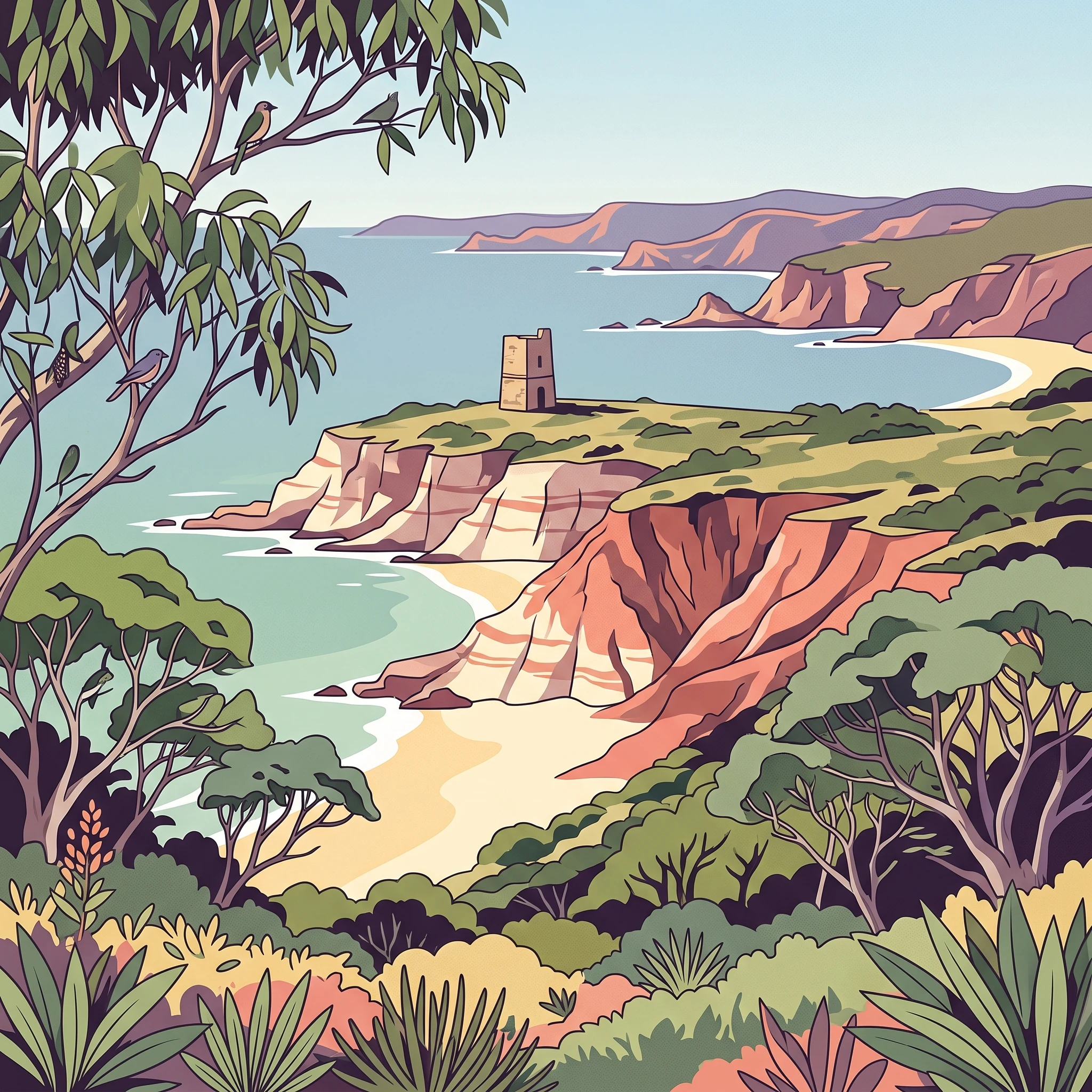
Beowa National Park is best known for The Pinnacles, a striking multicolored erosion gully where white sands are overlain by rusty red clay, creating a visually dramatic landscape feature. The park is also recognized for its significant birdlife, forming part of the Ulladulla to Merimbula Important Bird Area particularly important for swift parrots. The park's coastal location at Twofold Bay provides dramatic headlands and historical structures including the incomplete Ben Boyd's Tower, a sandstone lookout commissioned in the 1840s to alert whaling crews. The park's 2022 renaming to honor the orca, following Thaua cultural guidance, represents a significant moment of reconciliation and acknowledgment of Indigenous heritage.
Beowa National Park history and protected-area timeline
The establishment of Beowa National Park in 1971 marked the protection of approximately 8,900 hectares of South Coast wilderness, originally named after Benjamin Boyd, a prominent pastoralist and businessman who operated along the South Coast during the 1840s. Boyd's operations included shipping and whaling interests based at Twofold Bay, and he commissioned the construction of a sandstone tower overlooking the bay entrance to alert whaling crews to the approach of prey, though the tower was never completed. The park's original naming became increasingly controversial as awareness grew of Boyd's historical role as the first person in Australia to engage in blackbirding, a practice that brought Melanesian laborers to the area under conditions akin to slavery. Following the George Floyd protests and the Black Lives Matter movement gaining momentum in 2020, renewed calls emerged for renaming the park. NSW Environment Minister Matt Kean initiated consultation with Aboriginal and South Sea Islander communities, ultimately selecting the name Beowa, meaning orca in the Thaua language. The official renaming occurred in September 2022 under Environment Minister James Griffin, and in November 2023, Thaua and South Sea Islander elders conducted a ceremony to mark the name change. The park has also expanded over time from its original 8,900 hectares to the current 10,486 hectares.
Beowa National Park landscape and geographic character
The landscape of Beowa National Park presents a coastal environment of subtle but distinctive character, shaped by ancient geological processes and ongoing erosion. The two sections of the park on either side of Twofold Bay exhibit notably different geological compositions. The northern section features sedimentary deposits from the Paleogene period, primarily ironstone and clay with occasional quartzite outcrops, creating terrain that rarely exceeds 100 meters in elevation. The most visually striking feature within this northern section is The Pinnacles, a multicolored erosion gully where white sands are dramatically overlaid with rusty red clay, creating an almost otherworldly landscape of contrasting colors. The southern section reveals much older geology, with metamorphic and Devonian-age rocks forming the coastline and featuring heavily folded sections at Red Point near Ben Boyd's Tower. The park's topography remains predominantly flat, with the tallest peak, Haycock Hill, reaching only 252 meters above sea level. The coastal headlands are exposed to the elements, supporting low ground-hugging heathland vegetation, while the more sheltered inland areas transition to open eucalypt woodland.
Beowa National Park ecosystems, habitats, and plant life
The ecological character of Beowa National Park reflects the interplay between the challenging coastal climate and diverse habitat niches created by the park's varied terrain. The headlands, exposed to the region's notably windy, dry, and cold conditions, support a low heathland community that hugs the ground, creating a distinctive coastal scrub. Moving inland, this heathland gives way to open eucalypt woodland, which forms the dominant habitat across most of the park. The two principal tree species are silvertop ash and red bloodwood, creating a woodland canopy that shelters the understory beneath. Within the more sheltered gullies and protected areas, pockets of rainforest persist, featuring species such as scentless rosewood and smooth mock-olive, representing remnants of more humid forest types that survive in microclimatic refuges. The park forms part of the Ulladulla to Merimbula Important Bird Area, identified by BirdLife International for its significance to bird populations, particularly the endangered swift parrot.
Beowa National Park wildlife and species highlights
Beowa National Park supports a notable diversity of wildlife, with particular significance attached to its bird populations. The park's designation as part of the Ulladulla to Merimbula Important Bird Area reflects its importance for swift parrots, an endangered species that migrates to the area. Survey work has documented 212 bird species within the park, with the heathland habitats supporting populations of eastern ground parrot and the endangered eastern bristlebird. The coastal beaches and sand dunes serve as breeding grounds for little terns, though this species has faced threats from recreational vehicle activity. Mammal diversity includes approximately 50 recorded species, though the park faces challenges from invasive species including feral cats, foxes, occasional feral dogs, and rabbits. The invasive bitou bush has posed a particular threat to vegetation in areas north of the Pambula River.
Beowa National Park conservation status and protection priorities
The conservation significance of Beowa National Park extends beyond its role as a protected coastal landscape, encompassing both biodiversity value and cultural reconciliation. The park's inclusion in the Ulladulla to Merimbula Important Bird Area highlights its international importance for migratory bird species, particularly the swift parrot. The 2022 renaming from Ben Boyd National Park to Beowa National Park represents a significant conservation outcome that extends beyond ecological considerations to acknowledge and honor Indigenous cultural values, with the orca holding deep significance for the Thaua traditional owners. The protection of diverse habitat types, from coastal heathland through eucalypt woodland to rainforest gullies, ensures the preservation of multiple ecological communities within a single protected area. Ongoing management challenges include control of invasive species such as bitou bush and introduced animals that threaten native wildlife populations.
Beowa National Park cultural meaning and human context
The cultural context of Beowa National Park encompasses both its Indigenous heritage and more recent colonial history, with the 2022 renaming bringing these dimensions into focus. The park lies within the traditional Country of the Thaua people, for whom the orca holds profound cultural and spiritual significance. According to Thaua mythology, their ancestors are orcas, and when one dies they are reincarnated as an orca. The selection of Beowa as the park's new name honored this connection following extensive consultation with Aboriginal and South Sea Islander communities involving more than 60 representatives. The more recent colonial history is represented by the incomplete sandstone tower commissioned by Benjamin Boyd in the 1840s to serve his whaling operations at Twofold Bay, a period when the area was part of the District of Port Phillip. The renaming process, culminating in a ceremony conducted by Thaua and South Sea Islander elders in November 2023, marks a meaningful moment of recognition and healing.
Top sights and standout views in Beowa National Park
The Pinnacles stands as the park's most distinctive natural feature, a multicolored erosion gully where white sands meet rusty red clay creating dramatic visual contrast. Ben Boyd's Tower, the incomplete sandstone structure overlooking Twofold Bay, provides both historical context and elevated views of the coastal landscape. The park's location on the South Coast positions it within an Important Bird Area supporting significant populations of swift parrots and other bird species. The 2022 renaming to Beowa, honoring the orca's significance to the Thaua people, represents a meaningful reconciliation between conservation outcomes and Indigenous cultural recognition. The diverse habitat mosaic, from heathland headlands through eucalypt woodland to sheltered rainforest gullies, supports remarkable biodiversity within a relatively compact coastal park.
Best time to visit Beowa National Park
The park can be visited throughout the year, though the exposed coastal location means conditions vary significantly with the seasons. Winter and spring typically bring cooler temperatures and stronger winds, while summer and autumn may offer more comfortable conditions for exploring the various trails and coastal viewpoints. The heathland wildflower displays tend to be more prominent during the spring months, and this is also when bird activity increases across the park's various habitats. Visitors interested in coastal scenery and photography may find the clearer conditions of autumn provide good visibility for viewing features like The Pinnacles and the coastline from Ben Boyd's Tower.