Why Blackbuck National Park, Velavadar stands out
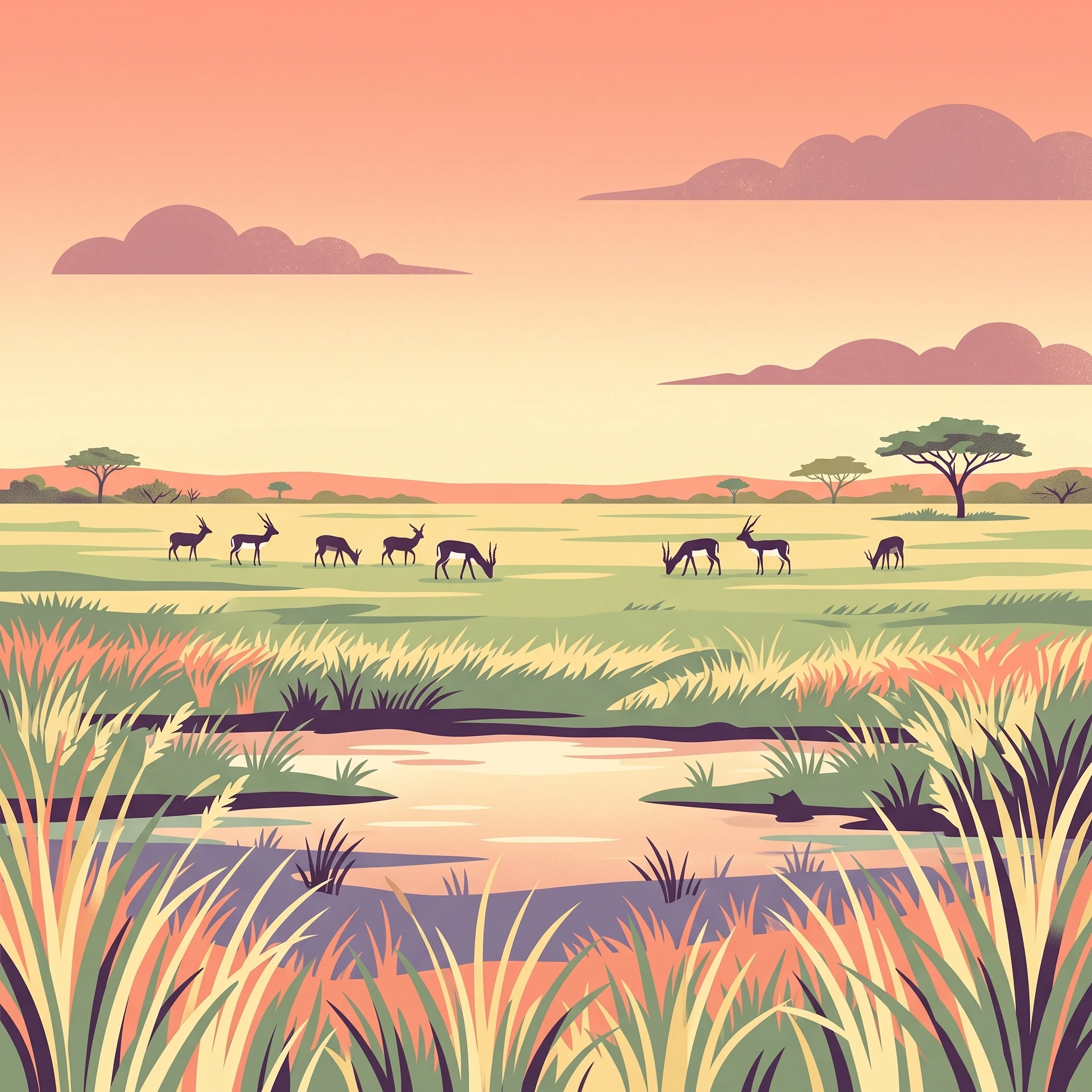
Blackbuck National Park is best known for its thriving population of blackbuck antelope, the species for which the park is named and which has been the focus of intensive conservation efforts since the park's establishment. The park is equally significant for protecting the lesser florican, an endemic and endangered bustard species that has suffered dramatic population declines across India, with this park now holding the largest remaining population. The grasslands of Velavadar also host one of the world's largest roosting congregations of migratory harriers, including marsh harrier, pallid harrier, and Montagu's harrier, which gather in impressive numbers during the winter months. This combination of flagship mammals, endangered ground birds, and spectacular migratory raptor concentrations makes Velavadar a singular destination for wildlife observation and conservation in the Indian subcontinent.
Blackbuck National Park, Velavadar history and protected-area timeline
Blackbuck National Park was established in July 1976 as a protected area for the blackbuck antelope and associated grassland ecosystems. The initial protected area covered approximately 18 square kilometers, representing the core grassland habitat that had historically been managed as the private hunting grounds of the maharaja of the princely state of Bhavnagar. These grasslands, locally known as 'vidi,' were maintained specifically for the pursuit of blackbucks using the maharaja's famous trained hunting cheetahs, a traditional practice that continued into the early decades of the twentieth century.
In 1980, the park was significantly expanded through the addition of approximately 16 square kilometers of adjacent land, bringing the total protected area to 34.08 square kilometers. This expansion incorporated additional grassland habitat as well as coastal mudflat areas adjacent to the Gulf of Khambhat, creating a more comprehensive protected landscape that encompassed both terrestrial and coastal ecological zones. The expansion reflected growing recognition of the area's ecological significance beyond just the blackbuck population, particularly regarding the lesser florican and migratory bird populations.
Management of the park falls under the Forest Department of Gujarat, which has implemented focused conservation programs targeting the park's flagship species. The successful recovery of blackbuck populations, along with the establishment of the lesser florican as the park's other flagship endangered species, demonstrates the effectiveness of targeted conservation efforts in this semi-arid grassland setting.
Blackbuck National Park, Velavadar landscape and geographic character
The landscape of Blackbuck National Park is defined by flat, gently undulating terrain characteristic of the Bhal region of Saurashtra. The park's topography is essentially featureless plains with minimal elevation variation, typical of the semi-arid grassland belt that extends across this portion of Gujarat. The elevation and flatness of the landscape contribute to the park's distinctive visual character, where the eye sweeps across an expansive sea of grass with occasional low shrubs breaking the horizon.
The park's southern boundary directly interfaces with the Gulf of Khambhat, creating a coastal element that distinguishes Velavadar from purely inland grassland parks. This coastal zone includes tidal mudflats that experience regular inundation during high tides, particularly in the monsoon season when the gulf's waters rise significantly. The interplay between the flat terrestrial landscape and the coastal tidal zone creates a visual contrast between dry grassland and exposed mud and shallow water.
The vegetation across the park is dominated by grassland species adapted to semi-arid conditions, interspersed with Prosopis shrubs that create patches of scrubland. Areas of saline soil occur where water evaporation leaves mineral deposits, particularly in lower-lying portions that receive periodic tidal flooding. The combination of flat terrain, seasonal grass coverage, and the coastal mudflat interface creates a landscape of subtle but distinctive ecological zones that vary with distance from the gulf and elevation above sea level.
Blackbuck National Park, Velavadar ecosystems, habitats, and plant life
Blackbuck National Park protects a representative example of semi-arid grassland ecosystems within the Gujarat-Rajwada biotic province of India's semi-arid bio-geographical zone. The park's habitat composition includes approximately 7.57 square kilometers of dense grassland, 9.91 square kilometers of sparse grassland, 5.05 square kilometers of Prosopis shrubland, 5.13 square kilometers of saline land, and 5.08 square kilometers of high tidal mudflats. This diversity of habitat types creates a complex ecological mosaic that supports different species assemblages across relatively small spatial scales.
The semi-arid climate of the region produces distinct seasonal patterns in vegetation structure and availability. During the monsoon season, the grasslands become lush and green, supporting grazers and providing breeding habitat for ground-nesting birds. The dry season sees the grass senesce to golden tones, creating the classic savanna-like appearance that characterizes the park for much of the year. The tidal mudflats along the southern boundary represent a unique habitat where the marine influence creates conditions suited to specialized invertebrate fauna and shorebird foraging.
The grassland ecosystem represents one of the most threatened habitat types in India, with extensive conversion to agriculture and infrastructure having eliminated much of the original semi-arid grassland cover across the country. The protection of this remaining grassland habitat at Velavadar therefore carries significance beyond just the species it supports, representing the preservation of an entire ecosystem type that has largely disappeared from the Indian landscape.
Blackbuck National Park, Velavadar wildlife and species highlights
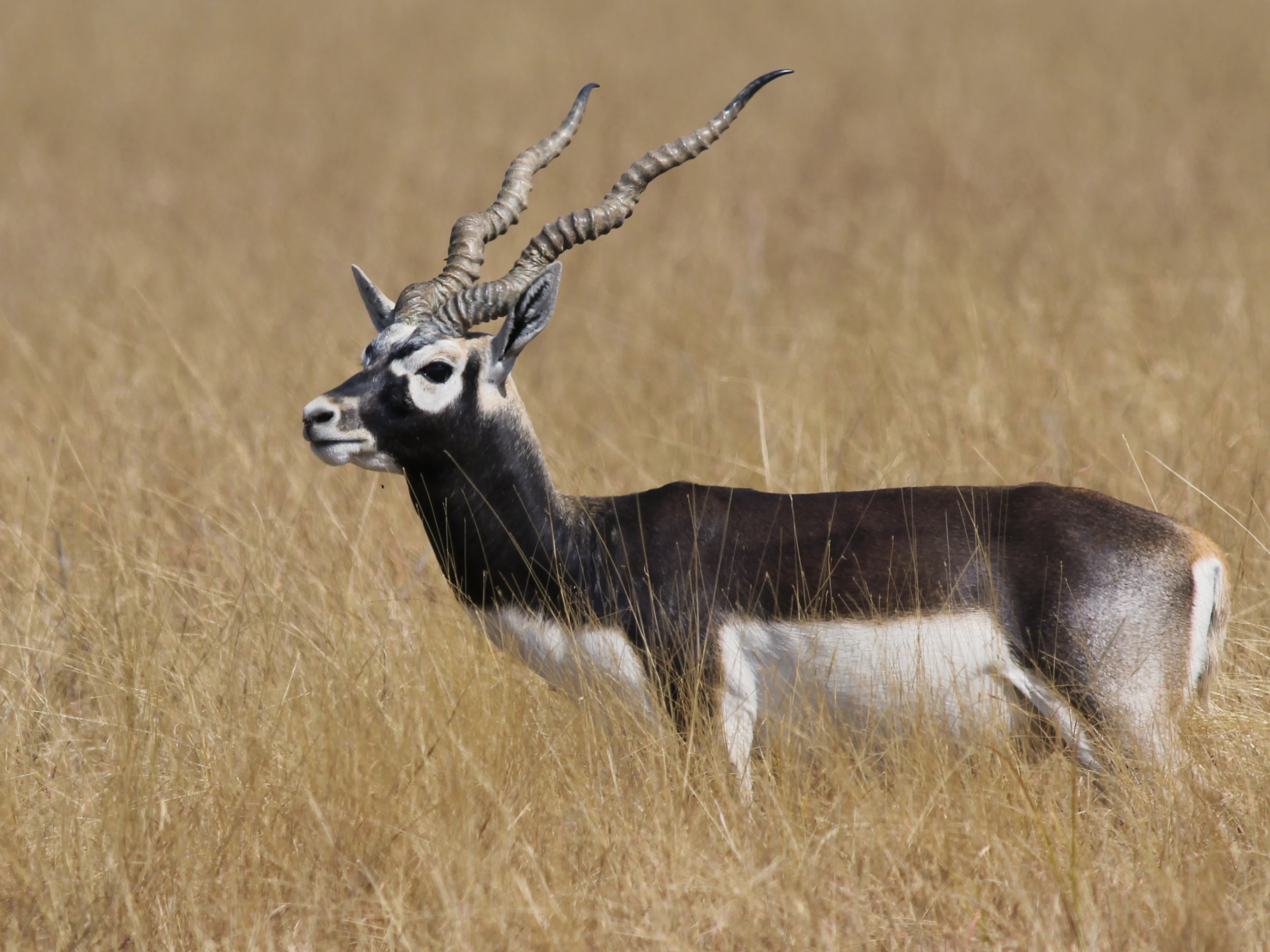
Blackbuck National Park supports a remarkable concentration of wildlife within its grassland and coastal habitats, centered on several flagship species that define the park's conservation identity. The blackbuck antelope remains the park's most visible large mammal, present in substantial populations throughout the grasslands where their graceful movements and distinctive spiral horns are a defining element of the park's wildlife viewing experience.
The lesser florican represents perhaps the park's most significant conservation asset, as this endemic Indian bustard species has experienced dramatic population declines across its former range. Once found throughout much of the Indian subcontinent, the lesser florican is now endangered and concentrated in few remaining strongholds, with Velavadar supporting the largest known population. This ground-dwelling bird inhabits the tall grassland areas and is particularly associated with the monsoon breeding season when males perform their distinctive breeding displays.
The park's carnivore community includes the Indian wolf, striped hyena, Indian fox, golden jackal, and jungle cat. The Indian wolf population has shown positive trends in recent years, with sightings becoming increasingly common even during daylight hours in winter months. The striped hyena, a generally elusive scavenger, is also reported with growing frequency, indicating successful conservation of these often-persecuted predators.
The winter months bring spectacular concentrations of migratory harriers to the park, with the grasslands serving as one of the largest roosting grounds for three species: marsh harrier, pallid harrier, and Montagu's harrier. According to expert assessments, this harrier roost is among the largest in the world, with birds gathering in impressive numbers during late afternoon and evening hours before dispersing to hunt across the grasslands during daylight. Additional avian diversity includes sandgrouse, various lark species, and numerous passerines that inhabit the grassland and shrubland habitats.
Blackbuck National Park, Velavadar conservation status and protection priorities
Blackbuck National Park represents a significant conservation success story within India's protected area network, demonstrating effective management of semi-arid grassland ecosystems and their associated biodiversity. The park's flagship conservation programs have focused on the blackbuck, Indian wolf, and lesser florican, each representing different conservation challenges and requiring distinct management approaches.
The successful recovery of blackbuck populations from the historical hunting grounds of the maharaja to a thriving population within a protected landscape illustrates the potential for grassland habitat restoration and species recovery when appropriate protection measures are implemented. This recovery required not only direct species protection but also management of the grassland habitat to maintain the open vegetation structure that blackbucks require for foraging and predator detection.
The lesser florican conservation program holds particular significance given the species' endangered status and the park's role as the primary remaining population stronghold. The park's protection of extensive tall grassland habitat, combined with management practices that maintain suitable breeding conditions during the monsoon season, has enabled this population to persist when others have declined throughout the species' range. The winter congregation of harriers, including globally significant concentrations of pallid harrier and Montagu's harrier, adds international conservation significance to the site, as these species face population pressures across their Eurasian breeding range.
Blackbuck National Park, Velavadar cultural meaning and human context
The landscape that now comprises Blackbuck National Park carries historical significance as the private grassland of the maharaja of Bhavnagar, a princely state that existed in Gujarat before Indian independence. The grasslands were historically maintained as 'vidi,' a term referring to the open grassland areas used for specific purposes including grazing and hunting. The maharaja's hunting traditions involved trained hunting cheetahs, and the blackbuck was the primary quarry of these sporting hunts.
This aristocratic hunting heritage, while representing a period of intensive pressure on wildlife populations, also incidentally maintained the grassland habitat structure that many species require. The transition from private hunting ground to national park represents a transformation in the relationship between humans and this landscape, shifting from exclusive use by a ruling family to protection for broader ecological and public values.
The broader Bhal region of Saurashtra in which the park is situated has historically been characterized by pastoral land use and agriculture, with the local communities maintaining connections to the grassland landscape. The park's location within this region places it within a cultural landscape where human use and ecological processes have interacted over extended time periods.
Top sights and standout views in Blackbuck National Park, Velavadar
The grassland landscapes of Blackbuck National Park support remarkable wildlife concentrations that make it a singular destination within India's protected area network. The park's blackbuck populations, visible across the open grasslands, represent one of the most accessible viewing experiences for this elegant antelope species. The lesser florican, though more secretive, offers exceptional birdwatching opportunities for those who visit during the monsoon breeding season when males display in the tall grass. The winter harrier roost, with hundreds of birds gathering at dusk, represents a spectacle rivaled by few other locations globally.
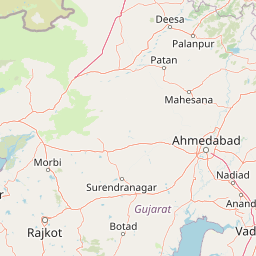
The park's location in Bhavnagar District, approximately 42 kilometers from the city of Bhavnagar, makes it accessible for day visits while maintaining a remote and wild character. The flat landscape creates an open, panoramic environment quite different from the mountainous or forested national parks that dominate India's protected area system, offering a distinctive experience focused on grassland wildlife observation. The combination of successful flagship species conservation, significant migratory bird populations, and accessible wildlife viewing makes Velavadar an important destination for both conservation-focused naturalists and general visitors interested in India's grassland ecosystems.
Best time to visit Blackbuck National Park, Velavadar
The optimal time to visit Blackbuck National Park depends on the wildlife experiences desired, with different seasons offering distinct advantages. The winter months from November through February represent the most popular period for general wildlife viewing, when temperatures are comfortable and the dry-season grass provides good visibility for observing blackbucks and other mammals. Theharrier migration and roosting activity peaks during winter, making this the prime season for witnessing the spectacular evening congregations of these raptors.
The monsoon season from June to September brings the landscape to life with lush green grass and represents the critical breeding period for the lesser florican. Visitors during this period may witness the male floricans' distinctive breeding displays, but the heavy rainfall and difficult field conditions make this a more challenging time for park visits. The post-monsoon period in October offers a transition with pleasant weather and the beginning of the winter bird migration.
Summer months from March to May bring high temperatures that can make daytime wildlife viewing difficult, though early morning excursions remain possible. The dry conditions during this period concentrate wildlife around remaining water sources, potentially improving sightings despite the challenging heat.