Mori Atlas logo
National parkRanthambore National Park

Trace the mapped boundaries and diverse dry deciduous terrain of this premier national park.

Ranthambore National Park: Protected Landscape, Terrain, and Map Atlas in Rajasthan

Ranthambore National Park represents a crucial protected landscape within Rajasthan, India, offering a unique lens into the region's geography and conservation efforts. This atlas entry details the park's dry deciduous forest ecosystem, its distinctive rocky terrain interspersed with lakes, and its strategic location between key rivers. Users can explore the mapped contours of this significant protected area and understand its ecological and geographical context within northwestern India, focusing on landscape character and natural terrain.

Tiger ReserveDry Deciduous ForestRajasthan National ParkProject Tiger ReserveWildlife ConservationFort Heritage

Ranthambore National Park

National park

Park overview

Structured park overview, official facts, and landscape profile for Ranthambore National Park

Ranthambore National Park park facts, protected area profile, and essential visitor context
Review the core facts for Ranthambore National Park, including designation, size, terrain, visitor scale, habitats, and operating context in one park-focused overview.

About Ranthambore National Park

Ranthambore National Park occupies a significant position in India's protected area network, representing a crucial conservation landscape in the semi-arid zone of Rajasthan. The park's geography is defined by a complex topography of rocky hills, steep cliffs, narrow valleys, and flat plateaus interspersed with numerous seasonal and perennial water bodies. The Aravalli range, one of the oldest mountain ranges in the world, forms the backdrop to this landscape, contributing to the park's rugged character.

The park's boundaries are naturally delineated by two major river systems: the Banas River to the north and the Chambal River to the south, both of which support riparian ecosystems within the broader arid matrix. Within the park's perimeter, visitors encounter the imposing Ranthambore Fort, a medieval fortress that changed hands multiple times between Rajput rulers and Muslim sultans before becoming a prominent historical landmark. The fort houses several ancient temples, including those dedicated to Ganesh, Shiva, and Jain tirthankaras, adding a spiritual and architectural dimension to the wildlife experience.

The park's ecological significance extends beyond its charismatic megafauna. It serves as a critical corridor connecting the tiger populations of central India with those in the northwestern region, facilitating genetic exchange essential for long-term population viability. The diverse habitats within the park, ranging from dense forest patches to open grasslands, support a wide array of species and maintain ecological processes that would otherwise be lost in this climatically challenging region.

Quick facts and research context for Ranthambore National Park

Ranthambore National Park covers 1,334 km² in southeastern Rajasthan, with a core zone of approximately 275 km². Established as a wildlife sanctuary in 1955, it became a Project Tiger reserve in 1980 and was formally designated a national park in 1980. The park sits at elevations between 215 and 505 meters above sea level within the Khathiar-Gir dry deciduous forest ecoregion. The park contains over 300 tree species, including more than 100 of medicinal importance. The tiger population has grown from 25 in 2005 to 69 tigers as of 2022, representing one of India's most successful tiger conservation stories.

Park context

Deeper park guide and search-rich context for Ranthambore National Park

Ranthambore National Park history, landscape, wildlife, and travel context
Explore Ranthambore National Park through its history, landscape character, ecosystems, wildlife, conservation priorities, cultural context, and seasonal travel timing in a structured park guide built for atlas discovery and search intent.

Why Ranthambore National Park stands out

Ranthambore is best known as one of India's most prominent tiger reserves, offering visitors some of the most reliable tiger sighting opportunities in the country. The park's unique selling point is the juxtaposition of Bengal tigers wandering among the ruins of the 10th-century Ranthambore Fort, creating an almost cinematic landscape that has captured the imagination of wildlife photographers and nature enthusiasts worldwide. The dry deciduous forest environment, characterized by dhok trees and open grasslands, allows for relatively clear sightlines compared to denser jungle reserves, making wildlife observation more accessible.

Ranthambore National Park history and protected-area timeline

Ranthambore's conservation journey began in 1955 when the area was designated as the Sawai Madhopur Game Sanctuary, covering 282 square kilometers. Initially established to protect the area's wildlife from unregulated hunting, the sanctuary gradually gained importance as wildlife populations showed promising recovery. In 1974, Ranthambore was selected as one of the original reserves under Project Tiger, India's flagship conservation program aimed at stabilizing tiger populations in designated protected areas.

The formal proclamation as a national park followed in 1980, expanding the protected area to its current extent while incorporating the Kailadevi Wildlife Sanctuary and Sawai Man Singh Sanctuary into its boundary. The inclusion of these adjacent protected areas created a larger conservation landscape capable of supporting viable tiger populations and allowing for natural dispersal between subpopulations. The park's management has since balanced conservation objectives with growing tourism pressure, implementing regulated safari operations and zone-based access to minimize disturbance to wildlife while providing visitors meaningful wildlife experiences.

Ranthambore National Park landscape and geographic character

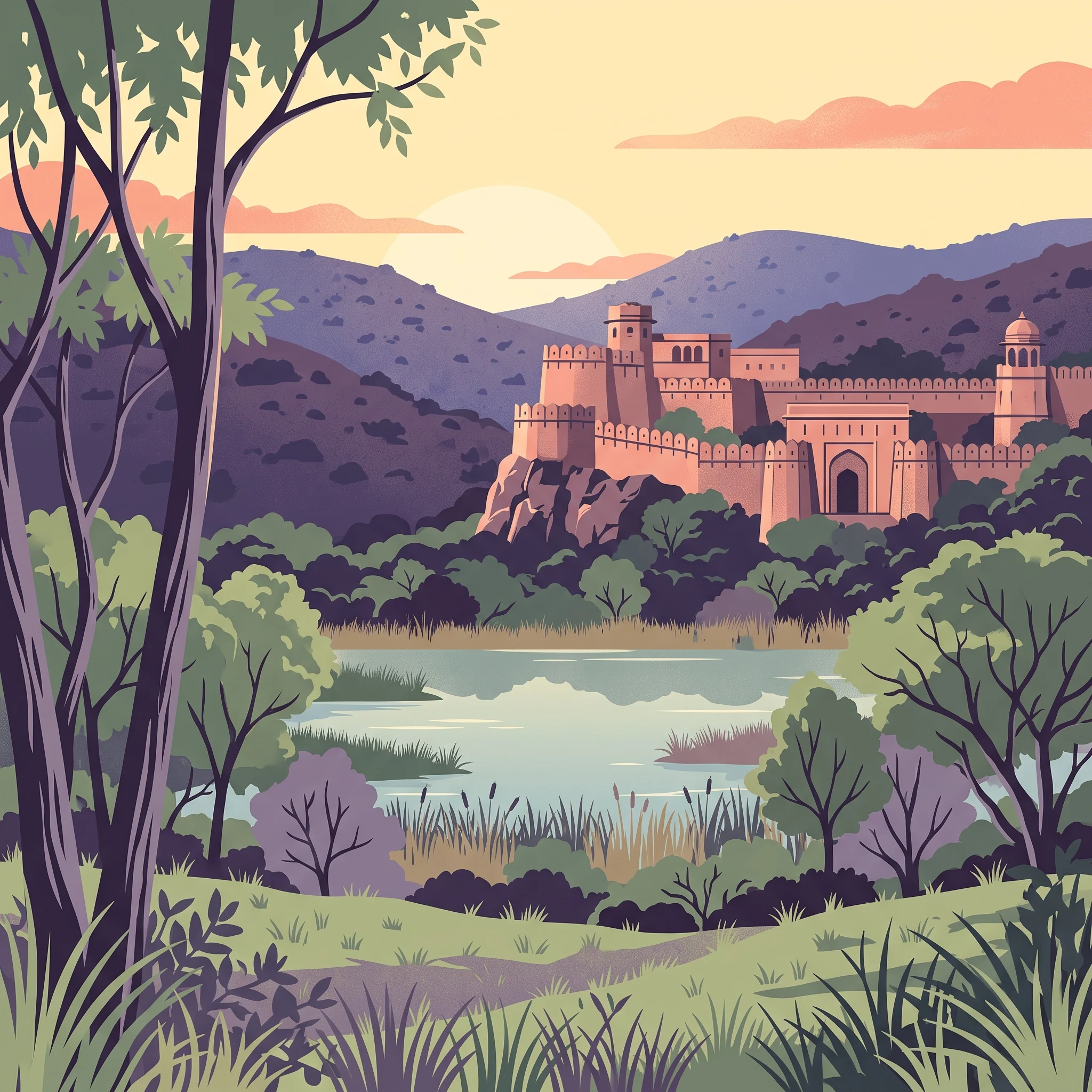
The physical landscape of Ranthambore National Park presents a striking contrast between the rugged, rocky hills of the Aravalli range and the more gently undulating plains below. The terrain is characterized by a series of steep, often cliff-lined hills that rise dramatically from the surrounding terrain, with elevation differences creating diverse microclimates and habitat niches. These rocky outcrops are interspersed with narrow valleys and plateaus that collect monsoon runoff, supporting lush vegetation in pockets surrounded by otherwise dry savanna.

The park's forest cover is classified as tropical dry deciduous, dominated by dhok (Anogeissus pendula) trees that form a relatively open canopy allowing sunlight to reach the forest floor. This open forest structure supports a rich understory of grasses and shrubs that provide ideal habitat for many wildlife species. Several natural lakes, locally called talaos, are scattered throughout the park, with Padam Talao being the largest. These water bodies are critical wildlife watering stations, especially during the hot summer months when the surrounding landscape becomes parched. The red sandstone formations that appear throughout the park, particularly around the fort complex, add a distinctive warm hue to the landscape.

Ranthambore National Park ecosystems, habitats, and plant life

Ranthambore's ecological character is defined by the Khathiar-Gir dry deciduous forest ecoregion, one of the distinctive biomes of the Indian subcontinent adapted to the region's seasonal climate with hot summers and limited rainfall. The forest ecosystem supports over 300 tree species, of which more than 100 have documented medicinal properties, reflecting the traditional knowledge of local communities who utilized these plants for various healing practices. The park's vegetation shows distinct zonation based on moisture availability and soil conditions, with denser forest in valleys and more open bushland on ridges and plateaus.

The ecosystem processes within Ranthambore maintain essential functions including water retention, soil stabilization, and nutrient cycling that support the entire food web. The park's location between two major river systems contributes to its role as a water catchment area that recharges groundwater and provides water to surrounding agricultural lands. The diverse plant communities also support significant pollinator populations and contribute to regional biodiversity maintenance.

Ranthambore National Park wildlife and species highlights

Ranthambore hosts an impressive assemblage of wildlife species adapted to the dry deciduous environment. The ungulate community is dominated by chital (spotted deer), which forms the primary prey base for the park's predator population, along with sambar deer, blackbuck, chinkara (Indian gazelle), and nilgai (blue bull). These herbivores are frequently observed grazing in the open grasslands and around water bodies, particularly during early morning and late afternoon hours.

The predator community includes Bengal tigers, leopards, striped hyenas, jungle cats, and caracals, representing a well-balanced predator-prey system. Sloth bears are also present, often seen near water sources foraging for insects and honey. The primate community includes both gray langurs and rhesus macaques, with langurs frequently encountered near the fort ruins. Over 270 bird species have been recorded in the park, including peafowl (the national bird of India), crested serpent eagle, painted francolin, and Indian paradise flycatcher. The avian diversity is particularly notable during winter months when migratory species join the resident population.

Ranthambore National Park conservation status and protection priorities

Ranthambore represents one of India's success stories in tiger conservation, with the population growing from 25 individuals in 2005 to 69 by 2022. This recovery reflects decades of dedicated conservation effort under Project Tiger, including anti-poaching patrols, habitat management, and community engagement programs. The park's economic valuation as a tiger reserve has been estimated at 8.3 billion rupees annually in flow benefits, with significant contributions from gene-pool protection services, water provisioning to neighboring regions, and carbon sequestration.

The conservation model at Ranthambore has balanced wildlife protection with sustainable tourism, generating revenue that supports local communities while funding park operations. The park's success has made it a model for other tiger reserves in India and has contributed to the country's overall tiger population recovery. Ongoing challenges include managing human-wildlife conflict at the park's boundaries, addressing poaching threats, and maintaining genetic connectivity with neighboring tiger populations.

Ranthambore National Park cultural meaning and human context

The cultural landscape of Ranthambore extends far beyond its wildlife, with the Ranthambore Fort serving as a testament to centuries of human history woven into this terrain. Built in the 10th century by the Chahamanas of Ranastambhapura, the fort rises approximately 210 meters above the surrounding plain and served as a strategic stronghold for various Rajput and Sultanate rulers over the centuries. Within the fort's walls, three red-stone temples dedicated to Ganesh, Shiva, and Ramlalaji continue to attract devotees, while the Digamber Jain temples of Sumatinatha and Sambhavanatha reflect the area's historical religious diversity.

These architectural monuments, dating primarily from the 12th and 13th centuries, have not become isolated heritage sites but remain integrated with the living ecosystem of the national park. The Jogi Mahal, a red sandstone structure on the edge of Padam Talao lake, represents another element of this cultural landscape. The presence of this historical fort amidst thriving wildlife creates a unique visitor experience where ancient human history and natural wildness intersect directly.

Top sights and standout views in Ranthambore National Park

Ranthambore's most compelling highlight remains the opportunity to observe Bengal tigers in their natural habitat, with the park offering some of the most reliable tiger sightings in India. The sight of a tiger navigating the dry forest or resting beside one of the park's lakes against the backdrop of the ancient fort creates an unforgettable image that draws wildlife enthusiasts from around the world. Beyond tigers, the park's avifauna, particularly the crested serpent eagle and various waterfowl at the lakes, provides excellent birdwatching opportunities. The historical element, particularly guided tours of the Ranthambore Fort with its ancient temples and panoramic views, adds a cultural dimension that few other national parks can match.

Best time to visit Ranthambore National Park

The optimal visiting season for Ranthambore National Park runs from October through June, with the winter months from November to February offering the most comfortable temperatures for safari excursions. During this period, daytime temperatures range from mild to warm, and wildlife visibility improves as animals congregate more frequently around the remaining water sources. The summer months of April and June can be extremely hot, with temperatures exceeding 40°C, but this period often provides the best tiger sighting opportunities as animals become more active near water bodies during the heat of the day. The monsoon season from July to September brings heavy rainfall to the region, and the park remains closed during this period to allow for natural regeneration and to minimize visitor impact during the breeding season.
Park location guide

Geography guide, regional context, and park location map for Ranthambore National Park

Ranthambore National Park park geography, regions, and map view in India
Understand where Ranthambore National Park sits in India through a broader geographic reading of the surrounding landscape, nearby location context, and its mapped position within the national park landscape.

How Ranthambore National Park fits into India

India is a South Asian country bordered by the Indian Ocean, Arabian Sea, and Bay of Bengal. It shares land borders with Pakistan, China, Nepal, Bhutan, Bangladesh, and Myanmar. The country has a population of over 1.4 billion people and operates as a federal parliamentary republic with its capital in New Delhi.

Wider geography shaping Ranthambore National Park in India

India occupies the Indian subcontinent in South Asia, bordered by the Arabian Sea to the southwest, the Bay of Bengal to the southeast, and the Indian Ocean to the south. It shares land borders with Pakistan to the west, China, Nepal, and Bhutan to the north, and Bangladesh and Myanmar to the east. The territory also includes the Andaman and Nicobar Islands in the Indian Ocean.

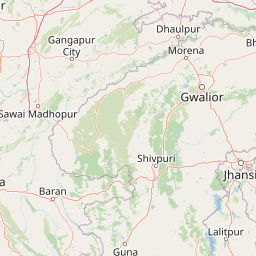
Map view of Ranthambore National Park

Use this park location map to pinpoint Ranthambore National Park in India, understand its exact geographic position, and read its mapped placement within the surrounding landscape more clearly.

Pigeon | © OpenStreetMap contributors

Location context for Ranthambore National Park

RajasthanSawai Madhopur
Park atlas

Trace the regional park geography and diverse protected landscapes, comparing areas adjacent to Ranthambore National Park.

Discover Nearby National Parks and Protected Areas Beyond Ranthambore National Park
Explore additional national parks and protected areas near Ranthambore National Park, tracing the regional spread of India's conservation landscapes, diverse ecosystems, and wildlife habitats. This atlas view offers contextual comparison, allowing you to map adjacent protected terrain and understand broader geographic patterns of natural heritage beyond the iconic tiger reserve.
National parkMadhya Pradesh

Kuno National Park: Madhya Pradesh National Park Atlas and Protected Landscape

Explore its diverse dry deciduous forests and savannah terrain.

Kuno National Park is a protected area in Madhya Pradesh, India, renowned for its dry deciduous forest and savannah grassland ecosystems. This national park, bisected by the Kuno River, offers a significant landscape for understanding regional geography and conservation efforts within India. Its varied terrain provides essential habitat and contributes to the broader atlas of protected lands, making it a key destination for geographic discovery.

Area
748.76 km²
Established
2018
IUCN
II
National parkRajasthan

Mukundara Hills National Park: Rajasthan's Protected Landscape for Tigers and Diverse Habitats

Explore its dry deciduous forests, rocky hills, and riverine ecosystems.

Mukundara Hills National Park is a significant national park and tiger conservation landscape situated in eastern Rajasthan, India. This protected area features a varied terrain encompassing rocky hills, dry deciduous forests, and crucial grassland patches, all intersected by major rivers like the Chambal. Its ecological importance lies in providing vital habitat for Bengal tigers and a mosaic of landscapes that support a wide array of wildlife. Understanding its mapped boundaries and geographic context reveals its critical role in regional conservation efforts and provides a rich atlas-level view of protected lands in western India.

Area
759.99 km²
Established
2004
IUCN
II
National parkIndia

Keoladeo National Park: India's Renowned Wetland Bird Sanctuary and Protected Landscape

Explore its mapped terrain and critical avian habitat near Bharatpur.

Keoladeo National Park, a designated national park in India, represents a critical hub for wetland conservation and avian biodiversity. The park's meticulously managed wetland system, a mosaic of shallow waters and grasslands, provides essential habitat for thousands of resident and migratory birds from across Eurasia. Situated near Bharatpur, this protected landscape offers a unique opportunity to study the intersection of arid and fertile plains geography and serves as a vital stopover point on major bird flyways, underscoring its importance in regional conservation efforts.

Area
28.7 km²
Established
1982
IUCN
II
National parkUttarakhand

Rajaji National Park: Uttarakhand National Park and Tiger Reserve Landscape

Sivalik Hills geography and protected area context

Rajaji National Park is a vital protected landscape situated in the Uttarakhand region of India, recognized as both a national park and a tiger reserve. Its territory spans across the Sivalik Hills, offering a diverse terrain characterized by deciduous forests and riparian ecosystems. The park's location along the Ganga river significantly influences its ecology, providing a unique geographic context for its protected status and wildlife significance.

Area
820.5 km²
Established
1983
IUCN
II
National parkHaryana

Kalesar National Park: Exploring Haryana's Unique Sal Forest Protected Landscape

Discover mapped terrain and regional geography within the Shivalik foothills.

Kalesar National Park, located in the Shivalik foothills of Haryana, is a crucial protected area renowned for its natural sal forest, a rare ecological feature in the state. Spanning approximately 53 square kilometers, the park's diverse terrain offers insights into regional geography and conservation, serving as a vital habitat for leopards and a corridor for wild elephants. Its mapped boundaries encompass a unique landscape that contrasts sharply with surrounding agricultural lands, making it a significant point of study for protected-area enthusiasts.

Area
53 km²
Established
2003
IUCN
IV
National parkLakhimpur Kheri district

Dudhwa National Park: Terai Grasslands and Alluvial Plain Geography within Lakhimpur Kheri

Discover the mapped protected landscape of this vital Indian national park.

Dudhwa National Park in Lakhimpur Kheri district stands as a crucial example of the Terai grassland ecosystem, characterized by its expansive alluvial plains and marshy habitats. This page provides an atlas-style exploration of its protected landscape, detailing the unique terrain and geographic context essential for understanding its conservation significance.

Area
614 km²
Established
1977
IUCN
II
Visitors
26K annual
National parkBardiya District

Bardiya National Park: Nepal's Expansive Terai Protected Landscape and Atlas

Mapped geography, tiger habitat, and rhino conservation in Bardiya District.

Bardiya National Park represents a significant protected area within Nepal's Terai lowlands, providing an exceptional resource for geographic discovery. Its diverse terrain, including vast grasslands and dense forests bisected by major river systems like the Karnali and Babai, creates unique ecosystems. As the largest national park in Nepal, it is instrumental in mapping wildlife corridors and understanding regional landscape dynamics, particularly for endangered species such as Bengal tigers and Indian rhinoceroses. This park offers a profound glimpse into the mapped natural heritage of the Bardiya District.

Area
968 km²
Established
1988
IUCN
II
National parkPunjab

Lal Suhanra National Park: Protected Landscape in Punjab, Pakistan with Desert, Forest, and Wetland

Explore the mapped boundaries and unique geography of this national park.

Lal Suhanra National Park, a expansive national park in Pakistan's Punjab province, is distinguished by its extraordinary ecological mosaic. This UNESCO Biosphere Reserve seamlessly integrates desert regions characterized by dynamic sand dunes with areas of dense forest plantations and vital wetland habitats. The park's terrain offers a fascinating study in contrasts, showcasing how diverse ecosystems can coexist and thrive within a protected area, providing rich context for geographic and landscape exploration. Understand its mapped protected area and its significance within the regional geography.

Area
657.91 km²
Established
1972
IUCN
II

Common questions about visiting, size, designation, and location context for Ranthambore National Park

Ranthambore National Park FAQs for park facts, access, geography, and protected area context
Find quick answers about Ranthambore National Park, including protected-area facts, park geography, trail and visitor context, and how the park fits into its surrounding country and regional landscape.
MoriAtlas Explorer

Continue Your Protected Areas Search Across the Global Atlas

Deepen your exploration by continuing the structured search for national parks and protected areas worldwide. Utilize the comprehensive filtering capabilities to compare different conservation landscapes and refine your understanding of global park geography. Discover more about the distribution and characteristics of protected natural areas.

Global natural geography
Ranthambore National Park: Protected Area Atlas & Landscape Map