Mori Atlas logo
National parkCrater Lake National Park

Discover the mapped protected area and dramatic volcanic landscape of Crater Lake.

Crater Lake National Park: Oregon's Deepest Volcanic Caldera National Park

Crater Lake National Park in Oregon preserves a truly unique volcanic caldera, renowned for the deepest and most vivid blue lake in the United States. This protected landscape, shaped by the ancient collapse of Mount Mazama, offers a profound glimpse into geological history and dramatic natural formations. Explore its mapped boundaries and the surrounding mountainous terrain within the Cascade Range atlas for a comprehensive understanding of this remarkable national park.

Volcanic lakeCalderaDeep lakeCascade RangeOld-growth forestCinder cone

Crater Lake National Park

National park

Park overview

Structured park overview, official facts, and landscape profile for Crater Lake National Park

Crater Lake National Park park facts, protected area profile, and essential visitor context
Review the core facts for Crater Lake National Park, including designation, size, terrain, visitor scale, habitats, and operating context in one park-focused overview.

About Crater Lake National Park

Crater Lake National Park occupies a dramatic volcanic landscape in southern Oregon, centered around a lake that fills a massive caldera formed by the catastrophic collapse of Mount Mazama around 7,700 years ago. The park encompasses the deep blue lake, its surrounding caldera walls, and extensive forests and meadows that characterize the high Cascade environment. The lake's surface sits at 6,178 feet above sea level while the surrounding rim reaches elevations between 7,000 and 8,000 feet, creating a setting of considerable vertical relief and scenic grandeur. Beyond the lake itself, the park protects diverse volcanic features including cinder cones, lava flows, and the remarkable Pumice Desert where volcanic deposits remain so porous that water drains through too quickly to support vegetation. The park's position at the crest of the Cascade Range places it in a transition zone between coastal and interior climate influences, resulting in heavy winter snowfall and a short summer visitor season.

Quick facts and research context for Crater Lake National Park

Crater Lake National Park sits in Klamath County, southern Oregon, at an elevation of approximately 6,178 feet above sea level. The caldera rim ranges from 7,000 to 8,000 feet in elevation, creating a dramatic backdrop to the lake below. The park contains no inlet or outlet streams; all water enters through precipitation and is lost through evaporation or subsurface seepage. The lake's striking blue color results from its great depth and clarity, with light penetration creating the distinctive hue. The park features old-growth forests covering roughly 50,000 acres, volcanic cinder cones including Wizard Island, and the Pumice Desert area where volcanic deposits still prevent vegetation growth.

Park context

Deeper park guide and search-rich context for Crater Lake National Park

Crater Lake National Park history, landscape, wildlife, and travel context
Explore Crater Lake National Park through its history, landscape character, ecosystems, wildlife, conservation priorities, cultural context, and seasonal travel timing in a structured park guide built for atlas discovery and search intent.

Why Crater Lake National Park stands out

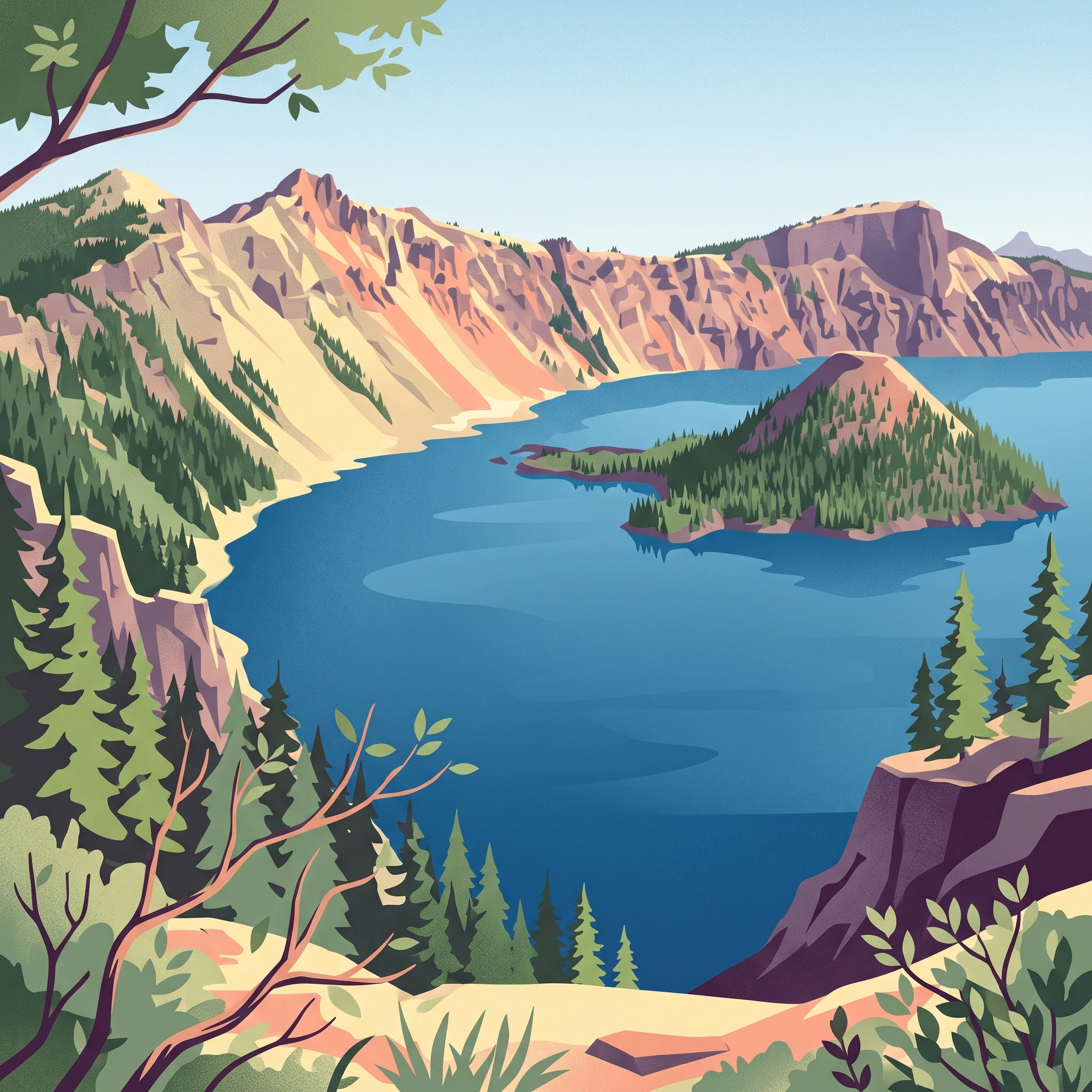
Crater Lake is renowned for being the deepest lake in the United States and one of the clearest and deepest lakes in the world. The park is famous for its remarkably blue water, the result of great depth, high clarity, and the way light refracts in the cold, pure water. The caldera formation story, tied to the violent eruption and collapse of Mount Mazama, adds geological significance. Wizard Island, a cinder cone rising from the lake's surface, has become an iconic image associated with the park. The absence of any inlet or outlet streams makes the lake unusual, with all water entering through direct precipitation.

Crater Lake National Park history and protected-area timeline

Crater Lake National Park was established on May 22, 1902, through legislation signed by President Theodore Roosevelt, making it the fifth-oldest national park in the United States and the only national park in Oregon. The movement to protect the lake was led by William Gladstone Steel, who devoted considerable effort and personal resources to preserving the area after learning of its existence. Steel organized and supported scientific expeditions, including an 1886 USGS survey conducted with geologist Clarence Dutton that used a half-ton boat lowered into the lake to measure depth via piano wire, recording a maximum depth very close to modern measurements. The survey provided scientific credibility that supported the eventual park designation. Native American tribes, particularly the Klamath people, have legends describing the creation of the lake through the battle of two chiefs that resulted in the destruction of Mount Mazama. Gold prospectors John Wesley Hillman, Henry Klippel, and Isaac Skeeters were the first American visitors known to have reached the lake in 1853, calling it Deep Blue Lake before the name Crater Lake became preferred. The historic Crater Lake Lodge opened in 1915 and the scenic Rim Drive was completed by 1918.

Crater Lake National Park landscape and geographic character

The park's landscape is defined by the dramatic volcanic caldera that contains Crater Lake, with steep cliffs rising 1,000 to 2,000 feet above the lake surface. The caldera walls display varying rock types and formations, with Llao Rock on the north side rising 1,800 feet above the lake as a particularly prominent feature. Within the lake itself, Wizard Island forms a cinder cone rising about 755 feet above the water surface, while the Phantom Ship appears as a cluster of dark volcanic rocks resembling a sailing vessel. Beyond the lake, the terrain includes cinder cone formations, with at least 13 cinder cones preserved within the park boundaries. The Pumice Desert, a thick deposit of pumice and ash extending northward from the former volcano, remains largely devoid of vegetation due to the extreme porosity of the material. Mount Scott, the highest point in the park at 8,929 feet, provides panoramic views across the entire caldera and surrounding Cascade Range peaks.

Crater Lake National Park ecosystems, habitats, and plant life

The park's ecological character reflects its high-elevation Cascade Range setting, with forests dominated by coniferous species adapted to heavy snowfall and cold temperatures. Old-growth forests covering approximately 50,000 acres contain mature trees including Douglas fir, white pine, and true firs in varying density across different elevations and aspects. The park's climate classified as dry-summer subarctic results in precipitation primarily as snow during the eight months of winter, with annual snowfall averaging over 460 inches. Summer months from July through October provide the primary growing season when wildflower meadows bloom, particularly in the Castle Crest area. The lake's unique hydrology, with no inlet or outlet streams, means the water is entirely supplied by precipitation and lost through evaporation and seepage, creating a remarkably clear and chemically distinct aquatic environment.

Crater Lake National Park wildlife and species highlights

Mammal species residing in the park include black bears, elk, deer, coyotes, bobcats, Canadian lynxes, pikas, and various smaller mammals like chipmunks, squirrels, and beavers. The park supports populations of American martens, porcupines, badgers, and foxes in the forested areas. Birdlife includes bald eagles, peregrine falcons, spotted owls, and common ravens that soar above the caldera. Canada jays and Clark's nutcrackers are frequently observed in the forest areas, while American dippers can be found along any streams or shoreline areas. The lake itself supports populations of kokanee salmon and rainbow trout that were introduced beginning in 1888 and now reproduce naturally within the lake despite the absence of natural spawning streams.

Crater Lake National Park conservation status and protection priorities

Crater Lake National Park was established to preserve not only the lake itself but also the surrounding scenic landscapes, volcanic features, and unique ecological systems. The park's designation as an IUCN Category II protected area reflects its primary purpose of ecosystem conservation and preservation of natural landscapes. The preservation of old-growth forests within the park protects critical habitat for species dependent on mature forest conditions. The lake's exceptional clarity and unusual hydrology make it a valuable scientific reference site for understanding volcanic lake ecosystems and long-term water chemistry dynamics. Protection of the watershed ensures the continuation of the lake's distinctive blue color, which results from the purity of the water and depth of light absorption.

Crater Lake National Park cultural meaning and human context

The Klamath people, whose ancestral lands include the Crater Lake region, maintain oral traditions describing the creation of the lake through mythological narratives. According to Klamath legend, the battle between Chief Llao of the Below World and Chief Skell of the Above World resulted in the destruction of Mount Mazama and the formation of the crater. This oral tradition notably parallels the scientific understanding of the volcanic collapse that created the lake. The park area was also part of the traditional territory of other Native American groups who utilized the landscape for various purposes. Modern cultural heritage continues through the preservation of historic structures like Crater Lake Lodge and the maintenance of cultural landscapes that hold significance for descendant communities.

Top sights and standout views in Crater Lake National Park

The centerpiece of the park remains Crater Lake itself, with its vivid blue color and dramatic setting within the caldera walls. Wizard Island, the cinder cone rising from the lake's surface, offers boat tours and provides a distinctive visual landmark. The 33-mile Rim Drive circumnavigates the caldera providing access to numerous viewpoints, while hiking trails like the Cleetwood Cove Trail descend to the lake shore. Mount Scott, the park's highest point, offers sweeping views across the entire region on clear days. The Pacific Crest Trail passes through the park, providing access for long-distance hikers. The historic lodge and various viewpoints provide different perspectives on the lake throughout the day as light conditions change.

Best time to visit Crater Lake National Park

The summer months from July through October offer the most accessible conditions for visiting Crater Lake National Park. During this period, the Rim Drive is fully open, trails are accessible, and boat tours operate to Wizard Island. Winter arrives early at the park, typically beginning in September and continuing through June, with heavy snowfall closing most roads and trails. The park averages over 460 inches of snow annually, with depths reaching 10 to 15 feet by early spring. Most roads remain closed until late May or June, and even then, snow persists in shaded areas throughout the summer. The lake rarely freezes due to its great depth and relatively mild Pacific-influenced climate, with the last complete freeze occurring in 1949.
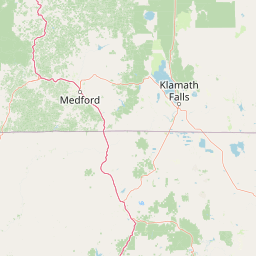
Park location guide

Geography guide, regional context, and park location map for Crater Lake National Park

Crater Lake National Park park geography, regions, and map view in United States of America
Understand where Crater Lake National Park sits in United States of America through a broader geographic reading of the surrounding landscape, nearby location context, and its mapped position within the national park landscape.

How Crater Lake National Park fits into United States of America

The United States of America is a federal presidential republic and one of the world's largest countries by area and population. It consists of 50 states across a vast territory spanning multiple time zones, with its capital in Washington, D.C. and largest city in New York City. The nation has a diverse economy, influential political system, and significant cultural and military presence globally.

Wider geography shaping Crater Lake National Park in United States of America

The United States occupies a vast territory in North America, bordered by Canada to the north and Mexico to the south. The 48 contiguous states stretch from the Atlantic to the Pacific Ocean, while Alaska occupies the northwestern region and Hawaii is an archipelago in the Pacific. The country encompasses diverse terrain including the Rocky Mountains, Appalachian Mountains, Great Plains, and extensive river systems.

Map view of Crater Lake National Park

Use this park location map to pinpoint Crater Lake National Park in United States of America, understand its exact geographic position, and read its mapped placement within the surrounding landscape more clearly.

Pigeon | © OpenStreetMap contributors

Location context for Crater Lake National Park

Oregon
Park atlas

Browse the unique protected landscapes and regional geography surrounding Crater Lake, tracing the Cascade Range's volcanic and forest heritage.

Discover Nearby National Parks and Protected Areas Beyond Crater Lake National Park
Continue your geographic exploration beyond Crater Lake National Park by discovering other significant national parks and protected areas in the surrounding Cascade Range region. Compare their unique volcanic formations, deep forest ecosystems, and hydrological features to understand the broader conservation landscape of the Pacific Northwest.
National parkCalifornia

Redwood National and State Parks: Protected Landscape Geography and Mapped Boundaries

Explore California's protected area atlas.

Gain a structured understanding of Redwood National and State Parks as a protected national park within the geographic context of California. This dedicated page focuses on its mapped boundaries and protected landscape identity, offering critical atlas-level insights for regional geography exploration and conservation land context. Discover how this protected area fits into the larger mapped terrain.

Area
562.88 km²
Established
1968
IUCN
V
National parkCalifornia

Lassen Volcanic National Park: Protected Landscape Identity and Geographic Context

Discover the mapped boundaries and natural terrain of this California national park.

Gain a structured understanding of Lassen Volcanic National Park as a protected landscape. This detail page provides essential geographic context, focusing on the park's mapped boundaries and its specific terrain characteristics within California. It is designed for users seeking detailed information about the park's protected status and its placement within the broader atlas of natural areas, emphasizing its unique geographic identity and conservation significance.

Area
430.8 km²
Established
1916
IUCN
II
National parkWashington

Mount Rainier National Park: A National Park in Washington with Distinct Mapped Boundaries

Explore its protected landscape and regional geography.

Mount Rainier National Park represents a core protected area within Washington State, offering rich opportunities for geographic discovery through its mapped boundaries and natural terrain. As a designated national park, it contributes significantly to the atlas of United States protected lands. This destination allows for detailed exploration of its landscape context, making it an essential point of reference for understanding regional geography and conservation areas.

Area
956.6 km²
Established
1899
IUCN
II
National parkWashington

Olympic National Park National Park: Geographic Atlas and Protected Landscape Discovery

Explore its unique Washington landscape and mapped protected areas.

Olympic National Park serves as a key protected area within Washington, offering rich opportunities for geographic exploration. This detail page provides essential context on its designation as a national park, its mapped boundaries, and its contribution to the regional geography. Understand the park's specific landscape character and its role within the atlas of protected lands, facilitating a structured approach to discovering its natural terrain and geographic significance.

Area
3,733.8 km²
Established
1938
IUCN
II
National parkCalifornia

Yosemite National Park: Protected Landscape Identity and Geographic Atlas Context

Mapped boundaries and regional setting for a key California national park.

Delve into the protected landscape identity of Yosemite National Park, examining its specific geographic features and its place within the broader atlas of California's natural areas. This entry provides detailed context on its mapped boundaries, regional positioning, and significance as a protected natural site, essential for understanding its landscape and conservation geography.

Area
3,070 km²
Established
1890
IUCN
II
National parkWashington

North Cascades National Park: US National Park Protected Landscape and Geographic Context

Explore mapped boundaries and regional Washington geography.

Gain insight into North Cascades National Park, a vital US National Park located in Washington. This entry focuses on its protected land status, mapped geographic extent, and its role within the regional atlas. Users seeking to understand the park's landscape character, natural terrain, and its specific location in Washington will find this an essential point for detailed park geography exploration and protected area discovery.

Area
2,042.26 km²
Established
1968
IUCN
II
National parkBritish Columbia

Gulf Islands National Park Reserve: British Columbia National Park Protected Area

Mapped boundaries and regional geographic context.

Delve into the protected landscape of Gulf Islands National Park Reserve, a significant national park located in British Columbia. This entry provides detailed insights into its mapped boundaries, regional geographic setting, and its identity as a protected area. Understand the park's place within the natural terrain and atlas of Canada, offering a clear geographic overview for focused discovery and landscape context.

Area
36 km²
Established
2003
IUCN
VI
National parkBritish Columbia

Pacific Rim National Park Reserve: National Park Protected Landscape & Map Atlas

Mapped boundaries and regional geographic context in British Columbia.

Pacific Rim National Park Reserve stands as a distinct protected natural landscape, serving as a critical component of Canada's national park inventory. This page facilitates an atlas-style exploration of its mapped boundaries and its position within the broader geography of British Columbia. Understanding the park's protected status and its integration with the surrounding natural terrain offers valuable insight into conservation landscapes.

Area
511 km²
Established
1970
IUCN
VI

Common questions about visiting, size, designation, and location context for Crater Lake National Park

Crater Lake National Park FAQs for park facts, access, geography, and protected area context
Find quick answers about Crater Lake National Park, including protected-area facts, park geography, trail and visitor context, and how the park fits into its surrounding country and regional landscape.
MoriAtlas Explorer

Continue Your Protected Areas Search Across the Global Atlas

Deepen your exploration by continuing the structured search for national parks and protected areas worldwide. Utilize the comprehensive filtering capabilities to compare different conservation landscapes and refine your understanding of global park geography. Discover more about the distribution and characteristics of protected natural areas.

Global natural geography