Mori Atlas logo
National parkMount Rainier National Park

Explore the mapped boundaries and natural terrain of Mount Rainier National Park in Washington.

Mount Rainier National Park: National Park Protected Landscape and Geographic Atlas

Mount Rainier National Park stands as a significant protected area within the state of Washington, offering a distinct geographic identity for atlas exploration. This national park serves as a focal point for understanding regional landscape context and mapped natural terrain. Delve into the protected boundaries and the unique geography that defines Mount Rainier National Park, providing a detailed view for those interested in conservation landscapes and their placement within the broader United States atlas.

Volcanic LandscapeGlaciersOld-Growth ForestSubalpine MeadowsWilderness AreaMountaineering Destination

Mount Rainier National Park

National park

Park overview

Structured park overview, official facts, and landscape profile for Mount Rainier National Park

Mount Rainier National Park park facts, protected area profile, and essential visitor context
Review the core facts for Mount Rainier National Park, including designation, size, terrain, visitor scale, habitats, and operating context in one park-focused overview.

About Mount Rainier National Park

Mount Rainier National Park represents a landmark achievement in American conservation history, established after years of advocacy by John Muir and other preservationists who recognized the unique value of this glaciated volcano. The park preserves not only the physical icon of Mount Rainier but an entire ecological system that ranges from lowland old-growth forests through subalpine meadows to permanent ice and rock. The mountain itself is a stratovolcano that has built itself through successive eruptions over approximately 500,000 years, and its glaciers continue to shape the landscape through erosion and hydrological processes. The park contains several distinct areas accessible through different entrances: Paradise on the south side offers the most developed visitor infrastructure and spectacular meadow views; Sunrise in the northeast provides access to high subalpine terrain and the Emmons Glacier; the Carbon River area in the northwest preserves the park’s only true rainforest environment; and Mowich Lake serves as the largest and deepest lake within the park boundaries. Ninety-seven percent of the park is designated as wilderness under the National Wilderness Preservation System, preserving primitive recreation opportunities and natural processes.

Quick facts and research context for Mount Rainier National Park

Mount Rainier National Park occupies 236,381 acres in Washington State, making it one of the larger national parks in the contiguous United States. The park was established on March 2, 1899, as the fourth national park in the United States and was the first created from a national forest reserve. Elevation within the park ranges from 1,600 feet at the lowest entrances to over 14,000 feet at the summit. The mountain is surrounded by 91,000 acres of old-growth forest and is cut by the 93-mile Wonderland Trail that circles the entire volcano. More than 25 glaciers descend the mountain’s flanks, with Carbon Glacier being the largest by volume in the contiguous United States and Emmons Glacier the largest by area.

Park context

Deeper park guide and search-rich context for Mount Rainier National Park

Mount Rainier National Park history, landscape, wildlife, and travel context
Explore Mount Rainier National Park through its history, landscape character, ecosystems, wildlife, conservation priorities, cultural context, and seasonal travel timing in a structured park guide built for atlas discovery and search intent.

Why Mount Rainier National Park stands out

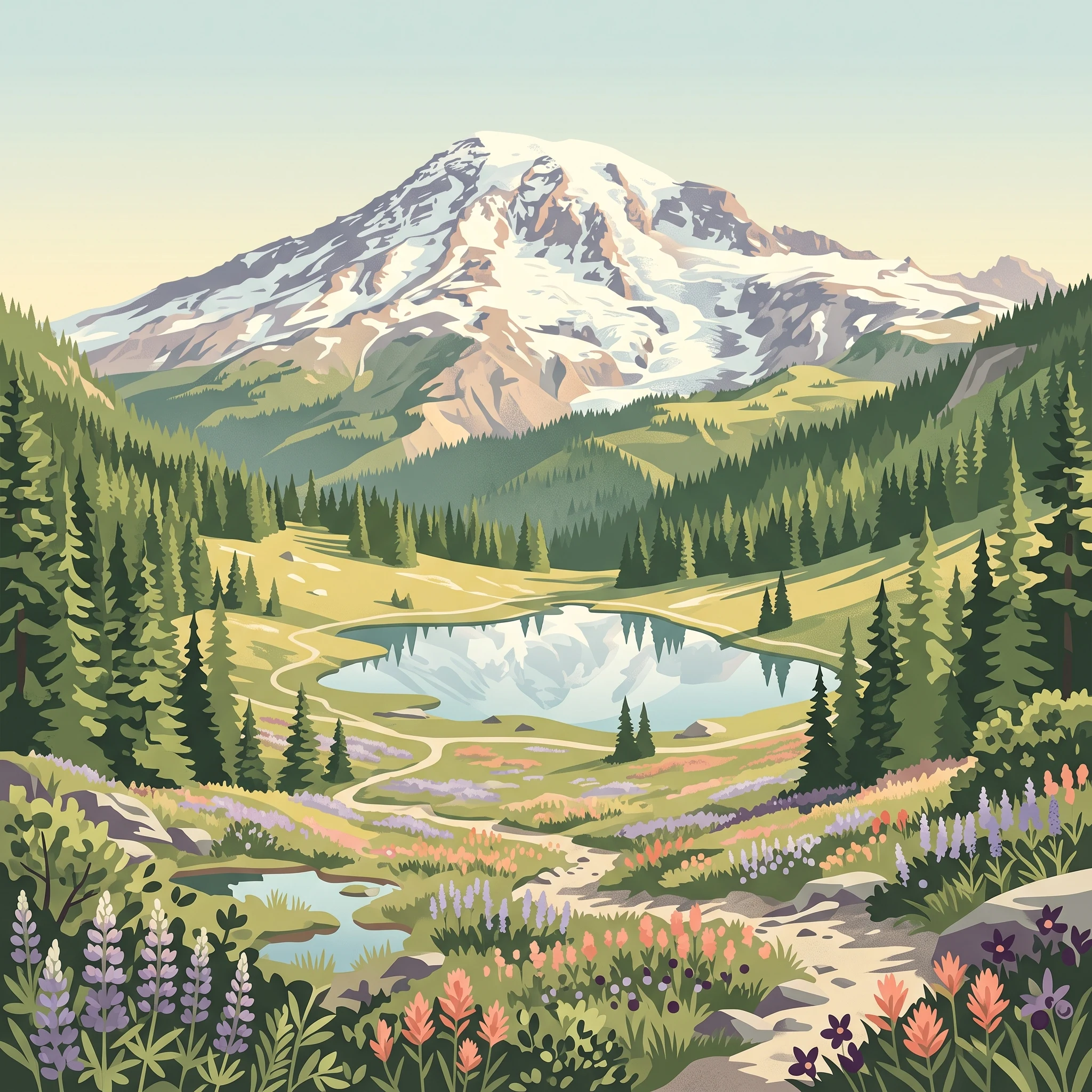
Mount Rainier is best known as a heavily glaciated volcanic peak that dominates the Washington landscape, visible from the Seattle-Tacoma metro area on clear days. The park is famous for its subalpine meadows that bloom with wildflowers during July and August, its extensive network of old-growth Douglas fir, western red cedar, and western hemlock forests, and the dramatic contrast between the snow-covered summit and the verdant forest valleys below. The mountain is a premier mountaineering destination with approximately 10,000 summit attempts per year, about half of which succeed. Paradise, on the south slope, remains the most visited area, while Sunrise offers the highest vehicle-accessible point in the park at 6,400 feet.

Mount Rainier National Park history and protected-area timeline

The land that now comprises Mount Rainier National Park has been used by indigenous peoples for thousands of years, with archaeological evidence of human activity dating back 4,000 to 5,800 years. The mountain’s name in Lushootseed is “Tacoma” (pronounced Taquoma), the same root as the nearby city of Tacoma. Studies by Washington State University researchers in the 1960s, led by Richard Daugherty, determined that prehistoric humans most heavily used the area between 8,000 and 4,500 years before present for hunting, gathering, and spiritual quests, though evidence suggests no permanent habitation within the park boundaries. The park was created through the efforts of John Muir and others who pushed for national park status for Rainier beginning in the 1890s, with the Sierra Club, National Geographic Society, and scientific organizations supporting the campaign. President William McKinley signed the legislation creating Mount Rainier National Park on March 2, 1899, making it the first national park created from a former national forest reserve. The park was designated a National Historic Landmark in 1997 recognizing its exceptional National Park Service rustic architecture from the 1920s and 1930s, exemplified by the Paradise Inn. A significant natural event occurred in November 2006 when a Pineapple Express storm deposited 18 inches of rain in 36 hours, causing extensive flooding that damaged roads, campsites, and facilities, with some areas remaining closed to vehicles since that time.

Mount Rainier National Park landscape and geographic character

The landscape of Mount Rainier National Park is dominated by the massive volcanic edifice of Mount Rainier itself, a 14,410-foot stratovolcano that rises abruptly from the surrounding terrain. The mountain is surrounded by concentric ridges and valleys carved by glacial processes, with the Tatoosh Range forming a prominent southern arc. More than 25 glaciers descend from the summit, including Carbon Glacier, the largest by volume in the contiguous United States, and Emmons Glacier, the largest by area. The glaciers and permanent snowfields cover approximately 35 square miles, feeding numerous streams and waterfalls throughout the park. Elevations range from 1,600 feet at the lowest park entrances to over 14,000 feet at the summit, creating dramatic ecological zonation. The Paradise area sits at approximately 5,400 feet in a subalpine valley while the Sunrise area reaches 6,400 feet as the highest point accessible by vehicle. Deep valleys such as the Nisqually River valley cut through the park, while the Ohanapecosh area contains old-growth forest in a deep valley setting.

Mount Rainier National Park ecosystems, habitats, and plant life

The ecological diversity of Mount Rainier National Park reflects its extreme elevation range and varied climatic conditions. More than 960 vascular plant species and over 260 nonvascular plant species have been documented within the park, growing across distinct zones from lowland forest through subalpine meadows to alpine tundra. According to the Kuchler potential natural vegetation classification, the park contains Alpine Meadows and Barren vegetation with Alpine Meadow potential form at higher elevations. The old-growth forests at lower elevations are dominated by Douglas fir, western red cedar, and western hemlock, some of which predate European settlement. The subalpine zone features characteristic meadows that support extensive wildflower displays during the summer months. The climate varies significantly with elevation, from Mediterranean-influenced humid continental at lower elevations to subarctic conditions near the summit, with Paradise famously recording the highest annual snowfall totals in the Cascade Range.

Mount Rainier National Park wildlife and species highlights

Mount Rainier National Park supports a diverse mammalian fauna including cougar, black bear, coyote, bobcat, elk, mountain goat, and smaller mammals such as snowshoe hare, marmot, and pika. The American pika is particularly associated with rocky alpine habitats near the summit. Black bears and cougars represent the park’s large predators. The bird population includes numerous species characteristic of Pacific Northwest forests and alpine environments, including thrushes, chickadees, kinglets, Steller’s jay, Clark’s nutcracker, and birds of prey such as northern goshawk, bald eagle, and peregrine falcon. The park’s lakes and streams support native fish including bull trout, cutthroat trout, and rainbow trout, while anadromous salmon including Chinook and coho enter park waters during spawning migrations. The presence of salmon in park streams connects the aquatic food web to forest ecosystems.

Mount Rainier National Park conservation status and protection priorities

Mount Rainier National Park serves as a critical protected area within the Pacific Northwest, preserving both iconic volcanic scenery and vital ecological habitats. The designation of 97 percent of the park as Mount Rainier Wilderness in 1988 provides the highest level of federal protection for these lands, maintaining opportunities for wilderness experience and preserving natural processes. The park’s old-growth forests represent some of the most intact examples remaining in the region, serving as carbon stores and habitat for species dependent on mature forest structure. The glaciers themselves are subjects of scientific study as indicators of climate change, with long-term monitoring programs tracking their retreat. The park also protects watersheds that feed downstream ecosystems and provide clean water for communities in the Puget Sound region. As a National Historic Landmark District, the park also preserves significant examples of early National Park Service architectural design.

Mount Rainier National Park cultural meaning and human context

The cultural landscape of Mount Rainier National Park includes thousands of years of indigenous use by tribes of the Pacific Northwest. The mountain known as Tahoma or Tacoma in Lushootseed holds significance for the Nisqually, Puyallup, Muckleshoot, Yakama, and Taidnapam (Upper Cowlitz) tribes, who used the area for hunting, gathering, and spiritual purposes rather than permanent settlement. The park also preserves the legacy of early National Park Service development through its collection of rustic architecture buildings, including the Paradise Inn built in 1916, the Paradise Guide House from 1920, and the Longmire Administration Building from 1928. These structures represent the early twentieth-century vision for national park development that sought to integrate buildings with their natural settings using local materials and design vocabulary.

Top sights and standout views in Mount Rainier National Park

The highlights of Mount Rainier National Park center on the iconic glacial volcano itself, with the summit visible from the Seattle-Tacoma metropolitan area on clear days. The subalpine meadows at Paradise and Sunrise offer spectacular wildflower displays during July and August. The 93-mile Wonderland Trail provides backcountry hikers access to the entire park perimeter. The Paradise area contains the historic Paradise Inn and Henry M. Jackson Visitor Center. The Carbon River area preserves the only true rainforest environment in the park. More than 25 glaciers descend from the summit, with guided glacier walks available. The park offers world-class mountaineering with approximately 10,000 summit attempts annually.

Best time to visit Mount Rainier National Park

The best time to visit Mount Rainier National Park depends on what visitors want to experience. Summer months from July through September offer the most accessible conditions with all roads open, wildflowers blooming in the subalpine meadows, and the longest days for hiking. July and August bring the famous Paradise wildflower displays but also the highest visitation, with 70 percent of the annual 1.6 million visitors arriving during these months. Fall offers changing foliage colors and reduced crowds, though weather becomes less predictable. Winter transforms the park into a snowy landscape with cross-country skiing and snowshoeing opportunities, though many roads and facilities close. Spring brings waterfalls at their fullest as snowmelt begins but some roads remain closed due to snow. The park experiences extreme snowfall at higher elevations, with Paradise recording over 28,000 inches in the 1971-72 season.
Park location guide

Geography guide, regional context, and park location map for Mount Rainier National Park

Mount Rainier National Park park geography, regions, and map view in United States of America
Understand where Mount Rainier National Park sits in United States of America through a broader geographic reading of the surrounding landscape, nearby location context, and its mapped position within the national park landscape.

How Mount Rainier National Park fits into United States of America

The United States of America is a federal presidential republic and one of the world's largest countries by area and population. It consists of 50 states across a vast territory spanning multiple time zones, with its capital in Washington, D.C. and largest city in New York City. The nation has a diverse economy, influential political system, and significant cultural and military presence globally.

Wider geography shaping Mount Rainier National Park in United States of America

The United States occupies a vast territory in North America, bordered by Canada to the north and Mexico to the south. The 48 contiguous states stretch from the Atlantic to the Pacific Ocean, while Alaska occupies the northwestern region and Hawaii is an archipelago in the Pacific. The country encompasses diverse terrain including the Rocky Mountains, Appalachian Mountains, Great Plains, and extensive river systems.

Map view of Mount Rainier National Park

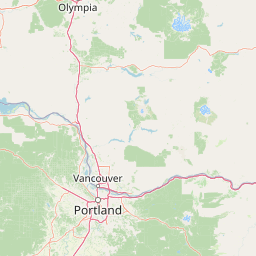
Use this park location map to pinpoint Mount Rainier National Park in United States of America, understand its exact geographic position, and read its mapped placement within the surrounding landscape more clearly.

Pigeon | © OpenStreetMap contributors

Location context for Mount Rainier National Park

Washington
Park atlas

Trace the regional park geography of the Pacific Northwest, comparing diverse protected landscapes near Mount Rainier National Park.

Discover Nearby National Parks and Protected Areas Around Mount Rainier, Washington
Explore national parks and protected areas within the broader geographic region surrounding Mount Rainier, tracing diverse volcanic landscapes, old-growth forests, and glaciated terrain. Geographic comparison of these protected areas provides deeper insight into regional conservation efforts and how distinct ecosystems connect across the Pacific Northwest.
National parkWashington

Olympic National Park National Park: Geographic Atlas and Protected Landscape Discovery

Explore its unique Washington landscape and mapped protected areas.

Olympic National Park serves as a key protected area within Washington, offering rich opportunities for geographic exploration. This detail page provides essential context on its designation as a national park, its mapped boundaries, and its contribution to the regional geography. Understand the park's specific landscape character and its role within the atlas of protected lands, facilitating a structured approach to discovering its natural terrain and geographic significance.

Area
3,733.8 km²
Established
1938
IUCN
II
Visitors
3.7M annual
National parkWashington

North Cascades National Park: US National Park Protected Landscape and Geographic Context

Explore mapped boundaries and regional Washington geography.

Gain insight into North Cascades National Park, a vital US National Park located in Washington. This entry focuses on its protected land status, mapped geographic extent, and its role within the regional atlas. Users seeking to understand the park's landscape character, natural terrain, and its specific location in Washington will find this an essential point for detailed park geography exploration and protected area discovery.

Area
2,042.26 km²
Established
1968
IUCN
II
Visitors
16.5K annual
National parkBritish Columbia

Gulf Islands National Park Reserve: British Columbia National Park Protected Area

Mapped boundaries and regional geographic context.

Delve into the protected landscape of Gulf Islands National Park Reserve, a significant national park located in British Columbia. This entry provides detailed insights into its mapped boundaries, regional geographic setting, and its identity as a protected area. Understand the park's place within the natural terrain and atlas of Canada, offering a clear geographic overview for focused discovery and landscape context.

Area
36 km²
Established
2003
IUCN
VI
Visitors
28.4K annual
National parkBritish Columbia

Pacific Rim National Park Reserve: National Park Protected Landscape & Map Atlas

Mapped boundaries and regional geographic context in British Columbia.

Pacific Rim National Park Reserve stands as a distinct protected natural landscape, serving as a critical component of Canada's national park inventory. This page facilitates an atlas-style exploration of its mapped boundaries and its position within the broader geography of British Columbia. Understanding the park's protected status and its integration with the surrounding natural terrain offers valuable insight into conservation landscapes.

Area
511 km²
Established
1970
IUCN
VI
Visitors
1.2M annual
National parkOregon

Crater Lake National Park: Oregon National Park Atlas of Volcanic Landscapes

Explore mapped boundaries and unique caldera geography.

Crater Lake National Park represents a significant protected area within Oregon, defined by the dramatic volcanic caldera it contains. This national park is celebrated for its exceptionally deep, clear blue lake, formed by the collapse of Mount Mazama, offering a unique subject for geographic and landscape study. Users can explore its mapped boundaries and understand its position within the broader atlas of protected lands and mountainous terrain of the Cascade Range.

Area
741.48 km²
Established
1902
IUCN
II
Visitors
527K annual
National parkBritish Columbia

Mount Revelstoke National Park: Explore Protected Landscape Geography and Mapped Boundaries

British Columbia's National Park Atlas Entry

Delve into the protected landscape of Mount Revelstoke National Park, a critical national park located in British Columbia. This entry provides a detailed look at its mapped geographic extent and protected area identity, offering valuable context for regional atlas exploration. Understand the park's distinct contribution to the mapped natural landscapes of Canada.

Area
260 km²
Established
1914
IUCN
II
Visitors
775.2K annual
National parkColumbia-Shuswap Regional District

Glacier National Park: A National Park within Canada's Protected Landscape Atlas

Explore its mapped boundaries and regional geography.

Glacier National Park represents a significant protected area entity within the broader Canadian geography. This page offers an atlas-oriented perspective on its identity as a national park, focusing on its mapped geographic spread and role as a conservation landscape. Users can explore the park's place within the Columbia-Shuswap Regional District and understand its distinct contribution to the national protected area framework.

Area
1,349 km²
Established
1886
IUCN
II
Visitors
4M annual
National parkBritish Columbia

Kootenay National Park: National Park Protected Landscape and Geographic Context

Explore Kootenay National Park's mapped terrain and regional geography.

Kootenay National Park is a protected national park located in British Columbia, Canada. This dedicated detail page provides an atlas-style exploration of its geographic identity, focusing on its mapped boundaries and the surrounding natural terrain. Understand how Kootenay National Park fits into the larger regional geography, offering rich context for protected landscape discovery and analysis.

Area
1,406 km²
Established
1920
IUCN
II
Visitors
574.1K annual

Common questions about visiting, size, designation, and location context for Mount Rainier National Park

Mount Rainier National Park FAQs for park facts, access, geography, and protected area context
Find quick answers about Mount Rainier National Park, including protected-area facts, park geography, trail and visitor context, and how the park fits into its surrounding country and regional landscape.
MoriAtlas Explorer

Continue Your Protected Areas Search Across the Global Atlas

Deepen your exploration by continuing the structured search for national parks and protected areas worldwide. Utilize the comprehensive filtering capabilities to compare different conservation landscapes and refine your understanding of global park geography. Discover more about the distribution and characteristics of protected natural areas.

Global natural geography