Mori Atlas logo
National parkGrand Canyon National Park

Discover mapped boundaries and regional atlas context for this iconic protected area.

Grand Canyon National Park: Arizona National Park Protected Landscape & Geography

Grand Canyon National Park represents a key protected landscape within the expansive geography of Arizona. As a national park, its mapped boundaries define a significant area for atlas exploration. This page offers a focused view on the park's identity as a protected land, situating its geographic context within the broader regional atlas and highlighting its role in Arizona's natural landscape.

Geological WonderCanyon LandscapesUNESCO World Heritage SiteColorado RiverNational Park ServiceArizona Parks

Grand Canyon National Park

National park

Park overview

Structured park overview, official facts, and landscape profile for Grand Canyon National Park

Grand Canyon National Park park facts, protected area profile, and essential visitor context
Review the core facts for Grand Canyon National Park, including designation, size, terrain, visitor scale, habitats, and operating context in one park-focused overview.

About Grand Canyon National Park

Grand Canyon National Park preserves one of Earth's most spectacular natural landscapes, a place where the immense power of geological time is visible in the exposed rock layers that tell a story spanning nearly two billion years. The canyon was formed through the combined forces of uplift of the Colorado Plateau and the relentless erosive power of the Colorado River and its tributaries, a process that continues today as the river cuts deeper into the ancient rock. The park is divided into two main visitor areas separated by the canyon itself, with the more accessible South Rim accounting for the vast majority of visitor traffic and offering a network of viewpoints, trails, and visitor services centered around Grand Canyon Village, a historic district featuring National Park Service rustic architecture designed by Mary Colter in the early twentieth century. The North Rim sits at a higher elevation exceeding 8,000 feet, offering a cooler, more forested environment with sweeping views across the canyon to the South Rim, though seasonal snowfall closes the road from December through May each year. Beyond the developed areas along the rims, the vast interior of the park remains extremely rugged and remote, accessible only to experienced backpackers and hikers who obtain special permits for overnight backcountry travel.

Quick facts and research context for Grand Canyon National Park

Grand Canyon National Park is situated in northwestern Arizona along the Colorado River, with the South Rim receiving approximately 90% of visitor traffic while the higher-elevation North Rim remains more remote and accessible only seasonally. The park protects one of the most spectacular geological formations on Earth, where the Colorado River has incised a canyon exposing nearly two billion years of geological history through colorful rock layers. The park's central feature, the Grand Canyon, is widely considered one of the Seven Natural Wonders of the World and attracts millions of visitors annually who come to experience its dramatic vistas, hiking trails, and backcountry wilderness. The park is administered by the National Park Service and operates visitor facilities at both the South Rim, including Grand Canyon Village, and the North Rim, centered around Bright Angel Point.

Park context

Deeper park guide and search-rich context for Grand Canyon National Park

Grand Canyon National Park history, landscape, wildlife, and travel context
Explore Grand Canyon National Park through its history, landscape character, ecosystems, wildlife, conservation priorities, cultural context, and seasonal travel timing in a structured park guide built for atlas discovery and search intent.

Why Grand Canyon National Park stands out

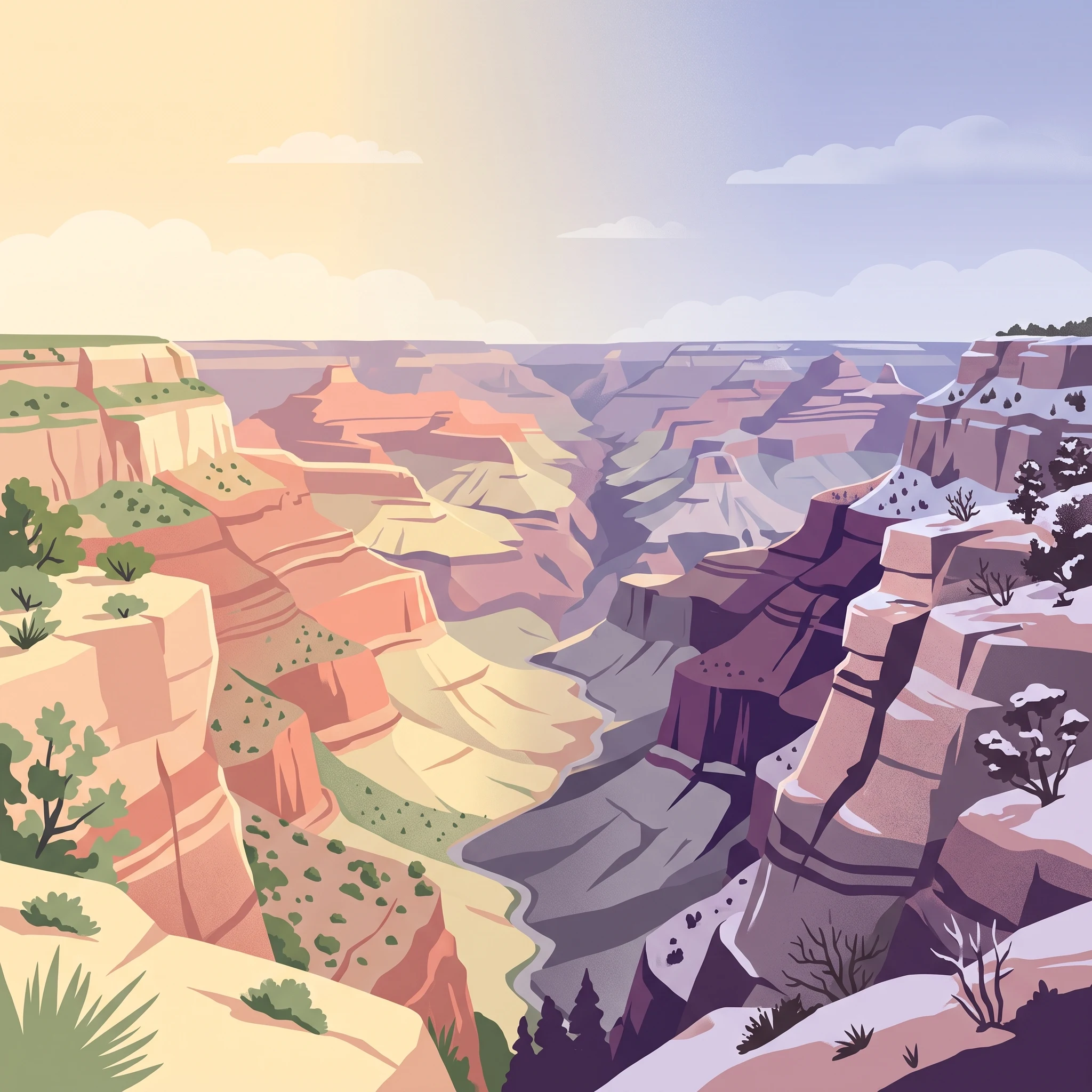
Grand Canyon National Park is best known for the Grand Canyon itself, a colossal geological masterpiece that displays an extraordinary cross-section of Earth's geological history through its layered rock walls. The park is renowned for its dramatic interplay of light and shadow across the canyon walls at sunrise and sunset, the vibrant colors of the exposed rock formations ranging from tan and pink to deep red and purple, and the sheer scale of the canyon which stretches 277 miles long, up to 18 miles wide, and over a mile deep. Visitors come from around the world to experience iconic viewpoints such as Mather Point, Yavapai Observation Station, Desert View Watchtower on the South Rim, and Point Imperial and Cape Royal on the North Rim. The park is also famous for its challenging backcountry hiking trails including the Bright Angel Trail, South Kaibab Trail, and North Kaibab Trail, which descend from the rims to the Colorado River far below.

Grand Canyon National Park history and protected-area timeline

The history of Grand Canyon National Park reflects the broader arc of American conservation history and the long struggle to preserve this natural wonder from commercial exploitation. The Grand Canyon became well known to Americans in the 1880s after railroads were built and pioneers developed infrastructure and early tourism, with early visitors arriving via the Atchison, Topeka and Santa Fe Railway which constructed the El Tovar Hotel in 1905. President Theodore Roosevelt visited the canyon in 1903 and expressed profound awe at its grandeur, declaring that it should remain unchanged for future generations, and he subsequently created the Grand Canyon Game Preserve in 1906 and the Grand Canyon National Monument in 1908. The first bill to establish Grand Canyon National Park was introduced in 1882 by Senator Benjamin Harrison, but successive attempts failed until the Grand Canyon National Park Act was finally signed by President Woodrow Wilson on February 26, 1919, making it the fifteenth national park in the United States. The park was significantly enlarged in 1975 when the Grand Canyon National Park Enlargement Act incorporated the previously separate Marble Canyon National Monument and a second Grand Canyon National Monument to the west, and that same year the park was transferred to the newly created National Park Service Intermountain Region.

Grand Canyon National Park landscape and geographic character

The landscape of Grand Canyon National Park is defined by one of the most dramatic geological features on the planet, where the Colorado River has carved an immense canyon through layers of ancient rock that reveal Earth's deep history. The canyon itself extends 277 miles along the Colorado River, with its walls exposing a nearly complete sequence of geological formations ranging from the ancient Vishnu Basement Rocks at the bottom, dating back nearly two billion years, through the colorful sedimentary layers of the Tonto Group, the prominent cream-colored Coconino Sandstone, and the youngest Kaibab Limestone forming the rims. The canyon achieves depths of over a mile between the South Rim at approximately 7,000 feet elevation and the Colorado River at around 2,000 feet, while the North Rim rises to over 8,000 feet, creating dramatically different environments from the arid canyon floor to the forested plateau. The landscape includes not only the main canyon but an extensive system of tributary canyons, side canyons, and amphitheaters that create an intricate maze-like topography, with landmarks such as the temples, buttes, and mesas that rise from the canyon floor bearing names like Vishnu, Shiva, and Buddha that reflect the spiritual awe the canyon has inspired.

Grand Canyon National Park ecosystems, habitats, and plant life

The ecological diversity of Grand Canyon National Park is remarkable, encompassing multiple life zones from the desert canyon floor through riparian corridors along the Colorado River up to the coniferous forests of the Kaibab Plateau. The park protects portions of the Colorado Plateau, a vast arid region characterized by desert scrub, pinyon-juniper woodlands, and mixed conifer forests, with the river itself supporting a unique aquatic ecosystem despite its altered flow regime from upstream dams. The South Rim environment features desert grassland and shrubland dominated by sagebrush, juniper, and pinyon pine, while the higher-elevation North Rim supports dense forests of ponderosa pine, Douglas fir, white fir, and aspen. The canyon floor and side canyons contain riparian zones with cottonwood, willow, and mesquite, supporting wildlife populations that would otherwise be absent in this arid environment. The park's biodiversity includes numerous species adapted to the harsh canyon environment, from desert bighorn sheep that navigate the steep cliff walls to California condors that soar on the thermal updrafts created by the heated canyon walls.

Grand Canyon National Park wildlife and species highlights

Grand Canyon National Park supports a rich diversity of wildlife that has adapted to the park's extreme environmental gradients from the desert floor to the forested rims. The park is home to approximately 1,500 species of plants, 355 species of birds, 89 species of mammals, 47 species of reptiles, and 17 species of fish, though some of these, including the native fish of the Colorado River, have been significantly impacted by dam construction upstream. Mammals commonly observed by visitors include mule deer on both rims, elk particularly on the North Rim, desert bighorn sheep navigating the rocky canyon walls, and the secretive mountain lion that roams the remote backcountry. The park provides critical habitat for the California condor, one of the rarest birds in North America, with a population that has been reintroduced through a collaborative program involving the National Park Service and other agencies, and condors can often be seen soaring on the thermal currents rising from the heated canyon walls. The riparian areas along the Colorado River and in side canyons support populations of osprey, great blue heron, and other water-associated bird species, while the forested rims provide habitat for endangered species such as the Mexican spotted owl.

Grand Canyon National Park conservation status and protection priorities

Grand Canyon National Park represents one of America's earliest and most significant conservation successes, with its protected status helping to prevent dam proposals within the park boundaries even as the Glen Canyon Dam was constructed upstream. The park's designation as a World Heritage Site by UNESCO in 1979 recognized its outstanding universal value as a natural phenomenon of exceptional importance, while its inclusion on the list of wetlands of international importance under the Ramsar Convention acknowledges the ecological significance of its riparian corridors and the Colorado River. Conservation challenges facing the park include managing the impacts of more than four million annual visitors, addressing the effects of air pollution and visibility impairment from regional emissions, protecting native fish species in the Colorado River from invasive non-native species, and preserving the natural soundscape from aircraft overflights that prompted the passage of the National Parks Overflights Act in 1987. The Grand Canyon Conservancy, the park's official nonprofit partner, works to support conservation, education, and trail preservation efforts through private fundraising and operates visitor centers and retail shops throughout the park.

Grand Canyon National Park cultural meaning and human context

The Grand Canyon has been home to indigenous peoples for thousands of years, with the park area containing numerous archaeological sites and cultural resources that reflect the long human history of this landscape. The Ancestral Puebloans, also known as the Hisatsinom, lived in the region and built structures including the towers and dwellings that inspired the design of the Desert View Watchtower, which was constructed by Mary Colter in 1932 to evoke the architecture of ancient Pueblo peoples. Several Native American tribes maintain cultural and spiritual connections to the Grand Canyon, including the Hopi, Navajo, Havasupai, Hualapai, and Paiute, with the park working to create inter-tribal cultural sites and engage with these communities in collaborative management. The historic Grand Canyon Village on the South Rim represents a well-preserved example of early twentieth-century National Park Service design philosophy, with multiple structures designed by Mary Colter including the Desert View Watchtower, Lookout Studio, Hermit's Rest, Hopi House, and the Bright Angel Lodge, all reflecting a design approach that sought to harmonize built structures with the dramatic natural environment.

Top sights and standout views in Grand Canyon National Park

The most iconic highlights of Grand Canyon National Park include the sunrise and sunset views from strategic viewpoints along both rims, where the changing light transforms the canyon walls into a palette of reds, oranges, pinks, and purples that draw photographers and visitors from around the world. The South Rim offers easily accessible highlights such as Mather Point, the first view most visitors encounter upon entering from the south, Yavapai Point with its excellent geological interpretation, and the Desert View Watchtower at the eastern end providing one of the few full views of the Colorado River far below. The North Rim features the elegant Cape Royal viewpoint with its sweeping panoramic view, Point Imperial the highest point on either rim at 8,803 feet, and the historic Grand Canyon Lodge overlooking Bright Angel Point. For those venturing below the rims, the trails descending into the canyon offer access to iconic landmarks including the Colorado River at the bottom, the Phantom Ranch area, and the remote Toroweap Overlook in the western section of the park where the canyon drops vertically for over 3,000 feet to the river.

Best time to visit Grand Canyon National Park

The best time to visit Grand Canyon National Park depends on the type of experience desired, with each season offering distinct advantages for experiencing this iconic landscape. The spring months of March through May bring mild temperatures, wildflower blooms, and relatively comfortable conditions for hiking, though the South Rim can be quite crowded during spring break periods. Summer months bring the highest visitation and the most intense heat, particularly on the canyon floor where temperatures can exceed 100 degrees Fahrenheit, making the early morning and evening hours the most comfortable times for outdoor activity. Fall offers some of the best overall conditions with cooler temperatures, thinner crowds following the peak summer season, and the added bonus of fall color particularly on the North Rim where the aspen trees turn brilliant gold. Winter brings the fewest visitors and snow-covered landscapes on both rims, though the North Rim is essentially closed from December through mid-May due to snow, while the South Rim remains open year-round and can offer a remarkably uncrowded experience during the winter months.
Park location guide

Geography guide, regional context, and park location map for Grand Canyon National Park

Grand Canyon National Park park geography, regions, and map view in United States of America
Understand where Grand Canyon National Park sits in United States of America through a broader geographic reading of the surrounding landscape, nearby location context, and its mapped position within the national park landscape.

How Grand Canyon National Park fits into United States of America

The United States of America is a federal presidential republic and one of the world's largest countries by area and population. It consists of 50 states across a vast territory spanning multiple time zones, with its capital in Washington, D.C. and largest city in New York City. The nation has a diverse economy, influential political system, and significant cultural and military presence globally.

Wider geography shaping Grand Canyon National Park in United States of America

The United States occupies a vast territory in North America, bordered by Canada to the north and Mexico to the south. The 48 contiguous states stretch from the Atlantic to the Pacific Ocean, while Alaska occupies the northwestern region and Hawaii is an archipelago in the Pacific. The country encompasses diverse terrain including the Rocky Mountains, Appalachian Mountains, Great Plains, and extensive river systems.

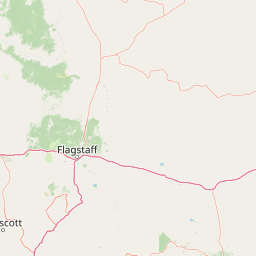
Map view of Grand Canyon National Park

Use this park location map to pinpoint Grand Canyon National Park in United States of America, understand its exact geographic position, and read its mapped placement within the surrounding landscape more clearly.

Pigeon | © OpenStreetMap contributors

Location context for Grand Canyon National Park

Arizona
Park atlas

Compare protected landscapes and regional park geography surrounding Grand Canyon National Park.

Explore Nearby National Parks and Protected Areas Beyond Grand Canyon National Park
Browse national parks and protected areas geographically close to Grand Canyon National Park, exploring a network of protected landscapes and distinct conservation zones. Gain broader geographic context, comparing diverse geological formations and ecological systems that complement the Grand Canyon's immense, ancient canyon system.
National parkUtah

Zion National Park National Park: Detailed Mapped Geography and Protected Landscape Identity

Explore the mapped terrain and regional context of this Utah national park.

Zion National Park represents a key protected area within Utah, ideal for detailed geographic exploration. This canonical page offers insights into the park's specific mapped boundaries, its inherent landscape character, and its regional geographic setting. It is designed for users seeking to understand the atlas-level significance of Zion National Park as a national park entity, focusing on its protected terrain and natural geography.

Area
593.26 km²
Established
1919
IUCN
II
Visitors
4.9M annual
National parkUtah

Bryce Canyon National Park: Utah's Mapped Protected Landscape and Geographic Context

Explore the unique geology and protected boundaries of Bryce Canyon National Park.

Bryce Canyon National Park offers a distinct protected landscape within the geography of Utah, characterized by its unique geological formations. This entry provides essential context for understanding its mapped boundaries and natural terrain, serving as a vital component for atlas-based discovery of protected areas. Investigate the specific geographic setting and conservation significance of this iconic national park.

Area
145.02 km²
Established
1928
IUCN
II
Visitors
2.5M annual
National parkNavajo County

Petrified Forest National Park: National Park Protected Landscape and Geographic Atlas

Explore its mapped terrain and regional park context.

Petrified Forest National Park represents a significant protected landscape within Navajo County, Arizona, offering focused insights into its unique terrain and geographic distribution. As a national park, it provides valuable data for understanding mapped park boundaries, regional landscape context, and its role within the broader atlas of protected areas. Discover the specific geographic features and natural identity that define this unique natural reserve.

Area
895.94 km²
Established
1962
IUCN
II
Visitors
644.9K annual
National parkUtah

Capitol Reef National Park: Utah National Park Protected Landscape and Geography

Explore Capitol Reef National Park's mapped terrain and boundaries.

Delve into the protected landscape and geographic identity of Capitol Reef National Park, a key national park in Utah. This resource provides detailed context on its mapped terrain and regional setting, supporting a structured understanding of protected areas for atlas exploration. Discover the specific geographic features and park boundaries that define this protected natural area.

Area
978.95 km²
Established
1971
IUCN
II
Visitors
1.4M annual
National parkUtah

Canyonlands National Park: A Mapped Protected Landscape in Utah's Geography

Explore its vast geography and protected area boundaries.

Canyonlands National Park stands as a significant protected entity within the state of Utah, characterized by its immense scale and dramatic geological formations. This page facilitates an atlas-style exploration of its terrain, emphasizing its mapped boundaries and its crucial role as a protected landscape. Gain a deeper appreciation for its unique geographic setting and its place within the broader regional context.

Area
1,366.21 km²
Established
1964
IUCN
II
Visitors
818.5K annual
National parkMontezuma County

Mesa Verde National Park: Protected Landscape Atlas and Geographic Identity

Discover the mapped terrain and regional context of this national park.

Mesa Verde National Park serves as a critical protected landscape within Montezuma County, offering distinct insights into regional geography and mapped terrain. This entry details the park's identity as a National Park, emphasizing its geographic setting and providing a foundation for atlas-driven exploration. Understand the park's place within the broader landscape context and its significance as a mapped protected area, ideal for focused geographic study.

Area
212.4 km²
Established
1906
IUCN
II
Visitors
463.1K annual
National parkUtah

Arches National Park: Utah National Park Protected Landscape Exploration

Explore mapped terrain and geographic context.

Delve into the specifics of Arches National Park, a protected national park located in Utah. This atlas-focused entry provides detailed insight into the park's protected landscape features and geographic distribution. Understand the mapped park boundaries and the unique natural terrain that shapes this significant conservation area within the United States' broader regional geography.

Area
310.31 km²
Established
1971
IUCN
II
Visitors
1.5M annual
National parkNevada

Great Basin National Park: Nevada's Protected National Park Geography and Map Details

Understanding its mapped boundaries and regional context.

Delve into the protected landscape of Great Basin National Park, a significant national park located in Nevada. This entry focuses on the park's geographic attributes, providing users with essential map context, details on its protected area boundaries, and an understanding of its place within the broader regional geography. It serves as a focused resource for exploring the park's unique natural terrain and landscape characteristics through an atlas-driven lens.

Area
312.3 km²
Established
1986
IUCN
II
Visitors
144.9K annual

Common questions about visiting, size, designation, and location context for Grand Canyon National Park

Grand Canyon National Park FAQs for park facts, access, geography, and protected area context
Find quick answers about Grand Canyon National Park, including protected-area facts, park geography, trail and visitor context, and how the park fits into its surrounding country and regional landscape.
MoriAtlas Explorer

Continue Your Protected Areas Search Across the Global Atlas

Deepen your exploration by continuing the structured search for national parks and protected areas worldwide. Utilize the comprehensive filtering capabilities to compare different conservation landscapes and refine your understanding of global park geography. Discover more about the distribution and characteristics of protected natural areas.

Global natural geography