Why Great Smoky Mountains National Park stands out
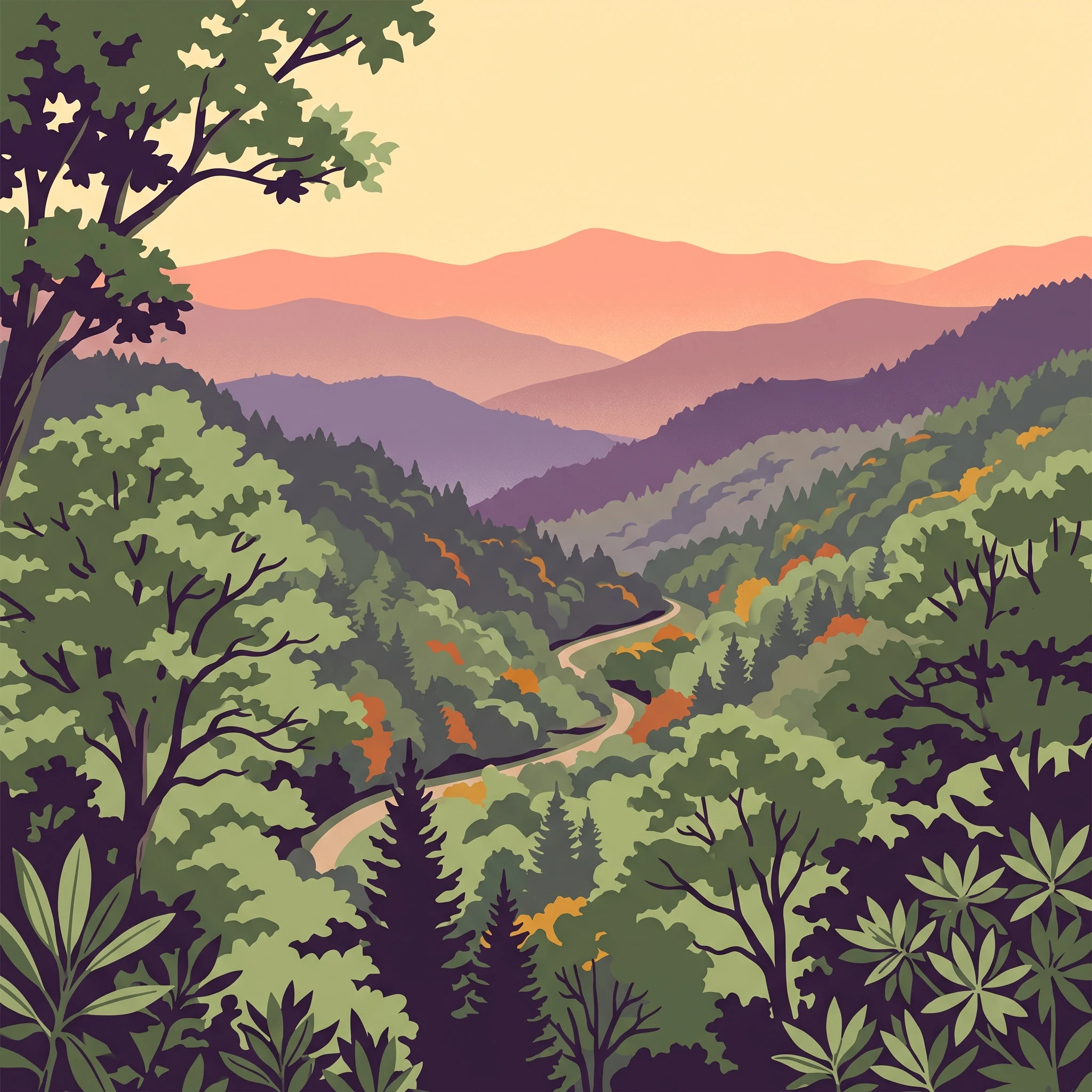
The Great Smoky Mountains are best known for their distinctive blue mist, caused by volatile compounds released from the vegetation in the warm, humid climate, which gives the range its name and creates the ethereal atmosphere that inspired the Cherokee name Shaconage, meaning place of blue smoke. The park is internationally recognized for its extraordinary biological diversity, supporting more species of plants than any other national park in North America, including over 1,500 flowering plant species and 101 native tree species. The ancient cove hardwood forests contain some of the largest tracts of old-growth temperate forest remaining in North America. The park is also famous for its spectacular waterfall systems, with Ramsey Cascades dropping 100 feet and Rainbow Falls plunging 80 feet in single drops. The preserved historic districts, particularly Cades Cove with its rolling meadows framed by mountain silhouettes and collection of 19th-century log structures, offer visitors a window into the lives of early Appalachian settlers.
Great Smoky Mountains National Park history and protected-area timeline
The human history of the Great Smoky Mountains extends back at least 14,000 years, with Native Americans hunting in the region since the Archaic period. The Cherokee people began migrating into the area in the latter 17th century, establishing the Great Smoky Mountains at the center of their territory and calling the range Shaconage, meaning place of blue smoke. European settlers arrived in the mid-18th century, establishing frontier outposts and eventually permanent communities in the valleys and coves throughout the range. The area saw conflict during the American Revolutionary War and the Civil War, with communities divided in their allegiances. By the early 20th century, extensive logging operations had removed two-thirds of the virgin forests from the Smokies, sparking a conservation movement led by local citizens, automobile clubs, and influential advocates including travel writer Horace Kephart and photographer George Masa. The creation of the park required unprecedented cooperation between federal, state, and local governments, along with a $5 million contribution from John D. Rockefeller Jr., and the displacement of thousands of residents from their mountain homesteads. The park was officially established by Congress on June 15, 1934, and formally dedicated by President Franklin D. Roosevelt at Newfound Gap in 1940, becoming the first national park with land purchased using federal funds.
Great Smoky Mountains National Park landscape and geographic character
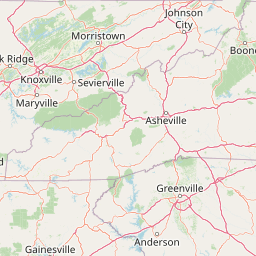
The Great Smoky Mountains rise as a complex mass of elongated ridges and deep valleys running roughly east to west along the Tennessee-North Carolina border. The range is part of the Blue Ridge Mountains, a subrange of the Appalachian Mountains, and represents some of the highest elevations in eastern North America. The topography is characterized by steep, heavily forested slopes descending into narrow valleys known as coves, with the most prominent being Cades Cove, a broad flat plain surrounded by mountain ridges that represents one of the most accessible and visited areas in the park. The elevation gradient from approximately 875 feet to 6,643 feet at Kuwohi creates dramatic changes in terrain, vegetation, and climate across relatively short distances. The mountains contain over 2,900 miles of streams, with water flowing generally northward from the high ridges into the Tennessee River watershed. More than 100 waterfalls are scattered throughout the park, with Ramsey Cascades being the tallest at 100 feet and Rainbow Falls the highest single-drop waterfall at 80 feet. The landscape also includes several notable balds, rare patches of grassland or heath where trees are unexpectedly absent, particularly at higher elevations.
Great Smoky Mountains National Park ecosystems, habitats, and plant life
The ecological diversity of Great Smoky Mountains National Park is unmatched by any other protected area in the United States, with the park serving as a critical refuge for species that were displaced during the last glacial period and have found suitable ecological niches in this temperate rainforest environment. The forests cover approximately 95 percent of the park and are organized into distinct zones based on elevation and moisture conditions. The cove hardwood forests in the stream valleys and lower mountain slopes represent one of the most diverse forest types in North America, with over 130 tree species in the canopy, including yellow birch, tulip tree, sugar maple, and eastern hemlock. The northern hardwood forests on higher slopes are dominated by yellow birch and American beech, while the spruce-fir forest at the highest elevations, typically above 5,500 feet, consists primarily of red spruce and Fraser fir, a relict of the ice ages. The park contains an estimated 20 to 25 percent old-growth forest, one of the largest blocks of deciduous temperate old-growth forest remaining in North America. Over 1,500 species of flowering plants grow in the park, more than in any other national park in North America, including 35 orchid species and 58 members of the lily family.
Great Smoky Mountains National Park wildlife and species highlights
Great Smoky Mountains National Park supports an extraordinary diversity of wildlife, with 65 species of mammals, over 240 species of birds, 67 species of fish, 40 species of reptiles, and 43 species of amphibians documented within its boundaries. The American black bear is the most iconic resident, with an estimated 1,900 individuals in the park representing the densest black bear population east of the Mississippi River. The park is known as the Salamander Capital of the World, home to five of the world's nine families of salamanders, including up to 31 species with several found nowhere else on Earth, such as the red-cheeked salamander and the imitator salamander. Bird diversity is remarkable due to the presence of multiple forest types, with nearly 120 species using the park as a breeding ground, including 52 neotropical migrants. The park supports populations of elk, reintroduced beginning in 2001, most abundantly in the Cataloochee area, as well as white-tailed deer, bobcat, beaver, and numerous bat species including the endangered Indiana bat. Brook trout are the only trout native to the park's waters, while introduced rainbow and brown trout now dominate lower elevation streams.
Great Smoky Mountains National Park conservation status and protection priorities
Great Smoky Mountains National Park represents one of the most important conservation areas in North America, recognized internationally for its outstanding ecological value and biodiversity significance. The park was designated a UNESCO World Heritage Site in 1983, recognizing its exceptional natural values including the Appalachian temperate rainforest ecosystem, outstanding geological features, and remarkable biological diversity. As an International Biosphere Reserve certified in 1988, the park serves as a living laboratory for scientific research and environmental education. The park's conservation significance stems from its role as a refugium for species that survived the last glacial period and the preservation of old-growth forest communities that predate European settlement. However, the park faces significant environmental challenges, including air pollution from nearby development that historically made it the most polluted national park in the United States, though air quality has improved substantially since the passage of the Clean Air Act. Invasive species such as the balsam wooly adelgid have devastated Fraser fir populations at higher elevations, and the park must manage the impacts of its extraordinary visitation while preserving its natural and cultural resources.
Great Smoky Mountains National Park cultural meaning and human context
The Great Smoky Mountains hold profound cultural significance for multiple communities, with the Cherokee people considering this landscape central to their ancestral territory for centuries before European contact. The Cherokee called the range Shaconage, meaning place of blue smoke, and established numerous settlements in the river valleys surrounding the mountains, with the village of Oconaluftee representing the only known permanent Cherokee village within the present park boundaries. The forced removal of most Cherokee in 1838 along the Trail of Tears led to the creation of the Qualla Boundary, home to the Eastern Band of Cherokee Indians, whose reservation borders the park to the south. European-American settlement began in the late 18th century, with communities establishing themselves in the coves and valleys, building farms, churches, mills, and schools that shaped the cultural landscape preserved today in historic districts at Cades Cove, Elkmont, Cataloochee, Roaring Fork, and Oconaluftee. The park preserves over 80 historic structures, including log cabins, barns, churches, and mills that provide tangible connections to the lives of early Appalachian settlers whose descendants were displaced to create the national park.
Top sights and standout views in Great Smoky Mountains National Park
The Great Smoky Mountains National Park offers visitors an unparalleled combination of natural beauty, ecological diversity, and cultural heritage. The iconic Cades Cove provides a scenic loop drive through a cleared valley surrounded by mountain ridges, with numerous preserved historic buildings including log cabins, barns, and churches that showcase 19th-century Appalachian life. Kuwohi, the highest point in Tennessee and along the entire Appalachian Trail, features an observation tower offering 360-degree views across three states on clear days. The park contains more than 850 miles of hiking trails, including 71.6 miles of the Appalachian Trail, with destinations ranging from the dramatic Alum Cave Trail to Mount Le Conte to the cascading waters of Grotto Falls and Laurel Falls. The synchronous fireflies at Elkmont in late May and early June represent one of the most remarkable natural light displays in North America, drawing thousands of visitors to witness the synchronized flashing of Photinus carolinus.
Best time to visit Great Smoky Mountains National Park
The Great Smoky Mountains National Park offers distinct seasonal experiences throughout the year, though the park's popularity means that crowds can be significant during peak periods. Spring brings spectacular wildflower displays, with rhododendrons, mountain laurel, and flame azalea blooming in succession from lower to higher elevations, while the cooler temperatures at higher elevations make this a comfortable time for hiking. Summer offers the warmest conditions for backcountry exploration, though afternoon thunderstorms are common, and the park's high elevation provides welcome relief from valley heat. Fall foliage in the Smokies is legendary, with the northern hardwood forests displaying brilliant oranges, reds, and yellows, typically peaking in mid-October at higher elevations and later in the lower elevations. Winter brings fewer crowds and the opportunity to experience snow-dusted mountain landscapes, though high-elevation roads and trails may be closed, and the climate varies dramatically from valley to summit. The park experiences heavy precipitation throughout the year, with annual amounts ranging from 50 to 80 inches, and heavy winter snowfall at higher elevations.