Mori Atlas logo
National parkCongaree National Park

Explore the mapped boundaries and regional terrain of this unique protected national park.

Congaree National Park: South Carolina National Park Atlas and Protected Landscape Geography

Congaree National Park stands as a significant protected area within South Carolina, offering a unique perspective on natural landscapes and regional geography. As a National Park, its mapped boundaries define a critical space for atlas exploration and understanding the context of protected lands. This page serves as the canonical entry point to discover the geographic identity of Congaree National Park and its place within the broader atlas of protected areas.

Old Growth ForestBottomland Hardwood ForestFloodplain EcosystemRamsar WetlandWilderness AreaUNESCO Biosphere Reserve

Congaree National Park

National park

Park overview

Structured park overview, official facts, and landscape profile for Congaree National Park

Congaree National Park park facts, protected area profile, and essential visitor context
Review the core facts for Congaree National Park, including designation, size, terrain, visitor scale, habitats, and operating context in one park-focused overview.

About Congaree National Park

Congaree National Park stands as a testament to what much of the southeastern United States once looked like before widespread deforestation and development transformed the landscape. Located in Richland County, South Carolina, the park encompasses the Congaree River floodplain, a dynamic environment where seasonal flooding deposits nutrient-rich sediments and shapes the distinctive character of the forest. Unlike the adjacent Piedmont region with its rolling hills and rocky terrain, the floodplain consists of flat, low-lying terrain that experiences periodic inundation from the Congaree River and its tributaries.

The park's character-defining features include massive bald cypress trees rising from buttressed roots, water tupelo dominating the wetter areas, and a diverse mix of oaks, sweetgum, and other hardwoods creating a complex forest structure across elevational gradients from 80 to 140 feet. The forest canopy reaches heights that rank among the highest in the eastern United States, with individual loblolly pines exceeding 160 feet. This remarkable vertical dimension results from the combination of fertile floodplain soils, adequate moisture, and the park's protection from logging that removed similar forests elsewhere.

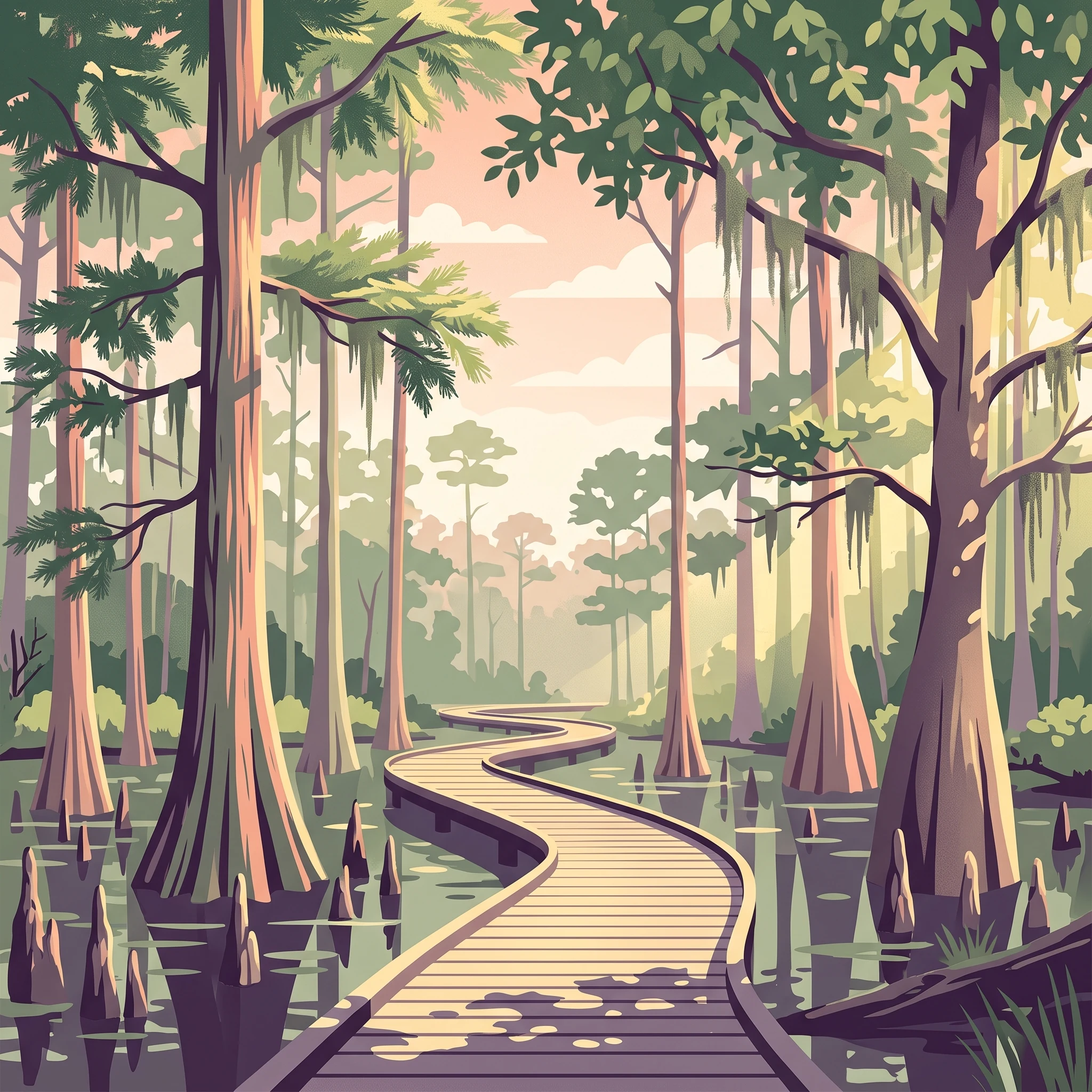
Visitors experience the park primarily through the elevated Boardwalk Loop, a 2.4-mile walkway that winds through the swampy environment while protecting delicate ground-level vegetation. The boardwalk provides access to the heart of the old-growth forest without impacting the sensitive floodplain ecosystem. Beyond the boardwalk, more adventurous visitors can explore miles of hiking trails, paddle 20 miles of canoe trail on Cedar Creek, or camp at primitive sites deep in the wilderness area.

Quick facts and research context for Congaree National Park

Congaree National Park protects the largest remaining old-growth bottomland hardwood forest in the United States, located in central South Carolina near Columbia. The park encompasses over 26,000 acres of floodplain ecosystem along the Congaree River, with about 15,000 acres designated as wilderness. The forest contains some of the tallest trees in the eastern United States, including champion specimens of 15 species. The park is a Ramsar Wetland, UNESCO biosphere reserve, Important Bird Area, and National Natural Landmark.

Park context

Deeper park guide and search-rich context for Congaree National Park

Congaree National Park history, landscape, wildlife, and travel context
Explore Congaree National Park through its history, landscape character, ecosystems, wildlife, conservation priorities, cultural context, and seasonal travel timing in a structured park guide built for atlas discovery and search intent.

Why Congaree National Park stands out

Congaree National Park is best known for its exceptional old-growth bottomland hardwood forest, which represents the largest remaining tract of this ecosystem type in the United States. The park preserves towering bald cypress and water tupelo trees that form one of the tallest temperate deciduous forest canopies remaining on Earth. Its designation as wilderness area protects a rare Primeval floodplain environment where ancient trees, some over 500 years old, continue to grow in the dynamic rhythm of seasonal flooding. The park is also renowned for its champion tree program, hosting specimens that represent the largest or tallest examples of numerous tree species.

Congaree National Park history and protected-area timeline

The story of Congaree National Park begins with theLogging industry that nearly destroyed the forest it now protects. The Santee River Cypress Logging Company began operations in the area in 1898, owned by Francis Beidler and Benjamin F. Ferguson of Chicago. This company harvested cypress from the floodplain until 1914, after which the Beidler family retained ownership of much of the tract. For decades, the forest remained vulnerable to further Logging pressure.

The modern conservation movement to protect the Congaree floodplain emerged in the 1950s and 1960s, led by Harry R.E. Hampton, a member of the Cedar Creek Hunt Club and co-editor of The State newspaper. Hampton joined with Peter Manigault of the Charleston Post and Courier to advocate for preservation of the Congaree floodplain. In 1961, Hampton formed the Beidler Forest Preservation Association, which successfully prompted a National Park Service study in 1963 that reported favorably on establishing a national monument.

When renewed Logging resumed in 1969, conservationists organized the Congaree Swamp National Preserve Association in 1972. This group joined forces with the Sierra Club and other organizations to push for federal legislation. South Carolina Senators Strom Thurmond and Ernest F. Hollings introduced legislation in 1975, leading to the creation of Congaree Swamp National Monument on October 18, 1976. An expansion in 1988 increased the monument to 22,200 acres and designated over two-thirds as wilderness. The monument achieved Important Bird Area status in 2001 before Congress redesignated it as Congaree National Park on November 10, 2003, simultaneously expanding the authorized boundary.

Congaree National Park landscape and geographic character

The landscape of Congaree National Park is defined by its position within the Congaree River floodplain, a flat, low-lying terrain that experiences periodic flooding from the Congaree River and its tributaries. The terrain slopes gently from about 140 feet in elevation in the higher portions to 80 feet near the river, creating subtle but ecologically significant gradients that influence vegetation patterns throughout the park. The floodplain consists of deposits of sand, silt, and clay laid down over millennia, topped with layers of muck and peat formed from the decay of vegetation.

The most distinctive landscape features include cypress trees with their characteristic knobby knees protruding from the water, buttressed roots that flare outward at the base, and the dramatic bald shape of their trunks. Oxbow lakes, formed as the meandering river cut off former channels, dot the landscape and provide permanent water habitat. The landscape changes markedly between wet and dry seasons, with extensive areas of standing water during flood periods transforming the forest floor into a vast wetland before receding to reveal rich organic soils.

Geologically, the park sits within the Congaree River Floodplain Complex, separated from the adjacent Piedmont by the Fall Line to the west. The Southern Bluffs to the south have been eroding since the Late Pleistocene, while the Augusta Fault trends northeast-southwest north of the park. This geological setting creates the distinctive separation between the flat coastal plain floodplain and the rolling terrain of the Piedmont.

Congaree National Park ecosystems, habitats, and plant life

The nature of Congaree National Park centers on its exceptional old-growth bottomland hardwood forest ecosystem, which represents the largest remaining example of this ecosystem type in the United States. The forest is part of the Middle Atlantic coastal forests ecoregion, characterized by its floodplain setting and the dominance of species adapted to periodic inundation. Unlike a true swamp, which is permanently saturated, the Congaree floodplain experiences dynamic water level changes that create a complex mosaic of wet and drier habitats.

The forest composition includes bald cypress and water tupelo in the wettest areas, transitioning to sweetgum, various oak species including cherrybark oak and overcup oak, and American elm in less frequently flooded zones. Loblolly pine dominates some of the higher ground. This diversity of tree species, combined with the old-growth structure featuring large canopy trees, a developed understory, and standing dead trees, creates complex habitat layers that support remarkable biodiversity.

The park has been recognized as part of the Old Growth Forest Network, acknowledging its role in preserving representative old-growth ecosystems. The concentration of champion trees, with the tallest known examples of 15 species, demonstrates the exceptional growing conditions the floodplain provides. The forest's ecological integrity depends on the natural flooding regime that deposits nutrients, disburses seeds, and maintains the conditions this ancient forest ecosystem requires.

Congaree National Park wildlife and species highlights

The wildlife community of Congaree National Park reflects the richness of the southeastern floodplain ecosystem. Large mammals that visitors may encounter include white-tailed deer, which are commonly seen along trails, as well as bobcats, coyotes, and the introduced feral pigs and armadillos. Wild turkeys roam the forest floor, while opossums and raccoons are common nocturnal residents.

The park's waters support diverse aquatic communities, including amphibians, turtles, snakes, and numerous fish species. Notable fish include bowfin, alligator gar, and various catfish species. River otters can be observed swimming in creeks and oxbow lakes. The bird community is exceptionally diverse, earning the park its Important Bird Area designation. The forest provides critical habitat for both year-round residents and migratory species, with the canopy creating ideal conditions for a variety of songbirds and raptors.

The park's designation as wilderness area ensures that large areas remain essentially unmodified, providing sanctuary for species that require extensive, undeveloped habitat. The combination of old-growth forest structure, permanent water bodies, and the seasonal flooding regime creates the diverse conditions that support this wildlife richness.

Congaree National Park conservation status and protection priorities

Congaree National Park represents multiple layers of conservation recognition that underscore its significance. As a Ramsar Wetland of International Importance, the park is recognized under the international convention protecting significant wetlands. Its designation as a UNESCO biosphere reserve places it within a global network of reserves demonstrating sustainable conservation and research. The wilderness area designation provides the highest level of protection under U.S. law, ensuring the ecological integrity of over 15,000 acres will be maintained indefinitely.

The park's National Natural Landmark status, designated in 1974, recognized its outstanding geological and biological features at the national level before the wilderness designation. The park preserves not just trees but an entire ecosystem, maintaining the natural processes of flooding, nutrient cycling, and species interactions that characterized these forests before European settlement transformed the landscape.

The conservation success story of Congaree National Park demonstrates the power of sustained advocacy. The grassroots campaign that began in the 1960s and continued for over three decades shows how dedicated individuals and organizations can ultimately protect irreplaceable natural heritage. The transition from national monument to national park in 2003, with simultaneous boundary expansion, represents the culmination of this effort and ensures the long-term protection of this remarkable forest.

Congaree National Park cultural meaning and human context

The cultural context of Congaree National Park is closely tied to the history of human interaction with the floodplain landscape. The Congaree River takes its name from the Congaree tribe, an indigenous people who lived along its banks before European settlement. The floodplain provided resources for indigenous communities through fishing, hunting, and gathering in the rich wetland environment.

More recent human history is written in theLogging history that nearly destroyed the old-growth forest. The Beidler family's ownership of much of the tract after 1914 created the opportunity for later preservation, as descendants eventually allowed portions to be protected. TheLogging era left a legacy of structures and modifications, though much of the forest remained untouched due to the challenging flood conditions that made extraction difficult.

The community of Lower Richland County maintains connections to the park, with the Harry Hampton Visitor Center honoring the conservationist whose advocacy was instrumental in protecting the forest. The 2008 SCETV documentary "Roots in the River: The Story of Congaree National Park" captured the stories of people involved in the movement that led to protection, documenting the park's significance to the surrounding community.

Top sights and standout views in Congaree National Park

Congaree National Park offers exceptional old-growth forest viewing along the elevated Boardwalk Loop, where visitors walk beneath the towering canopy of bald cypress and water tupelo. The park contains champion trees representing the tallest examples of 15 species, including a 167-foot loblolly pine and a 157-foot sweetgum. Paddling the 20-mile Cedar Creek canoe trail provides an immersive experience through the floodplain, while hikers on trails like the 11-mile King Snake Trail can explore deeper into the wilderness area. Summer firefly displays draw visitors for evening programs, and the park's bird watching is exceptional given its Important Bird Area status. The primitive camping opportunities allow visitors to experience the wilderness character that makes this park distinctive among national parks.

Best time to visit Congaree National Park

Congaree National Park can be visited year-round, though different seasons offer distinct experiences. Spring and fall provide comfortable temperatures for hiking and paddling, with moderate weather making the extensive trail system more accessible. Spring also brings migratory birds passing through the park, enhancing bird watching opportunities. Summer heat and humidity can be intense, but the forest canopy provides some relief, and summer evenings feature the famous firefly displays that draw many visitors. Winter offers a different experience as the deciduous forest drops its leaves, making it easier to see deep into the forest structure, though temperatures can still be mild compared to more northern latitudes. The floodplain character changes throughout the year, with winter and early spring typically offering lower water levels that allow exploration of areas that are otherwise flooded.
Park location guide

Geography guide, regional context, and park location map for Congaree National Park

Congaree National Park park geography, regions, and map view in United States of America
Understand where Congaree National Park sits in United States of America through a broader geographic reading of the surrounding landscape, nearby location context, and its mapped position within the national park landscape.

How Congaree National Park fits into United States of America

The United States of America is a federal presidential republic and one of the world's largest countries by area and population. It consists of 50 states across a vast territory spanning multiple time zones, with its capital in Washington, D.C. and largest city in New York City. The nation has a diverse economy, influential political system, and significant cultural and military presence globally.

Wider geography shaping Congaree National Park in United States of America

The United States occupies a vast territory in North America, bordered by Canada to the north and Mexico to the south. The 48 contiguous states stretch from the Atlantic to the Pacific Ocean, while Alaska occupies the northwestern region and Hawaii is an archipelago in the Pacific. The country encompasses diverse terrain including the Rocky Mountains, Appalachian Mountains, Great Plains, and extensive river systems.

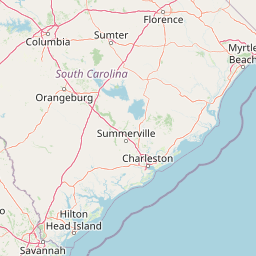
Map view of Congaree National Park

Use this park location map to pinpoint Congaree National Park in United States of America, understand its exact geographic position, and read its mapped placement within the surrounding landscape more clearly.

Pigeon | © OpenStreetMap contributors

Location context for Congaree National Park

Richland CountySouth Carolina
Park atlas

Browse the regional park geography and connected protected landscapes surrounding Congaree National Park.

Discover Other National Parks and Protected Areas Near Congaree National Park
Explore other national parks and protected areas that share geographic context or conservation themes with Congaree National Park. Compare floodplains, old-growth forests, or wetland ecosystems across the Southeastern United States and beyond, expanding your atlas knowledge of regional protected landscapes.
National parkTennessee

Great Smoky Mountains National Park: Exploring Its Protected Landscape and Regional Geography

Tennessee's premier national park, mapped for landscape discovery.

Delve into the protected area identity of Great Smoky Mountains National Park, a significant natural landmark within Tennessee. This page provides detailed context on its mountainous terrain, mapped ecological zones, and its foundational role in the broader geography of eastern North America. Understanding the park's specific protected landscape features and its geographic setting is essential for appreciating its unique conservation value.

Area
2,114.15 km²
Established
1934
IUCN
II
Visitors
12.2M annual
National parkWest Virginia

New River Gorge National Park and Preserve: Appalachian River Gorge Protected Landscape Atlas

Mapped terrain and geographic context within West Virginia.

Delve into the protected landscape identity of New River Gorge National Park and Preserve, a significant national park in West Virginia. This page details its role as a protected area, highlighting the dramatic river gorge geography, mapped terrain, and its place within the Appalachian Mountains. Understand the park's boundaries and the natural context that makes it a key destination for geographic discovery and conservation appreciation.

Area
294.64 km²
Established
2020
IUCN
V
Visitors
1.6M annual
Watercolor painting of rolling hills, trees, and a river in a scenic landscape
National parkVirginia

Shenandoah National Park: National Park Protected Landscape and Geography

Mapped terrain and protected area context in Virginia.

Shenandoah National Park is a designated national park in Virginia, offering a rich exploration of its protected landscape and geographic features. This page provides detailed atlas-oriented information, focusing on the park's mapped boundaries and its role within the regional geography. Discover the natural terrain and spatial identity of this important US protected area, ideal for understanding park landscapes.

Area
811.176 km²
Established
1935
IUCN
II
Visitors
1.7M annual
National parkKentucky

Mammoth Cave National Park: Kentucky's Premier National Park for Protected Landscape Exploration

Explore its mapped boundaries and regional geography.

Mammoth Cave National Park in Kentucky presents a profound opportunity for protected-area discovery, anchored by its status as a national park. This resource focuses on providing a factual atlas-style view of its landscape, emphasizing its geographic context within the region and the extent of its protected boundaries. Users can engage with detailed information designed for structured exploration, understanding the park not just as a location but as a key component of natural landscape data.

Area
210.46 km²
Established
1941
IUCN
II
Visitors
747K annual
National parkBahamas

Walker's Cay National Park: Bahamas National Park Featuring a Premier Barrier Reef Ecosystem

Explore mapped underwater geography and marine protected boundaries.

Walker's Cay National Park is a vital marine protected area located in the Bahamas, safeguarding approximately 3,840 acres of coastal and ocean waters. Its most distinguishing feature is the expansive barrier reef, a complex underwater geography teeming with diverse marine species that draws attention for diving and snorkeling. This park serves as a crucial element within the atlas of Bahamian protected lands, offering structured insights into marine conservation and the mapped distribution of critical reef habitats.

Area
16 km²
Established
2002
IUCN
II
Relief
Lowland
National parkGrand Bahama

Lucayan National Park: National Park Geography and Mapped Landscape Exploration

Discover protected area boundaries on Grand Bahama.

Lucayan National Park stands as a distinct national park entity within the geography of Grand Bahama. This page provides a focused atlas-style exploration of the park's protected landscape, detailing its mapped area and contributing to a structured understanding of its regional context. Delve into the geographic specifics that define Lucayan National Park as a key element of the Bahamas' protected lands, suitable for detailed map-based discovery and analysis.

Area
7.84 km²
Established
1982
IUCN
II
Climate
Tropical
National parkOhio

Cuyahoga Valley National Park: Detailed Atlas and Protected Landscape Information

Explore the mapped geography and natural terrain of Ohio's National Park.

Access detailed atlas information for Cuyahoga Valley National Park, a vital protected landscape in Ohio. Understand its geographic scope, mapped boundaries, and the surrounding natural terrain. This entry provides essential context for exploring the park's identity as a National Park and its significance within the broader mapped geography of the United States.

Area
132.7 km²
Established
2000
IUCN
II
Visitors
2.9M annual
National parkNorth Abaco

Black Sound Cay National Reserve National Park: Protected Landscape in North Abaco

Explore its mapped boundaries and regional geographic context.

Black Sound Cay National Reserve is a key protected area situated in North Abaco, within the Bahamas. This national park offers a unique lens into the island's natural geography and conservation landscapes. Users can delve into the park's mapped outlines and understand its specific role within the broader Abaco Islands archipelago, providing critical geographic context for any atlas-based discovery.

Area
0.008 km²
Established
1988
IUCN
Ia
Relief
Lowland

Common questions about visiting, size, designation, and location context for Congaree National Park

Congaree National Park FAQs for park facts, access, geography, and protected area context
Find quick answers about Congaree National Park, including protected-area facts, park geography, trail and visitor context, and how the park fits into its surrounding country and regional landscape.
MoriAtlas Explorer

Continue Your Protected Areas Search Across the Global Atlas

Deepen your exploration by continuing the structured search for national parks and protected areas worldwide. Utilize the comprehensive filtering capabilities to compare different conservation landscapes and refine your understanding of global park geography. Discover more about the distribution and characteristics of protected natural areas.

Global natural geography