Why Banff National Park stands out
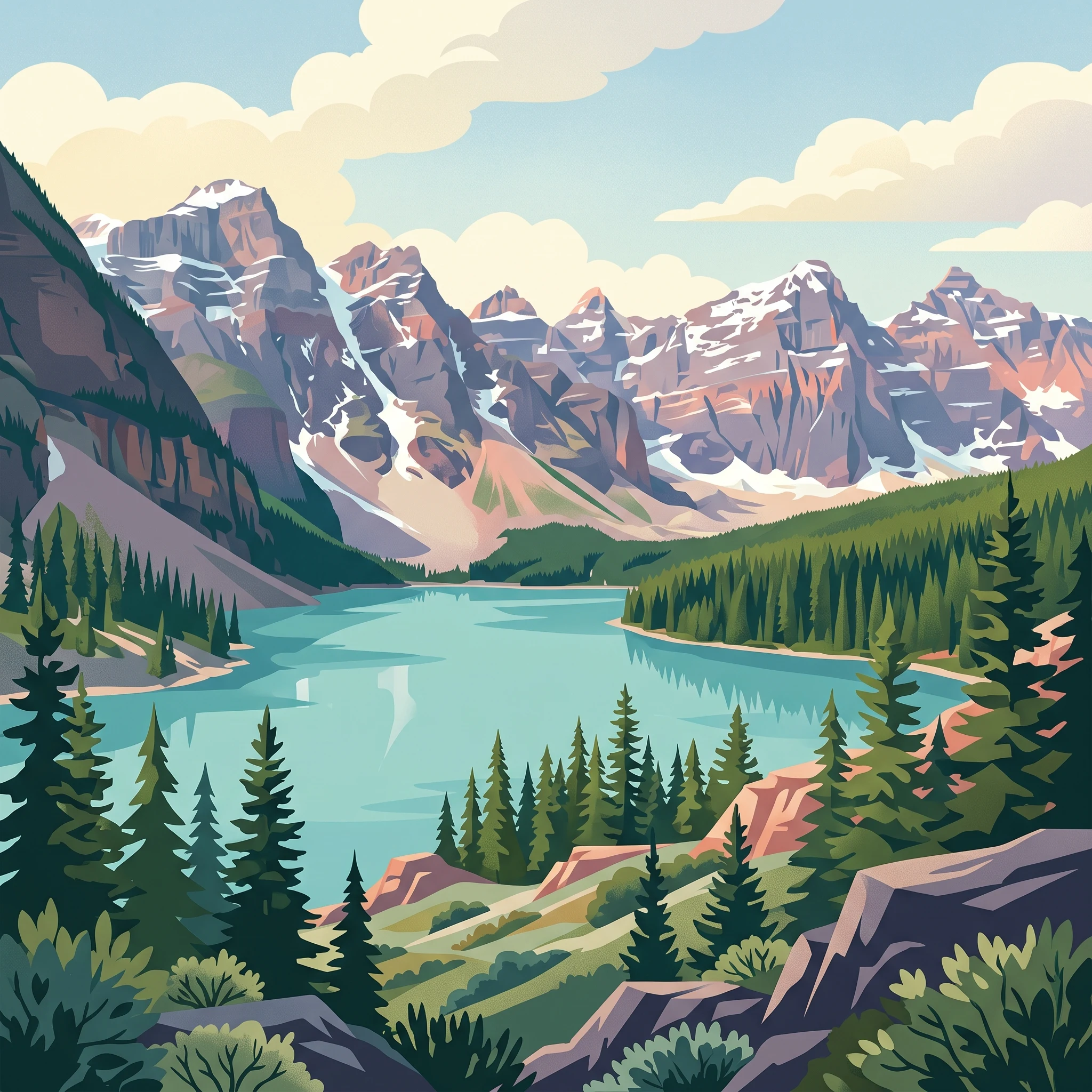
Banff National Park is best known for its spectacular Rocky Mountain scenery, including the iconic turquoise waters of Moraine Lake set against the Valley of the Ten Peaks, the glacially-fed Lake Louise framed by Mount Victoria Glacier, and the dramatic Bow Valley corridor. The park protects the Columbia Icefield, the largest ice field in the Canadian Rockies, which feeds glaciers visible from the Icefields Parkway scenic highway. Banff is renowned for its diverse wildlife including grizzly bears, elk, bighorn sheep, and mountain goats, as well as for the historic Banff Springs Hotel and Chateau Lake Louise, grand railway-era hotels that established Banff as a luxury mountain destination. The park's combination of accessibility, dramatic mountain landscapes, outdoor recreation opportunities, and significant conservation history makes it one of Canada's most recognizable and important protected areas.
Banff National Park history and protected-area timeline
Banff National Park's history reflects the broader tensions between conservation and land exploitation that have shaped North American protected areas since the late nineteenth century. The park's origins trace to 1885 when conflicting claims over the discovery of hot springs at Cave and Basin prompted Prime Minister John A. Macdonald to establish a 26-square-kilometre protected reserve around the springs. The Rocky Mountains Park Act of June 1887 expanded the reserve to 674 square kilometres and formally established Canada's first national park, making it the third in North America after Yellowstone and Mackinac. The Canadian Pacific Railway played a foundational role in developing the park, constructing the Banff Springs Hotel and Chateau Lake Louise to attract tourists and rail passengers. Throughout the early twentieth century, the Stoney Nakoda and other Indigenous peoples were systematically excluded from the park between 1890 and 1920. The park boundaries fluctuated significantly during this period, expanding to 11,400 square kilometres in 1902 before being reduced to 4,663 square kilometres in 1911 due to grazing and logging interests. The current boundaries were established in 1930 with the passage of the National Parks Act, which also formally renamed the area Banff National Park after the CPR station named for the Banffshire region in Scotland. During World War I, Austrian and German internees were held at Castle Mountain and Cave and Basin, contributing significantly to early infrastructure development. The Great Depression brought public works projects that constructed much of the park's enduring infrastructure, including the Upper Hot Springs facility. Winter tourism developed in 1917 with the first Banff Winter Carnival, though year-round operations only began in 1968 when the Banff Springs Hotel was winterized.
Banff National Park landscape and geographic character
Banff National Park showcases the dramatic geomorphology of the Canadian Rockies, a landscape shaped by ancient sea deposition, mountain-building forces, and glacial erosion over hundreds of millions of years. The park contains two principal mountain ranges: the Main Ranges (also called Park Ranges) along the western border forming part of the continental divide, and the Front Ranges occupying the eastern portion where the Banff townsite is located. The Main Ranges include the Waputik, Bow, and Blue Ranges, while the Front Ranges comprise the Palliser, Sawback, and Sundance Ranges. The highest peak entirely within the park is Mount Forbes at 3,612 metres, though Mount Assiniboine on the provincial boundary reaches 3,618 metres. The mountains exhibit diverse geological character, from classic dip-slope formations like Mount Rundle to the jagged dogtooth peaks of Mount Louis and the nearly vertical sedimentary layers of the Sawback Range that resemble saw teeth. Glacial landforms dominate the landscape, with classical examples including cirques, arêtes, hanging valleys, terminal moraines, and U-shaped valleys. The Columbia Icefield at the northern end straddles the Banff-Jasper boundary and extends into British Columbia, while Snow Dome within the icefield serves as a hydrological apex of North America where water flows to the Atlantic, Pacific, and Arctic Oceans. The Icefields Parkway, reaching 2,088 metres at Bow Summit, crosses the highest elevation reached by any public road in Canada.
Banff National Park ecosystems, habitats, and plant life
Banff National Park's ecological diversity spans three distinct ecoregions that create a vertical gradient of habitats from valley floors to alpine summits. The subalpine ecoregion dominates 53 percent of the park's area, characterized by dense forests of Engelmann spruce and subalpine fir with areas of lodgepole pine. Montane ecosystems occupy approximately 3 percent of the park at lower elevations, where lodgepole pine forests contain intermixed Engelmann spruce, willow, aspen, Douglas-fir, and Douglas maple. The alpine ecoregion accounts for 27 percent of the park above the tree line at approximately 2,300 metres, featuring open meadows, rock, and ice. The forests transition with elevation, with lodgepole pine dominating lower elevations while Engelmann spruce becomes more common in subalpine zones. The montane areas in the Bow Valley, which have experienced significant human development, historically provided preferred wildlife habitat and remain ecologically important despite modification. The park lies within the Alberta Mountain forests ecoregion, part of the broader Rocky Mountain coniferous forests that span the cordillera from Alaska to New Mexico.
Banff National Park wildlife and species highlights
Banff National Park supports remarkable wildlife diversity with 56 recorded mammal species, over 280 bird species, and a limited number of reptile and amphibian species adapted to the harsh subarctic climate. Large predators including grizzly bears and black bears inhabit the forested regions, while cougars, lynx, wolverines, red foxes, coyotes, and gray wolves maintain the predator guild. The park has been particularly significant for wolf recovery, with gray wolves recolonizing the Bow Valley starting in 1985 after a thirty-year absence due to systematic predator control. Ungulates including Rocky Mountain elk, mule deer, white-tailed deer, moose, mountain goats, and bighorn sheep occupy different habitats throughout the park, with elk particularly abundant in valley areas including around the Banff townsite. The park's smallest mammals include beavers, porcupines, squirrels, chipmunks, snowshoe hares, and Columbian ground squirrels. Boreal woodland caribou, once the rarest large mammals in the park, were likely extirpated following an avalanche in 2009 that killed the last known individuals. American bison were successfully reintroduced in 2017, with a herd of 16 animals from Elk Island National Park growing to 66 individuals by 2021. The Banff Springs snail, found only in the park's hot springs, represents an endangered endemic species requiring specific conservation attention.
Banff National Park conservation status and protection priorities
Banff National Park serves as a flagship for Canadian conservation policy and ecological management, particularly following the 1988 amendment to the National Parks Act that established ecological integrity as the primary priority in all park management decisions. The park's designation as a UNESCO World Heritage Site in 1984, as part of the Canadian Rocky Mountain Parks World Heritage Site, added international obligations for conservation of outstanding universal values including mountain landscapes, glaciers, lakes, waterfalls, canyons, and fossil beds. The mid-1990s Banff-Bow Valley Study represented a landmark assessment addressing the tension between visitor use and ecological integrity, producing over 500 recommendations including population caps for the town of Banff, trail quotas, and development limitations. Parks Canada employs ecosystem-based management approaches integrating modern scientific ecological information with traditional knowledge. Wildlife management strategies include wildlife crossings along the Trans-Canada Highway, which have reduced vehicle-wildlife collisions by over 80 percent through a system of underpasses and six overpasses combined with 82 kilometres of highway fencing. The park faces ongoing conservation challenges including climate-driven glacier retreat, mountain pine beetle infestations, and the need to balance visitor access with ecological protection.
Banff National Park cultural meaning and human context
The Banff area has been home to Indigenous peoples for over 10,000 years, with archaeological evidence at Vermilion Lakes dating to 10,300 years before present. Prior to European contact, the area now within Banff National Park was inhabited by the Stoney Nakoda, Ktunaxa, Tsuut'ina, Kainaiwa, Piikani, Siksika, and Plains Cree, who used the landscape for hunting, fishing, trading, travel, and cultural practices. Many locations within the park retain their Stoney Nakoda names, including Lake Minnewanka and the Waputik Range. Cave and Basin served as an important cultural and spiritual site for the Stoney Nakoda. With the completion of the transcontinental railway through Kicking Horse Pass in 1885, the Canadian Pacific Railway became instrumental in the park's early development, building grand hotels and promoting mountain tourism. The park's establishment marked the beginning of Canada's national parks system and represented a significant shift in how North American societies valued wild landscapes, moving from purely extractive uses toward preservation for public enjoyment. The internment of Austrian and German immigrants during World War I at Castle Mountain and Cave and Basin represents a darker chapter, commemorated by historical plaques and a 2013 interpretive pavilion. The Ukrainian Canadian Civil Liberties Association has been active in recognizing and commemorating this history.
Top sights and standout views in Banff National Park
Banff National Park offers an unparalleled combination of accessible mountain grandeur, with destinations like Moraine Lake's iconic turquoise waters and the Valley of the Ten Peaks, Lake Louise framed by Mount Victoria Glacier, and the dramatic vistas along the Icefields Parkway. The park protects the Columbia Icefield, the largest uninterrupted glacial mass in the Canadian Rockies, where visitors can walk on the Athabasca Glacier. Wildlife viewing opportunities include encounters with elk herds in the Bow Valley, mountain goats on cliff faces, bighorn sheep along highway corridors, and the possibility of spotting bears in forested areas. The Banff townsite provides cultural attractions including the Banff Centre for Arts and Creativity, the Whyte Museum, the Buffalo Nations Luxton Museum, and the Cave and Basin National Historic Site. The park's ski resorts at Sunshine Village, Mount Norquay, and Lake Louise Mountain Resort offer year-round recreation. The Icefields Parkway between Lake Louise and Jasper ranks among the world's most scenic drives, passing through the park's most dramatic mountain and glacial scenery.
Best time to visit Banff National Park
Banff National Park offers distinct seasonal experiences throughout the year, with each season presenting different character and opportunities. Summer months (June through August) bring the warmest temperatures, with daily highs averaging 22.5 degrees Celsius in July, and provide the most accessible hiking, wildlife viewing, and scenic driving opportunities, though this peak season also brings the highest visitor numbers. Autumn (September through October) offers fewer crowds, spectacular fall colour in the deciduous forests, and excellent wildlife viewing as elk enter mating season. Winter (December through March) transforms the park into a skiing destination with abundant snowfall averaging 184 centimetres in the townsite and 279 centimetres at Lake Louise, while the frozen landscapes and empty trails provide a dramatically different experience from the busy summer months. Spring (April through May) features melting snow, rising rivers, and awakening wildlife, though some roads and facilities remain closed. The park's subarctic climate means winter temperatures can drop below minus 20 degrees Celsius with wind chill, while Chinook winds moderate temperatures compared to other areas of central Alberta. Year-round access to the park is possible since accommodations became fully operational in 1968, though some higher-elevation roads and facilities have seasonal closures.