Mori Atlas logo
National parkGlacier National Park

Explore the mapped boundaries and natural terrain of this significant protected landscape.

Glacier National Park: Montana's National Park Protected Area and Landscape Geography

Glacier National Park stands as a vital protected area within Montana, offering a significant focus for geographic and atlas-based exploration. This entry provides detailed context on its mapped boundaries, the surrounding natural terrain, and its role as a national park within the United States' protected lands system. Understand the geographic scope and landscape identity that define Glacier National Park for atlas discovery.

Rocky MountainsGlacial LandscapeWorld Heritage SiteInternational Peace ParkAlpine EnvironmentHistoric Hotels

Glacier National Park

National park

Park overview

Structured park overview, official facts, and landscape profile for Glacier National Park

Glacier National Park park facts, protected area profile, and essential visitor context
Review the core facts for Glacier National Park, including designation, size, terrain, visitor scale, habitats, and operating context in one park-focused overview.

About Glacier National Park

Glacier National Park represents one of the most significant wilderness areas in the United States, protecting a remarkable diversity of ecosystems from prairie grasslands to alpine tundra within a single landscape. The park serves as the crown jewel of the Crown of the Continent Ecosystem, a vast wilderness region that remains largely untouched and provides critical habitat for numerous species including grizzly bears, gray wolves, and mountain goats. The park's significance extends beyond its natural beauty to its geological importance, as the Lewis Overthrust displays some of the oldest sedimentary rocks on Earth, with fossils dating back approximately 1.4 billion years.

The establishment of Glacier National Park in 1910 followed decades of advocacy by conservationist George Bird Grinnell, who first explored the region in 1885 and spent two decades working to protect the land. The park's creation was also influenced by the Great Northern Railway, whose president Louis W. Hill saw the tourism potential of the region and helped lobby Congress for the park's designation. Today the park maintains almost all of its modern original native plant and animal species since European discovery, providing biologists with an essentially intact ecosystem for research and study.

Quick facts and research context for Glacier National Park

Glacier National Park is located in northwestern Montana along the Canadian border, spanning Flathead and Glacier counties. The park covers 1,013,322 acres (4,100.77 km2) and was established on May 11, 1910, making it one of the oldest national parks in the United States. The park contains over 700 lakes, though only 131 have been named, with Lake McDonald being the longest at 10 miles and the deepest at 464 feet. Six mountains in the park exceed 10,000 feet in elevation, with Mount Cleveland being the tallest at 10,466 feet. The park is managed by the National Park Service with headquarters in West Glacier, Montana.

Park context

Deeper park guide and search-rich context for Glacier National Park

Glacier National Park history, landscape, wildlife, and travel context
Explore Glacier National Park through its history, landscape character, ecosystems, wildlife, conservation priorities, cultural context, and seasonal travel timing in a structured park guide built for atlas discovery and search intent.

Why Glacier National Park stands out

Glacier National Park is best known for its dramatic mountain landscapes carved by ancient glaciers, its iconic Going to the Sun Road that traverses the Continental Divide at Logan Pass, and its historic Swiss style lodges and chalets built by the Great Northern Railway in the early 1900s. The park is famous for its remaining glaciers though these have retreated dramatically from an estimated 150 glaciers over 25 acres in size in the mid 19th century to only 25 active glaciers by 2010. The mountain goat serves as the official park symbol and is commonly spotted on high rocky cliffs. The park is also renowned as part of the world's first International Peace Park with Waterton Lakes National Park in Canada.

Glacier National Park history and protected-area timeline

The region that became Glacier National Park was first inhabited by Native Americans, with the Blackfeet dominating the eastern regions and the Flathead (Salish) and Kootenai occupying the western areas. The Blackfeet considered the mountains of this area, especially Chief Mountain and the region at Two Medicine, as the Backbone of the World and frequented these areas during vision quests. In 1895 Chief White Calf of the Blackfeet authorized the sale of approximately 800,000 acres of mountain area to the U.S. government for $1.5 million, establishing the current boundary between the park and the reservation.

George Bird Grinnell first visited the region in 1885 and became so inspired by the scenery that he spent the next two decades working to establish a national park. His efforts, combined with those of the Boone and Crockett Club and Louis W. Hill president of the Great Northern Railway, led to the park's establishment in 1910 when President William Howard Taft signed the bill into law. The Great Northern Railway subsequently built numerous hotels and chalets throughout the park in the 1910s, constructing properties such as Many Glacier Hotel, Lake McDonald Lodge, and Sperry Chalet, all designed in Swiss alpine style. The Going to the Sun Road, completed in 1932, bisects the park and is recognized as a National Historic Civil Engineering Landmark.

Glacier National Park landscape and geographic character

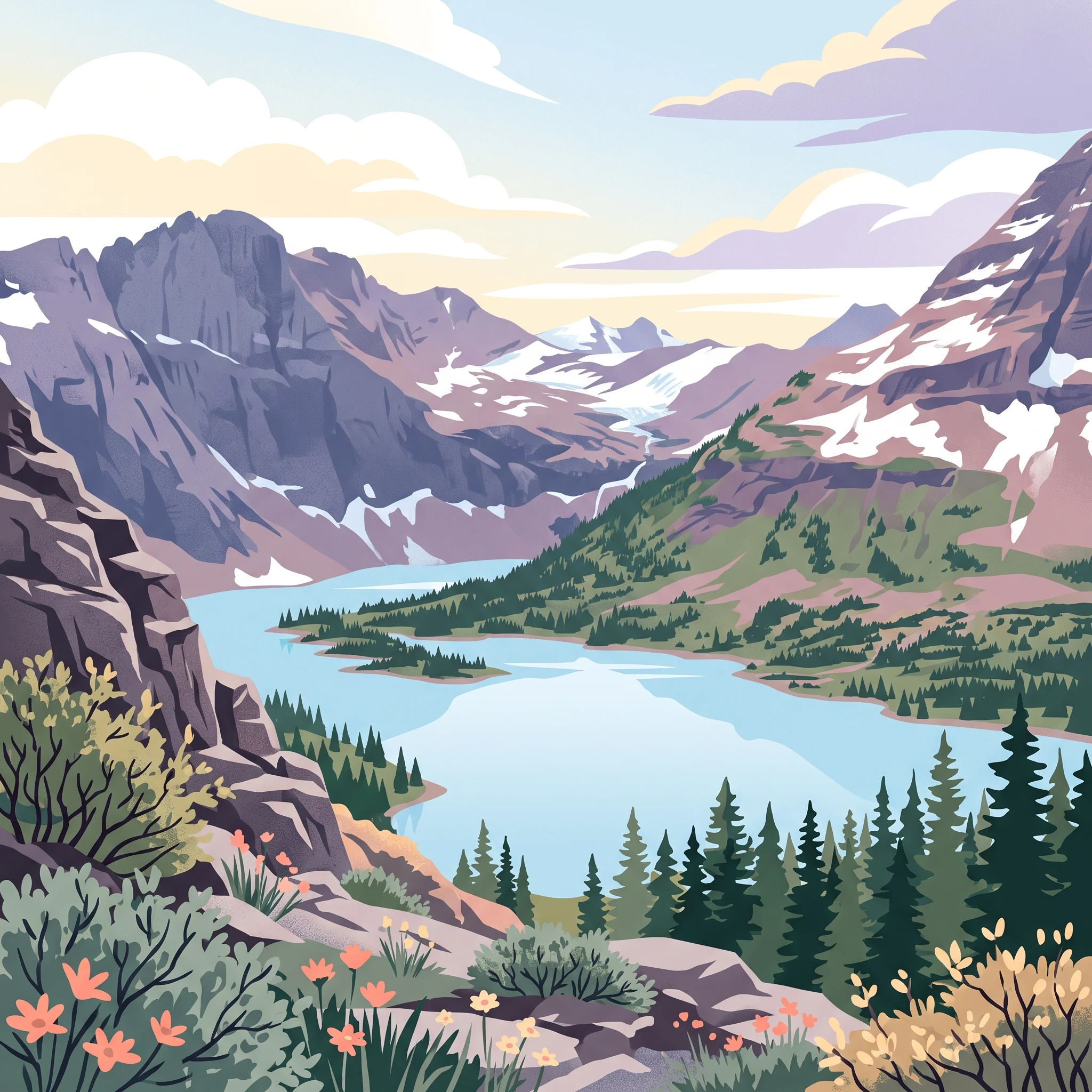
Glacier National Park displays dramatic mountain terrain shaped by glacial action, featuring U shaped valleys, cirques, arêtes, and large outflow lakes radiating like fingers from the base of the highest peaks. The park encompasses parts of two sub ranges of the Rocky Mountains, the Lewis Range and the Livingston Range, with six mountains exceeding 10,000 feet in elevation. Chief Mountain, an isolated peak on the eastern boundary, rises 2,500 feet above the Great Plains as a dramatic example of the Lewis Overthrust. Triple Divide Peak sends waters toward the Pacific Ocean, Hudson Bay, and the Gulf of Mexico, making it effectively the apex of the North American continent. The park contains over 700 lakes, including the 10 mile long Lake McDonald, with many smaller tarns located in cirques formed by glacial erosion. Some lakes such as Avalanche Lake and Cracker Lake display an opaque turquoise color from suspended glacial silt.

Glacier National Park ecosystems, habitats, and plant life

Glacier National Park contains numerous ecosystems ranging from prairie to tundra, representing one of the most ecologically diverse protected areas in North America. The park is part of the larger Crown of the Continent Ecosystem, all of which remains primarily untouched wilderness of pristine quality. Over 1,132 plant species have been identified parkwide, with coniferous forests dominated by Engelmann spruce, Douglas fir, subalpine fir, limber pine, and western larch. The cedar hemlock groves along the Lake McDonald valley represent the easternmost examples of this Pacific climatic ecosystem. Above the forested valleys, alpine tundra conditions prevail with grasses and small plants surviving in a region with as little as three months without snow cover. Whitebark pine communities have been heavily damaged by blister rust, a non native fungus, with 30 percent of trees dead and over 70 percent of remaining trees infected.

Glacier National Park wildlife and species highlights

Glacier National Park is home to an impressive diversity of wildlife, with large mammals including American black bear, grizzly bear, bighorn sheep, elk, moose, mountain lion, and mountain goats inhabiting the park. The gray wolf, wolverine, and Canadian lynx also inhabit the park, with the grizzly bear and lynx listed as threatened species. Over 1,000 grizzlies live in the region as of 2021, more than triple the population estimates in 1975. The mountain goat serves as the official park symbol and is commonly observed on high rocky cliffs throughout the park. Over 260 species of birds have been recorded, including raptors such as bald eagle, golden eagle, peregrine falcon, and osprey. Twenty three species of fish reside in park waters, including the threatened bull trout which must be returned to the water if caught.

Glacier National Park conservation status and protection priorities

Glacier National Park holds significant conservation importance as a World Heritage Site, Biosphere Reserve, and component of the world's first International Peace Park with Waterton Lakes National Park in Canada. The park was designated as a Biosphere Reserve in 1976 and received World Heritage Site status in 1995 for meeting natural criteria related to exceptional natural beauty and geological significance. In 2017 the joint park received provisional Gold Tier designation as an International Dark Sky Park, the first transboundary dark sky park. A wilderness study submitted to Congress in 1974 identified 95 percent of the park as qualifying for wilderness designation, and 93 percent is currently managed as wilderness even though it has not been officially designated. The park maintains almost all of its original native plant and animal species since European discovery, providing a rare example of an intact ecosystem.

Glacier National Park cultural meaning and human context

The Glacier region was first inhabited by the Flathead (Salish), Kootenai, Shoshone, and Cheyenne tribes, with the Blackfeet living on the eastern slopes and the Great Plains immediately to the east. The Blackfeet Indian Reservation borders the park to the east while the Flathead Indian Reservation lies west and south of the park. When the Blackfeet Reservation was first established in 1855 by the Lame Bull Treaty, it included the eastern area of the current park up to the Continental Divide. The Blackfeet ceded the mountainous parts of their treaty lands in 1895 to the federal government, which became part of the park. While the forest reserve designation confirmed traditional usage rights of the Blackfeet, the national park enabling legislation did not mention guarantees to Native Americans, leading to ongoing discussions about traditional usage rights.

Top sights and standout views in Glacier National Park

Glacier National Park offers exceptional mountain scenery with over 700 lakes, 200 waterfalls, and peaks reaching above 10,000 feet. The Going to the Sun Road provides access to the heart of the park, crossing the Continental Divide at Logan Pass with views of dramatic glaciated valleys. Historic Swiss style hotels and chalets built by the Great Northern Railway in the 1910s remain operational, including Sperry Chalet, Granite Park Chalet, Many Glacier Hotel, and Lake McDonald Lodge. The park contains 350 buildings and structures listed on the National Register of Historic Places. Over 700 miles of hiking trails traverse the park, including 110 miles of the Continental Divide National Scenic Trail. The park protects critical habitat for grizzly bears, gray wolves, mountain goats, and bighorn sheep.

Best time to visit Glacier National Park

Glacier National Park can be visited throughout the year, though the summer months of June through September offer the most accessible conditions for hiking and sightseeing. The Going to the Sun Road is typically fully open from late May or early June through October, depending on snow conditions. The winter months offer opportunities for cross country skiing in lower altitude valleys, though snowmobiling is prohibited throughout the park. Summer daytime temperatures average 60 to 70 degrees Fahrenheit with nighttime lows in the 40s, while high country temperatures remain considerably cooler. Fall brings fewer crowds and spectacular autumn foliage, particularly in the aspen and cottonwood groves along lakes and streams. Spring and early summer feature abundant wildflowers and snowmelt fed waterfalls, though many backcountry areas remain inaccessible until early July due to snowpack.
Park location guide

Geography guide, regional context, and park location map for Glacier National Park

Glacier National Park park geography, regions, and map view in United States of America
Understand where Glacier National Park sits in United States of America through a broader geographic reading of the surrounding landscape, nearby location context, and its mapped position within the national park landscape.

How Glacier National Park fits into United States of America

The United States of America is a federal presidential republic and one of the world's largest countries by area and population. It consists of 50 states across a vast territory spanning multiple time zones, with its capital in Washington, D.C. and largest city in New York City. The nation has a diverse economy, influential political system, and significant cultural and military presence globally.

Wider geography shaping Glacier National Park in United States of America

The United States occupies a vast territory in North America, bordered by Canada to the north and Mexico to the south. The 48 contiguous states stretch from the Atlantic to the Pacific Ocean, while Alaska occupies the northwestern region and Hawaii is an archipelago in the Pacific. The country encompasses diverse terrain including the Rocky Mountains, Appalachian Mountains, Great Plains, and extensive river systems.

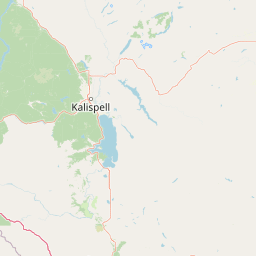
Map view of Glacier National Park

Use this park location map to pinpoint Glacier National Park in United States of America, understand its exact geographic position, and read its mapped placement within the surrounding landscape more clearly.

Pigeon | © OpenStreetMap contributors

Location context for Glacier National Park

Flathead CountyGlacier CountyMontana
Park atlas

Compare mountain terrain and protected landscapes around Glacier National Park, tracing regional conservation efforts.

Explore Other National Parks and Protected Areas Near Glacier National Park
Explore national parks and protected areas geographically near Glacier National Park, encompassing neighboring mountain ranges and the wider Crown of the Continent Ecosystem. This comparative view allows you to trace the spread of protected landscapes, understand regional conservation patterns, and continue your atlas-based discovery of significant natural sites.
National parkAlberta

Waterton Lakes National Park: Alberta's Protected Landscape and Geographic Atlas

Explore mapped boundaries and regional terrain context.

Waterton Lakes National Park represents a vital protected area situated within the province of Alberta. This atlas view focuses on its mapped boundaries and the characteristic natural terrain, providing essential geographic context for understanding its significance. Discover its role as a national park and its placement within the regional geography of Western Canada, ideal for users seeking structured data on protected lands and landscape features.

Area
505 km²
Established
1895
IUCN
II
Visitors
475.8K annual
National parkBritish Columbia

Kootenay National Park: National Park Protected Landscape and Geographic Context

Explore Kootenay National Park's mapped terrain and regional geography.

Kootenay National Park is a protected national park located in British Columbia, Canada. This dedicated detail page provides an atlas-style exploration of its geographic identity, focusing on its mapped boundaries and the surrounding natural terrain. Understand how Kootenay National Park fits into the larger regional geography, offering rich context for protected landscape discovery and analysis.

Area
1,406 km²
Established
1920
IUCN
II
Visitors
574.1K annual
National parkCanada

Banff National Park: Exploring Canada's Iconic National Park Protected Landscape and Geography

Mapped park boundaries and regional geographic context for Banff National Park.

Gain a structured understanding of Banff National Park as a key protected area within Canada. This resource details its identity as a national park, providing insights into its geographic setting and mapped landscape. It serves as a vital point for atlas-based discovery, helping to contextualize Banff National Park's significance within Canada's protected lands and natural terrain.

Area
6,641 km²
Established
1885
IUCN
II
Visitors
4.1M annual
National parkColumbia-Shuswap Regional District

Glacier National Park: A National Park within Canada's Protected Landscape Atlas

Explore its mapped boundaries and regional geography.

Glacier National Park represents a significant protected area entity within the broader Canadian geography. This page offers an atlas-oriented perspective on its identity as a national park, focusing on its mapped geographic spread and role as a conservation landscape. Users can explore the park's place within the Columbia-Shuswap Regional District and understand its distinct contribution to the national protected area framework.

Area
1,349 km²
Established
1886
IUCN
II
Visitors
4M annual
National parkBritish Columbia

Mount Revelstoke National Park: Explore Protected Landscape Geography and Mapped Boundaries

British Columbia's National Park Atlas Entry

Delve into the protected landscape of Mount Revelstoke National Park, a critical national park located in British Columbia. This entry provides a detailed look at its mapped geographic extent and protected area identity, offering valuable context for regional atlas exploration. Understand the park's distinct contribution to the mapped natural landscapes of Canada.

Area
260 km²
Established
1914
IUCN
II
Visitors
775.2K annual
National parkSaskatchewan

Grasslands National Park: Saskatchewan Protected Landscape Atlas

Discover its mapped boundaries and regional geographic context.

Grasslands National Park represents a vital component of protected lands in Saskatchewan, Canada, offering rich opportunities for atlas-based geographic exploration. This detail page provides specific insights into the park's mapped boundaries, its natural terrain, and its role as a national park within the broader regional geography. Understand how this protected landscape fits into the larger atlas of Canadian conservation areas and discover its unique geographic identity.

Area
907 km²
Established
1981
IUCN
II
Visitors
19.7K annual
National parkWyoming

Yellowstone National Park: US National Park Protected Landscape & Geographic Atlas

Explore mapped boundaries and regional natural landscape context.

Yellowstone National Park represents a significant protected landscape within Wyoming, designated as a US national park. This entry offers detailed insight into its geographic scope, mapped boundaries, and the unique natural terrain that defines it. Understand its role in regional geography and discover its protected-area identity through a structured atlas exploration, providing context for its conservation landscape.

Area
8,983.18 km²
Established
1872
IUCN
II
Visitors
4.7M annual
National parkAlberta

Jasper National Park National Park: Mapped Protected Landscape and Alberta Geography

Explore Alberta's regional park context and natural terrain.

Jasper National Park is a key protected national park in Alberta, Canada, offering extensive natural landscapes. This park page details its precise geographic location, outlines its protected boundaries, and provides context within the regional geography of Western Canada. Discover the mapped terrain and the park's significance as a protected area within a broader atlas perspective.

Area
10,878 km²
Established
1907
IUCN
II
Visitors
2.4M annual

Common questions about visiting, size, designation, and location context for Glacier National Park

Glacier National Park FAQs for park facts, access, geography, and protected area context
Find quick answers about Glacier National Park, including protected-area facts, park geography, trail and visitor context, and how the park fits into its surrounding country and regional landscape.
MoriAtlas Explorer

Continue Your Protected Areas Search Across the Global Atlas

Deepen your exploration by continuing the structured search for national parks and protected areas worldwide. Utilize the comprehensive filtering capabilities to compare different conservation landscapes and refine your understanding of global park geography. Discover more about the distribution and characteristics of protected natural areas.

Global natural geography