Mori Atlas logo
National parkMesa Verde National Park

Understand the mapped boundaries and regional terrain of this significant US National Park.

Mesa Verde National Park: A Protected Landscape in Montezuma County Geography

Mesa Verde National Park stands as a key protected landscape, offering deep insights into the regional geography of Montezuma County. This dedicated page provides an atlas-style exploration of its protected boundaries and natural terrain. Users can understand the park's specific geographic identity and its context within the United States' network of conservation lands, focusing on mapped landscape features relevant for discovery and geographic understanding.

UNESCO World Heritage SiteArchaeological PreserveAncestral Puebloan CultureCliff DwellingsSouthwest USAColorado National Park

Mesa Verde National Park

National park

Park overview

Structured park overview, official facts, and landscape profile for Mesa Verde National Park

Mesa Verde National Park park facts, protected area profile, and essential visitor context
Review the core facts for Mesa Verde National Park, including designation, size, terrain, visitor scale, habitats, and operating context in one park-focused overview.

About Mesa Verde National Park

Mesa Verde National Park stands as a testament to the remarkable civilization of the Ancestral Puebloans who inhabited this region for over 700 years. The park's extraordinary concentration of cliff dwellings, mesa-top villages, petroglyphs, and other archaeological sites provides an unparalleled window into the lives of people who developed complex agricultural societies in the challenging environment of the American Southwest. The Ancestral Puebloans transitioned from semi-nomadic hunting and gathering to established agricultural communities, eventually constructing the massive multi-story cliff dwellings that make Mesa Verda uniquely significant. The park's establishment in 1906 marked a pioneering recognition that archaeological and cultural sites deserved the same protection as natural wonders, setting a precedent for the preservation of cultural heritage in the United States.

Quick facts and research context for Mesa Verde National Park

Mesa Verde National Park encompasses 52,485 acres (212 km²) of protected land in southwestern Colorado. The park contains over 4,370 documented archaeological sites, making it the largest such preserve in the United States. Founded in 1906 as the first national park created specifically to protect cultural heritage, it was designated a UNESCO World Heritage Site in 1978. The park's elevation ranges from approximately 6,000 to 8,572 feet at Park Point. The nearest communities are Cortez, Colorado to the west and Mancos, Colorado to the east.

Park context

Deeper park guide and search-rich context for Mesa Verde National Park

Mesa Verde National Park history, landscape, wildlife, and travel context
Explore Mesa Verde National Park through its history, landscape character, ecosystems, wildlife, conservation priorities, cultural context, and seasonal travel timing in a structured park guide built for atlas discovery and search intent.

Why Mesa Verde National Park stands out

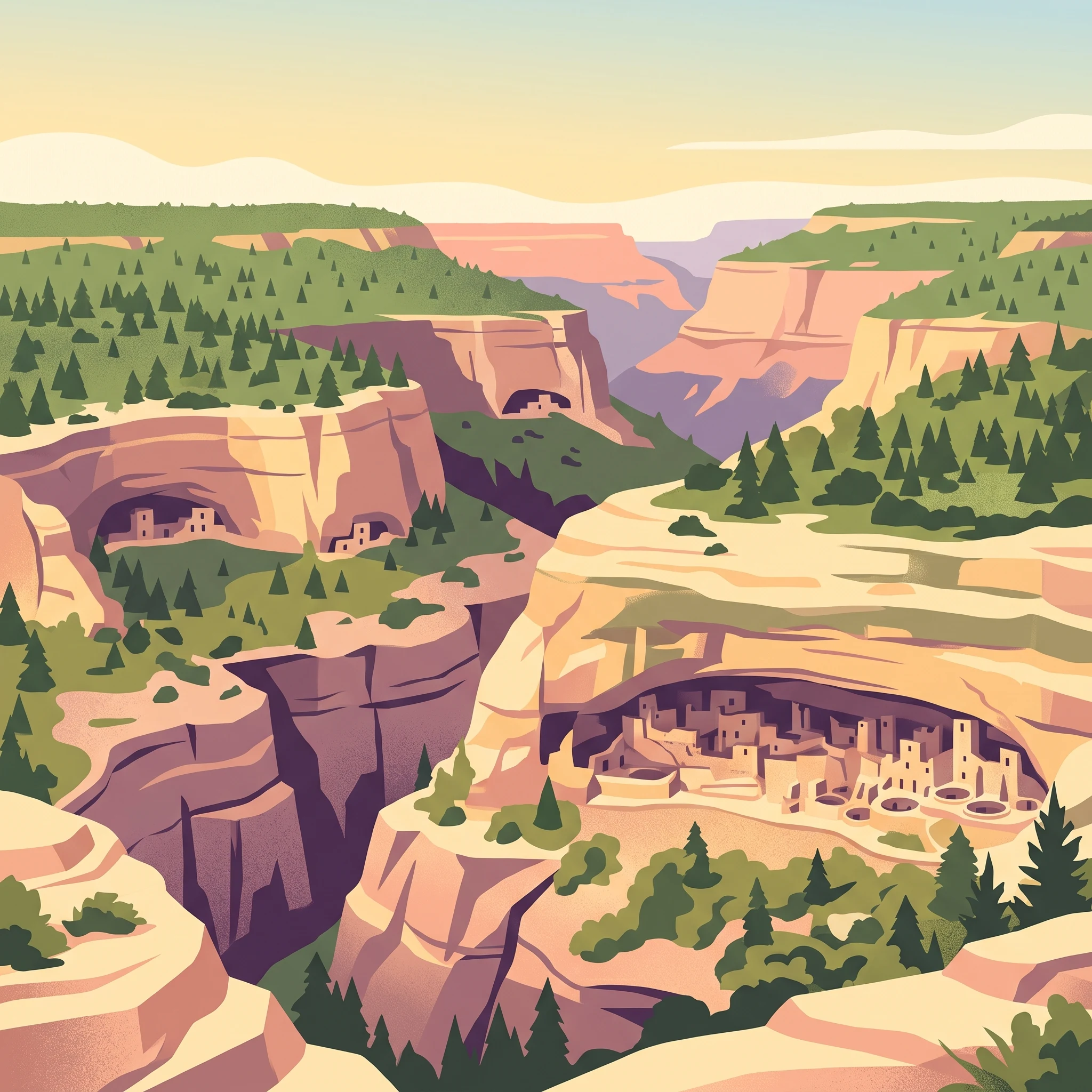
Mesa Verde is best known for its extraordinary collection of cliff dwellings, particularly Cliff Palace, which is the largest cliff dwelling in North America with 150 rooms and 23 kivas. The park protects more than 600 cliff dwellings built by Ancestral Puebloans between the 12th and 13th centuries, representing some of the most sophisticated and well-preserved prehistoric architecture in North America. These sandstone and adobe structures, built into natural alcoves along canyon walls, represent the peak of Ancestral Puebloan architectural achievement and remain among the world's greatest archaeological treasures.

Mesa Verde National Park history and protected-area timeline

The history of Mesa Verde National Park spans both ancient human occupation and modern preservation efforts. The Ancestral Puebloans first occupied the region around 7500 BC, evolving through the Archaic period and Basketmaker culture before developing into the complex Pueblo civilizations that built the iconic cliff dwellings between approximately 1150 and 1300 AD. By the late 13th century, an estimated 20,000 people lived in the Mesa Verde region before migrating south around 1285 during the Great Drought. Modern rediscovery began in the 1870s when prospectors and photographers first documented the cliff dwellings. Virginia McClurg led the campaign to protect the sites from 1887 to 1906, and President Theodore Roosevelt established the national park in 1906, the first created specifically to protect cultural heritage. Subsequent efforts included stabilization work by Jesse Walter Fewkes, Civilian Conservation Corps projects in the 1930s and 1940s, and the major Wetherill Mesa Archaeological Project from 1958 to 1965. The park was designated a World Heritage Site in 1978 and was listed on the National Register of Historic Places in 1966.

Mesa Verde National Park landscape and geographic character

The Mesa Verde landscape is defined by a series of cuestas (south-sloping mesas) separated by deep canyons eroded into the soft Mancos Shale and sandstone formations. The geological structure consists of three main rock layers: the Point Lookout Sandstone at the base, the Menefee Formation with its coal seams in the middle, and the Cliff House Sandstone at the top. The Cliff House Sandstone's differential erosion created the alcoves that the Ancestral Puebloans utilized for their cliff dwellings. Elevations range from approximately 6,000 feet in the canyon bottoms to 8,572 feet at Park Point. The terrain sits at the transition between the Colorado Plateau's low desert plateaus and the Rocky Mountains, characterized by pinyon-juniper covered mesa tops and rugged canyon walls.

Mesa Verde National Park ecosystems, habitats, and plant life

While Mesa Verde is primarily an archaeological preserve, the park's semi-arid environment supports characteristic Great Basin and Southwest forest ecosystems. The vegetation is dominated by pinyon pine and juniper on the mesa tops, with sparse grass coverage in the canyon bottoms. The region's bimodal precipitation pattern brings rainfall during spring and summer and snowfall during winter and autumn, supporting the pinyon-juniper woodlands despite the challenging climate. Archaeological analysis of pack rat middens indicates that the flora and fauna have remained relatively consistent for the past 4,000 years, though invasive species such as tumbleweed and clover have been introduced.

Mesa Verde National Park wildlife and species highlights

The park provides habitat for various wildlife species adapted to the semi-arid pinyon-juniper environment. Mule deer are among the larger mammals commonly observed, while smaller mammals include rabbits, chipmunks, and various rodent species. The Ancestral Puebloans hunted deer, bighorn sheep, antelope, and elk, and began domesticating turkeys around 1000 AD, which eventually became a primary protein source. Birds common to the area include raptors, jays, and various songbirds. Reptiles including lizards and snakes are present in the warmer canyon environments.

Mesa Verde National Park conservation status and protection priorities

Mesa Verde National Park represents one of the most significant conservation achievements for cultural heritage in the United States. As the largest archaeological preserve in the country, the park protects over 4,370 documented sites including 600 cliff dwellings. The designation as a UNESCO World Heritage Site in 1978 recognized its universal value to humanity. In 1976, 8,500 acres were designated as wilderness area to provide additional protection for significant Native American sites. The park initiated the Archaeological Site Conservation Program in 1995 to analyze site construction and utilization patterns. The four ancient reservoirs (Morefield, Box Elder, Far View, and Sagebrush) were designated National Civil Engineering Historic Landmarks by the American Society of Civil Engineers in 2004. However, the park has faced significant challenges from wildfires between 1996 and 2003, which burned over 28,000 acres and damaged archaeological sites.

Mesa Verde National Park cultural meaning and human context

Mesa Verde holds profound cultural significance as the ancestral homeland of the Ancestral Puebloans, whose modern descendants include the Hopi, Zuni, Acoma, Jemez, and Laguna peoples. The park's archaeological sites represent the material remains of a sophisticated civilization that developed advanced agricultural techniques, complex social organization, and remarkable architectural achievements. The Ute people, whose reservation borders the park, consider the cliff dwellings sacred ancestral sites and did not inhabit the ancient structures. The establishment of the park involved controversial land exchanges with the Ute Mountain Ute Tribe in 1911, issues that continue to affect relationships between the park and tribal communities. The Ute Mountain Tribal Park, adjoining Mesa Verde to the east, preserves additional Ancestral Puebloan and Ute cultural sites with Native American-led tours.

Top sights and standout views in Mesa Verde National Park

The park's highlights include Cliff Palace, the largest cliff dwelling in North America with 150 rooms and 23 kivas, and Long House, the second-largest village on Wetherill Mesa. Balcony House offers an adventurous ranger-guided tour requiring ladder climbs and tunnel passage. Spruce Tree House, the third-largest dwelling, is accessible via a short trail from the Chapin Mesa Museum. Square Tower House features the tallest structure in the park. Beyond cliff dwellings, the Far View Complex and Cedar Tree Tower on Chapin Mesa, and Badger House Community on Wetherill Mesa provide examples of mesa-top ruins. The Morefield and Far View reservoirs represent sophisticated ancient water management systems. The Sun Temple served as an astronomical observatory aligned to the winter solstice and major lunar standstill.

Best time to visit Mesa Verde National Park

The best times to visit Mesa Verde are spring and fall when temperatures are moderate and visitor crowds are reduced compared to summer months. Summer offers the most complete access to facilities, including food, fuel, and lodging services, though temperatures can be high. Winter access is limited, with many facilities closed and some roads impassable due to snow, though the Chapin Mesa Museum remains open year-round. The park's high elevation (around 7,000 feet) means that even summer evenings can be cool. Visitors planning to tour specific cliff dwellings should reserve tickets in advance, particularly during peak season, as ranger-guided tours to Balcony House, Long House, and Cliff Palace have limited availability.
Park location guide

Geography guide, regional context, and park location map for Mesa Verde National Park

Mesa Verde National Park park geography, regions, and map view in United States of America
Understand where Mesa Verde National Park sits in United States of America through a broader geographic reading of the surrounding landscape, nearby location context, and its mapped position within the national park landscape.

How Mesa Verde National Park fits into United States of America

The United States of America is a federal presidential republic and one of the world's largest countries by area and population. It consists of 50 states across a vast territory spanning multiple time zones, with its capital in Washington, D.C. and largest city in New York City. The nation has a diverse economy, influential political system, and significant cultural and military presence globally.

Wider geography shaping Mesa Verde National Park in United States of America

The United States occupies a vast territory in North America, bordered by Canada to the north and Mexico to the south. The 48 contiguous states stretch from the Atlantic to the Pacific Ocean, while Alaska occupies the northwestern region and Hawaii is an archipelago in the Pacific. The country encompasses diverse terrain including the Rocky Mountains, Appalachian Mountains, Great Plains, and extensive river systems.

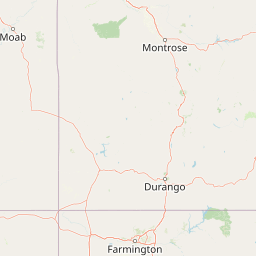
Map view of Mesa Verde National Park

Use this park location map to pinpoint Mesa Verde National Park in United States of America, understand its exact geographic position, and read its mapped placement within the surrounding landscape more clearly.

Pigeon | © OpenStreetMap contributors

Location context for Mesa Verde National Park

ColoradoMontezuma County
Park atlas

Trace the regional park geography and compare protected landscapes throughout the American Southwest.

Discover Nearby National Parks and Protected Areas Beyond Mesa Verde National Park
Browse other national parks and protected areas near Mesa Verde National Park, encompassing diverse conservation landscapes across the American Southwest. Continue your atlas exploration by comparing geological formations, unique ecosystems, and cultural heritage sites within this key geographic context.
National parkUtah

Canyonlands National Park: A Mapped Protected Landscape in Utah's Geography

Explore its vast geography and protected area boundaries.

Canyonlands National Park stands as a significant protected entity within the state of Utah, characterized by its immense scale and dramatic geological formations. This page facilitates an atlas-style exploration of its terrain, emphasizing its mapped boundaries and its crucial role as a protected landscape. Gain a deeper appreciation for its unique geographic setting and its place within the broader regional context.

Area
1,366.21 km²
Established
1964
IUCN
II
Visitors
818.5K annual
National parkMontrose County

Black Canyon of the Gunnison National Park: Protected Area Geography and Mapped Landscape

Explore the natural terrain and protected boundaries in Montrose County.

Black Canyon of the Gunnison National Park is a national park defined by its profound geological features and its status as a protected landscape. Located within Montrose County, it offers a distinct geographic profile for atlas-based exploration. Users can understand the park's mapped boundaries, its relation to the surrounding regional geography, and the unique natural terrain that defines this protected area, contributing to a structured discovery of its natural landscape identity.

Area
124.4 km²
Established
1999
IUCN
II
Visitors
357.1K annual
National parkUtah

Arches National Park: Utah National Park Protected Landscape Exploration

Explore mapped terrain and geographic context.

Delve into the specifics of Arches National Park, a protected national park located in Utah. This atlas-focused entry provides detailed insight into the park's protected landscape features and geographic distribution. Understand the mapped park boundaries and the unique natural terrain that shapes this significant conservation area within the United States' broader regional geography.

Area
310.31 km²
Established
1971
IUCN
II
Visitors
1.5M annual
National parkUtah

Capitol Reef National Park: Utah National Park Protected Landscape and Geography

Explore Capitol Reef National Park's mapped terrain and boundaries.

Delve into the protected landscape and geographic identity of Capitol Reef National Park, a key national park in Utah. This resource provides detailed context on its mapped terrain and regional setting, supporting a structured understanding of protected areas for atlas exploration. Discover the specific geographic features and park boundaries that define this protected natural area.

Area
978.95 km²
Established
1971
IUCN
II
Visitors
1.4M annual
National parkNavajo County

Petrified Forest National Park: National Park Protected Landscape and Geographic Atlas

Explore its mapped terrain and regional park context.

Petrified Forest National Park represents a significant protected landscape within Navajo County, Arizona, offering focused insights into its unique terrain and geographic distribution. As a national park, it provides valuable data for understanding mapped park boundaries, regional landscape context, and its role within the broader atlas of protected areas. Discover the specific geographic features and natural identity that define this unique natural reserve.

Area
895.94 km²
Established
1962
IUCN
II
Visitors
644.9K annual
National parkColorado

Great Sand Dunes National Park and Preserve: Colorado's Unique Mapped Landscape

Explore the natural terrain and protected boundaries.

Great Sand Dunes National Park and Preserve offers a unique protected landscape within Colorado, characterized by its distinct natural terrain and extensive dune fields. This destination provides valuable context for atlas exploration, detailing the park's mapped boundaries and its specific geographic setting. Understand its significance as a protected area and appreciate the unique natural features that define its landscape for a richer geographic discovery.

Area
603.1 km²
Established
2004
IUCN
V
Visitors
432.5K annual
National parkUtah

Bryce Canyon National Park: Utah's Mapped Protected Landscape and Geographic Context

Explore the unique geology and protected boundaries of Bryce Canyon National Park.

Bryce Canyon National Park offers a distinct protected landscape within the geography of Utah, characterized by its unique geological formations. This entry provides essential context for understanding its mapped boundaries and natural terrain, serving as a vital component for atlas-based discovery of protected areas. Investigate the specific geographic setting and conservation significance of this iconic national park.

Area
145.02 km²
Established
1928
IUCN
II
Visitors
2.5M annual
National parkArizona

Grand Canyon National Park: Arizona National Park Protected Landscape & Geography

Explore mapped boundaries and regional atlas context.

Grand Canyon National Park stands as a premier national park, showcasing a unique protected landscape within Arizona's diverse geography. This detailed entry focuses on the park's specific geographic identity, its mapped boundaries, and its significance within the regional atlas. Discover the contours of this protected area and its place in the natural terrain of the American Southwest.

Area
4,926.08 km²
Established
1919
IUCN
II
Visitors
4.9M annual

Common questions about visiting, size, designation, and location context for Mesa Verde National Park

Mesa Verde National Park FAQs for park facts, access, geography, and protected area context
Find quick answers about Mesa Verde National Park, including protected-area facts, park geography, trail and visitor context, and how the park fits into its surrounding country and regional landscape.
MoriAtlas Explorer

Continue Your Protected Areas Search Across the Global Atlas

Deepen your exploration by continuing the structured search for national parks and protected areas worldwide. Utilize the comprehensive filtering capabilities to compare different conservation landscapes and refine your understanding of global park geography. Discover more about the distribution and characteristics of protected natural areas.

Global natural geography