Mori Atlas logo
National parkArches National Park

Mapping the unique protected area boundaries and terrain of Arches National Park.

Arches National Park: Protected Landscape and Geographic Atlas Context in Utah

Arches National Park stands as a significant protected landscape within the state of Utah. This dedicated page offers an atlas-focused perspective, detailing the park's geographic setting and mapped boundaries. Explore the unique natural terrain that defines Arches National Park, providing essential context for understanding its protected area identity within the broader regional geography of the United States.

Sandstone ArchesHigh DesertColorado PlateauGeological WondersUtah National ParksNatural Arches

Arches National Park

National park

Park overview

Structured park overview, official facts, and landscape profile for Arches National Park

Arches National Park park facts, protected area profile, and essential visitor context
Review the core facts for Arches National Park, including designation, size, terrain, visitor scale, habitats, and operating context in one park-focused overview.

About Arches National Park

Arches National Park occupies a striking portion of the Colorado Plateau in eastern Utah, where the interplay of geological processes over hundreds of millions of years has created one of Earth's most remarkable landscapes. The park's foundational geology begins with a salt bed thousands of feet thick that was deposited in the Paradox Basin when an ancient sea flowed into the region approximately 300 million years ago and eventually evaporated. This salt layer was later buried beneath thousands of feet of sediment eroded from the Uncompahgre Uplift, and the weight of this cover caused the salt to liquefy and thrust upward, creating the domes and anticlines that form the underlying structural framework of the region. Over time, erosion stripped away the younger rock layers, exposing the salmon-colored Entrada Sandstone and buff-colored Navajo Sandstone that contain the park's arches. Today, visitors encounter a landscape of extraordinary diversity, from the delicate curves of Delicate Arch to the towering columns of the Courthouse Towers, the maze-like passages of the Fiery Furnace, and the petrified remnants of ancient dunes scattered across the terrain.

Quick facts and research context for Arches National Park

Arches National Park spans 76,679 acres in Grand County, Utah, at elevations ranging from 4,085 feet at the visitor center to 5,653 feet at Elephant Butte. The park was established as a national monument in 1929 and redesignated as a national park in 1971, now receiving approximately 1.5 million visitors annually. Located adjacent to the Colorado River near Moab, the park sits above a thick underground salt bed that is the primary geological force behind the formation of its famous arches. The average annual precipitation is less than 10 inches, creating an arid high-desert environment.

Park context

Deeper park guide and search-rich context for Arches National Park

Arches National Park history, landscape, wildlife, and travel context
Explore Arches National Park through its history, landscape character, ecosystems, wildlife, conservation priorities, cultural context, and seasonal travel timing in a structured park guide built for atlas discovery and search intent.

Why Arches National Park stands out

Arches National Park is best known for its extraordinary concentration of natural sandstone arches, with over 2,000 documented arches within its boundaries. The park's signature feature is Delicate Arch, a freestanding arch that has become an iconic symbol of Utah and appears on license plates and the 2014 America the Beautiful quarter. The park also features Landscape Arch, the longest arch in the park and the fifth-longest in the world with a span of 290 feet, along with distinctive formations like Balanced Rock, the Courthouse Towers, and the Fiery Furnace maze. This unique assemblage of arches, spires, fins, and balanced rocks represents the highest density of natural arches anywhere on Earth.

Arches National Park history and protected-area timeline

Human occupation of the Arches region spans approximately 10,000 years, beginning with peoples of the last ice age. The Fremont culture and Ancestral Puebloans inhabited the area until about 700 years ago, leaving behind evidence of their presence including petroglyphs visible along the Delicate Arch trail. Spanish missionaries encountered Ute and Paiute tribes in the area in 1775, and the first European-American settlers were the Mormon Elk Mountain Mission in 1855, though they soon abandoned the area. Ranchers, farmers, and prospectors arrived in the late 1870s, establishing Moab in the neighboring Riverine Valley. The area came to national attention in 1923 when Frank A. Wadleigh of the Denver and Rio Grande Western Railroad, accompanied by photographer George L. Beam, visited the region at the invitation of Hungarian-born prospector Alexander Ringhoffer. Following recommendations from Park Service director Stephen T. Mather and additional support from geologist Laurence Gould, the area was designated a national monument in April 1929 under President Herbert Hoover. The monument was expanded in 1938 by President Franklin D. Roosevelt and again in 1969 by President Lyndon B. Johnson. Arches National Park was formally created through congressional legislation signed by President Richard Nixon in November 1971 and dedicated in May 1972.

Arches National Park landscape and geographic character

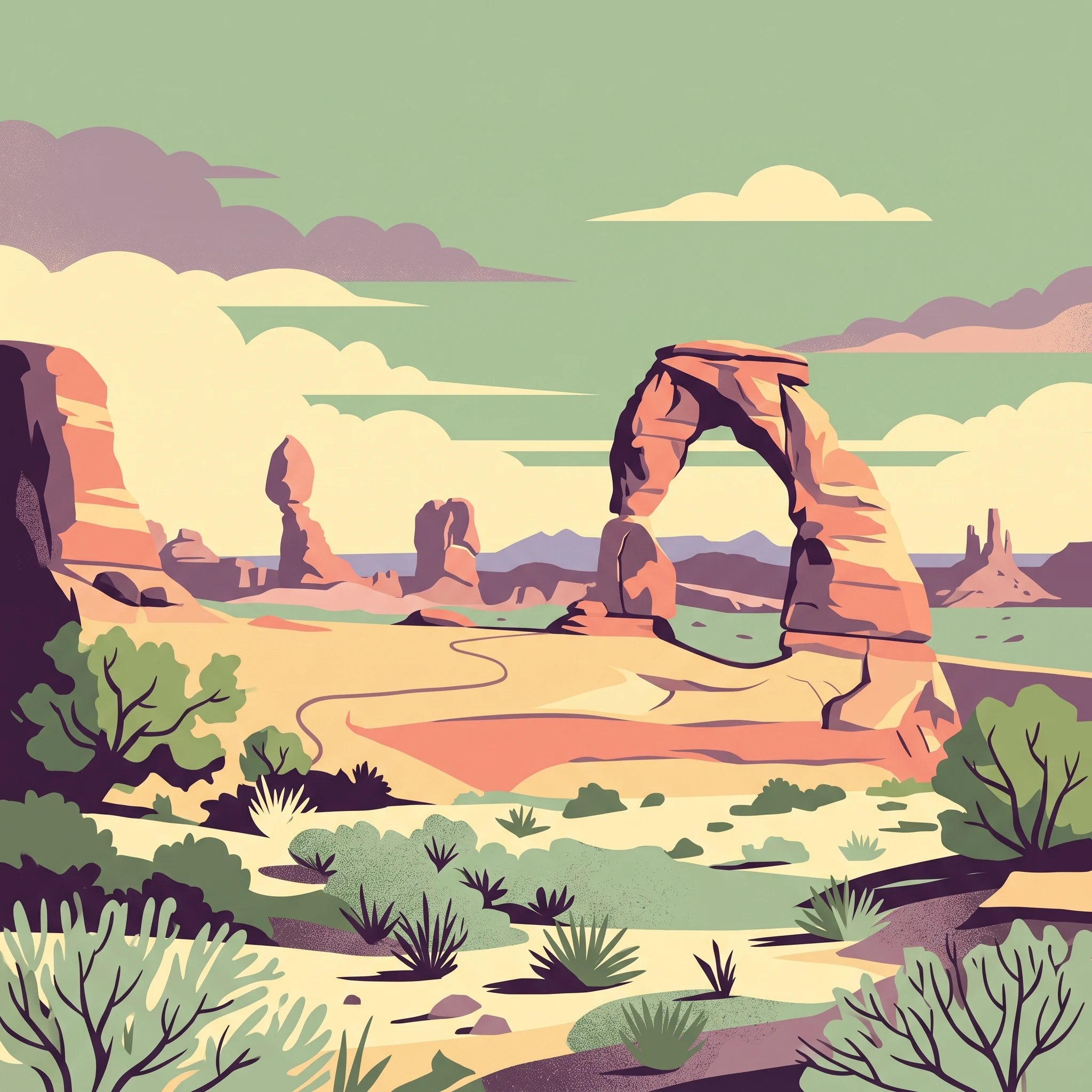
The Arches landscape presents an otherworldly terrain of sculpted sandstone formations rising from the high desert floor. The park's defining features are the natural arches, formed when vertical sandstone fins develop openings that grow into the distinctive arch shapes through ongoing erosion. Beyond arches, the landscape encompasses spires that rise as slender pillars from the desert floor, balanced rocks that appear to defy gravity atop narrow pedestals, and massive monoliths like the Courthouse Towers that dominate their surroundings. The terrain varies from the exposed slickrock of the park's interior to the petrified dunes that preserve evidence of ancient lakes that once covered the area. Park Avenue provides access to a corridor of towering formations, while the Devils Garden area contains the highest concentration of arches. The La Sal Mountains rise to the southeast, providing a dramatic backdrop of forested peaks visible from many locations within the park. The landscape is characterized by its vivid sandstone coloration, ranging from deep reds and oranges to cream and buff hues that shift with the changing light.

Arches National Park ecosystems, habitats, and plant life

The ecological character of Arches National Park reflects the harsh conditions of a high desert environment that receives less than 10 inches of precipitation annually. Despite the aridity, the park supports a surprising diversity of plant life adapted to desert conditions. Vegetation includes prickly pear cactus, Indian ricegrass, bunch grasses, and various shrubs like blackbrush and four-winged saltbrush. Utah juniper and pinyon pine appear in upland areas, while Mormon tea, cliffrose, and yucca dot the landscape. Of particular ecological significance is the biological soil crust that covers much of the park's surface, consisting of cyanobacteria, lichen, mosses, green algae, and microfungi that help stabilize soil and retain moisture. This living crust is extremely fragile and can be damaged by foot traffic, making it a focus of conservation efforts. The park's position on the Colorado Plateau places it within a transition zone between different ecological communities, contributing to its biological diversity.

Arches National Park wildlife and species highlights

Arches National Park supports a variety of wildlife species adapted to the desert environment. Mammals resident to the park include desert bighorn sheep, mule deer, coyotes, red foxes, and cougars, along with smaller mammals like kangaroo rats and antelope squirrels. The kangaroo rat, a nocturnal rodent, is particularly well-adapted to arid conditions and can survive without drinking water, obtaining moisture from the seeds it consumes. Birdlife is diverse, with scrub jays, peregrine falcos, and numerous sparrow species commonly observed. Peregrine falcons nest on cliff faces and can be seen hunting in the park's skies. Reptiles include collared lizards, western rattlesnakes, and the midget faded rattlesnake. Amphibians like spadefoot toads emerge during summer rains to breed in temporary pools. Insects including yucca moths play important ecological roles as pollinators. The park's wildlife, while not as abundant as in wetter environments, represents a carefully adapted community that survives in this challenging landscape.

Arches National Park conservation status and protection priorities

Arches National Park exists specifically to protect extraordinary examples of geologic features including arches, natural bridges, windows, spires, and balanced rocks, along with other features of geologic, historic, and scientific interest. The park's fragile high-desert ecosystem faces significant challenges from the approximately 1.5 million visitors who arrive annually. The biological soil crust that covers much of the park is particularly vulnerable to compression from foot traffic and vehicle use, and recovers very slowly from disturbance. The semiarid climate, limited rainfall, and lack of deep freezing create conditions where soils have low resistance to and slow recovery from compressional forces. Park management focuses on protecting both the geological formations and the biological soil crust while providing visitor opportunities. Conservation efforts also address threats from vandalism, including a 1980 incident where vandals attempted to deface ancient petroglyphs and a 2016 vandalism event at Frame Arch that required modern repair techniques.

Arches National Park cultural meaning and human context

The Arches region holds significance for several Native American peoples who have occupied the area over millennia. Ute and Paiute tribes were encountered by Spanish missionaries in the 1770s, and their ancestors followed earlier peoples including the Fremont culture and Ancestral Puebloans who lived in the area until approximately 700 years ago. Evidence of this long human presence remains in the form of petroglyphs found throughout the park, including examples along the popular Delicate Arch trail. The park also connects to the broader cultural history of eastern Utah and the development of Moab as a gateway community for exploration of the region's natural wonders. The park gained literary significance through Edward Abbey, who served as a park ranger at Arches National Monument in 1956 and 1957 and later wrote "Desert Solitaire," a classic account of desert exploration that has influenced generations of readers and helped establish the region's cultural identity as a destination for adventure and reflection.

Top sights and standout views in Arches National Park

Arches National Park offers extraordinary geological diversity across its 76,000-acre expanse. The park's signature arch, Delicate Arch, stands as a symbol of Utah and represents the most recognized natural arch in North America. Landscape Arch, spanning 290 feet, holds the distinction of being the longest arch in the park and the fifth-longest in the world. The Devils Garden area contains the greatest concentration of arches along a scenic trail, while the Courthouse Towers showcase towering stone columns. Distinctive formations like Balanced Rock, where a massive sandstone boulder rests precariously atop a narrow pedestal, and the Fiery Furnace, a maze of narrow passages between towering spires, offer unique recreational and visual experiences. The park's dark night skies provide exceptional stargazing opportunities, complementing its daytime geological wonders.

Best time to visit Arches National Park

The optimal time to visit Arches National Park depends on preferences for weather and crowd levels. Spring and fall offer generally comfortable temperatures and moderate visitor numbers, making these seasons popular for hiking and photography. Summer brings high temperatures often exceeding 100°F, though longer days allow for early morning or evening exploration. Winter provides solitude and dramatic winter landscapes, though some trails may be icy and temperatures can drop below freezing at night. The park's climate classification as cold semi-arid means that visitors should be prepared for significant temperature variations between day and night in any season. Those seeking to avoid crowds may find early morning visits during peak season provide more solitary experiences, while astronomy enthusiasts should consider timing visits around new moon phases to take advantage of the park's dark night skies.
Park location guide

Geography guide, regional context, and park location map for Arches National Park

Arches National Park park geography, regions, and map view in United States of America
Understand where Arches National Park sits in United States of America through a broader geographic reading of the surrounding landscape, nearby location context, and its mapped position within the national park landscape.

How Arches National Park fits into United States of America

The United States of America is a federal presidential republic and one of the world's largest countries by area and population. It consists of 50 states across a vast territory spanning multiple time zones, with its capital in Washington, D.C. and largest city in New York City. The nation has a diverse economy, influential political system, and significant cultural and military presence globally.

Wider geography shaping Arches National Park in United States of America

The United States occupies a vast territory in North America, bordered by Canada to the north and Mexico to the south. The 48 contiguous states stretch from the Atlantic to the Pacific Ocean, while Alaska occupies the northwestern region and Hawaii is an archipelago in the Pacific. The country encompasses diverse terrain including the Rocky Mountains, Appalachian Mountains, Great Plains, and extensive river systems.

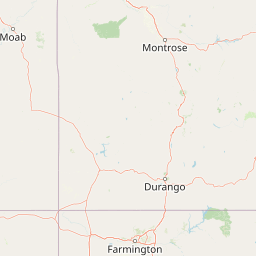
Map view of Arches National Park

Use this park location map to pinpoint Arches National Park in United States of America, understand its exact geographic position, and read its mapped placement within the surrounding landscape more clearly.

Pigeon | © OpenStreetMap contributors

Location context for Arches National Park

Utah
Park atlas

Discover the unique protected landscapes and regional geography surrounding Arches National Park, mapping similar high desert environments.

Compare Other National Parks and Protected Areas Near Arches National Park
Continue your exploration from Arches National Park by browsing other nearby national parks and protected areas, tracing the distinct sandstone geology and high desert terrain of the Colorado Plateau. Compare conservation landscapes across the surrounding region, understanding the geographic spread and varied natural arch formations that define this iconic protected-area atlas.
National parkUtah

Canyonlands National Park: A Mapped Protected Landscape in Utah's Geography

Explore its vast geography and protected area boundaries.

Canyonlands National Park stands as a significant protected entity within the state of Utah, characterized by its immense scale and dramatic geological formations. This page facilitates an atlas-style exploration of its terrain, emphasizing its mapped boundaries and its crucial role as a protected landscape. Gain a deeper appreciation for its unique geographic setting and its place within the broader regional context.

Area
1,366.21 km²
Established
1964
IUCN
II
Visitors
818.5K annual
National parkUtah

Capitol Reef National Park: Utah National Park Protected Landscape and Geography

Explore Capitol Reef National Park's mapped terrain and boundaries.

Delve into the protected landscape and geographic identity of Capitol Reef National Park, a key national park in Utah. This resource provides detailed context on its mapped terrain and regional setting, supporting a structured understanding of protected areas for atlas exploration. Discover the specific geographic features and park boundaries that define this protected natural area.

Area
978.95 km²
Established
1971
IUCN
II
Visitors
1.4M annual
National parkMontrose County

Black Canyon of the Gunnison National Park: Protected Area Geography and Mapped Landscape

Explore the natural terrain and protected boundaries in Montrose County.

Black Canyon of the Gunnison National Park is a national park defined by its profound geological features and its status as a protected landscape. Located within Montrose County, it offers a distinct geographic profile for atlas-based exploration. Users can understand the park's mapped boundaries, its relation to the surrounding regional geography, and the unique natural terrain that defines this protected area, contributing to a structured discovery of its natural landscape identity.

Area
124.4 km²
Established
1999
IUCN
II
Visitors
357.1K annual
National parkMontezuma County

Mesa Verde National Park: Protected Landscape Atlas and Geographic Identity

Discover the mapped terrain and regional context of this national park.

Mesa Verde National Park serves as a critical protected landscape within Montezuma County, offering distinct insights into regional geography and mapped terrain. This entry details the park's identity as a National Park, emphasizing its geographic setting and providing a foundation for atlas-driven exploration. Understand the park's place within the broader landscape context and its significance as a mapped protected area, ideal for focused geographic study.

Area
212.4 km²
Established
1906
IUCN
II
Visitors
463.1K annual
National parkUtah

Bryce Canyon National Park: Utah's Mapped Protected Landscape and Geographic Context

Explore the unique geology and protected boundaries of Bryce Canyon National Park.

Bryce Canyon National Park offers a distinct protected landscape within the geography of Utah, characterized by its unique geological formations. This entry provides essential context for understanding its mapped boundaries and natural terrain, serving as a vital component for atlas-based discovery of protected areas. Investigate the specific geographic setting and conservation significance of this iconic national park.

Area
145.02 km²
Established
1928
IUCN
II
Visitors
2.5M annual
National parkUtah

Zion National Park National Park: Detailed Mapped Geography and Protected Landscape Identity

Explore the mapped terrain and regional context of this Utah national park.

Zion National Park represents a key protected area within Utah, ideal for detailed geographic exploration. This canonical page offers insights into the park's specific mapped boundaries, its inherent landscape character, and its regional geographic setting. It is designed for users seeking to understand the atlas-level significance of Zion National Park as a national park entity, focusing on its protected terrain and natural geography.

Area
593.26 km²
Established
1919
IUCN
II
Visitors
4.9M annual
National parkColorado

Great Sand Dunes National Park and Preserve: Colorado's Unique Mapped Landscape

Explore the natural terrain and protected boundaries.

Great Sand Dunes National Park and Preserve offers a unique protected landscape within Colorado, characterized by its distinct natural terrain and extensive dune fields. This destination provides valuable context for atlas exploration, detailing the park's mapped boundaries and its specific geographic setting. Understand its significance as a protected area and appreciate the unique natural features that define its landscape for a richer geographic discovery.

Area
603.1 km²
Established
2004
IUCN
V
Visitors
432.5K annual
National parkColorado

Rocky Mountain National Park: National Park Protected Landscape in Colorado

Explore its mapped boundaries and regional geographic context.

Rocky Mountain National Park is a designated National Park within Colorado, crucial for understanding the distribution and geographic context of protected areas in the United States. This detail page provides an atlas-oriented perspective, emphasizing the park's mapped boundaries and its place within the natural landscape of the region. It is designed to facilitate a clear understanding of the park's protected status and its contribution to the atlas of natural landscapes, offering factual insights for geographic discovery.

Area
1,074.28 km²
Established
1915
IUCN
II
Visitors
4.2M annual

Common questions about visiting, size, designation, and location context for Arches National Park

Arches National Park FAQs for park facts, access, geography, and protected area context
Find quick answers about Arches National Park, including protected-area facts, park geography, trail and visitor context, and how the park fits into its surrounding country and regional landscape.
MoriAtlas Explorer

Continue Your Protected Areas Search Across the Global Atlas

Deepen your exploration by continuing the structured search for national parks and protected areas worldwide. Utilize the comprehensive filtering capabilities to compare different conservation landscapes and refine your understanding of global park geography. Discover more about the distribution and characteristics of protected natural areas.

Global natural geography