Mori Atlas logo
National parkBlack Canyon of the Gunnison National Park

Discover the mapped boundaries and natural terrain of this national park in Montrose County.

Black Canyon of the Gunnison National Park: Protected Landscape and Regional Geography

Black Canyon of the Gunnison National Park stands as a significant protected landscape within the United States, offering unique insights into its geological formation and regional geographic context. As a designated national park in Montrose County, it presents a distinct natural terrain shaped by dramatic canyons. This page serves as a focal point for understanding the park's mapped boundaries and its place within the broader atlas of protected areas, emphasizing its unique landscape character and geographic significance.

Canyon LandscapeRock ClimbingTrout FishingGeological WonderWilderness AreaColorado Plateau

Black Canyon of the Gunnison National Park

National park

Park overview

Structured park overview, official facts, and landscape profile for Black Canyon of the Gunnison National Park

Black Canyon of the Gunnison National Park park facts, protected area profile, and essential visitor context
Review the core facts for Black Canyon of the Gunnison National Park, including designation, size, terrain, visitor scale, habitats, and operating context in one park-focused overview.

About Black Canyon of the Gunnison National Park

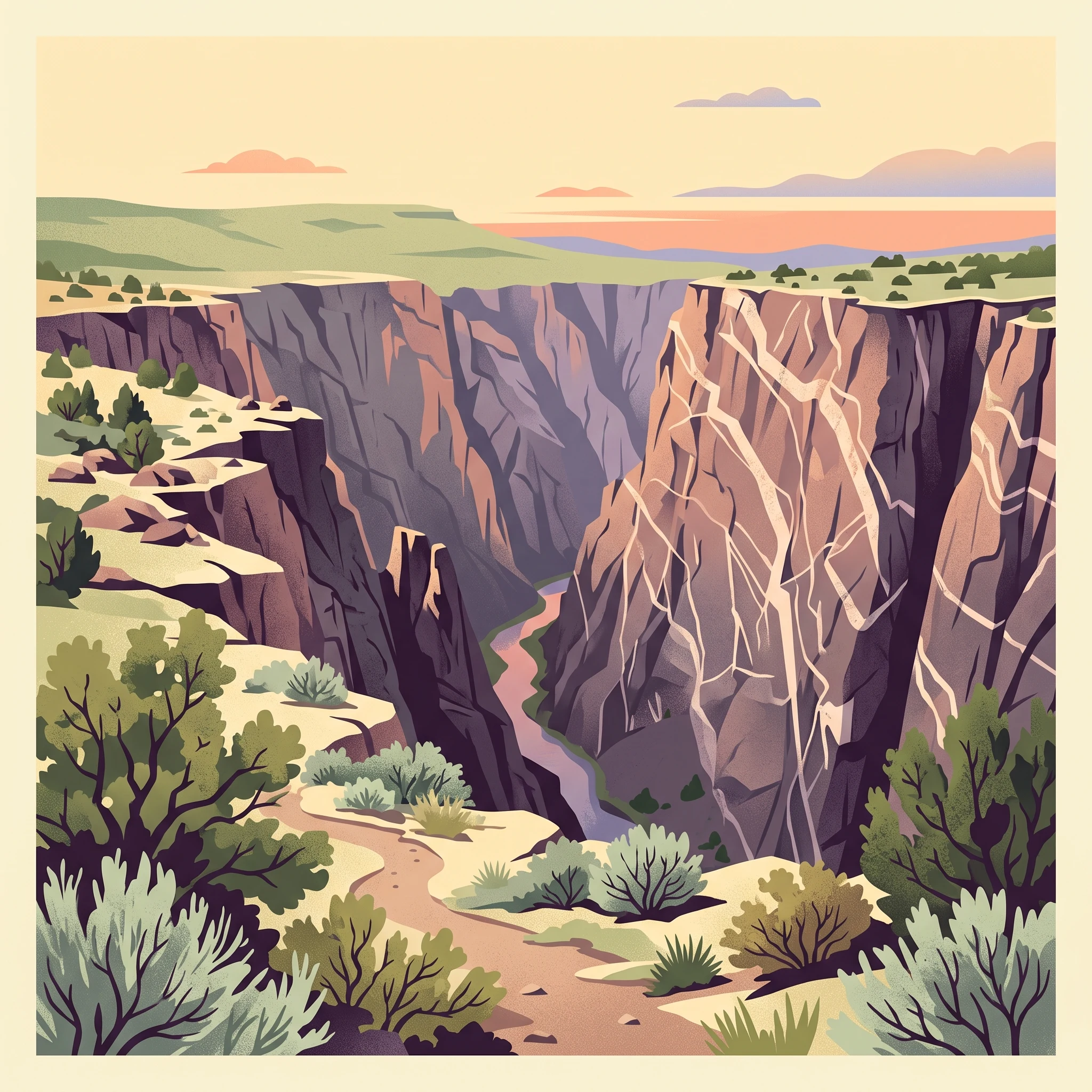
Black Canyon of the Gunnison National Park represents one of the Colorado Plateau's most compelling geological displays. The canyon formed as the Gunnison River, unable to change its course once established, cut through progressively harder metamorphic rock over millions of years. The river's descent of 34 feet per mile ranks as the fifth steepest mountain descent in North America, with the most dramatic drop occurring at Chasm View where the river falls 240 feet per mile. The canyon reaches just 40 feet in width at its narrowest point, creating an intimate, enclosed space where the walls rise thousands of feet above the river. Light-colored pegmatite dikes crosscut the dark ancient rock, most dramatically displayed on Painted Wall where they create geometric patterns against the 2,250-foot cliff face. The park protects the deepest and most dramatic section of a canyon that extends 48 miles total, with the upper portions managed as Curecanti National Recreation Area and the lower portions within Gunnison Gorge National Conservation Area.

Quick facts and research context for Black Canyon of the Gunnison National Park

Black Canyon of the Gunnison National Park spans 30,750 acres along the Gunnison River in Montrose County, western Colorado. The canyon reaches a depth of over 2,000 feet with walls of Precambrian gneiss and schist, and at its narrowest point measures just 40 feet across at river level. The Gunnison River drops an average of 34 feet per mile through the canyon, ranking among the steepest mountain descents in North America. Painted Wall, the tallest sheer cliff in Colorado at 2,250 feet, features distinctive light-colored pegmatite dikes cutting through dark metamorphic rock. About half the park was designated wilderness in 1976, preserving 15,599 acres of remote canyon country.

Park context

Deeper park guide and search-rich context for Black Canyon of the Gunnison National Park

Black Canyon of the Gunnison National Park history, landscape, wildlife, and travel context
Explore Black Canyon of the Gunnison National Park through its history, landscape character, ecosystems, wildlife, conservation priorities, cultural context, and seasonal travel timing in a structured park guide built for atlas discovery and search intent.

Why Black Canyon of the Gunnison National Park stands out

The park is best known for its extraordinary geological character: a deep, steep, narrow canyon where the Gunnison River has carved through ancient Precambrian rock to create one of North America's most dramatic river gorges. The Painted Wall, Colorado's tallest sheer cliff at 2,250 feet, showcases striking pegmatite dikes that contrast with the dark gneiss and schist walls. The canyon is also renowned among rock climbers for its traditional climbing routes, among anglers for its Gold Medal trout fishing waters, and among hikers for its challenging inner canyon routes that descend to the river.

Black Canyon of the Gunnison National Park history and protected-area timeline

The Black Canyon has human history extending back to the Ute people, who knew of the canyon and referred to the river as "much rocks, big water," reportedly avoiding the gorge out of superstition. The first European to document the canyon was Captain John Williams Gunnison in 1853, leading a survey expedition from Saint Louis to San Francisco. He described the terrain as the roughest he had ever seen, skirted the canyon south toward present-day Montrose, and was later killed by the Ute that same year. The river was renamed in his honor. In 1881, the Denver and Rio Grande Railroad reached Gunnison, and narrow-gauge tracks were carved through the canyon by Irish and Italian laborers at extraordinary cost. The first passenger train traversed the canyon in August 1882, with contemporary accounts describing it as the most rugged canyon in the world traversed by rail. Engineer Bryan Bryant's 1882 exploration of the inner canyon reported it was impenetrable. The railroad route through the canyon was eventually abandoned in the early 1950s. Between 1901 and 1909, the Gunnison Tunnel was constructed, a 5.8-mile irrigation tunnel that was the world's longest at its completion and cost 26 lives. The canyon became a national monument in 1933 and a national park in 1999.

Black Canyon of the Gunnison National Park landscape and geographic character

The Black Canyon landscape is defined by its extreme vertical relief and narrowness. The canyon walls consist of Precambrian gneiss and schist formed 1.7 billion years ago during the collision of ancient volcanic island arcs with what is now Wyoming. These dark metamorphic rocks are crosscut by lighter-colored pegmatite dikes that formed during the same metamorphic period. The Gunnison River has carved a steep, winding gorge through these ancient rocks, with the river at river level only 40 feet across at the narrowest point while the walls tower thousands of feet above. The river drops dramatically through the canyon, with an average descent of 34 feet per mile and a maximum of 240 feet per mile at Chasm View. Feeder canyons slope in the wrong direction for water to flow into the main canyon, a geological anomaly caused by drainage pattern shifts in surrounding terrain.

Black Canyon of the Gunnison National Park ecosystems, habitats, and plant life

The park supports diverse habitats ranging from desert shrubland at lower elevations to mixed conifer forests on the rims. Common plant communities include aspen, Ponderosa pine, sagebrush, Utah juniper, gambel oak, desert mahogany, and single-leaf ash. The Black Canyon gilia, a wildflower species, is endemic to the park. The dramatic elevation change from river to rim creates multiple ecological zones, with riparian vegetation along the river contrasting with the more arid canyon walls. The canyon provides critical habitat for species adapted to the steep, rocky environment, while the river corridor supports aquatic and riparian-dependent wildlife.

Black Canyon of the Gunnison National Park wildlife and species highlights

Black Canyon of the Gunnison supports a wide variety of wildlife. Mammals include pronghorn, black bear, coyote, cougar, elk, mule deer, bobcat, raccoon, beaver, river otter, and muskrat. The canyon is home to numerous bird species, including resident eagles, hawks, owls, and the American dipper along the river. Migratory birds such as mountain bluebird, peregrine falcon, white-throated swift, and canyon wren pass through the area. Reptiles include six species of lizard. The Gunnison River within the park is designated as a Gold Medal water for trout fishing, with artificial flies and lures required and rainbow trout catch-and-release only.

Black Canyon of the Gunnison National Park conservation status and protection priorities

Approximately half of the park, totaling 15,599 acres, was designated as wilderness in 1976 under the National Wilderness Preservation System. The park preserves a crucial section of the Gunnison River corridor, which continues upstream into Curecanti National Recreation Area and downstream into Gunnison Gorge National Conservation Area, creating a nearly continuous protected corridor. The designation of wilderness ensures the most remote canyon sections will remain undeveloped. The park's geological resources are protected both for their scientific value and their role in understanding Earth's deep history through the 1.7-billion-year-old exposed rocks.

Black Canyon of the Gunnison National Park cultural meaning and human context

The Ute people had knowledge of the Black Canyon long before European contact, referring to the river as "much rocks, big water" and reportedly avoiding the canyon out of superstition. Captain John Williams Gunnison's 1853 expedition provided the first documented European account of the canyon, and he was killed by the Ute later that year, leading to the river's renaming in his honor. The canyon later became a path to Utah and southwestern mines for settlers and prospectors. The Denver and Rio Grande Railroad's narrow-gauge line through the canyon represented a remarkable engineering achievement of the late 19th century, with remnants preserved in the Cimarron area.

Top sights and standout views in Black Canyon of the Gunnison National Park

The park's signature feature is Painted Wall, Colorado's tallest sheer cliff at 2,250 feet, with its distinctive pegmatite dikes creating geometric patterns against dark rock. The scenic drives along the south and north rim offer dramatic canyon overlooks, while the inner canyon routes provide access to the river for those with advanced hiking and climbing skills. The Gunnison River is a premier trout fishing destination, designated Gold Medal water with strict catch-and-release requirements. Rock climbing on the steep canyon walls attracts advanced climbers seeking traditional climbing routes. The Gunnison Tunnel's East Portal is accessible via a steep road from the south rim, where the diversion dam can be viewed.

Best time to visit Black Canyon of the Gunnison National Park

The park is accessible year-round on the south rim, while the north rim closes seasonally during winter. Summer months offer warm conditions for hiking but the inner canyon can become extremely hot. Spring and fall provide more moderate temperatures and fewer crowds, making them ideal for experiencing the canyon. Winter offers solitude and snow-dusted canyon walls but some facilities are closed. The Gunnison River flow rates affect inner canyon camping and should be checked before descending to the river.
Park location guide

Geography guide, regional context, and park location map for Black Canyon of the Gunnison National Park

Black Canyon of the Gunnison National Park park geography, regions, and map view in United States of America
Understand where Black Canyon of the Gunnison National Park sits in United States of America through a broader geographic reading of the surrounding landscape, nearby location context, and its mapped position within the national park landscape.

How Black Canyon of the Gunnison National Park fits into United States of America

The United States of America is a federal presidential republic and one of the world's largest countries by area and population. It consists of 50 states across a vast territory spanning multiple time zones, with its capital in Washington, D.C. and largest city in New York City. The nation has a diverse economy, influential political system, and significant cultural and military presence globally.

Wider geography shaping Black Canyon of the Gunnison National Park in United States of America

The United States occupies a vast territory in North America, bordered by Canada to the north and Mexico to the south. The 48 contiguous states stretch from the Atlantic to the Pacific Ocean, while Alaska occupies the northwestern region and Hawaii is an archipelago in the Pacific. The country encompasses diverse terrain including the Rocky Mountains, Appalachian Mountains, Great Plains, and extensive river systems.

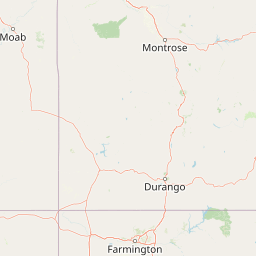
Map view of Black Canyon of the Gunnison National Park

Use this park location map to pinpoint Black Canyon of the Gunnison National Park in United States of America, understand its exact geographic position, and read its mapped placement within the surrounding landscape more clearly.

Pigeon | © OpenStreetMap contributors

Location context for Black Canyon of the Gunnison National Park

ColoradoMontrose County
Park atlas

Trace the regional park geography and discover protected landscapes adjacent to Black Canyon of the Gunnison National Park

Explore Other National Parks Near Black Canyon of the Gunnison and Surrounding Colorado Landscapes
After exploring Black Canyon of the Gunnison National Park, continue your geographic discovery by browsing a curated selection of other national parks and protected areas in the surrounding Colorado region. Compare diverse landscapes, trace regional park networks, and understand the broader conservation context of the western United States through detailed atlas views.
National parkUtah

Arches National Park: Utah National Park Protected Landscape Exploration

Explore mapped terrain and geographic context.

Delve into the specifics of Arches National Park, a protected national park located in Utah. This atlas-focused entry provides detailed insight into the park's protected landscape features and geographic distribution. Understand the mapped park boundaries and the unique natural terrain that shapes this significant conservation area within the United States' broader regional geography.

Area
310.31 km²
Established
1971
IUCN
II
Visitors
1.5M annual
National parkMontezuma County

Mesa Verde National Park: Protected Landscape Atlas and Geographic Identity

Discover the mapped terrain and regional context of this national park.

Mesa Verde National Park serves as a critical protected landscape within Montezuma County, offering distinct insights into regional geography and mapped terrain. This entry details the park's identity as a National Park, emphasizing its geographic setting and providing a foundation for atlas-driven exploration. Understand the park's place within the broader landscape context and its significance as a mapped protected area, ideal for focused geographic study.

Area
212.4 km²
Established
1906
IUCN
II
Visitors
463.1K annual
National parkUtah

Canyonlands National Park: A Mapped Protected Landscape in Utah's Geography

Explore its vast geography and protected area boundaries.

Canyonlands National Park stands as a significant protected entity within the state of Utah, characterized by its immense scale and dramatic geological formations. This page facilitates an atlas-style exploration of its terrain, emphasizing its mapped boundaries and its crucial role as a protected landscape. Gain a deeper appreciation for its unique geographic setting and its place within the broader regional context.

Area
1,366.21 km²
Established
1964
IUCN
II
Visitors
818.5K annual
National parkColorado

Great Sand Dunes National Park and Preserve: Colorado's Unique Mapped Landscape

Explore the natural terrain and protected boundaries.

Great Sand Dunes National Park and Preserve offers a unique protected landscape within Colorado, characterized by its distinct natural terrain and extensive dune fields. This destination provides valuable context for atlas exploration, detailing the park's mapped boundaries and its specific geographic setting. Understand its significance as a protected area and appreciate the unique natural features that define its landscape for a richer geographic discovery.

Area
603.1 km²
Established
2004
IUCN
V
Visitors
432.5K annual
National parkColorado

Rocky Mountain National Park: National Park Protected Landscape in Colorado

Explore its mapped boundaries and regional geographic context.

Rocky Mountain National Park is a designated National Park within Colorado, crucial for understanding the distribution and geographic context of protected areas in the United States. This detail page provides an atlas-oriented perspective, emphasizing the park's mapped boundaries and its place within the natural landscape of the region. It is designed to facilitate a clear understanding of the park's protected status and its contribution to the atlas of natural landscapes, offering factual insights for geographic discovery.

Area
1,074.28 km²
Established
1915
IUCN
II
Visitors
4.2M annual
National parkUtah

Capitol Reef National Park: Utah National Park Protected Landscape and Geography

Explore Capitol Reef National Park's mapped terrain and boundaries.

Delve into the protected landscape and geographic identity of Capitol Reef National Park, a key national park in Utah. This resource provides detailed context on its mapped terrain and regional setting, supporting a structured understanding of protected areas for atlas exploration. Discover the specific geographic features and park boundaries that define this protected natural area.

Area
978.95 km²
Established
1971
IUCN
II
Visitors
1.4M annual
National parkUtah

Bryce Canyon National Park: Utah's Mapped Protected Landscape and Geographic Context

Explore the unique geology and protected boundaries of Bryce Canyon National Park.

Bryce Canyon National Park offers a distinct protected landscape within the geography of Utah, characterized by its unique geological formations. This entry provides essential context for understanding its mapped boundaries and natural terrain, serving as a vital component for atlas-based discovery of protected areas. Investigate the specific geographic setting and conservation significance of this iconic national park.

Area
145.02 km²
Established
1928
IUCN
II
Visitors
2.5M annual
National parkNavajo County

Petrified Forest National Park: National Park Protected Landscape and Geographic Atlas

Explore its mapped terrain and regional park context.

Petrified Forest National Park represents a significant protected landscape within Navajo County, Arizona, offering focused insights into its unique terrain and geographic distribution. As a national park, it provides valuable data for understanding mapped park boundaries, regional landscape context, and its role within the broader atlas of protected areas. Discover the specific geographic features and natural identity that define this unique natural reserve.

Area
895.94 km²
Established
1962
IUCN
II
Visitors
644.9K annual

Common questions about visiting, size, designation, and location context for Black Canyon of the Gunnison National Park

Black Canyon of the Gunnison National Park FAQs for park facts, access, geography, and protected area context
Find quick answers about Black Canyon of the Gunnison National Park, including protected-area facts, park geography, trail and visitor context, and how the park fits into its surrounding country and regional landscape.
MoriAtlas Explorer

Continue Your Protected Areas Search Across the Global Atlas

Deepen your exploration by continuing the structured search for national parks and protected areas worldwide. Utilize the comprehensive filtering capabilities to compare different conservation landscapes and refine your understanding of global park geography. Discover more about the distribution and characteristics of protected natural areas.

Global natural geography