Why Gulf of Mannar Marine National Park stands out
Gulf of Mannar Marine National Park is best known for its extensive coral reef system and the presence of the dugong, a vulnerable marine mammal that depends on seagrass meadows for survival. The park contains India's most diverse fish habitat, with about 23 percent of all Indian marine fish species found in its waters. Its coral reefs, though facing pressures, remain among the more healthy reef systems in mainland India. The park is also notable for hosting a unique endemic species, the acorn worm Ptychodera fluva at Kurusadai Island, a living fossil that provides insight into the evolutionary transition between invertebrates and vertebrates.
Gulf of Mannar Marine National Park history and protected-area timeline
The Gulf of Mannar Marine National Park was formally established as a National Park in 1980 through official notification, with subsequent establishment in 1986 creating the protected area framework that exists today. The creation of the park reflected growing recognition of the ecological significance of India's coastal and marine environments during the late twentieth century, a period when marine conservation was gaining prominence globally. The park was designated as the core zone of the Gulf of Mannar Biosphere Reserve, an acknowledgment of its central role in preserving the broader ecological character of the gulf region. Management responsibility rests with the Tamil Nadu Ministry of Environment and Forests, which oversees protection and conservation activities through its wildlife division. The establishment came during a period when coral reef conservation was attracting increased scientific and governmental attention, though by the time of the park's creation, significant habitat degradation had already occurred from activities including coral mining for construction materials and industrial purposes. The park's creation also responded to concerns about overfishing and habitat destruction in one of India's most productive marine fishing areas.
Gulf of Mannar Marine National Park landscape and geographic character
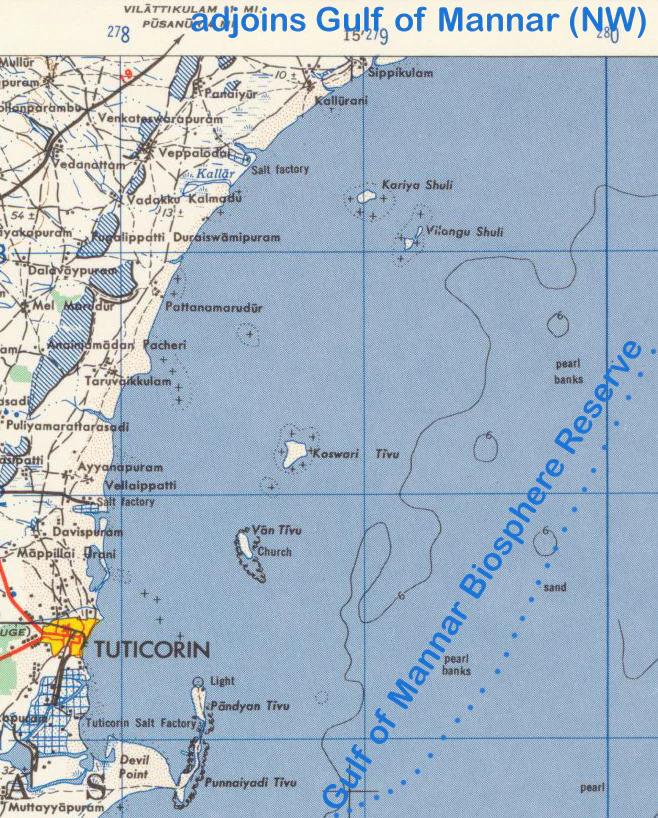
The Gulf of Mannar Marine National Park encompasses a distinctive island archipelago landscape characterized by small, low-lying islands surrounded by shallow lagoon waters and coral reef formations. The 21 islands, ranging from just 0.25 hectares to 130 hectares in area, are distributed across four main groups separated by gaps of open water. The islands are generally flat with minimal elevation, typically rising only one to six meters above sea level, though some reach nearly twelve meters. The surrounding sea floor features a combination of fringing reefs that lie 150 to 300 meters from island shores and patch reefs that rise from depths of two to nine meters, extending up to two kilometers in length. Tidal amplitude in the area is approximately 0.5 meters, creating intertidal zones that support mangrove vegetation. The islands once supported more diverse vegetation but have been altered by the introduction of Prosopis, a genus that has become dominant on several islands. Two islands, Pandayan and Punnaiyadi, have been lost entirely to port construction activities near Thoothukudi, and others have experienced significant erosion, with Vhan Island reportedly splitting in two and losing substantial land area to coastal processes.
Gulf of Mannar Marine National Park ecosystems, habitats, and plant life
The park protects a remarkable array of marine and coastal ecosystems that together create one of India's most ecologically diverse marine protected areas. Coral reefs form the structural foundation of the marine environment, with 117 coral species recorded from 40 genera, including both reef-building hermatypic corals and non-reef-building ahermatypic species. These reefs, though showing signs of stress from human activities, support approximately 35 percent live coral cover and remain functional ecosystems despite pressures from sedimentation and coastal development. Seagrass meadows provide critical habitat for marine megafauna, particularly the dugong, with twelve species of seagrass documented in park waters. Mangroves dominate the intertidal zones, with species from genera including Rhizophora, Avicennia, Bruguiera, Ceriops, and Lumnizera forming dense coastal forests that stabilize shorelines and provide nursery habitat for fish and invertebrates. The islands support seaweed communities with 147 species documented, adding to the marine productivity of the area. This combination of coral reefs, seagrass beds, mangroves, and open water creates a mosaic of interconnected habitats that support extraordinary biodiversity.
Gulf of Mannar Marine National Park wildlife and species highlights
The marine wildlife of Gulf of Mannar Marine National Park demonstrates exceptional diversity across multiple animal groups. The dugong serves as the park's flagship species, a vulnerable marine mammal that feeds primarily on seagrass and represents one of only three remaining dugong populations in Indian waters. The park supports at least nine cetacean species, including Indo-Pacific bottlenose dolphins, finless porpoises, spinner dolphins, common dolphins, Risso's dolphins, melon-headed whales, dwarf sperm whales, and larger whales such as sperm whales, minke whales, Bryde's whales, sei whales, and critically endangered humpback, fin, and blue whales. Fish diversity is extraordinary, with approximately 510 species recorded, representing 23 percent of all fish species in Indian waters and making this the most diverse fish habitat in the country. Invertebrate fauna includes 106 crab species, 17 sea cucumber species, 466 mollusk species spanning gastropods, bivalves, cephalopods, and scaphopods, 108 sponge species, and 100 echinoderm species. Four shrimp species and four lobster species round out the invertebrate complement. The coral fauna includes numerous ornamental fish species such as butterflyfish, parrotfish, clownfish, and snappers.
Gulf of Mannar Marine National Park conservation status and protection priorities
Gulf of Mannar Marine National Park holds significant conservation importance as India's largest marine protected area and one of the few comprehensive marine parks on the subcontinent. The park protects critical habitat for the vulnerable dugong, a species whose survival depends on healthy seagrass meadows that the park preserves. Its coral reefs, while experiencing pressure from human activities, remain among the healthier reef systems in mainland India and represent important genetic reservoirs for reef organisms. The park's designation as a biosphere reserve core zone creates a framework for balancing conservation with sustainable use in the surrounding buffer zone where approximately 150,000 people live and depend on fishing. However, the park faces serious conservation challenges including habitat degradation from coral mining, which, though now banned, caused extensive damage over decades. Nutrient pollution from agriculture, industry, and urban areas affects water quality, while sedimentation from deforestation and coastal development stresses coral communities. Climate change poses additional threats to coral health and seagrass survival. Two islands have already submerged, and others face erosion risks that could further reduce the protected island habitat.
Gulf of Mannar Marine National Park cultural meaning and human context
The Gulf of Mannar region supports significant human coastal communities whose lives are intertwined with the marine environment. Approximately 125 villages with around 100,000 people inhabit the coastal areas adjacent to the park, predominantly from the Marakeyar community, a traditional fishing community whose identity and livelihood center on maritime activities. These communities have historically utilized the gulf's resources for fishing and other marine activities, creating a cultural landscape where human use and marine ecosystems have co-existed, though not always sustainably. While the islands themselves are largely uninhabited, with only three serving as locations for anti-poaching operations, the coastal communities maintain strong connections to the marine waters that the park encompasses. The establishment of the park and biosphere reserve creates a framework for managing the relationship between conservation objectives and traditional fishing livelihoods, a challenge common to marine protected areas worldwide. The region also has historical significance as part of the maritime routes between India and Sri Lanka.
Top sights and standout views in Gulf of Mannar Marine National Park
The Gulf of Mannar Marine National Park offers visitors rare opportunities to experience one of India's richest marine environments through guided glass-bottom boat excursions that provide views of coral reefs and marine life without direct disturbance to ecosystems. The park's 21 islands provide varied landscapes to explore, with several supporting mangrove forests and beach habitats. The dugong, though difficult to observe, represents a remarkable conservation target for the park and draws scientific interest globally. Coral reef diving and snorkeling, where permitted, reveal vibrant underwater communities with hundreds of fish species and diverse invertebrates. The presence of the living fossil Ptychodera fluva at Kurusadai Island offers a unique scientific attraction found nowhere else in India. The park's integration within a larger biosphere reserve allows for interpretation of the relationship between marine conservation and coastal community livelihoods.
Best time to visit Gulf of Mannar Marine National Park
The Gulf of Mannar region experiences a tropical marine climate with relatively consistent conditions throughout the year, though visitor experiences vary by season. The winter months from November to February typically offer more comfortable land temperatures and clearer visibility for underwater viewing, making this period popular for wildlife observation and marine excursions. The pre-monsoon months of March to May bring warmer conditions but also calmer seas in some periods. Monsoon influences from June to September can affect sea conditions and reduce visibility underwater, though the park remains accessible. The park can be visited year-round, though conditions for glass-bottom boat tours and underwater viewing are generally most favorable during the cooler winter months. Visitors interested in marine wildlife should consider that visibility and animal presence can vary based on seasonal conditions and tidal patterns.