Why Virachey National Park stands out
Virachey National Park is best known for its extraordinary remoteness and the conservation significance of its montane forest ecosystems. The park contains some of the last relatively intact old-growth forest in mainland Southeast Asia, including cloud forests that trap moisture from monsoon winds and support specialized flora found nowhere else in the region. Its designation as an ASEAN Heritage Park reflects the presence of species and ecological communities of pan-ASEAN importance. The park's dramatic elevation range creates distinct ecological zones, from dense semi-evergreen forest in the lower valleys to more open savannah and bamboo communities on exposed ridges, making it a living laboratory of tropical highland ecology.
Virachey National Park history and protected-area timeline
Virachey National Park was established in 1993 as part of Cambodia's developing network of protected areas following the end of the country's civil conflict period. The park's creation represented an important step in the Kingdom's commitment to conserving its natural heritage, particularly in the remote highland regions where biodiversity concentrations are highest. The establishment of the park came during a period when Cambodia was rebuilding its environmental governance structures after years of conflict had disrupted conservation efforts and allowed unchecked resource extraction in many areas. The park's subsequent designation as an ASEAN Heritage Park, one of only two such designations in Cambodia, confirmed its regional significance and brought additional attention to its conservation needs. The ASEAN Heritage Parks program recognizes protected areas of outstanding biodiversity value across Southeast Asia, and inclusion in this network has helped to highlight Virachey's global importance within conservation circles.
Virachey National Park landscape and geographic character
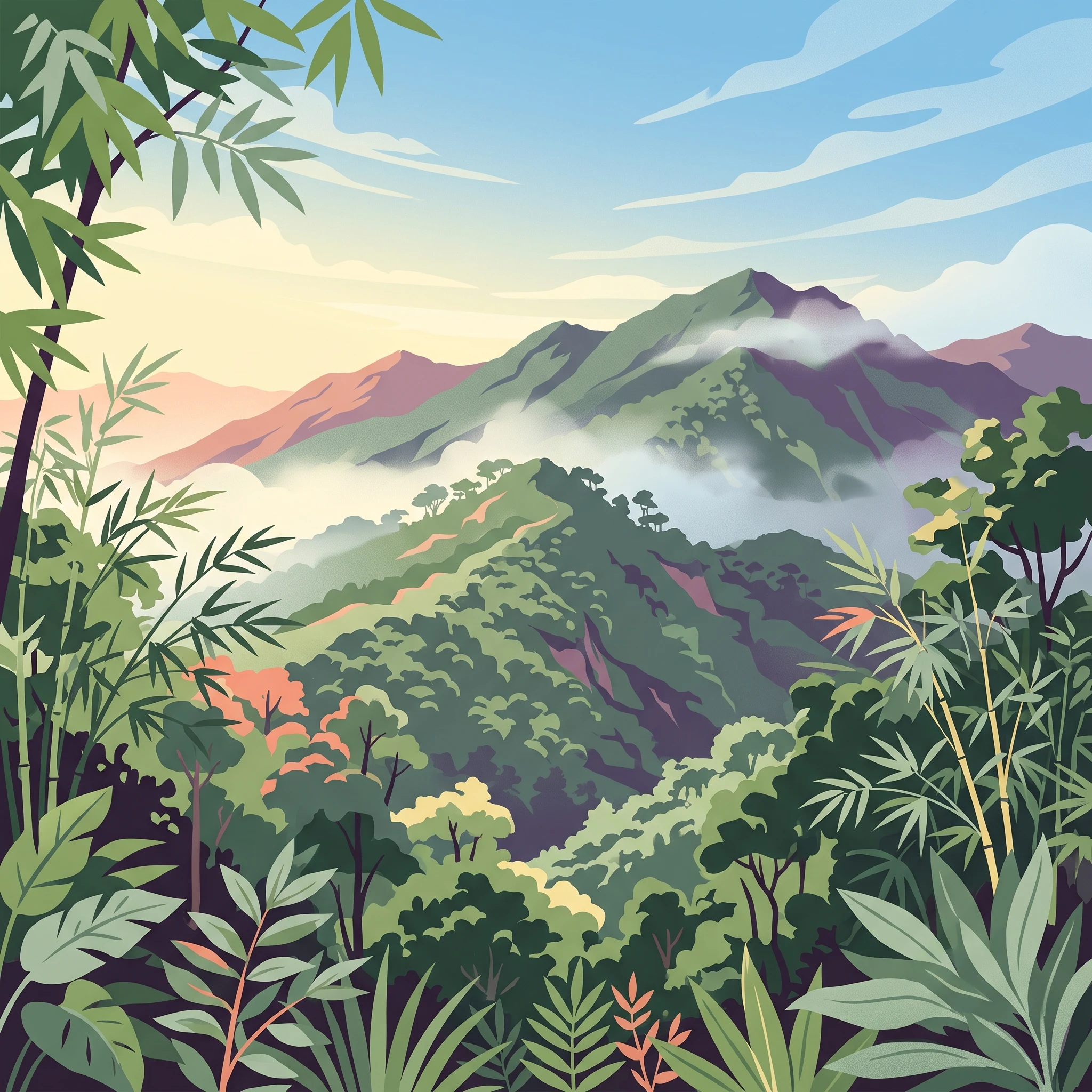
The physical landscape of Virachey National Park is defined by its position in the Annamite Mountain foothills, where elevation changes create dramatic shifts in terrain and vegetation within relatively short distances. The park encompasses steep mountain ridges separated by narrow, often V-shaped valleys carved by seasonal streams and perennial rivers flowing toward the Mekong basin. Most of the park area lies above 400 meters elevation, with the highest points reaching approximately 1,500 meters, creating a mountainous character quite different from the lowland plains that dominate most of Cambodia. The park's terrain includes dense semi-evergreen lowland forests in the more protected valleys, where tree canopy heights can exceed 40 meters and create a dark, humid understory environment. Moving upslope, the vegetation transitions through bamboo thickets and into montane cloud forests, where epiphytic plants, ferns, and mosses dominate the treescapes as persistent cloud cover provides continuous moisture. Occasional patches of mixed deciduous forest occur on ridges and in areas with more seasonal water availability, adding to the habitat diversity. The park also contains distinctive upland savannah areas where more open conditions support different plant communities adapted to periodic fire and seasonal drought.
Virachey National Park ecosystems, habitats, and plant life
The ecological character of Virachey National Park is defined by the extraordinary diversity of habitats contained within its boundaries, ranging from semi-evergreen lowland forest through cloud forest to bamboo thicket and savannah. This habitat mosaic supports a corresponding diversity of species, though the park's remoteness means that scientific documentation of its biodiversity remains incomplete. The montane cloud forests represent the most ecologically significant habitat, characterized by their constant immersion in mist and the unique plant species that have evolved to exploit these conditions, including numerous epiphytic orchids, ferns, and bryophytes. The semi-evergreen lowland forests contain some of the oldest trees in Southeast Asia, with certain areas supporting individuals that may be centuries old. The bamboo thickets and savannah areas, while less botanically complex, provide important habitat for different animal species and create the natural fire regimes that have shaped these ecosystems over millennia. The park's watersheds feed into river systems that support downstream communities and contain their own aquatic biodiversity, making the protected area important for watershed protection as well as terrestrial conservation.
Virachey National Park wildlife and species highlights
The wildlife of Virachey National Park remains imperfectly documented due to the difficulty of accessing much of the park's terrain, but available records indicate the presence of significant mammal and bird populations. The dense forest environments provide habitat for large mammals including several species of ungulates and primates, though specific species documentation is limited in the available literature. The montane forest zones are likely to support bird species adapted to highland forest conditions, including various thrushes, babblers, and flycatchers that occur at the southern limits of their ranges here. The rivers and streams within the park contain fish species that represent important food sources for local communities and provide connectivity to larger Mekong River fishery resources. The presence of significant wildlife populations is suggested by the ongoing threat from illegal hunting and the continued presence of species that have been eliminated from more accessible areas of Cambodia. Future survey work will likely reveal additional species of conservation importance as the park receives more scientific attention.
Virachey National Park conservation status and protection priorities
Virachey National Park's designation as an ASEAN Heritage Park reflects its recognition as one of the most important protected areas in Southeast Asia, yet the park faces significant conservation challenges that threaten the ecosystems it was created to protect. Illegal logging represents the most immediate threat, with old-growth trees targeted for their valuable timber and the forest cleared to make way for agricultural expansion or simply to harvest the wood. The park's isolation, while providing some protection from conventional development pressure, also makes effective patrol and enforcement difficult, as law enforcement resources are limited and the terrain permits access from multiple directions. The conservation significance of Virachey extends beyond its borders, as the forests serve as carbon stores important for regional climate regulation and the watersheds provide downstream benefits for communities in both Cambodia and the broader Mekong region. Effective conservation will require sustained investment in patrol capacity, community engagement to reduce pressure on park resources, and regional cooperation given the park's position near international boundaries.
Virachey National Park cultural meaning and human context
Virachey National Park occupies territory that has been inhabited by indigenous communities for generations, with the highland areas of northeastern Cambodia home to various ethnic groups whose traditional lifestyles are closely tied to the forest environment. The park's establishment created a formal protected area where some traditional resource use practices may be restricted, requiring balance between conservation objectives and the livelihoods of communities who have historically relied on forest resources. The surrounding region, particularly Ratanakiri Province, is known for its ethnic diversity, with multiple indigenous groups maintaining distinct cultural traditions, languages, and relationships with the landscape. While the park itself may be essentially uninhabited in the formal sense, the cultural context of the surrounding area is important for understanding the human dimensions of conservation planning. Future management approaches that recognize indigenous rights and traditional knowledge may prove more effective than approaches that treat local communities purely as external stakeholders.
Top sights and standout views in Virachey National Park
Virachey National Park stands as Cambodia's largest protected area and one of the last great wilderness areas of mainland Southeast Asia, offering a rare combination of remote, intact forest ecosystems and dramatic montane topography. The park's cloud forests represent some of the most significant montane ecosystems in the region, supporting unique plant communities and serving as important water catchments. Its status as an ASEAN Heritage Park provides international recognition of its conservation significance within the broader Southeast Asian context. The elevation range from 400 to 1,500 meters creates diverse habitats within a single protected area, making it a compact representation of multiple forest types that would otherwise require traveling great distances to experience. The park remains largely unexplored, offering potential for scientific discovery and adventure travel experiences that few other protected areas in the region can match.
Best time to visit Virachey National Park
The optimal period for visiting Virachey National Park falls during the dry season from November through April, when lower rainfall makes trail conditions more manageable and access to remote areas is more feasible. The wet season from May through October brings heavy monsoon rains that can make trails impassable and increase the risk of flooding in valley bottoms, though this period also brings the cloud forests to life with dramatic mists and flowing waterfalls. The cooler months from November through February generally offer the most comfortable conditions for hiking and exploration, with temperatures in the highland areas noticeably cooler than the lowlands. Wildlife viewing may be more productive during the dry season when animals concentrate around remaining water sources, though the forest canopy is denser and animal activity harder to observe year-round. Visitors should be prepared for the park's remote nature, which requires self-sufficiency and flexibility in itinerary planning given the limited infrastructure and unpredictable conditions.