

Mori Atlas logo
National parkAddo Elephant National Park

Discover the mapped boundaries, varied terrain, and unique megafauna habitats of this Eastern Cape national park.

Addo Elephant National Park: A Protected Landscape of Geographic Diversity and Conservation Success

Addo Elephant National Park in South Africa's Eastern Cape province represents a significant achievement in wildlife conservation, safeguarding diverse landscapes from semi-arid karoo to coastal dunes and marine zones. This national park offers a unique lens into protected area geography, featuring critical habitats for its iconic elephant populations and being the sole African park protecting all Big Seven megafauna species. Explore its mapped extent and understand its role as a vital sanctuary within the broader regional geography.

Elephant ConservationBig Seven SafariEastern Cape ParksSouth African National ParksCoastal Protected AreasMarine Protected Areas

Addo Elephant National Park

National park

Park overview

Structured park overview, official facts, and landscape profile for Addo Elephant National Park

Addo Elephant National Park park facts, protected area profile, and essential visitor context
Review the core facts for Addo Elephant National Park, including designation, size, terrain, visitor scale, habitats, and operating context in one park-focused overview.

About Addo Elephant National Park

Addo Elephant National Park stands as one of South Africa's most significant conservation achievements, representing both ecological diversity and successful species recovery. Located in the Eastern Cape province near the coastal city of Gqeberha, the park encompasses an extensive array of habitats that support remarkable biodiversity across terrestrial, freshwater, and marine environments. The original park was created primarily to protect the last remaining elephants in the region, which had been nearly wiped out through intensive hunting during the early 20th century when farmers complained of crop damage, destroyed water infrastructure, and threats to human life. What began as a small sanctuary has expanded substantially over the decades to become one of the country's largest protected areas and the only national park where all Big Seven African megafauna species can be observed in their natural habitats. The park now includes the Woody Cape Nature Reserve extending along the Sundays River mouth toward Alexandria, as well as marine protected areas that encompass critical seabird nesting islands. This expansion reflects a broader vision of creating a comprehensive Greater Addo Elephant National Park that integrates multiple ecosystems and protects five of South Africa's seven major vegetation biomes.

Quick facts and research context for Addo Elephant National Park

Addo Elephant National Park spans roughly 1,640 square kilometers in the Eastern Cape, South Africa, near the coastal city of Gqeberha. Founded in 1931 as an elephant sanctuary, it has grown to become South Africa's third-largest national park and the only one protecting all Big Seven species: African bush elephant, rhinoceros, lion, Cape buffalo, leopard, southern right whale, and great white shark. The park features five of South Africa's seven major vegetation biomes and includes coastal marine areas with seabird breeding colonies. Over 600 elephants now inhabit the park, recovered from a population of just 16 individuals in the early 20th century. The park received over 305,000 visitors in 2017-2018, with approximately 55% being international tourists.

Park context

Deeper park guide and search-rich context for Addo Elephant National Park

Addo Elephant National Park history, landscape, wildlife, and travel context
Explore Addo Elephant National Park through its history, landscape character, ecosystems, wildlife, conservation priorities, cultural context, and seasonal travel timing in a structured park guide built for atlas discovery and search intent.

Why Addo Elephant National Park stands out

Addo Elephant National Park is best known for its remarkable elephant population recovery from near extinction and its unique status as the only African park protecting all Big Seven megafauna species in natural settings. The park houses the world's largest breeding colony of gannets on Bird Island and the second-largest African penguin breeding colony on St. Croix Island. Its diverse landscapes range from semi-arid succulent karoo to coastal dunes, forest thickets, and marine environments. The park's conservation history, spanning from a desperate safeguard for 16 remaining elephants to a thriving ecosystem supporting over 600 elephants plus rhinos, lions, buffaloes, and leopards, represents one of South Africa's most successful wildlife recovery stories.

Addo Elephant National Park history and protected-area timeline

The foundation of Addo Elephant National Park emerged from one of South Africa's most dramatic wildlife survival stories. In the early 20th century, the local elephant population had been nearly decimated due to intensive culling operations prompted by complaints from fruit farmers who suffered crop damage, broken water pipelines, and even loss of lives from roaming elephants. Between June 1919 and August 1920, professional hunter Major P.J. Pretorius was contracted to thin the herd and shot approximately 120 elephants, reducing the population from around 130 to just 16 individuals. In 1925, Deneys Reitz, then Minister for Lands, intervened to proclaim the area a sanctuary, establishing legal protection for the remaining elephants. Following the passage of the Natural Parks Act in 1926, the Addo forest was formally established as a national park in 1931, with conservationist Sydney Skaife playing a pivotal role in this designation. Stephen Harold Trollope, the first park manager and former Kruger National Park ranger, worked to consolidate the remaining elephants within the park boundaries using creative methods including shotguns, firecrackers, and controlled fires. By 1954, the elephant population had grown to 22 individuals, and in 1957, eland were introduced to the park. The 1990s brought additional species including hippopotamus, rhinoceros, Burchell's zebra, and warthog. A landmark moment occurred in 2003 when six Kalahari lions were introduced along with the first hyenas, completing the predator component of the ecosystem. The park has continued expanding to incorporate coastal marine areas and the Woody Cape Nature Reserve, creating the comprehensive Greater Addo Elephant National Park concept.

Addo Elephant National Park landscape and geographic character

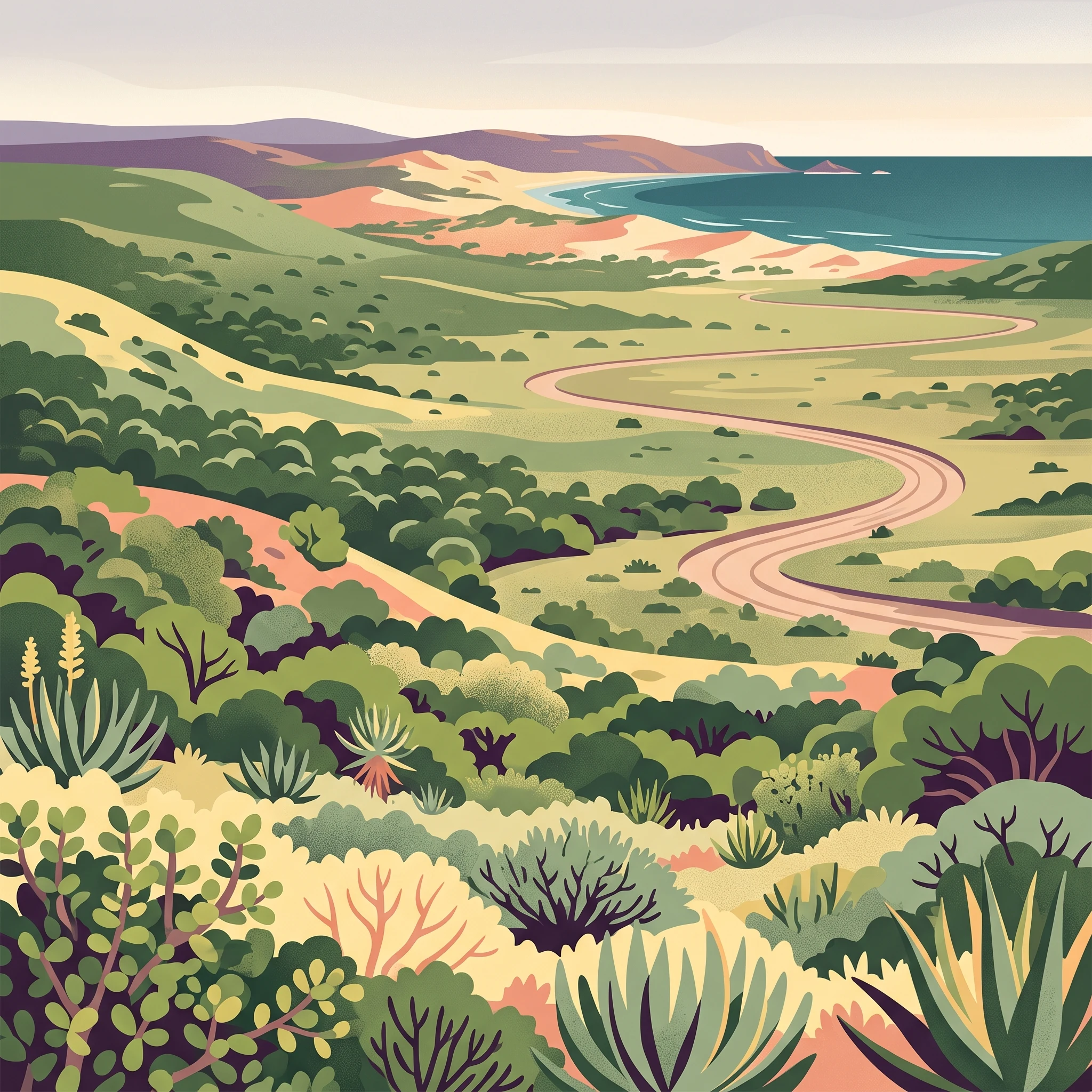
The Addo Elephant National Park encompasses remarkable topographical variety spanning approximately 1,640 square kilometers across the Eastern Cape interior and coastline. The park's terrain includes semi-arid karoo plains characterized by succulent vegetation, dense valley thickets, coastal dunes along the Indian Ocean shoreline, and riparian zones along river systems like the Sundays River. The landscape transitions from inland arid zones toward the coastal belt where the Woody Cape Nature Reserve extends from the Sundays River mouth toward Alexandria, featuring wind-shaped dunes and coastal forest patches. Marine environments form an integral component of the protected area, with the park's marine protected zones encompassing islands in Algoa Bay including St. Croix Island and Bird Island. These islands serve as critical breeding habitats for seabirds and support diverse marine life in the surrounding waters. The park's interior displays a patchwork of vegetation communities adapted to the region's variable rainfall patterns and soil conditions, creating a visually diverse landscape that ranges from open grassy plains to dense woody thickets.

Addo Elephant National Park ecosystems, habitats, and plant life

The ecological character of Addo Elephant National Park is distinguished by its exceptional diversity, encompassing five of South Africa's seven major vegetation biomes within a single protected area. The park's flora includes numerous rare and endemic plant species, particularly succulent shrubs and geophytes adapted to the semi-arid conditions of the succulent karoo biome. These plant communities have evolved under challenging environmental pressures and represent significant conservation value. However, the park faces ongoing ecological tensions between megaherbivore populations and vegetation sustainability, as elephant browsing and trampling impact plant communities and have contributed to the vulnerability of up to 77 South African endemic plant species. The integration of marine protected areas has added coastal and oceanic ecosystems to the park's conservation mandate, protecting not only terrestrial but also seabird breeding colonies and marine biodiversity. This multi-habitat approach reflects the park's evolution from a single-species elephant sanctuary to a comprehensive ecosystem preservation initiative.

Addo Elephant National Park wildlife and species highlights

Addo Elephant National Park supports impressive wildlife populations that have recovered dramatically from historical lows. The park is home to over 600 African bush elephants, representing a remarkable recovery from the 16 individuals that survived the early 20th-century culling. Approximately 400 Cape buffaloes graze the savanna areas, while over 48 endangered south-western black rhinoceros persist in the park's protected environment. The predator community includes lions reintroduced in 2003 and spotted hyenas, completing the Big Seven lineup alongside leopards that maintain territory throughout the park. Various antelope species including red hartebeest, common eland, and warthogs populate the different habitat zones. A particularly notable resident is the flightless dung beetle, Circellium bacchus, whose largest remaining global population resides within Addo. The marine components protect critical breeding colonies, with Bird Island hosting the world's largest gannet breeding population of approximately 120,000 birds and the second-largest African penguin breeding colony, while St. Croix Island holds the largest penguin colony. Southern right whales and great white sharks occur in the marine protected waters, completing the Big Seven marine representation.

Addo Elephant National Park conservation status and protection priorities

Addo Elephant National Park represents both a conservation success story and an ongoing ecological management challenge. The park's foundational achievement lies in preventing the local elephant extinction and establishing a thriving population where fewer than 20 individuals once remained. However, the recovery of megaherbivore populations has created new conservation dynamics, particularly regarding vegetation pressure from elephant overpopulation and browsing impacts on endemic plant species. Up to 77 South African endemic plant species have been classified as vulnerable to elephant browsing, representing a significant conservation concern that requires careful ecological management. The park's expansion to include marine protected areas demonstrates an integrated conservation approach, protecting seabird nesting islands and marine biodiversity. The vision for the Greater Addo Elephant National Park aims to expand the protected area to approximately 3,600 square kilometers, consolidating terrestrial, coastal, and marine ecosystems under unified management. The park's conservation significance also includes protecting five of South Africa's seven major vegetation biomes and providing habitat for multiple endangered species including black rhinos and the endemic flightless dung beetle.

Addo Elephant National Park cultural meaning and human context

The park's establishment reflects a historical period of human-wildlife conflict in South Africa's Eastern Cape region, where expanding agricultural activities brought elephants and farmers into direct competition for land and resources. The original elephant population occupied an area where fruit farms had been sold at reduced rates due to the presence of elephants, yet farmers subsequently sought government intervention to address crop damage and safety concerns. The intervention of Deneys Reitz as Minister for Lands in 1925 marked a pivotal moment in recognizing the need to protect remaining elephant populations, while the formal establishment as a national park in 1931 came following the passage of South Africa's first national parks legislation. The park's expansion to include the Woody Cape Nature Reserve incorporated coastal areas with historical connections to the Sundays River mouth and the town of Alexandria, areas with their own regional history and land use patterns. The ongoing inclusion of marine protected areas recognizes the interconnectedness of terrestrial and oceanic ecosystems and the traditional maritime significance of Algoa Bay.

Top sights and standout views in Addo Elephant National Park

Addo Elephant National Park offers distinctive experiences centered on its unique conservation status and diverse ecosystems. Visitors can observe the remarkable elephant populations in close proximity, often viewing herds at waterholes and grazing areas throughout the park. The marine component provides exceptional wildlife viewing opportunities, with boat-based whale watching for southern right whales and potential encounters with great white sharks in the protected marine zones. Bird Island and St. Croix Island represent global significance for seabird conservation, particularly the gannet breeding colony and African penguin populations. The park's position as the only protected area containing all Big Seven species in natural settings makes it a premier safari destination for comprehensive African wildlife experiences. The varied terrain from semi-desert karoo to coastal forests provides visual diversity and supports multiple ecosystems within a single park boundary.

Best time to visit Addo Elephant National Park

Addo Elephant National Park can be visited throughout the year, though different seasons offer distinct advantages for wildlife viewing and park experiences. The drier winter months from May to September typically provide easier animal spotting as vegetation thins and animals concentrate around remaining water sources, making elephant and other megafauna observations more reliable. Summer months from November to March bring higher rainfall that transforms the landscape into lush greenery but can make animal detection more challenging as dense vegetation provides greater cover. The shoulder seasons of spring and autumn offer balanced conditions with moderate weather and good wildlife viewing opportunities. The marine protected areas provide year-round interest, though southern right whale sightings are most common during their migration season from June to November when they breed in the warmer coastal waters. Visitors interested in combining terrestrial and marine experiences should consider the warmer months for optimal conditions across both park components.
Park location guide

Geography guide, regional context, and park location map for Addo Elephant National Park

Addo Elephant National Park park geography, regions, and map view in South Africa
Understand where Addo Elephant National Park sits in South Africa through a broader geographic reading of the surrounding landscape, nearby location context, and its mapped position within the national park landscape.

How Addo Elephant National Park fits into South Africa

South Africa is the southernmost country in Africa, spanning 1.22 million km² with a population of over 63 million. The country operates with three capital cities, Pretoria (executive), Cape Town (legislative), and Bloemfontein (judicial), and is renowned for its biodiversity, national parks, and multicultural society.

Wider geography shaping Addo Elephant National Park in South Africa

South Africa occupies the southernmost region of Africa, with coastline along both the Atlantic Ocean to the west and the Indian Ocean to the east. The interior features elevated plateaus including the Highveld, with the Drakensberg escarpment marking the eastern highlands. The country shares borders with Namibia, Botswana, Zimbabwe, Mozambique, Eswatini, and Lesotho.

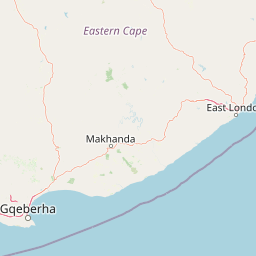
Map view of Addo Elephant National Park

Use this park location map to pinpoint Addo Elephant National Park in South Africa, understand its exact geographic position, and read its mapped placement within the surrounding landscape more clearly.

Pigeon | © OpenStreetMap contributors

Location context for Addo Elephant National Park

Eastern Cape
Park atlas

Compare diverse protected landscapes and conservation areas within South Africa's Eastern Cape, extending beyond Addo Elephant National Park.

Explore Other National Parks and Protected Areas Near Addo Elephant National Park
Browse a curated selection of national parks and protected areas near Addo Elephant National Park, mapping the geographic spread of South Africa's Eastern Cape conservation landscapes. Compare diverse ecosystems, unique wildlife habitats, and regional protected land parcels to gain a broader atlas perspective on South African natural heritage.
National parkEastern Cape

Mountain Zebra National Park: A National Park within Eastern Cape's Geography

Explore its mapped protected boundaries and regional landscape context.

Mountain Zebra National Park serves as a key protected area within South Africa's Eastern Cape region. This page offers an atlas-driven perspective, detailing the park's geographic scope and mapped boundaries. Understand its role as a national park and its contribution to the regional landscape context, providing structured data for those interested in protected land distribution and natural terrain.

Area
284 km²
Established
1937
IUCN
II
National parkSouth Africa

Tsitsikamma National Park: South Africa's Protected Coastal Forest and Terrain

Explore the unique mapped landscape and protected area boundaries.

Tsitsikamma National Park in South Africa is defined by its striking coastal geography, where ancient indigenous forests descend towards rugged shores. This national park is a prime example of a protected landscape that showcases the dynamic interface between land and sea, featuring dramatic cliffs and iconic river mouths. Understanding its mapped boundaries and diverse terrain provides critical context for regional geographic exploration and the study of conservation areas within South Africa.

Established
2009
IUCN
II
National parkSouth Africa

Garden Route National Park: South Africa's Protected Landscape and Forest Atlas

Explore indigenous forests, coastal cliffs, and lake systems.

Garden Route National Park is a key national park in South Africa, celebrated for its rich indigenous forests and dramatic coastline. As a protected landscape, it offers a unique geographic profile, blending ancient woodlands with rugged coastal terrain and interconnected lake systems. This page serves as an atlas entry, detailing the park's spatial extent and its significance as a conservation area within the broader geography of South Africa.

Area
1,210 km²
Established
2009
IUCN
II
National parkWestern Cape

Bontebok National Park: A Unique Protected Landscape in South Africa's Western Cape

Mapping the endemic bontebok's habitat and diverse fynbos.

Bontebok National Park represents a singular achievement in conservation, dedicated to protecting the rare bontebok antelope and showcasing the extraordinary biodiversity of the Cape Floristic Region. Located in the Western Cape, this smallest of South Africa's national parks features a landscape of fynbos-covered foothills beneath the Langeberg Mountains, with the Breede River defining its southern edge. Explore its mapped boundaries and unique ecosystems, offering a concentrated natural discovery experience within a UNESCO World Heritage Site.

Area
27.86 km²
Established
1931
IUCN
II
National parkQacha's Nek District

Sehlabathebe National Park: Mapped Protected Landscape in Lesotho's Maloti Mountains

Explore high-altitude terrain, waterfalls, and ancient rock art sites.

Sehlabathebe National Park stands as a protected national park within the rugged Maloti Mountains of Lesotho's Qacha's Nek District. This destination is vital for understanding the geographic context of protected areas, featuring dramatic cliffs, iconic waterfalls like Tsoelikana, and numerous rock art sites that speak to its cultural and historical significance. Its high-altitude Afro-Alpine and sub-alpine ecosystems offer unique landscape characteristics and support notable biodiversity, making it a key point of interest for atlas-driven exploration of natural and protected terrains.

Area
69.5 km²
Established
1969
IUCN
IV
National parkLeribe District

Ts'ehlanyane National Park: Indigenous Forest & Maloti Mountain Protected Landscape

Explore unique terrain and endemic plant habitats.

Ts'ehlanyane National Park is a vital protected area in Lesotho's Leribe District, distinguished by its rare indigenous forest and the prevalence of berg bamboo. This national park offers insight into unique altitudinal landscapes and botanically significant ecosystems, situated within the expansive Maloti Mountains. Its protected status makes it a key destination for understanding the regional geography and the conservation of specialized natural habitats.

IUCN
II
National parkNorthern Cape

Augrabies Falls National Park: A South African National Park Defined by Granite Gorge and Semi-Desert Terrain

Explore the mapped natural landscape and protected boundaries.

Augrabies Falls National Park in South Africa's Northern Cape Province is a key protected area known for its thundering waterfall on the Orange River and the profound granite gorge carved over millennia. The park's semi-desert environment showcases the distinctive quiver trees and geological landmarks like Moon Rock, offering a unique landscape context. Understand its protected status and geographic significance within the arid Nama-Karoo biome through detailed mapping and landscape information.

Area
820 km²
Established
1966
IUCN
II
National parkEswatini

Hlane Royal National Park: Eswatini's Vast Protected Savanna Woodland Landscape

Mapped geography and protected area context in northeastern Eswatini.

Delve into Hlane Royal National Park, Eswatini's most extensive protected territory, a prime example of lowland bushveld savanna. This national park is defined by its expansive woodland terrain, dotted with ancient trees and seasonal water pans, creating a dynamic landscape. It is an essential component for understanding the regional geography and the distribution of protected areas within Southern Africa, offering significant opportunities for landscape exploration.

Area
300 km²
IUCN
VI

Common questions about visiting, size, designation, and location context for Addo Elephant National Park

Addo Elephant National Park FAQs for park facts, access, geography, and protected area context
Find quick answers about Addo Elephant National Park, including protected-area facts, park geography, trail and visitor context, and how the park fits into its surrounding country and regional landscape.
MoriAtlas Explorer

Continue Your Protected Areas Search Across the Global Atlas

Deepen your exploration by continuing the structured search for national parks and protected areas worldwide. Utilize the comprehensive filtering capabilities to compare different conservation landscapes and refine your understanding of global park geography. Discover more about the distribution and characteristics of protected natural areas.

Global natural geography