Mori Atlas logo
National parkAlberto de Agostini National Park

Discover the dramatic glacial terrain and subpolar forests of this Magallanes Region national park.

Alberto de Agostini National Park: Protected Landscape & Southern Andes Geography

Alberto de Agostini National Park represents a significant protected national park at the southernmost reach of the Andes, located within Chile's Magallanes Region. This vast wilderness area encompasses the formidable Cordillera Darwin, offering a unique insight into glacial landscapes, deep fjords, and subpolar forests shaped by dynamic geological processes. Explore its mapped boundaries and dramatic terrain, essential for understanding the geographic context of this remote Patagonian wilderness.

glacial landscapesCordillera Darwinsubpolar foreststidewater glaciersPatagonian wildernessUNESCO Biosphere Reserve

Alberto de Agostini National Park

National park

Park overview

Structured park overview, official facts, and landscape profile for Alberto de Agostini National Park

Alberto de Agostini National Park park facts, protected area profile, and essential visitor context
Review the core facts for Alberto de Agostini National Park, including designation, size, terrain, visitor scale, habitats, and operating context in one park-focused overview.

About Alberto de Agostini National Park

Alberto de Agostini National Park represents one of Chile's most significant protected wilderness areas, encompassing a vast territory of approximately 1.46 million hectares at the extreme southern tip of the continent. The park's defining geographic feature is the Cordillera Darwin, a mountain range whose peaks rise sharply from the sea, creating one of the most spectacular coastal mountain landscapes in the world. Monte Darwin reaches 2,488 meters elevation, while Monte Sarmiento stands at 2,404 meters, both dominating a landscape where glaciers descend directly to the water's edge through deep fjords. The park's coastline is highly irregular, deeply indented by fjords that include Agostini Fjord, Seno Pía, and the northwestern arm of the Beagle Channel. These glacial-carved valleys, now filled by the sea, create a labyrinthine waterways system that characterizes much of the park's marine environment. The park includes numerous islands, notably Gordon Island, Cook Island, Londonderry Island, and portions of Hoste Island, adding to the complexity of this maritime mountain landscape.

Quick facts and research context for Alberto de Agostini National Park

Located approximately 148 kilometers southwest of Punta Arenas in Chile's Magallanes y la Antártica Chilena Region, the park stretches across three provinces: Magallanes, Tierra del Fuego, and Antártica Chilena. It protects the Cordillera Darwin mountain range, the final terrestrial extension of the Andes before the mountains become islands sinking into the Southern Ocean. The park contains several significant glaciers including Marinelli, Romanche, Italia, Alemania, and Holanda, with Marinelli being the largest. The area is part of the Magellanic subpolar forests ecoregion, featuring coihue and canelo trees, and supports diverse wildlife including marine mammals, seabirds, and coastal dolphins. Access is exclusively by boat or aircraft, as no roads reach the park.

Park context

Deeper park guide and search-rich context for Alberto de Agostini National Park

Alberto de Agostini National Park history, landscape, wildlife, and travel context
Explore Alberto de Agostini National Park through its history, landscape character, ecosystems, wildlife, conservation priorities, cultural context, and seasonal travel timing in a structured park guide built for atlas discovery and search intent.

Why Alberto de Agostini National Park stands out

Alberto de Agostini National Park is best known for its dramatic glacial landscapes and the Cordillera Darwin, which represents the southernmost continental extension of the Andes. The park features the spectacular Avenue of the Glaciers along the Beagle Channel, where multiple glaciers can be viewed from the water, and the impressive Marinelli Glacier, one of the largest in the region. Its designation as part of the Cabo de Hornos World Biosphere Reserve reflects the area's unique mosaic of contrasting ecosystems. The park also honors the legacy of Italian missionary-explorer Alberto Maria De Agostini, whose photographic and cartographic work documented this remote wilderness in the early twentieth century.

Alberto de Agostini National Park history and protected-area timeline

The park is named in honor of Alberto Maria De Agostini, one of the most influential Salesian priests in Chilean history, who was born in Italy and became a renowned missionary, explorer, photographer, and writer in the early twentieth century. De Agostini dedicated his life to exploring and documenting the remote wilderness of southern Chile and Tierra del Fuego, producing extensive photographic records, maps, and written accounts that brought international attention to this region's extraordinary landscapes. The park was officially established on January 22, 1965, created from lands formerly part of the Hollanda forest reserve and Hernando de Magallanes National Park. The region holds significant historical importance as the area where Charles Darwin encountered indigenous Fuegian peoples during his voyage on HMS Beagle, including the Selkʼnam, Haush, Manekʼenk, and Yaghan peoples. The Yaghan settled these lands along the channel approximately 10,000 years ago, and Darwin's encounters with them proved vital to the development of his theories on human evolution. In 2005, Alberto de Agostini National Park, together with Cabo de Hornos National Park, was designated as the Cabo de Hornos World Biosphere Reserve by UNESCO, recognizing its exceptional ecological value.

Alberto de Agostini National Park landscape and geographic character

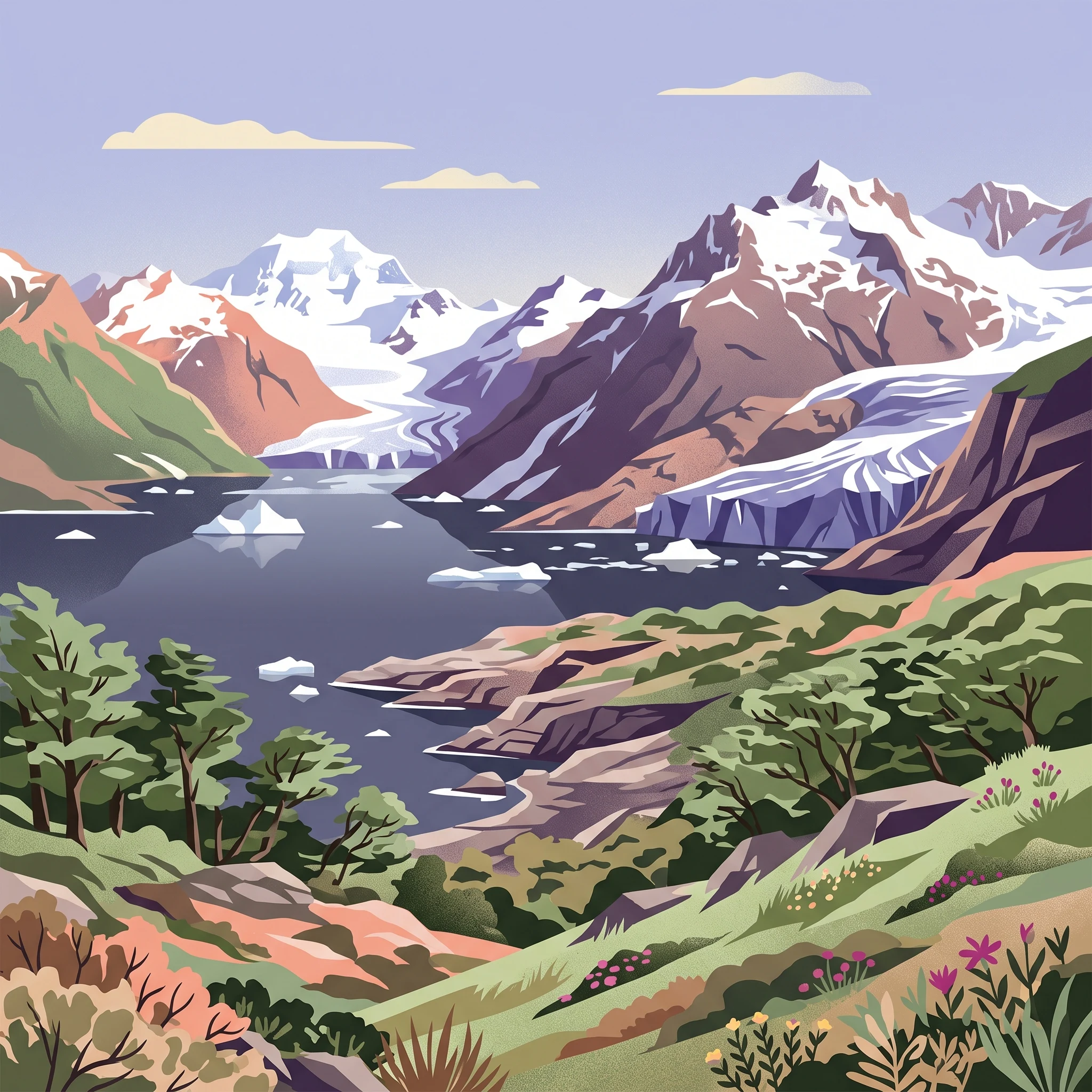
The landscape of Alberto de Agostini National Park is defined by the dramatic meeting of mountain and sea at the southern terminus of the Andes. The Cordillera Darwin forms the backbone of the park, with its steep, glacier-clad peaks dropping abruptly to the ocean. The highest summits include Monte Darwin at 2,488 meters and Monte Sarmiento at 2,404 meters, the latter famous enough to earn a mention in Jules Verne's Twenty Thousand Leagues Under the Seas. The park's coastline is extraordinarily irregular, deeply carved by fjords that penetrate far inland, creating a complex shoreline of islands, channels, and steep-walled inlets. Glaciers occupy the valleys and high plateaus, with the Marinelli Glacier being the most extensive, featuring imposing ice walls that descend to the water. The Avenue of the Glaciers along the Beagle Channel offers a remarkable concentration of glacial features, where glaciers including España, Romanche, Alemania, Italia, Francia, and Holanda can be observed from the water. The landscape has been fundamentally shaped by glacial erosion, with most of the modern terrain representing the results of Pleistocene and more recent glacier activity.

Alberto de Agostini National Park ecosystems, habitats, and plant life

The park lies within the Magellanic subpolar forests ecoregion, representing one of the world's southernmost forest ecosystems. The vegetation consists primarily of evergreen species adapted to the cold, wet conditions, with coihue (Nothofagus betuloides) and canelo (Drimys winteri) being the dominant tree species. Lenga (Nothofagus pumilio) also occurs throughout the park, adding variety to the forest composition. The understory and forest floor support rich communities of mosses, lichens, and fungi, particularly in the moist subpolar environment. In the lowland areas, peat bogs and wetlands (turberas) dominate, creating distinct habitat types that support specialized plant communities. The forest vegetation creates a striking visual contrast with the white ice of the glaciers that descend through the mountain valleys to the sea. This pristine coastal ecosystem forms part of the broader Magallanes Sub-Polar (or Sub-Antarctic) Evergreen Rainforest, which UNESCO has recognized for its mosaic of contrasting ecosystems with unique and singular characteristics on a global scale.

Alberto de Agostini National Park wildlife and species highlights

The park supports a rich diversity of marine and terrestrial wildlife adapted to the subpolar environment. Marine mammals are particularly well-represented, with South American sea lions and southern elephant seals haul out on coastal beaches, while leopard seals patrol the icy waters. Several dolphin species inhabit the park's waters, including the Chilean dolphin (also called the black dolphin or tonina), Peale's dolphin, and humpback whales that migrate through the region. The park's islands and coastline support significant seabird populations, with southern royal albatrosses among the most prominent, along with various cormorant species and southern giant petrels. In the forested areas, the Magellanic woodpecker represents one of the most distinctive bird species, while the white-crested elaenia and austral thrush add to the avifauna diversity. Terrestrial mammals include the culpeo (Andean fox) and South American gray fox (Patagonian fox), while the marine otter (locally called chungungo) occupies the coastal zone. Guanacos are found in more open terrain, representing the park's only large native herbivore.

Alberto de Agostini National Park conservation status and protection priorities

Alberto de Agostini National Park forms a critical component of Chile's protected area network and holds international significance through its UNESCO Biosphere Reserve designation. Along with Cabo de Hornos National Park, it was recognized in 2005 as part of the Cabo de Hornos World Biosphere Reserve, acknowledging the area's outstanding universal value as a representative example of the Magellanic subpolar forest ecosystem. The park protects a landscape of exceptional global significance, where the final stretch of the Andes creates unique ecological conditions that support species found nowhere else on Earth. The glacier-covered mountains, extensive fjord systems, and subpolar forests represent a relatively intact ecosystem that provides vital habitat for numerous species, including several marine mammals and seabirds of conservation concern. The park's management by Chile's National Forest Corporation (CONAF) aims to preserve these wilderness values while allowing for limited scientific and educational use.

Alberto de Agostini National Park cultural meaning and human context

The region holds deep cultural significance as the ancestral homeland of the Fuegian peoples, including the Selkʼnam, Haush, Manekʼenk, and Yaghan, who inhabited these lands for thousands of years before European contact. The Yaghan people specifically settled along the Beagle Channel approximately 10,000 years ago, developing a culture intimately connected to the marine environment. Charles Darwin's visit to the region during his voyage on HMS Beagle proved historically significant, as his encounters with these indigenous peoples contributed to his developing theories on human evolution. The park's namesake, Alberto Maria De Agostini, represents another layer of cultural significance. As a Salesian missionary and explorer active in the early twentieth century, his extensive documentation through photography, writing, and mapping brought the region's extraordinary landscapes to international attention and established a legacy of exploration and conservation awareness in Chilean Patagonia.

Top sights and standout views in Alberto de Agostini National Park

The park offers exceptional opportunities to experience some of the most dramatic glacial wilderness remaining in South America. The Cordillera Darwin provides the backdrop for spectacular mountain scenery, with Monte Darwin and Monte Sarmiento ranking among Patagonia's most iconic peaks. The Avenue of the Glaciers along the Beagle Channel presents a remarkable concentration of tidewater glaciers observable from boat, including the massive Marinelli Glacier with its imposing ice walls. The park's designation as a UNESCO Biosphere Reserve reflects its outstanding ecological significance within the Magellanic subpolar forest ecoregion. Wildlife viewing opportunities include marine mammals such as sea lions, elephant seals, and dolphins, along with seabirds including albatrosses and petrels. The absence of roads ensures that the park retains a remote, wilderness character accessible only by boat or aircraft, preserving an experience of true remoteness.

Best time to visit Alberto de Agostini National Park

The park can be visited year-round, though the subpolar oceanic climate means weather conditions are variable and often challenging regardless of season. The summer months of December through February offer the longest daylight hours and relatively milder temperatures, making this the most popular period for visits. However, the park's exposed position at the southern tip of South America means wind and rain are common throughout the year, and visitors should be prepared for inclement conditions even during the peak season. Winter months bring shorter days but can offer dramatic winter landscapes with snow-covered peaks and glaciers. The frequently overcast conditions create a moody, atmospheric quality to the landscape that many find evocative. Marine wildlife viewing is possible year-round, though sea conditions vary seasonally. Given the park's remote nature and dependence on boat access, most visitors experience the park as part of organized cruise ship itineraries or specialized expedition tours.
Park location guide

Geography guide, regional context, and park location map for Alberto de Agostini National Park

Alberto de Agostini National Park park geography, regions, and map view in Chile
Understand where Alberto de Agostini National Park sits in Chile through a broader geographic reading of the surrounding landscape, nearby location context, and its mapped position within the national park landscape.

How Alberto de Agostini National Park fits into Chile

Chile is a presidential republic in western South America, extending as a narrow strip along the western edge of the continent between the Andes Mountains and the Pacific Ocean. It is the southernmost country in the world and the closest to Antarctica. The country is bordered by Peru, Bolivia, and Argentina, and administers several Pacific islands including Easter Island. Chile is a major copper producer and has a population of approximately 19.6 million.

Wider geography shaping Alberto de Agostini National Park in Chile

Chile occupies a narrow strip of land along the western edge of South America, extending approximately 4,300 km north to south but only about 350 km east to west at its widest point. The country is sandwiched between the Andes Mountains to the east and the Pacific Ocean to the west. It shares borders with Peru to the north, Bolivia to the northeast, and Argentina to the east. Southern Chile borders the Drake Passage. Chile also administers several Pacific islands including Juan Fernández Islands, Isla Salas y Gómez, Desventuradas Islands, and Easter Island, plus the Chilean Antarctic Territory.

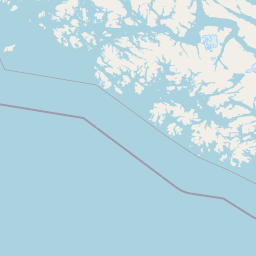
Map view of Alberto de Agostini National Park

Use this park location map to pinpoint Alberto de Agostini National Park in Chile, understand its exact geographic position, and read its mapped placement within the surrounding landscape more clearly.

Pigeon | © OpenStreetMap contributors

Location context for Alberto de Agostini National Park

Magallanes Region
Park atlas

Map the Geographic Proximity and Landscape Similarities of Protected Areas Across Southern Chile

Explore Other Protected Areas and National Parks Near Alberto de Agostini National Park
Browse a curated selection of national parks and protected areas geographically close to Alberto de Agostini National Park, revealing the diverse glacial landscapes and subpolar forests of Patagonia. Compare their unique conservation features, mapped terrain, and regional context to deepen your understanding of Chile's dramatic southern wilderness.
National parkTierra del Fuego Province

Tierra del Fuego National Park: Argentina's Southernmost Protected Landscape and Geography

Subantarctic terrain, glacial valleys, and coastal Patagonian forest.

Tierra del Fuego National Park is a significant protected area at the southern tip of South America, celebrated for its unique subantarctic landscapes. This national park showcases the dramatic intersection of Patagonian forests and Andean terrain, with its mapped boundaries extending along the rugged coastline of the Beagle Channel. Users can explore the park's geographic features, understanding its role within the broader atlas of protected lands and its distinct natural heritage in Tierra del Fuego Province. Discover the park's terrain, from ancient beech forests to glacial valleys, and its ecological significance.

Area
630 km²
Established
1960
IUCN
II
Relief
Mountain
National parkSanta Cruz Province

Monte León National Park: A Protected Coastal Landscape in Argentina's Santa Cruz Province

Explore unique sandstone formations and marine park geography.

Monte León National Park represents a crucial protected landscape, safeguarding a significant stretch of the Patagonian coastline in Argentina's Santa Cruz Province. This area is defined by striking sandstone cliffs, the iconic Lion Head Mount formation, and a dynamic coast with beaches and emergent sandbars. As the nation's first continental marine park, it offers a unique geographic context for understanding steppe and coastal biodiversity, providing an essential atlas entry for those exploring Argentina's natural heritage.

Area
621.68 km²
Established
2004
IUCN
II
National parkAysén del General Carlos Ibáñez del Campo Region

Bernardo O'Higgins National Park: Southern Patagonian Ice Field & Glacial Terrain

Chile's largest protected area: a map of vast ice caps and fjords.

Bernardo O'Higgins National Park is a colossal protected landscape in Chile, safeguarding much of the Southern Patagonian Ice Field and its colossal glacial features like the Pío XI Glacier. Explore the dramatic terrain of towering granite peaks and intricate fjord systems that define this remote national park. This page provides essential context for understanding its geography, mapped boundaries, and significance as a vast wilderness preservation.

Area
35,259 km²
Established
1969
IUCN
II
National parkSanta Cruz Province

Perito Moreno National Park: Mapped Protected Landscape and Geographic Context in Santa Cruz Province

Explore Argentinian Patagonian mountain terrain and its ecological transition.

Perito Moreno National Park is a vast protected area in Argentina's Santa Cruz Province, known for its dramatic Patagonian mountain landscapes and unique ecological transition zone between wet Magellanic forests and dry Andean steppe. Spanning over 126,830 hectares, the park's geography features an amphitheater-like structure with valleys radiating from central highlands, and peaks reaching nearly 2,800 meters. This national park provides critical insight into the regional natural landscapes and mapped protected areas of Patagonia, offering a detailed view of its terrain and hydrographic features.

Area
1,268.3 km²
Established
1937
IUCN
II
National parkAysén del General Carlos Ibáñez del Campo Region

Cerro Castillo National Park: Dramatic Granite Peaks and Patagonian Protected Landscape

Mapped geography and huemul conservation in Chile's Aysén Region.

Cerro Castillo National Park is a premier protected area in southern Chile, celebrated for its iconic Cerro Castillo granite mountain that dominates the landscape. This national park, spanning over 1,700 square kilometers in the Aysén del General Carlos Ibáñez del Campo Region, showcases a dynamic Patagonian terrain shaped by glaciers and rivers. Its significance extends to being a vital corridor for endangered huemul, offering critical habitat within a broader regional conservation strategy and the famous Route of Parks.

Area
1,795.5 km²
Established
1970
IUCN
II
National parkAysén del General Carlos Ibáñez del Campo Region

Queulat National Park: Patagonian Andes Glacier and Rainforest Discovery

Mapped protected area in Aysén del General Carlos Ibáñez del Campo Region.

Queulat National Park is a vast protected wilderness in southern Chile, renowned for its dramatic glacial alpine terrain and lush temperate rainforests. The park's geography is defined by steep glacial valleys, ice fields, and the iconic Queulat Hanging Glacier cascading from sheer cliffs. Discover the mapped boundaries of this significant Patagonian national park, offering unparalleled insight into its unique ecosystems and dramatic landscapes shaped by ice and forest.

Area
1,541 km²
Established
1983
IUCN
II
Relief
Mountain
National parkArgentina

Los Alerces National Park: Ancient Alerce Forests and Glacial Terrain in Argentina

Discover the park's protected landscape and regional geography.

Los Alerces National Park in Argentina is a globally significant protected area, celebrated for its ancient alerce forests, some of the longest-living trees on Earth. This national park showcases a dramatic landscape shaped by glaciers, featuring a series of interconnected lakes and rugged Andean terrain. Explore the unique ecosystem and mapped geography of this UNESCO World Heritage site to understand its profound natural and conservation value.

Area
2,599 km²
Established
1937
IUCN
II
National parkRío Negro Province

Islote Lobos National Park: Coastal Archipelago National Park in Río Negro Province

Mapping the dynamic intertidal zones and unique Patagonian marine geography.

Islote Lobos National Park is a notable national park on the Atlantic coast of Río Negro Province, Argentina. This protected area preserves a distinctive landscape of six rocky promontories emerging from San Matías Gulf, creating unique island ecosystems. The park's coastal and marine environments, characterized by significant tidal fluctuations and important habitats for marine fauna, are vital to the Patagonian natural heritage. Its mapped geography offers critical insights into regional conservation efforts.

Area
19.079 km²
Established
2020
IUCN
II

Common questions about visiting, size, designation, and location context for Alberto de Agostini National Park

Alberto de Agostini National Park FAQs for park facts, access, geography, and protected area context
Find quick answers about Alberto de Agostini National Park, including protected-area facts, park geography, trail and visitor context, and how the park fits into its surrounding country and regional landscape.
MoriAtlas Explorer

Continue Your Protected Areas Search Across the Global Atlas

Deepen your exploration by continuing the structured search for national parks and protected areas worldwide. Utilize the comprehensive filtering capabilities to compare different conservation landscapes and refine your understanding of global park geography. Discover more about the distribution and characteristics of protected natural areas.

Global natural geography