Why Budo, Su-ngai Padi National Park stands out
The park is best known for its pristine tropical rainforest environment and the endangered spectacled langur, a primate species that inhabits the high mountains and deep jungle in social groups. The park is also distinguished by the rare golden-leaved plant known locally as yandao, first discovered within its boundaries in 1988. This vine features distinctive gold-colored leaves with a velvet-like texture that can exceed the size of a human palm. The protected area represents one of the most significant remaining tracts of lowland and montane rainforest in southern Thailand, supporting populations of other rare mammals including rhinoceros, agile gibbons, tapirs, and Sumatran serows.
Budo, Su-ngai Padi National Park history and protected-area timeline
The area that now comprises Budo–Su-ngai Padi National Park was historically known for its remoteness and thick jungle cover. During periods of political instability in Thailand's far south, the mountains served as a refuge for guerrilla forces, making the region largely inaccessible to civilians and outside researchers. Following improvements in the security situation in 1974, the Royal Forest Department moved to establish formal protection for the area by creating Pacho Waterfall Park, one of the earliest conservation designations in the region. This initial protected area focused on preserving the scenic waterfall and surrounding forest. Over the following decades, the protected area was expanded and upgraded in status, eventually achieving full national park designation in 1999 under the name Budo–Su-ngai Padi National Park. The establishment reflected growing recognition of the region's ecological significance and the need to protect its unique biodiversity from logging and agricultural expansion.
Budo, Su-ngai Padi National Park landscape and geographic character
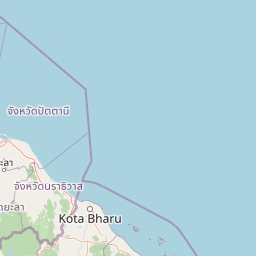
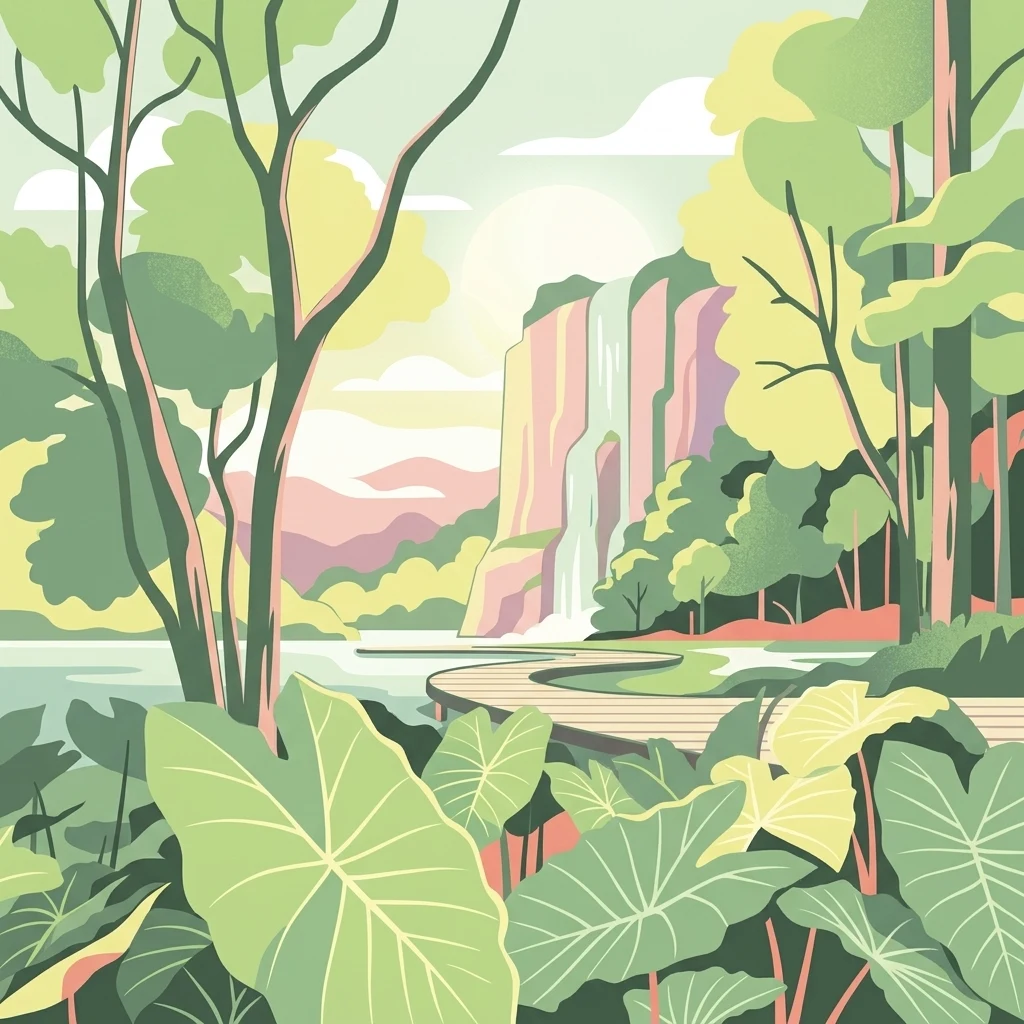
The physical landscape of Budo–Su-ngai Padi National Park is defined by the rugged, forested slopes of the Budo mountains, which form part of the Tenasserim Hills system. This mountain range represents the southernmost extension of the broader Indo-Burman mountain arc and creates a dramatic backdrop of steep ridges, deep valleys, and cascading streams. The terrain rises from lower foothills toward higher peaks in the park's interior, with elevation gradients creating diverse microhabitats across relatively short distances. The forest cover is dense and continuous, characterized by tall canopy trees, abundant epiphytes, and a complex understory. Several perennial waterfalls punctuate the landscape, with Pacho waterfall being the most prominent, dropping over a high cliff face. The combination of monsoonal rainfall, steep terrain, and热带植被 creates a landscape of exceptional visual and ecological richness.
Budo, Su-ngai Padi National Park ecosystems, habitats, and plant life
The ecological character of Budo–Su-ngai Padi National Park is defined by its representation of Indo-Malayan tropical rainforest at the northern edge of the Malay Peninsula. The year-round rainfall and consistently warm temperatures support evergreen forest with high species diversity across multiple canopy layers. The forest exhibits typical tropical rainforest structure with emergent trees, a dense canopy, and a varied understory. Watercourses and riparian zones add further habitat diversity to the protected area. The park falls within a region recognized for its high degree of endemism, where species have evolved in isolation due to geographic barriers created by mountain ranges and river systems. The protected status ensures the continuation of these ecological processes and the维持 of habitat connectivity for wildlife populations moving through the landscape.
Budo, Su-ngai Padi National Park wildlife and species highlights
The wildlife community of Budo–Su-ngai Padi National Park includes several species of significant conservation concern. The spectacled langur represents the park's most notable primate species, living in groups of 30-40 individuals in the high canopy with social structure led by a dominant male. This species ranges across Southeast Asia from southern Myanmar and Thailand through Malaysia and into island habitats. Other rare mammals present include the rhinoceros, agile gibbon, tapir, and Sumatran serow, all species that depend on intact forest habitats. The primate community also includes three other langur species found in Thailand: banded langurs, gray langurs, and northern spectacled langurs, all of which are endangered. The forest provides critical habitat for these species, supporting feeding, breeding, and movement corridors through the mountainous terrain.
Budo, Su-ngai Padi National Park conservation status and protection priorities
Budo–Su-ngai Padi National Park plays a vital role in conserving Thailand's remaining tropical rainforest biodiversity. The protected area shelters several endangered mammal species, with the spectacled langur and its four Thai relatives representing particularly important conservation targets. The park's location within the Tenasserim Hills places it within a recognized biodiversity hotspot, where forest protection contributes to regional conservation goals. The ecosystem provides essential ecological services including watershed protection, soil conservation, and carbon storage. The discovery of the yandao plant within the park boundaries demonstrates that significant biological discoveries continue to emerge from these protected landscapes. The national park designation provides legal framework for managing human activities and ensuring the long-term viability of the forest ecosystem and its dependent species.
Budo, Su-ngai Padi National Park cultural meaning and human context
The cultural context of Budo–Su-ngai Padi National Park is influenced by its location in Thailand's far southern region, an area with distinct linguistic and cultural ties to neighboring Malaysia. The park name incorporates elements from both Thai and Malay languages, reflecting the cultural geography of the border region. The waterfall name Pacho derives from the Malay word pancur, illustrating the linguistic connections between the two sides of the border. The local communities in the surrounding provinces maintain cultural traditions that are shared with populations across the Malaysia border, creating a cultural landscape that transcends national boundaries. The region's history of political complexity has shaped both human settlement patterns and the conservation trajectory of the area.
Top sights and standout views in Budo, Su-ngai Padi National Park
The standout features of Budo–Su-ngai Padi National Park include its status as one of Thailand's most significant tropical rainforest protected areas, home to the endangered spectacled langur and other rare mammals. The dramatic mountain landscape of the Budo range offers scenic beauty through its steep forested peaks, deep valleys, and cascading waterfalls. The discovery of the unique golden-leaved yandao plant demonstrates the park's ongoing scientific significance. The protected area represents a critical conservation anchor in the Tenasserim Hills corridor, connecting forest habitats across international boundaries. Visitors can experience the Pacho waterfall and explore trails through pristine rainforest that remains largely undeveloped.
Best time to visit Budo, Su-ngai Padi National Park
The optimal time to visit Budo–Su-ngai Padi National Park coincides with Thailand's dry season, typically from December through April, when rainfall is reduced and trail conditions are more favorable for hiking. However, the park's tropical rainforest environment maintains its lush character year-round due to the monsoon climate. The wet season from May through November brings heavier rainfall, which sustains the waterfalls at their fullest flow but may make some trails more difficult to navigate. The high humidity present throughout the year means visitors should prepare for warm, moist conditions regardless of season. Wildlife viewing opportunities may vary with seasonal patterns, and the dense forest cover means that sightings of arboreal species like the spectacled langur require patience and careful observation.