Why Khao Lampi, Hat Thai Mueang National Park stands out
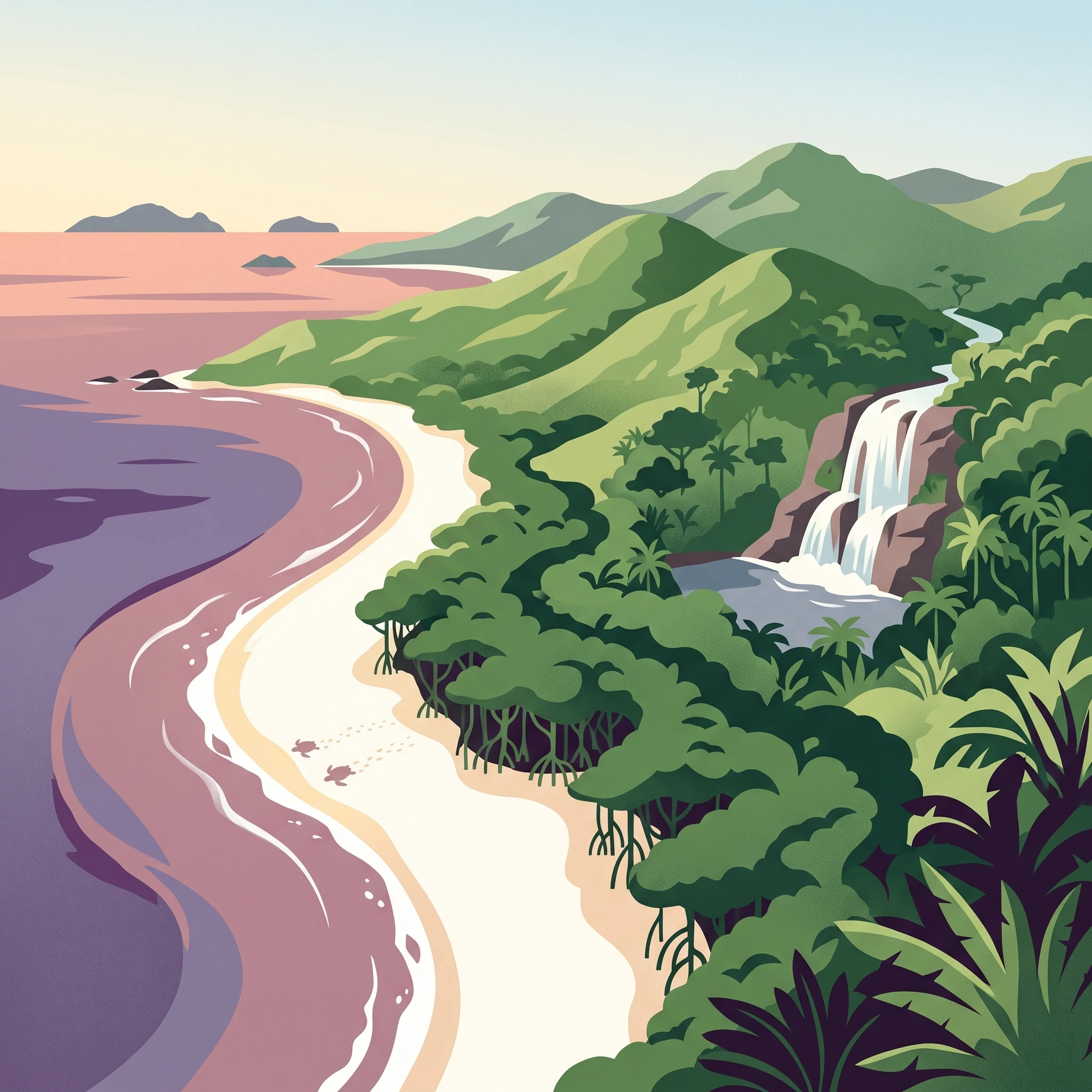
This park is best known for its remarkable dual-character landscape combining mountainous rainforest with coastal beach environments. The eastern mountain section features prominent waterfalls including Ton Phrai, the tallest at 40 meters, and the multi-tiered Lampi Waterfall after which the park was named. The beach section is significant for being a major sea turtle nesting area, with leatherback, green, and hawksbill turtles coming ashore between November and February. The mangroves behind Hat Thai Mueang beach serve as critical nurseries for marine species and provided natural tsunami buffering during the 2004 Indian Ocean event. The park also supports populations of endangered mammals including the Malayan tapir, Sumatran serow, lar gibbon, and sun bear.
Khao Lampi, Hat Thai Mueang National Park history and protected-area timeline
The area now comprising Khao Lampi–Hat Thai Mueang National Park was originally known as Lampi Waterfall and Lampi Forest Park prior to national park designation. The site gained attention for its natural beauty and ecological importance beginning in the 1970s, with formal proposals to establish protected status emerging in the early 1980s. Historical records indicate that Field Marshal Plaek Pibulsonggram (Prime Minister of Thailand from 1944-1957) visited Lampi Waterfall as early as 1955, demonstrating the site's longstanding recognition as a natural landmark. The proposal to establish the area as a national park was motivated by concerns about encroachment and the need to preserve the watershed, forest, and beach resources. Following administrative processing, Khao Lampi–Hat Thai Mueang became Thailand's 52nd national park on April 14, 1986. The establishment combined the previously separate Lampi Forest Park area with the coastal Hat Thai Mueang section into a unified protected area.
Khao Lampi, Hat Thai Mueang National Park landscape and geographic character
The park's landscape is defined by its two contrasting sections separated by the central highway corridor. The eastern mountainous section contains rugged terrain rising to 622 meters at Yot Khao Kanim, with steep ridges and valleys covered in dense tropical forest. Several waterfalls cascade down the mountain slopes, with Ton Phrai Waterfall being the most impressive at 40 meters height, followed by the park's namesake Lampi Waterfall which drops in multiple tiers. The landscape transitions dramatically as one moves westward toward the coast. The beach section features a long expanse of white sand facing the Andaman Sea, backed by a narrow strip of beach forest and then extensive mangrove systems along the canal networks that drain to the sea. The mangroves form a distinctive low-lying ecosystem with brackish water channels threading through dense vegetation. A notable feature is the presence of peat swamp forest in portions of the beach section, one of few such ecosystems along the Andaman coast.
Khao Lampi, Hat Thai Mueang National Park ecosystems, habitats, and plant life
The park's ecological diversity stems from its dual terrestrial and coastal environments. The mountain section supports tropical rainforest with canopy species including dipterocarps such as Dipterocarpus, Anisoptera costata, and Hopea odorata, along with bullet wood. Bamboo and rattan dominate the understory in lower sections. The beach and mangrove section contains distinct vegetation zones: mangroves along the brackish canals including large-leaved and small-leaved mangroves, and beach forest further inland featuring casuarina, Terminalia catappa, Derris indica, and Barringtonia species. The peat swamp forest represents a particularly rare habitat type on the Andaman coast. The mangroves serve crucial ecological functions including water filtration from higher ground, provision of nursery habitat for juvenile marine species, and natural coastal protection. The park's bird diversity includes at least 188 species, making it significant for avifauna in the region.
Khao Lampi, Hat Thai Mueang National Park wildlife and species highlights
The park supports a notable array of mammal species typical of southern Thai forests. Large mammals include the Malayan tapir, a distinctive species with its black-and-white patterning, and the Sumatran serow, a goat-antelope found on steep forested slopes. Primates are represented by lar gibbon, while the Malayan sun bear, the smallest bear species, also occurs in the park. The coastal and marine environments support significant reptile populations, particularly sea turtles. Three species nest on Hat Thai Mueang beach: leatherback, green, and hawksbill turtles. Monitoring data from Thai Mueang beach between 2003 and 2013 recorded 2,678 leatherback eggs laid, with 58.7 percent hatching successfully, though the species faces significant threats. Reptiles also include pythons and Malayan pit vipers in the forest areas. Freshwater fish in the park's streams include several species of conservation interest, while the mangrove and coastal waters support diverse marine life.
Khao Lampi, Hat Thai Mueang National Park conservation status and protection priorities
Khao Lampi–Hat Thai Mueang holds significance within Thailand's conservation framework as a protected area preserving both forest and coastal ecosystems. The sea turtle nesting beach represents one of the park's most important conservation values, with leatherback turtles returning annually to lay eggs despite facing numerous threats. Conservation challenges include irresponsible trawler fishing operations, beachfront property development that displaces nesting turtles, and traditional beliefs regarding the supposed health benefits of turtle eggs that drive illegal egg collection. The park's mangroves proved ecologically valuable during the 2004 Indian Ocean tsunami, demonstrably reducing wave energy and protecting the coastline. The presence of peat swamp forest adds to the park's conservation significance as one of few such ecosystems on the Andaman coast, representing a rare habitat type requiring protection.
Khao Lampi, Hat Thai Mueang National Park cultural meaning and human context
The park's coastal section has supported local community interactions with the marine environment over generations. Hat Thai Mueang beach has traditional significance as a nesting ground for sea turtles, a relationship that continues today though facing pressures from development and changing practices. The area was historically accessible via the route connecting Phuket and Phang Nga, making it a known destination within the region. Local festivals associated with turtle conservation, including events marking the release of hatchlings in March, reflect the continuing connection between communities and the park's natural resources.
Top sights and standout views in Khao Lampi, Hat Thai Mueang National Park
The park's defining feature is its combination of two completely different ecosystems within one protected boundary: mountain rainforest with dramatic waterfalls and a pristine beach with sea turtle nesting. Ton Phrai Waterfall at 40 meters is the tallest and most impressive waterfall, best viewed during the rainy season when water volume is highest. The Lampi Waterfall gives the park its name and offers a multi-tiered cascade. Hat Thai Mueang beach provides 13 kilometers of undeveloped sand along the Andaman Sea, a rare sight on Thailand's developed coast. The sea turtle nesting program draws attention between November and February when turtles come ashore, and a local festival celebrates hatchling releases in March. The mangrove forests behind the beach offer ecological tours and demonstrate important coastal protection functions.
Best time to visit Khao Lampi, Hat Thai Mueang National Park
The optimal time to visit Khao Lampi–Hat Thai Mueang depends on what visitors wish to experience. Waterfall viewing is best during the rainy season from May through October when rainfall creates the most impressive flows at Ton Phrai and Lampi waterfalls. For beach and sea turtle activities, the period from November through February is most significant as this is when leatherback and other sea turtles come ashore to nest. The coolest and driest conditions generally occur from December through February, making this period comfortable for general exploration though visitor numbers increase during turtle season. The park is open year-round, but those wishing to avoid peak heat might prefer the slightly cooler months from November through March. The monsoon season brings heavier rainfall to the mountain section, which while creating better waterfall conditions, may also make some trails more difficult to navigate.