
Why Nam Phong National Park stands out
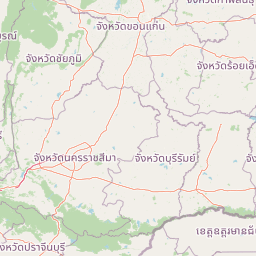
Nam Phong National Park is best known for its dramatic highland scenery where forested mountains meet the waters of the Ubol Ratana Dam reservoir, creating striking viewpoints such as Hin Chang Si that overlook both the reservoir and the surrounding landscape toward Khon Kaen. The park contains significant rock formation areas at Pha Chan Dai and Kham Phon, with the latter featuring unusual circular depression structures possibly created by volcanic activity or long-term erosion. The prehistoric rock paintings at Hin Chang Si add an archaeological dimension to the park's attractions. The southern section's Phu Meng mountain supports particularly diverse plant and animal life within its dry evergreen and mixed deciduous forests.
Nam Phong National Park history and protected-area timeline
Nam Phong National Park was officially established in 2000 as part of Thailand's ongoing efforts to protect representative ecosystems in the northeastern region. The park takes its name from the Nam Phong River, which was impounded to create the Ubol Ratana Dam, a significant infrastructure project that now forms part of the park's northern boundary. The establishment of the park reflected growing recognition in Thailand of the ecological and watershed value of the Phu Phan Kham and Phu Meng mountain ranges, which had previously experienced varying levels of human use and resource extraction. As a relatively young national park compared to many established earlier in Thailand's conservation history, Nam Phong represents a later addition to the country's protected area network, designed to preserve the remaining natural habitats within this populated region of northeastern Thailand.
Nam Phong National Park landscape and geographic character
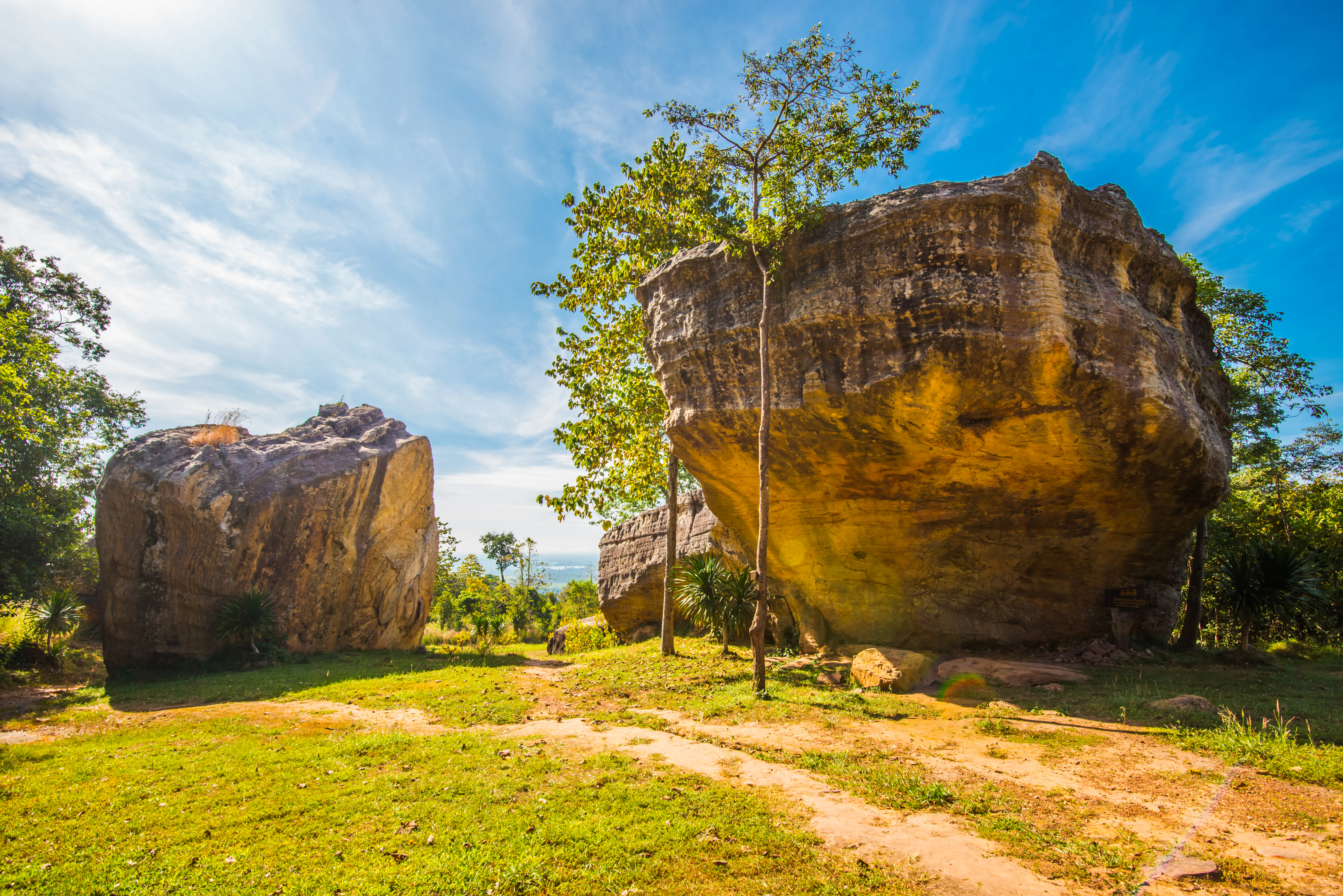
The physical landscape of Nam Phong National Park is characterized by mountainous terrain with sandstone formations typical of northeastern Thailand's Phu Phan highlands. The park encompasses two main mountain ranges: the Phu Phan Kham Range in the northern section and the Phu Meng Range in the southern section, both running in a north-south orientation parallel to the Ubol Ratana reservoir. The western areas feature steep slopes interspersed with cliff faces that descend into the reservoir basin, while the eastern portions consist of rolling foothill terrain averaging approximately 600 meters in elevation. Rock formations at locations such as Pha Chan Dai and Kham Phon create distinctive geological features, with Kham Phon particularly notable for its circular depressions that may represent either volcanic vent remnants or erosion-formed sinkholes. The landscape provides several scenic viewpoints, with Hin Chang Si offering panoramic views over the reservoir, forested slopes, and eastward toward Khon Kaen city.
Nam Phong National Park ecosystems, habitats, and plant life
The ecological character of Nam Phong is defined by deciduous dipterocarp forest, which covers approximately 80 percent of the park's area and represents the dominant vegetation type of northeastern Thailand's highlands. This forest type is characterized by trees that lose their leaves during the dry season, creating a distinctive seasonal appearance. The remaining forest areas consist of mixed deciduous woodland with evergreen species persisting in valleys and on north-facing slopes, as well as grassland patches scattered throughout the park. The park's position within the Phu Phan Kham and Phu Meng mountain ranges, along with its multiple water sources from the Nam Phong, Chi, and Choen rivers, supports ecological processes that extend beyond the park boundaries. The dry evergreen forests found in the deeper valleys and within the Phu Meng area represent more mesic conditions and support different species assemblages than the surrounding dipterocarp-dominated slopes.
Nam Phong National Park wildlife and species highlights
Nam Phong National Park provides habitat for various wildlife species typical of northeastern Thailand's forests, including wild boar, northern red muntjac, porcupine, pangolin, and Siamese hare. The mammal community reflects the park's forest and woodland habitats, though larger species that once inhabited the region have been largely displaced by human activity in surrounding areas. Bird life in the park includes both resident and migratory species such as white wagtail, grey wagtail, Richard's pipit, sooty-headed bulbul, kingfisher, and munia. The Phu Meng mountain area in the southern section reportedly hosts particularly diverse animal and plant life, likely due to the more intact forest cover and reduced human disturbance in that portion of the park. The park's function as a wildlife sanctuary is supported by its protected status and the relatively limited human settlement within its boundaries.
Nam Phong National Park conservation status and protection priorities
As a national park designated under IUCN Category II, Nam Phong plays a formal role in protecting the forest ecosystems and biodiversity of Thailand's northeastern highlands. The park's conservation value is tied to its function as a watershed area, with the Nam Phong, Chi, and Choen rivers originating within its boundaries and flowing outward to support downstream ecosystems and human communities. The deciduous dipterocarp forest, while common to the region, faces pressure from agricultural expansion and resource extraction in unprotected areas, making the park's protected status significant for maintaining representative examples of this ecosystem type. The presence of prehistoric rock paintings at Hin Chang Si adds an archaeological conservation dimension, recognizing the site as a location of historical and cultural significance in addition to its natural value.
Nam Phong National Park cultural meaning and human context
The landscape of Nam Phong National Park lies within the traditional territory of northeastern Thailand's Isan region, which has historically been characterized by agricultural communities and interactions with the forested highlands. The prehistoric rock paintings found at Hin Chang Si indicate human presence in this area dating back to earlier periods, though the park does not contain major indigenous protected areas or formally recognized traditional land claims of the kind found in some other Thai protected areas. The Phu Meng mountain in the southern section holds local significance for surrounding communities, particularly for residents of Ban Meng and other villages in Nong Ruea District. The park's establishment in 2000 reflects modern conservation approaches applied to a landscape that has been modified by human activity over many generations.
Top sights and standout views in Nam Phong National Park
The standout features of Nam Phong National Park include the scenic viewpoints overlooking the Ubol Ratana reservoir, particularly Hin Chang Si, which provides panoramic vistas of the water body surrounded by forested mountains. The rock formations at Pha Chan Dai and Kham Phon offer geological interest, with the latter featuring unusual circular depressions that may represent volcanic or erosional origins. The prehistoric rock paintings at Hin Chang Si add archaeological significance to the natural attractions. The Huai Khe waterfall in the southern section provides a aquatic highlight, while the park's two-wilderness section layout offers visitors different experiences between the Phu Phan Kham-dominated north and the Phu Meng mountain area in the south.
Best time to visit Nam Phong National Park
The best time to visit Nam Phong National Park depends on seasonal conditions typical of northeastern Thailand. The dry season from November through February offers comfortable temperatures and easier trail conditions, though the landscape may appear more austere as deciduous trees lose their leaves. The hot season from March to May can bring high temperatures, particularly in April, making early morning or late afternoon visits preferable. The rainy season from June through October brings greener vegetation and flowing waterfalls but also potential trail closures and access difficulties. The park's average annual rainfall of approximately 1,145 millimeters falls mainly during the rainy season, with August and October typically receiving the highest precipitation. Visitors interested in wildlife viewing may find the transitional periods at the start and end of the dry season most productive, while those seeking lush scenery should consider the mid-to-late rainy season.