Why Preah Monivong Bokor National Park stands out
Preah Monivong Bokor National Park is best known for its dual identity as both a conservation area and a repository of colonial history. The abandoned Bokor Hill Station, built by French colonists in 1921, stands as a haunting reminder of the region's colonial past and draws visitors seeking a glimpse into early 20th-century Southeast Asian history. The park is also notable for its diverse forest ecosystems and wildlife, particularly the presence of Asian elephant, pileated gibbon, and green peafowl. The 29-meter statue of Lok Yeay Mao, constructed in 2010, has become an iconic landmark within the park. The designation as an ASEAN Heritage Park underscores its regional importance as a biodiversity hotspot within the Cardamom Mountains ecosystem.
Preah Monivong Bokor National Park history and protected-area timeline
The history of Preah Monivong Bokor National Park is deeply intertwined with Cambodia's modern political evolution and colonial legacy. The Dâmrei Mountains region was formerly controlled by the Khmer Rouge during the country's turbulent period of conflict, and the establishment of the national park in 1993 represented a significant step in the broader post-conflict restoration of protected areas across Cambodia. The park was inaugurated alongside most of Cambodia's other national parks in 1993, marking a new chapter in the country's approach to environmental stewardship. The colonial history of the area is perhaps its most distinctive feature, with the French colonialists establishing Bokor Hill Station in 1921 as a remote mountain retreat, complete with infrastructure that now stands as an atmospheric abandoned settlement. In 1928, the French built a Catholic church nearby, a rare religious structure in predominantly Buddhist Cambodia. King Sisowath Monivong, after whom the park is named, ordered the construction of a Buddhist temple in the area in 1924 and frequently visited the region until his death there in 1941. In recent decades, the park has emerged as a popular tourist destination, with the Thansur Bokor Highland Resort, a large luxury hotel, constructed in 2012. The 2010 construction of a 29-meter statue of Lok Yeay Mao, a mythic heroine from Cambodian Buddhism believed to protect travelers, hunters, and fishermen, added a new landmark to the park's landscape. The 2019 government release of the Bokor City Development Master Plan until 2035, which envisions development on 18,987 hectares of the park for residents, tourism, and businesses, represents a major policy development that may significantly alter the park's character.
Preah Monivong Bokor National Park landscape and geographic character
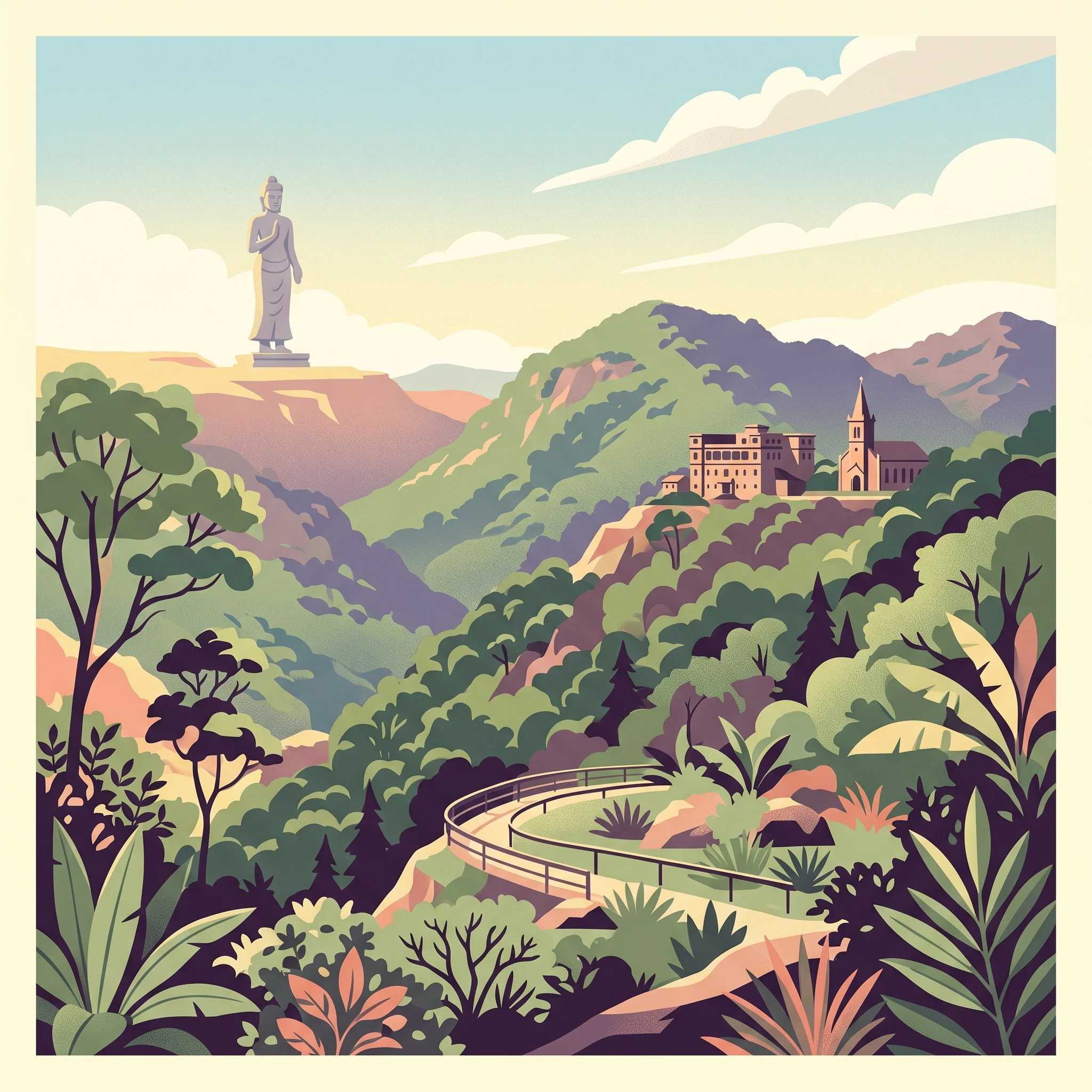
The landscape of Preah Monivong Bokor National Park is defined by its mountainous terrain within the Dâmrei Mountains, the southeastern extension of the Cardamom Mountains that traverse much of southwestern Cambodia. The park's topography is characterized by rolling highlands and steep ridges, with elevations ranging from lower valleys up to the prominent peak of Phnom Bokor at 1,081 meters. Most of the park's area sits at approximately 1,000 meters above sea level, giving the landscape a cool mountainous character distinct from the tropical lowlands below. The forest cover creates a visually rich environment, with different forest types contributing varied textures and shades of green across the terrain. The combination of elevation, forest cover, and relative remoteness creates a landscape that feels distinct from the surrounding Cambodian countryside, offering visitors an experience of cooler temperatures and more temperate-seeming vegetation within the tropics. The abandoned structures of Bokor Hill Station add an element of human history to the natural landscape, with decaying colonial-era buildings nestled among the mountain forests.
Preah Monivong Bokor National Park ecosystems, habitats, and plant life
The nature of Preah Monivong Bokor National Park is characterized by remarkable forest diversity, with the park supporting multiple distinct forest types within its boundaries. These include dipterocarp forests, which dominate much of lowland Southeast Asia and provide critical habitat for many species, deciduous forests that lose their leaves seasonally, tropical evergreen forests that maintain year-round foliage, and mangrove forests in coastal wetland areas. This forest diversity creates a complex ecological system that supports varied wildlife communities and maintains important environmental functions including watershed protection and carbon storage. The park contains the threatened Burretiodendron hsienmu tree species, adding to its conservation significance. However, environmental challenges exist, with a University of Maryland study finding that the park had lost approximately nine percent of its primary forest between 2001 and 2019, with deforestation continuing into 2020 and 2021. This habitat loss poses significant concerns for the long-term ecological integrity of the park and the species that depend on its forests.
Preah Monivong Bokor National Park wildlife and species highlights
The wildlife of Preah Monivong Bokor National Park reflects the park's position within the Cardamom Mountains ecosystem, one of Southeast Asia's most important biodiversity regions. Large mammals present in the park include Asian elephant, gaur, banteng, and Asian black bear, representing some of the region's most iconic megafauna. The park also supports populations of pileated gibbon, an arboreal primate that inhabits the forest canopy, along with large Indian civet and dhole, the social wild dog. This assemblage of species indicates a relatively intact ecological community, though ongoing deforestation pressures threaten habitat connectivity and population sustainability. Bird life includes chestnut-headed partridge, a ground-dwelling bird of forest understory, and green peafowl, a striking species that ranks among the most beautiful birds in the region. The presence of these species, particularly the green peafowl which faces conservation challenges across its range, underscores the park's importance as a refuge for wildlife within the increasingly fragmented landscapes of Cambodia.
Preah Monivong Bokor National Park conservation status and protection priorities
The conservation significance of Preah Monivong Bokor National Park is underscored by its designation as an ASEAN Heritage Park in 2003, a recognition that places it among the most important protected areas in Southeast Asia. This designation reflects the park's substantial biodiversity value and its role as a reservoir of natural heritage within the ASEAN region. The park is one of only two ASEAN Heritage Parks in Cambodia, highlighting its exceptional status within the country's protected area network. Beyond its formal designation, the park's conservation value lies in its diverse forest ecosystems, which provide critical habitat for numerous species including threatened species such as Burretiodendron hsienmu and green peafowl. However, the park faces significant conservation challenges, including ongoing deforestation that has resulted in the loss of approximately nine percent of primary forest since 2001. The 2019 Master Plan for Bokor City Development Project, which envisions developing nearly 19,000 hectares of the park, represents a major potential future pressure on the park's ecological integrity.
Preah Monivong Bokor National Park cultural meaning and human context
The cultural context of Preah Monivong Bokor National Park is rich with historical layers that span Cambodia's royal heritage and colonial period. The park's name honors King Sisowath Monivong, a monarch of Cambodia who used to visit the area and eventually died there in 1941, establishing a direct link between the landscape and Cambodian royal history. The king's order for the construction of a Buddhist temple in the area in 1924 further cemented this connection. The park also contains remnants of French colonial presence, most notably the abandoned Bokor Hill Station established in 1921, which provides a tangible connection to Cambodia's colonial-era history. The rare Catholic church built in 1928 by French colonists stands as an unusual religious landmark in this predominantly Buddhist nation. The 2010 construction of a 29-meter statue of Lok Yeay Mao, a mythic heroine from Cambodian Buddhist tradition believed to protect travelers, hunters, and fishermen, adds a contemporary layer to the site's cultural landscape, representing the continued relevance of traditional beliefs in the area.
Top sights and standout views in Preah Monivong Bokor National Park
Preah Monivong Bokor National Park offers visitors a distinctive combination of natural beauty, historical intrigue, and cultural significance within a single protected area. The abandoned Bokor Hill Station provides an atmospheric window into colonial-era Southeast Asia, with its decaying buildings and eerie atmosphere drawing visitors interested in history and photography. The panoramic views from Phnom Bokor, the park's highest peak at 1,081 meters, reward visitors with sweeping vistas across the surrounding mountains and forests. The diverse forest ecosystems, ranging from dipterocarp to mangrove, create varied landscapes within the park that can be explored and appreciated. Wildlife viewing opportunities include the chance to observe species such as pileated gibbon, Asian elephant, and green peafowl in their natural habitat. The towering statue of Lok Yeay Mao at 29 meters represents the tallest such statue in Cambodia and has become an iconic visual landmark for the park.
Best time to visit Preah Monivong Bokor National Park
The optimal time to visit Preah Monivong Bokor National Park coincides with the cooler, drier months typically spanning November through February, when temperatures in the mountainous terrain are most comfortable for exploration. This period generally offers clearer skies and more stable weather conditions, making it ideal for hiking, wildlife observation, and appreciating the park's landscapes. The wet season from May to October brings heavier rainfall to the region, which can affect visibility and trail conditions, though the forests become particularly lush during this period. Visitors should be aware that the park's high elevation means temperatures can be significantly cooler than in the surrounding lowlands, so layering is advisable regardless of the season. The park's popularity as a tourist destination means that weekends and holidays may see increased visitor numbers, particularly at attractions like Bokor Hill Station and the Lok Yeay Mao statue.