Why Salamanca Island Road Park stands out
Salamanca Island Road Park is best known for its extensive mangrove forests that form one of the most significant coastal wetland ecosystems in the Colombian Caribbean. The park protects a critical area at the confluence of the Magdalena River and Caribbean Sea, creating a unique estuarine environment that supports remarkable biodiversity. It is particularly recognized for its bird populations, with nearly 200 species including many migratory, endemic, and resident birds. The park's designation as a UNESCO Biosphere Reserve in 2000 underscores its importance as a conservation area of international significance.
Salamanca Island Road Park history and protected-area timeline
Salamanca Island Road Park was established in 1964 as a protected area dedicated to preserving the exceptional natural values of Colombia's Caribbean coastal wetlands. The creation of the park reflected growing recognition of the ecological importance of mangrove ecosystems and the need to protect critical bird habitats along migration routes. The decision to establish the park was prompted by the abundance of bird species found in the area and the extensive coastal mangrove forests that characterized the region. In 2000, the park received additional recognition when it was designated as a Biosphere Reserve under UNESCO's Man and the Biosphere Programme, acknowledging its significance as a model of sustainable development and conservation. The park is managed under Colombia's National System of Protected Areas, which oversees the management and conservation of the country's protected natural areas.
Salamanca Island Road Park landscape and geographic character
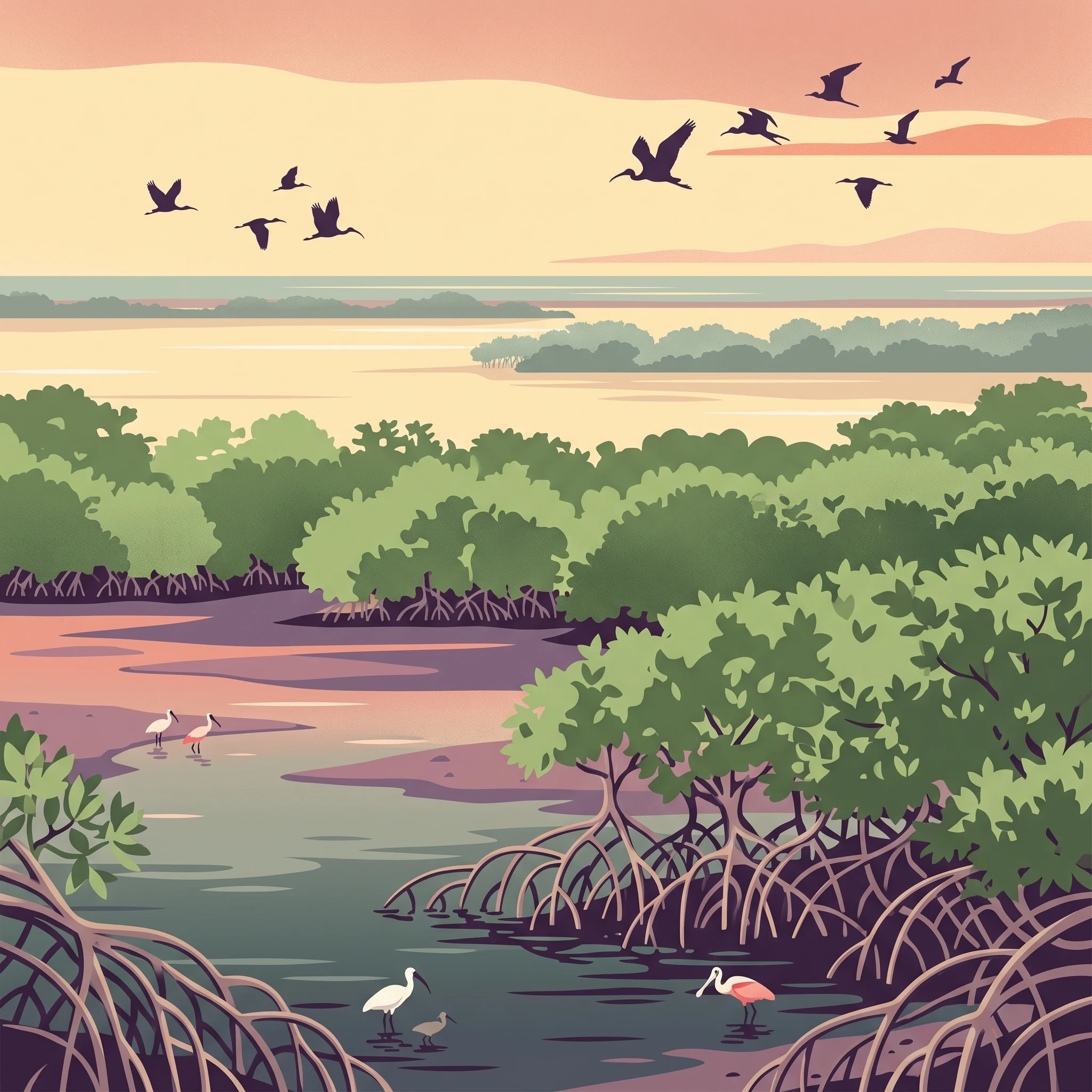
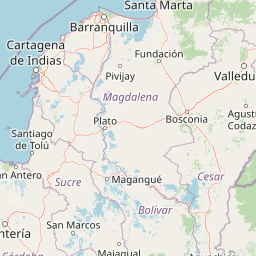
The landscape of Salamanca Island Road Park is characterized by extensive mangrove forests, tidal wetlands, and coastal flats where fresh and salt water meet. The terrain is predominantly flat and low-lying, typical of coastal wetland environments. The mangrove forests dominate the visual character of the park, with dense stands of trees adapted to tidal inundation and saline conditions. The interplay between river and sea creates a dynamic landscape where channels, ponds, and mangrove islands shift and change with tidal cycles. The road that runs through the park, connecting Santa Marta to Barranquilla, provides the primary traversable route through this otherwise water-dominated landscape, offering views of the mangrove-covered terrain on both sides.
Salamanca Island Road Park ecosystems, habitats, and plant life
The nature of Salamanca Island Road Park is defined by its position at the intersection of two major water systems, creating an estuarine environment of exceptional ecological complexity. The park's ecosystems include mangrove forests, tropical dry forests, and riparian forests, each supporting distinct communities of plants and animals. Mangrove forests cover approximately one-third of the park's total area, with red mangrove, black mangrove, white mangrove, and buttonwood being the predominant tree species. These mangrove forests provide critical ecosystem services including shoreline stabilization, carbon storage, and habitat provision for numerous species. The tropical dry forests and riparian areas add additional habitat diversity, creating a complex mosaic of environments that supports the park's high biodiversity.
Salamanca Island Road Park wildlife and species highlights
Salamanca Island Road Park supports remarkable wildlife diversity despite the environmental challenges affecting the broader ecosystem. The park is home to 199 bird species, many of which are migratory, endemic, or year-round residents, making it a significant area for birdwatching and ornithological study. The fish population exceeds 140 species, reflecting the richness of the estuarine and coastal waters. Mammal diversity includes 33 species, while reptiles are represented by 35 species and amphibians by 9 species. Invertebrates total 98 species, demonstrating the invertebrate abundance in these productive waters. Many of these species are endangered, underscoring the conservation importance of the park's protected status and the critical role it plays in maintaining biodiversity in the Colombian Caribbean.
Salamanca Island Road Park conservation status and protection priorities
Salamanca Island Road Park represents a critical conservation area in Colombia's Caribbean region, protecting one of the most important mangrove ecosystems along the Caribbean coast. The park's designation as a Biosphere Reserve by UNESCO in 2000 reflects international recognition of its ecological significance and the need for coordinated conservation efforts. The protection of this area ensures the preservation of biodiversity hotspots, migratory bird routes, and critical habitat for endangered species. The park's management under Colombia's National System of Protected Areas provides the framework for conservation activities and sustainable use of natural resources. The mangroves within the park also provide important ecosystem services that benefit surrounding communities, including coastal protection, water filtration, and support for fisheries.
Top sights and standout views in Salamanca Island Road Park
The most distinctive highlights of Salamanca Island Road Park include the extensive mangrove forests visible from the road that traverses the park, the exceptional bird diversity with nearly 200 species, and the unique position at the confluence of the Magdalena River and Caribbean Sea. The UNESCO Biosphere Reserve designation underscores the park's international significance. The park offers a rare opportunity to experience a major coastal wetland ecosystem from a road that passes through the heart of the protected area, providing access to scenery that would otherwise require boat transportation to explore.
Best time to visit Salamanca Island Road Park
The best time to visit Salamanca Island Road Park is during the dry season, typically from December through April, when rainfall is minimal and conditions are more comfortable for exploration. The climate is consistently hot year-round, with temperatures averaging between 28 and 30 degrees Celsius, but the dry season offers slightly more pleasant conditions for outdoor activities. Visitors should be prepared for the arid and dry conditions, with evaporation exceeding rainfall throughout the year, creating a water deficit in the ecosystem. The dry season also provides better opportunities for wildlife observation as animals concentrate around remaining water sources.