
Mori Atlas logo
National parkUlu Temburong National Park

Discover the mapped geography and protected landscape of Borneo's iconic Green Jewel.

Ulu Temburong National Park: Brunei's First National Park and Pristine Tropical Rainforest Landscape

Ulu Temburong National Park, Brunei's inaugural national park, safeguards an expansive 550 square kilometers of virgin lowland tropical rainforest. Established to protect the nation's most untouched natural environments, this protected landscape forms a significant portion of the Batu Apoi Forest Reserve. Situated in the remote Temburong District, its geographic context is defined by mountainous terrain, steep river valleys, and a critical position within Borneo's broader transboundary conservation efforts, offering a unique window into pristine forest ecosystems.

Tropical RainforestBorneoDipterocarp ForestEcotourismCanopy WalkwayImportant Bird Area

Ulu Temburong National Park

National park

Park overview

Structured park overview, official facts, and landscape profile for Ulu Temburong National Park

Ulu Temburong National Park park facts, protected area profile, and essential visitor context
Review the core facts for Ulu Temburong National Park, including designation, size, terrain, visitor scale, habitats, and operating context in one park-focused overview.

About Ulu Temburong National Park

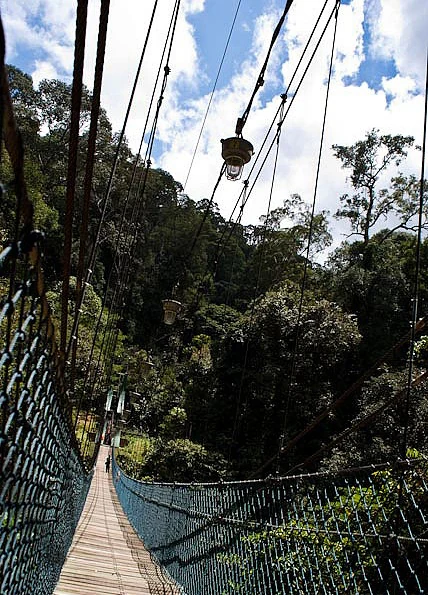
Ulu Temburong National Park represents the pinnacle of Brunei's conservation efforts, established in 1991 as the first national park in the small hydrocarbon-rich sultanate on the island of Borneo. The park occupies the southern portion of Temburong District, Brunei's easternmost administrative region, and is contained within the larger Batu Apoi Forest Reserve, creating a layered protection framework for the area's ecological resources. The park's geography ranges dramatically from mangrove-covered coastal flats in the north through lowland river valleys to mountainous terrain exceeding 1,800 metres elevation in the southern highlands, where lower montane forest ecosystems thrive. This elevation gradient supports exceptional biodiversity, with the primary forest type being dipterocarp forest dominated by Shorea, Dryobalanops, and Dipterocarpus tree genera. The park is accessible only by water, with visitors traveling by longboat from Bandar Seri Begawan through a landscape of sand bars, log-strewn channels, and boulder-strewn rapids before reaching the park headquarters near the confluence of the Belalong and Temburong Rivers. An extensive network of visitor infrastructure including boardwalks, suspension bridges, and interpretation boards allows exploration while minimizing forest impact, with the iconic canopy walkway providing sweeping views of the forest canopy from 50 metres height.

Quick facts and research context for Ulu Temburong National Park

Ulu Temburong National Park spans 550 square kilometres of protected lowland and hill dipterocarp rainforest in eastern Brunei's Temburong District, established in 1991 as the nation's inaugural national park. The park features dramatic elevation changes from coastal mangroves in the north to mountainous terrain reaching 1,800 metres in the southern highlands. The principal rivers flowing through the protected area are the Temburong and Belalong Rivers, which have carved narrow valleys through the terrain. The park is managed by Brunei's Forestry Department within the Ministry of Primary Resources and Tourism and contains a research station operated by Universiti Brunei Darussalam. A 70,000-hectare tract encompassing the park and adjacent forest reserves has been designated an Important Bird Area by BirdLife International.

Park context

Deeper park guide and search-rich context for Ulu Temburong National Park

Ulu Temburong National Park history, landscape, wildlife, and travel context
Explore Ulu Temburong National Park through its history, landscape character, ecosystems, wildlife, conservation priorities, cultural context, and seasonal travel timing in a structured park guide built for atlas discovery and search intent.

Why Ulu Temburong National Park stands out

Ulu Temburong National Park is best known for its pristine lowland tropical rainforest that remains largely untouched by human development, earning it the moniker "Green Jewel of Brunei." The park offers visitors rare access to Borneo's ancient forest ecosystems through an extensive network of boardwalks, bridges, and stairways spanning seven kilometres, including a steel-frame canopy walkway rising 50 metres above the forest floor. The park protects critical habitat for the Eastern grey gibbon, a fully arboreal primate species, as well as diverse birdlife including the rhinoceros hornbill, bushy-crested hornbill, and the striking Rajah Brooke's birdwing butterfly. The park's inaccessibility by road, requiring river travel via traditional longboats piloted by experienced Iban boatmen, has preserved its wilderness character and made it a premier ecotourism destination in Brunei.
Long boat journey on Temburong River
Travel by long boat on the Temburong River towards Ulu Temburong National Park.

Ulu Temburong National Park history and protected-area timeline

Ulu Temburong National Park was established in 1991 as Brunei's inaugural national park, representing a landmark achievement in the sultanate's environmental protection framework. The park was created within the existing Batu Apoi Forest Reserve, building upon earlier conservation designations to provide stronger institutional protection for the area's exceptional forest ecosystems. In 1990, prior to the park's formal establishment, Universiti Brunei Darussalam established the Kuala Belalong Field Studies Centre approximately 500 metres from the mouth of the Belalong River, creating a research facility that would become vital for international scientific collaboration and environmental education. The park's ecotourism infrastructure developed gradually, with the construction of boardwalks, bridges, and stairways enabling visitor access while protecting sensitive forest areas. A significant milestone in the park's modern history occurred in November 2008 when Ulu Ulu Resort opened as Brunei's first public-private partnership in national park management, operated by Sunshine Borneo Tours and Travel under authorization from the Forestry Department. This partnership was suspended in June 2020 due to the COVID-19 pandemic, though the resort's infrastructure remains part of the park's visitor facilities.

Ulu Temburong National Park landscape and geographic character

The physical landscape of Ulu Temburong National Park encompasses a remarkable diversity of terrain within its 550-square-kilometre boundary. The northern portion of the park features lowland areas with coastal influence, where the Limbang River emerges from Sarawak state in Malaysia and drains into Brunei Bay through mangrove-dominated muddy deltas. Moving southward, the terrain rises progressively through narrow river valleys carved by the Temburong and Belalong Rivers into increasingly hilly topography, culminating in mountain ridges reaching approximately 1,800 metres elevation. This elevation gradient creates distinct landscape zones from tropical lowland rainforest through lower montane forest in the southern highlands. The park's interior is characterized by steep-sided valleys, exposed rock outcrops, and cascading streams, while the river courses themselves feature sand bars, fallen logs, and boulders that create navigation challenges for the traditional longboats that provide the only access. The landscape remains largely pristine, with no road access ensuring that the forest has never been significantly disturbed by development.

Ulu Temburong National Park ecosystems, habitats, and plant life

The ecological character of Ulu Temburong National Park is defined by its position within the Borneo lowland rain forests ecoregion, one of the most biodiverse forest ecosystems on Earth. The park's vegetation is dominated by dipterocarp tree species from the Shorea, Dryobalanops, and Dipterocarpus genera, which form the canopy of the primary lowland and hill forests throughout most of the protected area. In the southern highlands above approximately 1,000 metres elevation, the forest transitions to lower montane rain forest with distinct species composition. Coastal areas in the northern park boundary support mangrove ecosystems characteristic of the Sunda Shelf mangroves. The forest understory contains abundant rattan palms, while the ground level features diverse herbaceous plants including gingers, begonias, and members of the gesneriad and aroid families. River courses support specialized vegetation including palms, ferns, mosses, and lichens, with fruiting fig trees providing critical food resources for forest-dwelling wildlife. The Belalong tree frog and earless monitor lizard represent two of the more notable endemic species discovered within the park's boundaries.

Ulu Temburong National Park wildlife and species highlights

Ulu Temburong National Park supports a remarkable diversity of wildlife despite its relatively limited geographic extent, with the Eastern grey gibbon standing out as the most charismatic arboreal species commonly observed in the forest canopy. The park's mammalian fauna includes various squirrel species, with the tiny plain pygmy squirrel frequently observed near human habitation areas, while the smooth-coated otter can be spotted along the Temburong River. The park is renowned for its butterfly diversity, with approximately 400 species documented including the rare Rajah Brooke's birdwing, whose jet black wings feature distinctive emerald green banding, and the striking tree nymph butterfly with its white and black spotted pattern. The Important Bird Area designation encompassing the park and adjacent forest reserves recognizes the site as critical habitat for numerous threatened bird species including Bornean crestless firebacks, large and cinnamon-headed green pigeons, lesser adjutants, Storm's storks, and the distinctive rhinoceros hornbill and bushy-crested hornbill. The Belalong tree frog and earless monitor lizard represent significant herpetofauna discoveries from this protected area.

Ulu Temburong National Park conservation status and protection priorities

Ulu Temburong National Park is managed by Brunei's Forestry Department within the Ministry of Primary Resources and Tourism, with the National Park Headquarters situated near the confluence of the Belalong and Temburong Rivers. The park's conservation significance extends beyond national boundaries through its inclusion in the Heart of Borneo initiative, an international conservation agreement coordinating forest protection across portions of Brunei, Malaysia, and Indonesia on the island of Borneo. The Kuala Belalong Field Studies Centre, established by Universiti Brunei Darussalam in 1990, serves as a vital research facility supporting scientific investigation and environmental education programs. BirdLife International has identified a 70,000-hectare tract encompassing the park and extensions to the Batu Apoi Forest Reserve as an Important Bird Area, recognizing the significance of its forest habitats for threatened bird species. The park's designation as Brunei's first national park in 1991 represented a commitment to maintaining representative samples of the country's forest ecosystems for future generations.

Ulu Temburong National Park cultural meaning and human context

The cultural context of Ulu Temburong National Park is closely tied to the indigenous Iban people of Borneo, whose traditional longboat navigation skills are essential for accessing the remote protected area. Visitors traveling from Bangar town to the park are transported by experienced Iban boatmen who skillfully navigate the sand bars, floating logs, and boulders that obstruct the Temburong River channel. The Iban have historically inhabited the forests of northern Borneo, and their traditional relationship with the riverine environment remains visible in the park's access procedures. The park's location within the Temburong District, Brunei's easternmost region, places it adjacent to the Malaysian state of Sarawak, creating a transboundary landscape where cultural and ecological connections extend across international borders. The park's designation as the "Green Jewel of Brunei" reflects national pride in the sultanate's successful forest protection policies, distinguishing Brunei from its more heavily forested neighbours in Borneo.

Top sights and standout views in Ulu Temburong National Park

Ulu Temburong National Park offers several outstanding features that distinguish it as Brunei's premier nature destination. The iconic canopy walkway, a steel-cable structure supported by towers and rising 50 metres above the forest floor, provides visitors with sweeping panoramic views of the Bornean rainforest canopy thatFew other protected areas can match. The seven-kilometre network of boardwalks, bridges, and stairways enables exploration of multiple forest zones while maintaining minimal ecological impact, with interpretation boards providing educational context throughout the trail system. The park's wildlife includes several species of hornbills, most notably the rhinoceros hornbill with its distinctivecasque, as well as the colourful Rajah Brooke's birdwing butterfly among hundreds of documented lepidopteran species. The opportunity to travel by traditional longboat through pristine riverine landscapes, guided by local Iban boatmen, provides a memorable arrival experience that reinforces the park's wilderness character. The research station at Kuala Belalong offers potential for scientific visitation and environmental education programs.

Best time to visit Ulu Temburong National Park

The optimal time to visit Ulu Temburong National Park generally corresponds to Brunei's dry season, which typically runs from January through March, offering more predictable weather conditions for outdoor activities and wildlife viewing. The wet season from April through December brings higher rainfall that can affect river conditions and trail accessibility, though the forest remains green and vibrant throughout the year. Temperature and humidity remain relatively constant in this tropical environment, with warm conditions prevailing year-round. Visitors should note that access to the park requires advance booking through organized tour packages that include longboat transportation, as there is no independent visitor access. The park's elevation range from coastal lowlands to 1,800-metre highlands means that higher elevation areas may experience slightly cooler and less humid conditions than the river valleys.
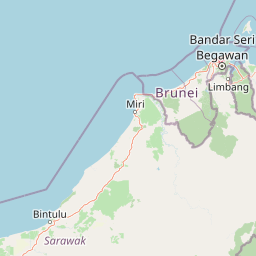

Park location guide

Geography guide, regional context, and park location map for Ulu Temburong National Park

Ulu Temburong National Park park geography, regions, and map view in Brunei
Understand where Ulu Temburong National Park sits in Brunei through a broader geographic reading of the surrounding landscape, nearby location context, and its mapped position within the national park landscape.

How Ulu Temburong National Park fits into Brunei

Brunei is a sovereign nation on the northern coast of Borneo island in Southeast Asia. It is the only country entirely on Borneo and is completely surrounded by Malaysia's Sarawak state. The country operates as an Islamic absolute monarchy ruled by the Sultan, with Malay as the official language.

Wider geography shaping Ulu Temburong National Park in Brunei

Brunei is located on the northern coast of Borneo island in Southeast Asia, with coastline along the South China Sea. The country is completely surrounded by the Malaysian state of Sarawak, and its territory is bifurcated by the Sarawak district of Limbang. Total area is 5,765 km².

Map view of Ulu Temburong National Park

Use this park location map to pinpoint Ulu Temburong National Park in Brunei, understand its exact geographic position, and read its mapped placement within the surrounding landscape more clearly.

Pigeon | © OpenStreetMap contributors

Location context for Ulu Temburong National Park

Temburong District

Visualizing Brunei's Green Jewel: Discover its Ancient Lowland Forest Scenery, Riverine Habitats, and Canopy Walkway Perspective

Ulu Temburong National Park Photos: Explore Pristine Rainforest Landscapes and Canopy Views
Explore a curated collection of imagery to visually comprehend Ulu Temburong National Park's untouched lowland tropical rainforests, unique riverine landscapes, and vital Bornean habitats. These photographs offer a clear perspective on the park's diverse terrain, dense forest canopy, and overall protected-area environment, essential for understanding Brunei's premier "Green Jewel".

Long boat journey on Temburong River

Ulu Temburong National Park suspension footbridge

Park atlas

Trace the regional geography of protected areas and compare neighboring rainforest landscapes across Borneo.

Explore Other National Parks and Protected Areas Near Ulu Temburong National Park in Borneo
Browse other significant national parks and protected areas across eastern Brunei and neighboring Sarawak, Malaysia, to understand their shared lowland tropical rainforest geography. Compare Borneo's extensive conservation landscapes, discovering areas with similar pristine riverine access and rich canopy exploration features.
Protected areaBrunei-Muara District

Bukit Shahbandar Forest Recreation Park: Protected Area with Ridge Landscape & Hiking Trails

Explore Brunei's unique recreational forest terrain and mapped natural features.

Bukit Shahbandar Forest Recreation Park is a notable protected area within the Brunei-Muara District, distinguished by its prominent grassy ridge and a network of challenging hiking trails that traverse its varied terrain. The park's landscape is characterized by rolling hills, including peaks that reach nearly 470 feet, offering strategic vantage points. As a recreational forest, it provides a distinct example of protected land use, blending modified natural vegetation with opportunities for outdoor activity and geographic discovery. Its unique topography and trail system offer a clear focus for atlas-based exploration.

Area
2.34 km²
Established
1998
IUCN
II
Nature reserveBrunei

Luagan Lalak Forest Recreation Park Nature Reserve: Brunei's Pristine Freshwater Swamp Landscape

Explore mapped protected-area geography and unique wetland terrain.

Luagan Lalak Forest Recreation Park, a protected nature reserve in Brunei, preserves a rare and visually distinctive freshwater swamp ecosystem. Characterized by dark, tranquil waters and vast fields of purun grass, this natural wetland offers a unique landscape context and is a prime location for observing its rich biodiversity, especially its notable birdlife. The park's preservation as an intact swamp environment within a recreational area highlights its ecological importance for regional geography and protected-area mapping.

Area
2.7 km²
Established
1980
IUCN
II
National parkNorth Kalimantan

Kayan Mentarang National Park: A Protected Landscape in North Kalimantan

Explore Borneo's critical protected area and its vast forest geography.

Kayan Mentarang National Park is an immense protected area in North Kalimantan, Indonesia, renowned for being a crucial part of the Heart of Borneo conservation initiative. This national park encompasses over 13,600 square kilometers of primary tropical rainforest, sheltering diverse montane and lowland habitats along the Indonesia-Malaysia border. Its importance lies in its vast, contiguous landscape, critical role in regional biodiversity, and its representation of one of Southeast Asia's last great wilderness expanses, offering significant insight into mapped protected areas.

Area
13,605 km²
Established
1996
IUCN
II
Scope
Mixed
National parkSabah

Tun Sakaran Marine Park National Park: Sabah Marine Archipelago Atlas

Explore the islands, sand cays, and coral reef geography.

Tun Sakaran Marine Park is a protected national park in Sabah, Malaysia, known for its stunning marine biodiversity and archipelago landscape. This atlas entry details the park's distinct islands, dynamic sand cays, and extensive coral reef systems within the Celebes Sea, offering insights into its unique geographic setting and ecological significance.

Area
101 km²
Established
2004
IUCN
II
National parkSarawak

Rajang Mangroves National Park: Borneo's Premier Mangrove Protected Landscape

Explore the mapped geography and wetland conservation of this Sarawak national park.

Rajang Mangroves National Park is a significant protected area dedicated to preserving the intricate mangrove swamp ecosystems of Sarawak's Rajang River delta. Encompassing a vast expanse of tidal channels and riverine forests, this national park serves as a critical habitat for unique wildlife and plays a vital role in coastal ecological health. Its landscape is defined by the dynamic interface between riverine and marine environments, offering a prime example of wetland conservation within Borneo's broader natural geography and atlas context.

Area
107 km²
Established
2000
IUCN
II
National parkKuching Division

Bako National Park: Sarawak's Oldest National Park and Coastal Protected Landscape

Explore diverse ecosystems and dramatic mapped geology near Kuching Division.

Bako National Park, the oldest national park in Sarawak, Malaysia, offers a profound study in ecological concentration and geological drama. Covering a mere 27 square kilometers on the Muara Tebas peninsula, it encapsulates seven distinct ecosystem types, from coastal heath forest to mangrove areas, supporting significant biodiversity. The park's protected landscape is defined by its stunning sandstone coastline, carved by the sea into cliffs, arches, and seastacks, providing a unique geographic context. This makes Bako an essential destination for understanding Borneo's environmental diversity and the mapped boundaries of its conservation areas.

Area
27 km²
Established
1957
IUCN
II
National parkCentral Kalimantan

Bukit Baka Bukit Raya National Park: Central Kalimantan's Protected Montane Rainforest Landscape

Explore the geographic core of Borneo's Schwaner mountain range.

Bukit Baka Bukit Raya National Park is a critical national park situated in Central Kalimantan, Indonesia, recognized for its extensive montane tropical rainforests and rugged topography. The park's landscape is dominated by the Schwaner mountain range, featuring prominent peaks like Bukit Raya, and functions as a vital watershed and biodiversity corridor. This protected area offers a rich subject for understanding regional geography, mapped landscapes, and the significance of Borneo's natural heritage within an atlas context.

Area
1,810 km²
Established
1992
IUCN
II
Relief
Mountain
National parkCentral Sulawesi

Lore Lindu National Park: Central Sulawesi's Protected Landscape and Atlas Anchor

Explore its endemic species, megalithic sites, and rich geography.

Lore Lindu National Park stands as a critical protected area within Central Sulawesi, Indonesia, recognized for its exceptional endemic biodiversity and profound archaeological importance. This national park features a dramatic geographic setting, rising from lowland forests to montane ecosystems and encompassing ancient megalithic structures within its protected landscape. Understanding Lore Lindu National Park through its mapped boundaries and unique regional geography offers deep insights into conservation and cultural heritage, providing a focal point for atlas-based discovery.

Area
2,180 km²
Established
1982
IUCN
II

Common questions about visiting, size, designation, and location context for Ulu Temburong National Park

Ulu Temburong National Park FAQs for park facts, access, geography, and protected area context
Find quick answers about Ulu Temburong National Park, including protected-area facts, park geography, trail and visitor context, and how the park fits into its surrounding country and regional landscape.
MoriAtlas Explorer

Continue Your Protected Areas Search Across the Global Atlas

Deepen your exploration by continuing the structured search for national parks and protected areas worldwide. Utilize the comprehensive filtering capabilities to compare different conservation landscapes and refine your understanding of global park geography. Discover more about the distribution and characteristics of protected natural areas.

Global natural geography