
Mori Atlas logo
Nature reserveBiotopo Lago di Toblino

A rare Alpine valley microclimate bridging mountain terrain and Mediterranean ecosystems

Biotopo Lago di Toblino Nature Reserve and Mapped Protected Landscapes in Trentino-Alto Adige

Biotopo Lago di Toblino represents a distinct protected landscape situated within the Trentino-Alto Adige region of northern Italy. This nature reserve sustains a singular microclimate where cool Alpine mountain slopes converge with the milder conditions of a valley basin. The area features a complex mosaic of lake, reedbed, and riparian woodland habitats that support both high-altitude vegetation and sub-Mediterranean plant species in a compact geographic setting.

biotopelake ecosystemreedbedriparian woodlandmixed forestsub-Mediterranean flora
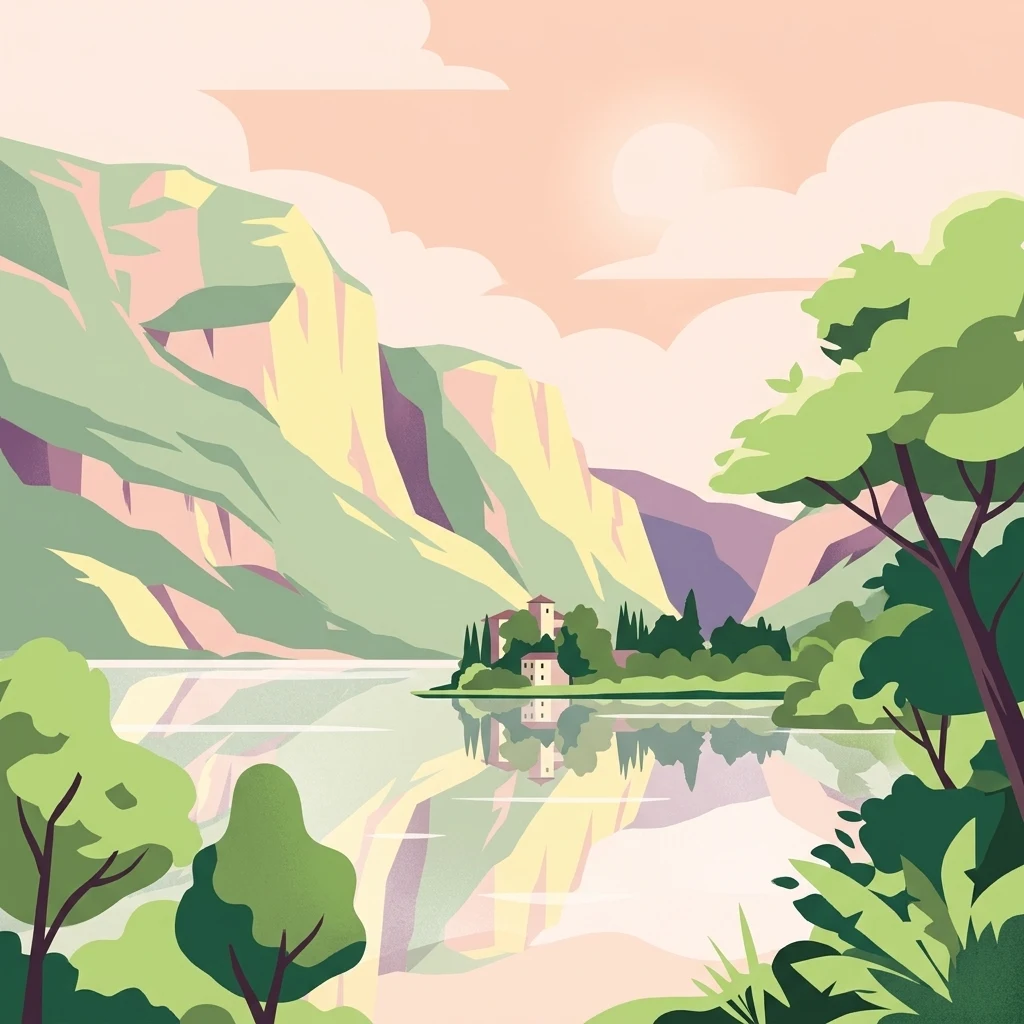
A stylized flat illustration of Lake Toblino, featuring a calm lake reflecting a stone castle on the shore, surrounded by green trees and towering mountains under a pale pink sky.

Biotopo Lago di Toblino

Nature reserve

Park overview

Structured park overview, official facts, and landscape profile for Biotopo Lago di Toblino

Biotopo Lago di Toblino park facts, protected area profile, and essential visitor context

Review the core facts for Biotopo Lago di Toblino, including designation, size, terrain, visitor scale, habitats, and operating context in one park-focused overview.

About Biotopo Lago di Toblino

Biotopo Lago di Toblino is one of the smaller but ecologically distinctive protected areas of the Trentino, set around a small lake in the lower part of the valley system that connects the Adige valley with Lake Garda. Established in 1992 by decree of the Autonomous Province of Trento, the biotope combines a typical Alpine mountain setting with an unusually mild valley floor climate, creating conditions in which ecological elements more often associated with southern Europe coexist with montane forest and aquatic communities.

The lake itself is small, and what sets the area apart is the surrounding complex of habitats: dense mixed forests climbing the slopes, patches of Mediterranean-style vegetation in the warmest sites near the shoreline, and a continuous belt of marsh, reedbeds, and floating aquatic vegetation around the water. These zones together provide habitat for a wide range of flora and fauna, including species whose distributions would not normally overlap in such a compact area.

Administrative recognition reinforces the ecological value of the site. Beyond its provincial status as a biotope, the area is included in the Natura 2000 network, with the designation 'Lago di Toblino' (IT3120055) marking it as both a Site of Community Importance and a Special Area of Conservation. The combination of provincial and European recognition helps anchor the area within broader strategies for habitat and species conservation in the southern Alps.

For visitors and researchers, the biotope represents a particularly accessible example of an ecological transition zone. A short walk around the lake reveals a sequence of landscapes: from damp reedbed and waterlily beds at the edge, through riparian woodland with willows and holm oaks, and up into the conifer-dominated slopes. This compressed gradient makes the area a useful place for observing how vegetation and wildlife respond to sharp changes in local climate, and reflects why the site has been singled out for sustained protection.

Quick facts and research context for Biotopo Lago di Toblino

Biotopo Lago di Toblino is a protected natural area (biotope) covering around 170 hectares of land around Lake Toblino in the province of Trento, in the Trentino-Alto Adige region of northern Italy. It was formally established in 1992 by provincial decree and is managed by the Autonomous Province of Trento.

The area is classified internationally as an IUCN Category IV protected area, aimed at the conservation of specific habitats and species. It is also part of the Natura 2000 ecological network as a Site of Community Importance and Special Area of Conservation under the designation 'Lago di Toblino' (IT3120055). The biotope encompasses most of the lake and its shoreline and is notable for the unusual overlap of Alpine and sub-Mediterranean conditions at the valley floor.

Protection and recognition

Documented conservation status, management scope, and official designation records

Biotopo Lago di Toblino Protection Status and International Recognition

Biotopo Lago di Toblino maintains official protected area records detailing its designated status and baseline framework. Structured conservation facts outline international recognition sources and administrative parameters for this protected landscape.

Protection details

WDPA ID
178836
Park context

Deeper park guide and search-rich context for Biotopo Lago di Toblino

Biotopo Lago di Toblino history, landscape, wildlife, and travel context

Explore Biotopo Lago di Toblino through its history, landscape character, ecosystems, wildlife, conservation priorities, cultural context, and seasonal travel timing in a structured park guide built for atlas discovery and search intent.

Why Biotopo Lago di Toblino stands out

Biotopo Lago di Toblino is best known for the unusual climatic overlap that occurs at the lake: a typical Alpine mountain landscape surrounding a valley floor that, thanks to the influence of nearby Lake Garda, supports Mediterranean and sub-Mediterranean species. This juxtaposition of cool mountain forests, lacustrine and palustrine vegetation, and warm-climate plants such as laurel, rosemary, olive, and lemon gives the area a distinctive ecotonic character within the broader Alpine region. The biotope is also recognized for its rich waterbird community. Ducks, swans, coots, grebes, herons, and various reedbed passerines find habitat among the extensive reedbeds and floating vegetation along the shore, while the surrounding woodlands host deer, roe deer, wild boar, foxes, and increasingly wolves and bears that move down from the nearby Brento and Casale mountains.
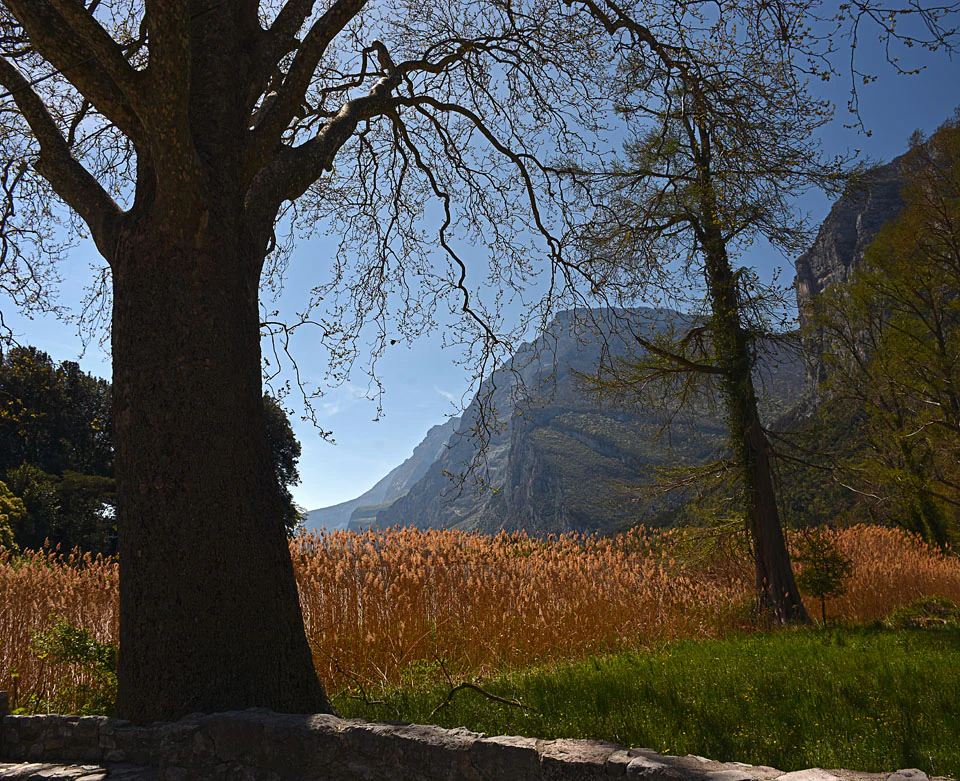
A large foreground tree silhouette framing a view of golden reeds in a marshy wetland with rugged mountain cliffs in the background under a blue sky.
A scenic view of the lake shores and surrounding cliffs at Biotopo Lago di Toblino.

Biotopo Lago di Toblino history and protected-area timeline

The Biotopo Lago di Toblino was formally established in 1992 through a decree of the president of the provincial government (D.G.P. 16949, dated 30 November 1992). The creation of the biotope reflected a broader movement in the late twentieth century to protect small, ecologically significant sites at the provincial level in Trentino, recognizing that even relatively limited areas could hold exceptional biological value when they combined multiple habitats or unusual microclimatic conditions.

Since its establishment, the area has been managed by the Autonomous Province of Trento, which oversees its conservation, monitoring, and public use. Over the following decades, the European Union's Natura 2000 framework added another layer of recognition, designating the lake and its surroundings as a Site of Community Importance and subsequently a Special Area of Conservation under the code IT3120055.

More recent ecological history has been shaped by wildlife returning to the broader landscape around the biotope. The recolonization of nearby mountains such as Monte Brento and Monte Casale by wolves, and the frequent presence of bears moving between wooded uplands and the lake basin, has expanded the set of large mammals regularly associated with the area, underlining its role as part of a wider Alpine ecological network rather than an isolated reserve.

Biotopo Lago di Toblino landscape and geographic character

The landscape of Biotopo Lago di Toblino is defined by a striking contrast between the lake basin and the surrounding mountains. Lake Toblino itself lies in a low valley setting, bordered by gentle slopes that rise into the steeper terrain typical of the southern Alps. This compact topographic setting creates a microclimate distinct from both the surrounding peaks and the broader Adige valley.

Around the shoreline, the terrain is low and flat, dominated by waterlogged ground, floating-leaved vegetation, and a soft transition from open water to reedbeds and then to wet woodland. Sloping up from this wet fringe, vegetation quickly becomes denser and drier, with mixed forests of conifers and broadleaves covering most of the hillsides. Glimpses of the lake through the trees, and the small islands of marsh that interrupt its surface, give the area a quiet, enclosed character despite its openness to the surrounding valley.

The broader context is one of strong vertical relief. The walls of nearby Monte Brento and Monte Casale rise sharply above the basin, reinforcing the sense of a sheltered valley pocket. Even though the biotope itself occupies only a modest portion of this landscape, the surrounding relief is an essential part of its identity, channeling winds, shading the water, and influencing the temperature patterns that allow sub-Mediterranean species to survive at this latitude.
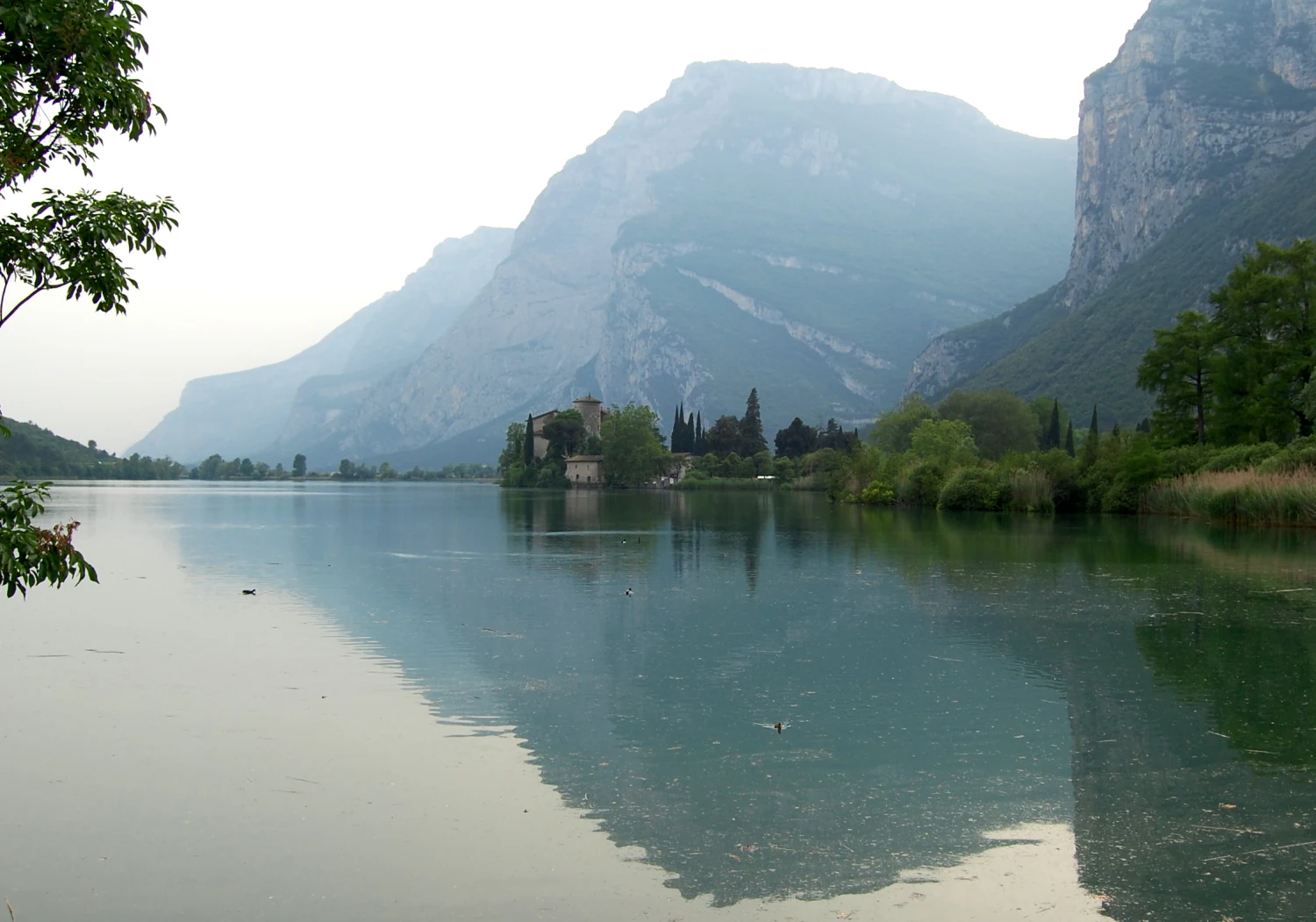
A calm lake reflecting the surrounding mountains and a small castle structure on the distant peninsula.
A view looking south across the calm waters of Lake Toblino, with the castle visible on the distant shore.

Biotopo Lago di Toblino ecosystems, habitats, and plant life

Ecologically, the biotope is best understood as a layered system in which water, marsh, woodland, and dry slope vegetation interact over short distances. The lake supports stands of waterlilies, broad-leaved pondweed communities, and extensive reedbeds dominated by common reed. The shallow shoreline edge transitions into sedge beds and damp meadows where yellow flag iris and other wetland plants thrive, while patches of willow and hazel grow where the land rises just above the water table.

At the warmer end of the ecological gradient, the valley floor near the lake supports a surprising Mediterranean-influenced flora, including laurel, rosemary, lemon, and olive in cultivation. This is layered against a more typical Alpine forest cover on the surrounding slopes, where Swiss stone pine, Scots pine, holm oak, and various deciduous species form mixed woods. Hawthorn and hazel line the transition between forest and water.

The combination of open water, emergent vegetation, riparian woodland, dry forest, and warm micro refuges gives the site an unusually high habitat density for its size. It is precisely this patchwork, rather than any single habitat, that gives the biotope its conservation value and supports the diversity of breeding, wintering, and migratory birds found in the area.

Biotopo Lago di Toblino wildlife and species highlights

The most conspicuous wildlife in the biotope is its waterbird community. Ducks, swans, coots, and mallards are regular presences on the open water, while species such as the great crested grebe and the grey heron hunt among the reedbeds and along the marshy shore. Reed-dwelling passerines, including the Eurasian reed warbler and reed bunting, nest in the dense common reed stands, and the common kingfisher is regularly recorded along the water's edge.

More specialized species have also been documented. The lake has supported occasional nesting attempts by the tufted duck in recent years, and visitors regularly observe the little grebe, the Eurasian bittern, the common pochard, the water rail, and the stone-curlew, all of which depend on the integrity of the lacustrine habitat. During migration and winter months, additional species such as the common goldeneye, the Eurasian wigeon, and the little gull have been recorded.

The surrounding woodlands and shores support an active terrestrial fauna. Red deer, roe deer, and wild boar move through the forest edge, while foxes, beech martens, red squirrels, and edible dormice occupy smaller niches. European hares, badgers, common shrews, hedgehogs, and European moles are also present. In recent years, wolves have become established on the higher slopes of nearby Monte Brento and Monte Casale, and bears from the surrounding forests are increasingly seen near the lake, marking the area as part of the recolonization front of large carnivores in the southern Alps.

Biotopo Lago di Toblino conservation status and protection priorities

The conservation significance of Biotopo Lago di Toblino rests on its dual recognition under Italian provincial protection and the European Natura 2000 network. As a Site of Community Importance and a Special Area of Conservation, it is part of a coordinated effort across Europe to safeguard habitats and species of special interest, reinforcing the protection already established by the provincial decree of 1992.

At the international level, the area is classified as a Category IV protected area under the IUCN system, a category reserved for sites whose primary aim is the conservation of particular habitats or species, often through active management. This is consistent with the biotope's role in maintaining the integrity of its lake, reedbed, riparian woodland, and forest communities, and in supporting the wildlife that depends on them.

The site's particular value lies in its ecological transition character. By protecting a site where Alpine and sub-Mediterranean conditions overlap, the biotope helps preserve genetic reservoirs and relict populations that might otherwise be lost to development or land-use change. Its inclusion in the broader network of Trentino protected areas and the Natura 2000 system means that conservation efforts there are linked to wider strategies for maintaining biodiversity across the southern Alps, including the recovery of large carnivores such as wolves and bears in the surrounding mountains.

Biotopo Lago di Toblino cultural meaning and human context

The Toblino area carries a cultural identity tied to the lake itself, which has long featured in local life as a recognizable landmark in the lower valley between Trento and Lake Garda. The lake has given its name to a small locality nearby, and the surrounding agro-pastoral landscape has historically included small-scale cultivation of olive, lemon, laurel, and rosemary, reflecting the mild valley conditions.

This quieter local context, rather than dramatic historical events, defines the cultural frame of the biotope. The site is integrated into a region where lake and mountain landscapes have shaped settlement patterns, food culture, and traditional land use for centuries, and the establishment of the protected area can be read as a modern extension of that long relationship between local communities and the natural features of the valley.

Top sights and standout views in Biotopo Lago di Toblino

The standout feature of the Biotopo Lago di Toblino is the way Alpine and Mediterranean-style environments meet within a very small area, a microclimatic phenomenon created by the lake's position relative to neighboring mountains and the climatic influence of Lake Garda. This unique overlap supports lush mixed forests, dense reedbeds, and patches of warmth-loving plants in close proximity.

The area is also notable for the density and quality of its birdlife, particularly the variety of waterbirds, reed-nesting passerines, and woodland species that share the lake, marsh, and forest habitats within a compact basin. Combined with its formal recognition under both provincial and European protection frameworks, the biotope stands out as a small but ecologically rich example of an Alpine valley protected area.

Best time to visit Biotopo Lago di Toblino

The biotope rewards visits at any time of year, but the character of the experience varies with the seasons. Spring is a good time to observe breeding waterbirds, the establishment of reedbed vegetation, and the early flowering of many lake-margin plants, while summer brings full foliage, lush marsh vegetation, and active insect life that draws feeding birds and bats to the shore.

Autumn typically softens the colors of the surrounding forest and brings migratory visitors to the lake, while winter offers quieter observation of waterfowl, with cold air accentuating the still surface of the lake and the contrast between the surrounding snowy slopes and the relatively milder valley floor. Walking around the shoreline at a calm pace, in any season, tends to be the most rewarding way to take in the layered landscapes of lake, marsh, and forest.
Monthly climate preview

Measured long-term temperature averages and monthly precipitation distributions for Biotopo Lago di Toblino

Biotopo Lago di Toblino Climate Normals and Annual Weather Patterns

Biotopo Lago di Toblino exhibits a measured annual temperature range from sub-zero winter minimums to warm summer highs, accompanied by distinct monthly precipitation variations across the representative elevation point. Reviewing the complete twelve-month climate profile provides detailed long-term averages for temperature and precipitation patterns across the protected landscape.
Annual mean7 °C
-3 °C18 °C
Jan-3°
Feb-1°
Mar
Apr
May11°
Jun15°
Jul18°
Aug18°
Sep13°
Oct
Nov
Dec-2°
Warmest month
July

17.7 °C

Coolest month
January

-3 °C

Wettest month
October

3.5 mm/day

Driest month
January

1.2 mm/day

Park location guide

Geography guide, regional context, and park location map for Biotopo Lago di Toblino

Biotopo Lago di Toblino park geography, regions, and map view in Italy

Understand where Biotopo Lago di Toblino sits in Italy through a broader geographic reading of the surrounding landscape, nearby location context, and its mapped position within the national park landscape.

How Biotopo Lago di Toblino fits into Italy

Italy is a unitary parliamentary republic in Southern and Western Europe, located on the Italian Peninsula with the Alps to the north. It borders France, Switzerland, Austria, Slovenia, Vatican City, and San Marino, and shares maritime boundaries with several Mediterranean countries. The country has approximately 59 million residents and uses the Euro as its currency.

Wider geography shaping Biotopo Lago di Toblino in Italy

Italy occupies a boot-shaped peninsula in southern Europe, bordered by the Alps to the north. It shares land borders with France, Switzerland, Austria, Slovenia, Vatican City, and San Marino. The country includes the Mediterranean islands of Sicily and Sardinia, along with approximately 800 smaller islands.

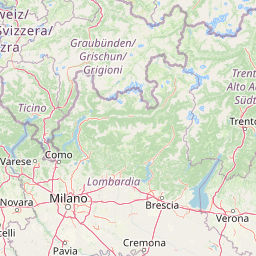
Map view of Biotopo Lago di Toblino

Use this park location map to pinpoint Biotopo Lago di Toblino in Italy, understand its exact geographic position, and read its mapped placement within the surrounding landscape more clearly.

Pigeon | © OpenStreetMap contributors

Location context for Biotopo Lago di Toblino

Trentino-Alto Adige

Examine protected area terrain, wetland habitats, and microclimatic transitions across the lake basin.

Biotopo Lago di Toblino Photos and Landscapes: Visual Explorer of Alpine Valley Scenery

Visual records illustrate the contrasting terrain, shoreline reedbeds, and mixed forests that define the protected valley environment. Photographic documentation reveals how Alpine topography meets Mediterranean flora around the lake basin.

A large foreground tree silhouette framing a view of golden reeds in a marshy wetland with rugged mountain cliffs in the background under a blue sky.

A calm lake reflection showing towering limestone cliffs, a small castle in the distance, and foreground tree branches on a clear day at Biotopo Lago di Toblino.

A calm lake reflecting the surrounding mountains and a small castle structure on the distant peninsula.

Park atlas

Compare adjacent wetland reserves, mountain lakes, and regional valley landscapes

Exploring Parks Near Biotopo Lago di Toblino and Surrounding Alpine Protected Areas

Browsing other protected areas near Biotopo Lago di Toblino reveals a diverse network of valley ecosystems and mountain reserves across the surrounding region. Comparing adjacent park geography provides a deeper understanding of the ecological transitions linking Alpine valleys to Mediterranean microclimates.
Nature reserveTrentino-Alto Adige
About 6.6 km away#1 closest

Southeast

Torbiera delle Viote Nature Reserve: Alpine Wetland Plateau Geography and Protected Boundaries

A high-elevation peat bog enclave within the Monte Bondone mountain landscape

Situated on the Piana delle Viote in the Trentino-Alto Adige region, this nature reserve protects a rare alpine peat bog ecosystem. The site functions as a unique wetland basin framed by dense conifer forests, offering significant insight into high-altitude hydrology, amphibian habitats, and the specific terrain features that define this protected mountain landscape.

Area
0.13 km²
Established
2003
Soft watercolor painting of layered green hills and distant mountain ranges with a hazy, light-filled sky.
Nature reserveTrentino-Alto Adige
About 7.7 km away#2 closest

South

Biotopo Marocche di Dro: Geologic Protected Landscape in Trentino-Alto Adige

Discover the massive postglacial rockfall deposits of northern Italy.

Biotopo Marocche di Dro is a protected nature reserve defined by its expansive, boulder-strewn arid surface and exceptional postglacial rockslide deposits. Unlike typical wetland biotopes, this site provides a rare, sun-exposed habitat for reptile-rich fauna and unique plant communities within the broader Trentino landscape, offering a window into the dramatic geological transformations that have shaped the valley floor.

Area
2.508 km²
Established
1989
IUCN
IV
Nature reserveTrentino-Alto Adige
About 11 km away#3 closest

Southwest

Biotopo Lomasona Nature Reserve: Protected Landscapes and Alpine Geography in Trentino

A small-scale conservation area in the heart of Val Lomasona

Biotopo Lomasona stands as a specialized nature reserve in the Italian Province of Trento. This compact protected area focuses on habitat conservation within the alpine terrain, serving as an important ecological anchor in the valley landscape of Comano Terme and the wider Trentino-Alto Adige region.

Area
0.26 km²
Established
1987
IUCN
IV
A watercolor painting showing a panoramic view of a green wetland landscape with soft purple mountains in the background.
Nature reserveTrentino-Alto Adige
About 12 km away#4 closest

Southwest

Biotopo Fiavé: A Protected Wetland and Archaeological Landscape in Trentino-Alto Adige

Mapping glacial lake basins and ancient prehistoric heritage sites

Located at the foot of Monte Cogorna, Biotopo Fiavé functions as a vital wetland reserve characterized by extensive peat bogs and mixed willow-alder thickets. This area offers a unique intersection of natural hydrological evolution and UNESCO-protected archaeological history, serving as a rare, compact cross-section of alpine valley ecosystems and prehistoric human settlement patterns.

Area
1.373 km²
Established
1988
IUCN
IV
Nature reserveTrentino-Alto Adige
About 20 km away#5 closest

South

Biotopo Monte Brione: Protected Nature Reserve and Mediterranean Landscape Map

Exploring the limestone ecology of northern Italy

Biotopo Monte Brione stands as a remarkable protected area where southern European vegetation, including holm oaks and Phoenician juniper, flourishes against a backdrop of sun-exposed limestone cliffs. Situated as a natural buffer near Lake Garda, this reserve offers a deep look into the intersection of Mediterranean floral diversity and Alpine geographic settings, providing a essential refuge for protected raptors and rare invertebrate species.

Area
0.663 km²
Established
1992
IUCN
IV
A soft watercolor painting of a wetland landscape with distant rolling hills, green grassy banks, and a calm water surface, rendered in a muted palette.
Nature reserveTrentino
About 20 km away#6 closest

South

Lago di Loppio Nature Reserve: A Protected Wetland and Archaeological Landscape in Trentino

Mapping the ecological intersection of wetlands and historical island sites.

Lago di Loppio functions as a critical provincial biotope, blending rare marshland ecology with a deep historical footprint on the Island of Sant'Andrea. Situated within a depression in the Adige valley, this protected area features a unique transitional microclimate that supports diverse flora and fauna, alongside ruins spanning Roman to medieval eras.

Area
1.126 km²
Established
1987
Relief
Upland
Climate
Temperate
Nature reserveTrentino-Alto Adige
About 29 km away#7 closest

Northeast

Biotopo Prati di Monte: Nature Reserve and Protected Alpine Landscape Discovery

Geographic overview of the Dossone di Cembra alpine ridge

Biotopo Prati di Monte represents a protected nature reserve in Trentino-Alto Adige, known for its unique concentration of peatland habitats. The area encompasses the remnant Lago di Valda basin, acidic spruce forests, and diverse wetland meadows. This atlas-focused perspective highlights the reserve as a significant refugium for sub-arctic flora situated along the porphyritic mountain terrain between the Val di Cembra and the Bassa Atesina.

Area
0.06 km²
Established
1994
IUCN
IV
A soft watercolor painting of a tranquil lake surrounded by gentle, rolling green hills and wetland vegetation.
Nature reserveTrentino-Alto Adige
About 31 km away#8 closest

Southwest

Lago d'Ampola: Mapping the Ecology of a Glacial Nature Reserve in Trentino

A critical protected wetland and montane biotope

Lago d'Ampola preserves a remarkably layered habitat of glacial origin, where water lilies, marsh vegetation, and spruce-beech forests converge. This protected site in Trentino-Alto Adige offers a focused look at the intersection of glacial geography and successful ecosystem recovery in an Alpine valley setting.

Area
0.5 km²
Established
1990
Relief
Mountain
Climate
Alpine

Common questions about visiting, size, designation, and location context for Biotopo Lago di Toblino

Biotopo Lago di Toblino FAQs for park facts, access, geography, and protected area context

Find quick answers about Biotopo Lago di Toblino, including protected-area facts, park geography, trail and visitor context, and how the park fits into its surrounding country and regional landscape.
MoriAtlas Explorer

Continue Your Protected Areas Search Across the Global Atlas

Deepen your exploration by continuing the structured search for national parks and protected areas worldwide. Utilize the comprehensive filtering capabilities to compare different conservation landscapes and refine your understanding of global park geography. Discover more about the distribution and characteristics of protected natural areas.

Global natural geography