
Why Bosque y Vegetación Protector El Artesan EcuadorianHands stands out
The protected area is best known for being a formally recognized private conservation fragment of Ecuadorian dry forest in one of the country's most deforested regions. Its botanical profile closely reflects the diagnostic character of the Ecuadorian dry forest ecoregion, with deciduous and semi-deciduous tree species, deep-rooted and thick-barked individuals, and open canopies that allow cacti, orchids, and bromeliads to flourish in the understory. It has also become recognized for the scientific work carried out within its boundaries. Academic studies have used standardized sampling plots across three altitudinal bands to evaluate species composition, ecological importance, and carbon storage in both above-ground biomass and soil. These investigations have positioned the forest as a reference point for understanding how even small dry-forest fragments contribute to regional biodiversity conservation and carbon retention.
Bosque y Vegetación Protector El Artesan EcuadorianHands history and protected-area timeline
The protected area has a relatively short formal history. It was officially created on 21 December 2022 through interministerial agreement MAATE-2022-136, an administrative step that recognized the site as a Bosque y Vegetación Protector. The agreement was issued by Ecuador's Ministry of Environment, Water, and Ecological Transition and gave the reserve its full official name.
The recognition came in response to growing awareness of the degraded state of Ecuadorian dry forests in coastal Manabí. Long-standing traditional land-use practices, including non-sustainable extraction of timber and other forest products, had modified the populations of many native species across the region. The establishment of the reserve formed part of a broader national effort to retain surviving dry-forest cover through a mix of public and private conservation arrangements.
After its designation, the site became a subject of academic investigation. Research teams established a network of permanent sampling plots across the reserve's altitudinal range and produced studies examining forest composition, ecological importance of dominant species, and carbon storage in biomass and soil. By providing a baseline of structural and ecological information for a recently protected site, these studies have effectively expanded the historical record of the reserve well beyond its legal founding moment.
Bosque y Vegetación Protector El Artesan EcuadorianHands landscape and geographic character
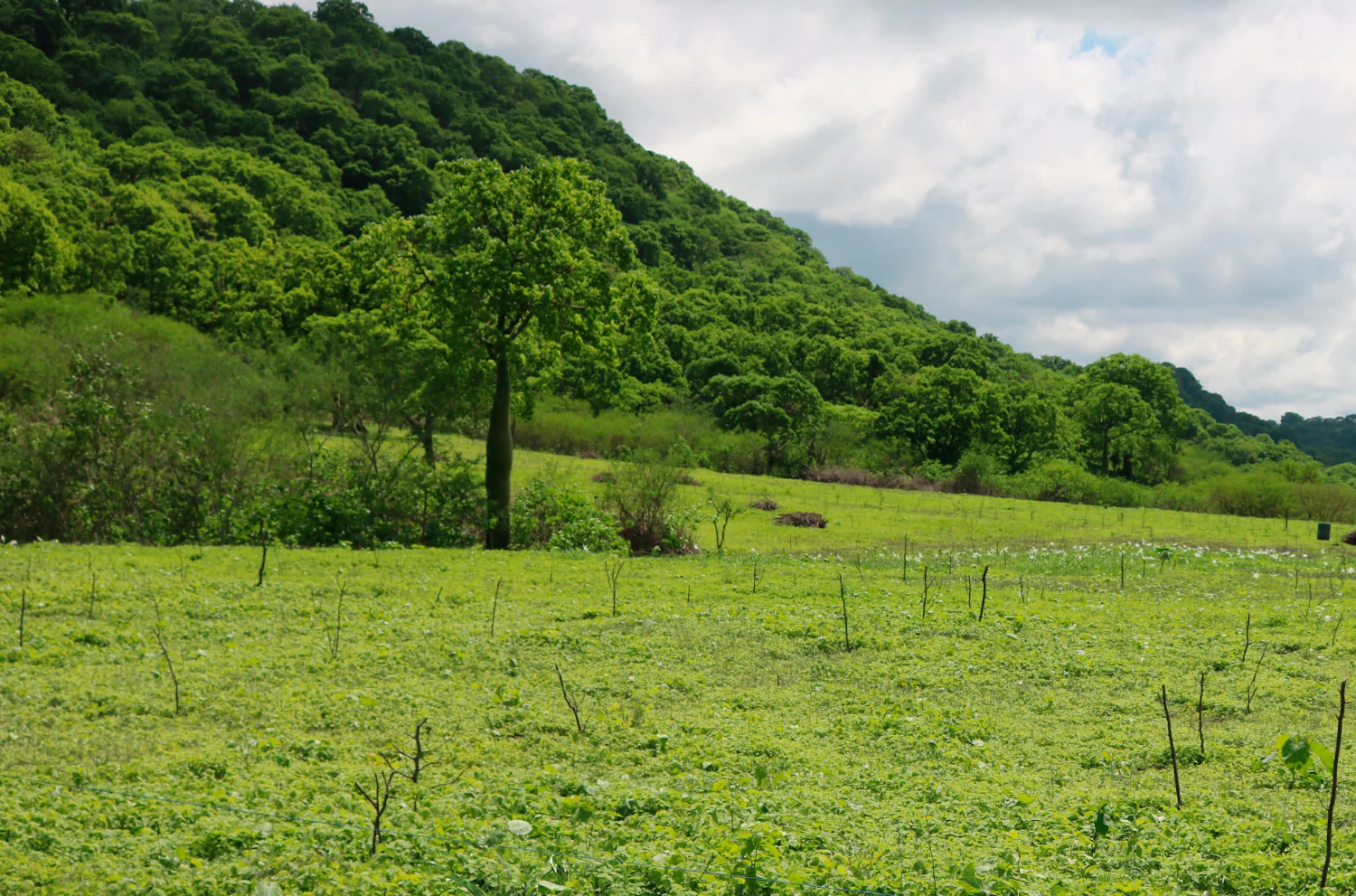
The reserve occupies a transitional landscape along Ecuador's central coast. To one side lies the Tiján plain, a lowland corridor that runs from south to north and passes the locality of Piñas de Julcuy. To the other side rise the lower slopes of the Cordillera Chongón-Colonche, a coastal mountain system that defines much of western Manabí and southern Santa Elena. The protected area sits in the zone where these two landscape units meet, giving it a varied altitudinal range that begins near 200 meters above sea level and extends past 300 meters.
The terrain is shaped by a tropical dry climate with long periods without rain. Soils and underlying geology combine with this climate to support a relatively open forest structure rather than the dense canopy typical of wetter forests. Openings between the tall trees are filled by grasses, herbs, shrubs, and a striking ground layer of cacti and other succulent or thorny plants adapted to seasonal drought. The combination of deciduous crown cover, rugged bark, and understory of succulents and orchids creates a visually distinctive landscape that contrasts sharply with the humid forests found elsewhere on Ecuador's coast.
During the dry months, the forest takes on a parched character as trees shed their leaves and the canopy thins, exposing pale trunks and a brighter understory. After rainfall events, growth resumes rapidly across seedlings and shrubs, briefly transforming the appearance of the site before the long dry period returns. Streams in the broader region tend to dry up or slow dramatically during the dry season, reinforcing the impression of a landscape finely tuned to the rhythm of seasonal water availability.
Bosque y Vegetación Protector El Artesan EcuadorianHands ecosystems, habitats, and plant life
The reserve protects a representative example of Ecuadorian dry forest, one of the most threatened ecosystems in the country because of its fragmentation and sensitivity to disturbance. The vegetation is dominated by a small number of drought-adapted tree species that together account for the great majority of all individuals recorded in scientific surveys. Among the most important are Ceiba trischistandra, Bursera graveolens, Cordia lutea, Eriotheca ruizii, Erythrina velutina, and Cochlospermum vitifolium, which collectively make up around three quarters of the forest's recorded flora.
These dominant trees set the ecological tone of the site. Many are deciduous, shedding their leaves during the long dry season to reduce water loss, and most develop thick bark and either deep or wide-spreading root systems to survive extended periods of drought. Some, like the ceibo, are armed with spines that deter herbivores and help capture moisture from passing breezes. Family-level analysis shows that Malvaceae, Burseraceae, Fabaceae, Boraginaceae, and Bixaceae carry the highest ecological importance values in the community.
Beneath the broken canopy, an unusually rich understory thrives. Because tree crowns are lower and less continuous than in humid forests, sunlight reaches the ground and encourages the growth of seedlings, herbaceous plants, and shrubs. The understory includes large populations of orchids and bromelias, and during the driest parts of the year gives way to cactus-dominated patches that reflect the extreme seasonal stress of the environment. Altitude is a significant ecological variable within the reserve, influencing the abundance of species across the three main altitudinal bands identified by researchers.
Bosque y Vegetación Protector El Artesan EcuadorianHands wildlife and species highlights
Wildlife in the reserve reflects the broader character of Ecuadorian dry forests, where fauna is shaped as much by scarcity of water as by vegetation structure. Surveys and general accounts of similar dry forests indicate that small mammals such as rodents, primates including monkeys, reptiles, and amphibians are typical inhabitants of these environments. Arthropod groups are abundant and conspicuous, with insects such as beetles, mosquitoes, and reduviid bugs coexisting alongside scorpions and spiders that thrive in the dry leaf litter and sheltered microhabitats provided by spiny vegetation.
Among larger mammals, deer (cervids) are widely noted as a common presence across dry forest ecosystems in the Americas, and the reserve falls within a region where they have historically been part of the fauna. Birds are particularly important: the seasonality and isolation of dry forest fragments make them valuable as migratory routes and stopover habitat for species moving through the broader coastal landscape seeking water and food. The reserve's position between lowland and foothill environments further enriches its potential for both resident and passing birdlife.
Bosque y Vegetación Protector El Artesan EcuadorianHands conservation status and protection priorities
From a conservation standpoint, the reserve is significant primarily because it safeguards a surviving fragment of the Ecuadorian dry forest ecoregion, one of the country's most threatened biomes. Dry forests are especially vulnerable to fragmentation because they have historically been easier to clear and convert than wetter forests, and the Manabí lowlands in particular have lost large areas of natural cover to agricultural expansion and unsustainable extraction of forest products.
The reserve's carbon profile reinforces its conservation value. Quantitative studies of above-ground biomass and soil have shown that the forest stores substantial amounts of organic carbon, with estimates placing total carbon storage in the range of 105 to 112 megagrams of carbon per hectare. A small group of species, mainly Ceiba trischistandra, Eriotheca ruizii, and Bursera graveolens, hold nearly 88 percent of the carbon held in living biomass. These figures highlight the disproportionate role that dominant dry-forest trees can play in climate mitigation.
Management as an Área de Conservación Privada places the long-term stewardship of the site in the hands of a private organization, a model that allows local and non-governmental actors to participate directly in the protection of representative ecosystems. Research has also documented that the forest retains strong ecological functionality even with visible signs of past disturbance and current successional change, supporting its recognition as a meaningful, if modest, contributor to regional biodiversity protection and carbon storage.
Bosque y Vegetación Protector El Artesan EcuadorianHands cultural meaning and human context
The reserve sits within the Joa commune, a rural community in the canton of Jipijapa that has historically interacted closely with the surrounding dry forests through traditional land uses, seasonal grazing, and small-scale harvesting. The scientific literature notes that past practices in the region have tended toward non-sustainable extraction, contributing to the modification of many species populations and shaping the present-day ecological character of surviving forest fragments.
The establishment of the reserve under a private conservation model reflects a recent shift in regional dynamics, where local stakeholders and non-governmental organizations are taking on formal responsibility for stewardship of native ecosystems. This places the site at an interface between long-standing rural livelihoods and the more recent institutional framework of Ecuador's private conservation system, giving the protected area a meaningful but evolving cultural dimension tied to its community context.
Top sights and standout views in Bosque y Vegetación Protector El Artesan EcuadorianHands
Bosque y Vegetación Protector El Artesan EcuadorianHands offers a compact but ecologically rich window into Ecuadorian dry forest within one of the country's most heavily altered coastal regions. Its scientific sampling program across three altitudinal bands has identified more than twenty species of native dry-forest trees and provided a rare quantitative look at carbon storage in both biomass and soil.
The reserve stands out for the unusually high concentration of a few key drought-adapted species that shape nearly the entire forest community, the dramatic seasonal contrast between dry and rainy phases, and the presence of an understory rich in orchids, bromeliads, and cacti. Small in size but rich in function, it functions both as a refuge for native flora and as a reference point for studying dry-forest conservation in coastal Ecuador.
Best time to visit Bosque y Vegetación Protector El Artesan EcuadorianHands
The reserve's character shifts dramatically with the seasons, so the ideal time to experience it depends on what a visitor hopes to see. During the long dry period that defines much of the year, the forest takes on an austere beauty: deciduous trees lose their leaves, the canopy thins, and the understory becomes dominated by cacti and other drought-adapted plants. Wildlife viewing in this period often focuses on animals adapted to scarce water, and the open canopy makes bird identification easier.
After rains arrive, the forest becomes greener and more lush for a relatively short window. Seedlings, herbs, and shrubs germinate quickly in response to moisture, temporarily expanding the understory and softening the parched character of the dry months. Travellers interested in observing this burst of growth, or in seeing many plant species actively flowering and leafing out, generally prefer the rainy season, while those drawn to the stark, sculptural landscape of bare branches and cacti tend to favor the dry months.