

Why Monte Choca State Forest stands out
Monte Choca is best known as a compact example of Puerto Rico's tropical moist forest ecosystem sitting on elevated terrain in the central part of the island. Foresters and biologists value the property because, despite its small size and a history of mining and agricultural disturbance, it has regenerated into a wooded landscape with 140 catalogued plant species across endemic, native, and exotic groups. The forest is also notable for its community character. Unlike remote wilderness reserves, Mono Choca integrates recreation, youth programs, and civic life through partnerships with local organizations, giving it a profile as both a working forest and a neighborhood natural area within Corozal.
Monte Choca State Forest history and protected-area timeline
The lands beneath what is now Monte Choca State Forest have a layered human history. Long before any modern protection, the area was part of Puerto Rico's colonial-era mining landscape: gold was extracted from the region during Spanish colonization of the island, leaving an early imprint of disturbance on what would later become forest.
In the twentieth century, parts of the area were converted to agriculture, particularly the cultivation of minor fruits, before being allowed to revert toward forest, thicket, and pasture. The turning point for conservation came on November 21, 2003, when Puerto Rico's legislature passed Law 295 formally declaring the area a state forest and placing it within the commonwealth's protected-area framework. The forest took its name from the surrounding geographical feature, Monte Choca.
Since its establishment, the forest has been managed as a public property with strong community involvement. Local conservation organizations help maintain the site, and a 2011 study by Ortiz Ramos Hecmarie examined how ecotourism could be developed further alongside the forest's existing scientific, educational, and recreational uses. The Civic and Cultural Recreational Club of Palos Blancos has come to operate from the forest itself, reinforcing its role as a focal point for community life in the area.
Monte Choca State Forest landscape and geographic character
Monte Choca lies at one of the higher elevation bands within the municipality of Corozal, giving it a terrain that rises above the surrounding inhabited valleys of central Puerto Rico. The property is compact, but its position on higher ground means cooler temperatures, more persistent moisture, and a topography that suits tropical moist-forest vegetation rather than the drier lowland habitats found nearer Puerto Rico's coasts.
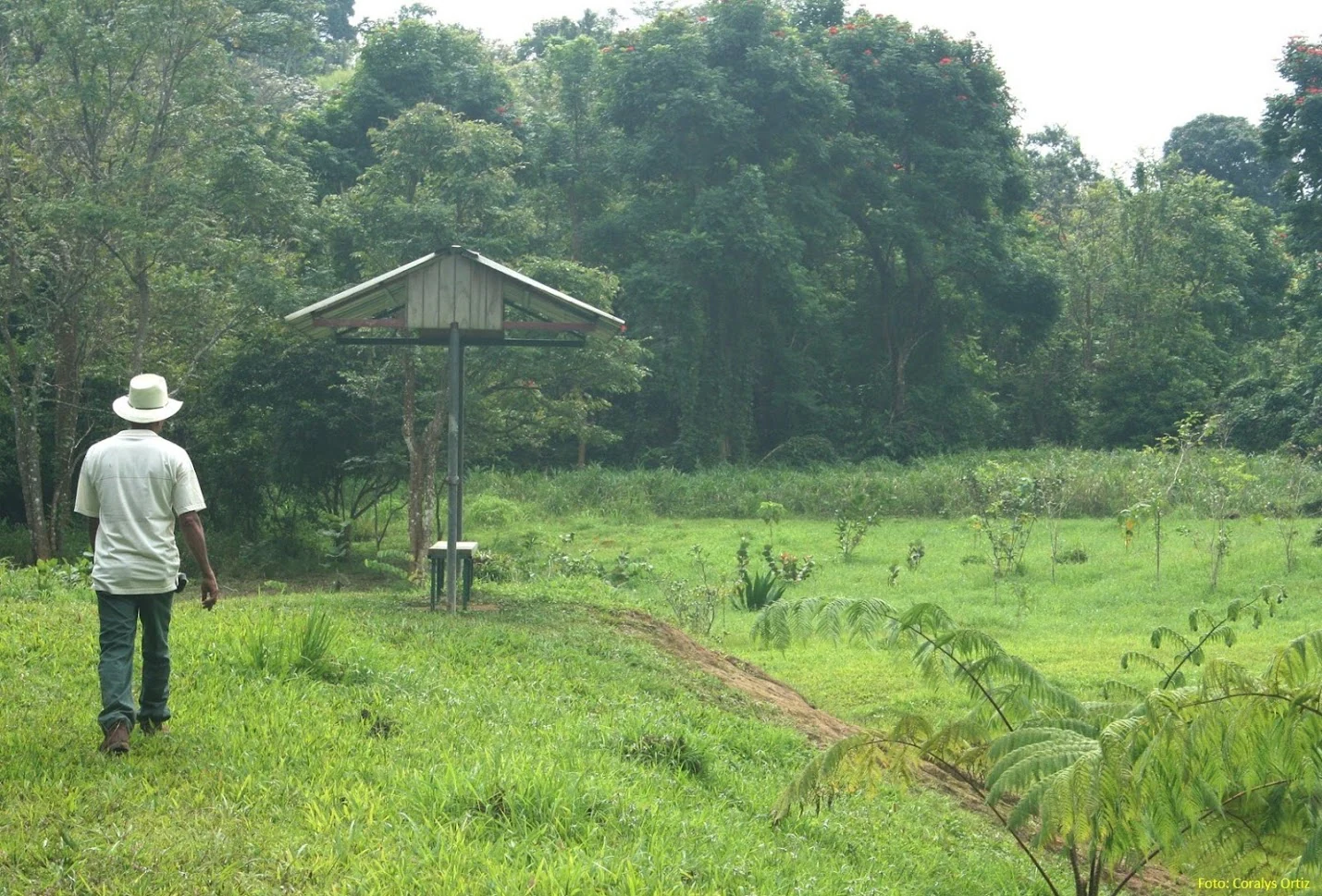
Within the small footprint of the forest, the land presents a mosaic rather than a single uniform cover. Some slopes carry closed-canopy forest, while other zones hold thickets and open pastures that mark the legacy of past agricultural use. This mixture produces a varied surface for visitors, with shaded forest trails giving way to lighter, more open edges where regrowth continues from former fruit-cultivation sites. The combination of elevation, moisture, and post-agricultural recovery gives the terrain a layered, recovering character rather than a deeply wild one.
Monte Choca State Forest ecosystems, habitats, and plant life
The defining ecological character of Monte Choca is that of a recovering tropical moist forest on previously disturbed land. Surveys of the property have documented around 140 plant species, dominated by trees and shrubs rather than herbs or grasses. These species are distributed across three meaningful groups: species native to the broader region, endemic species with a more restricted Caribbean or Puerto Rican distribution, and exotic species that reflect both the area's cultivated past and ongoing succession.
Recreationally and ecologically important natives recorded in the forest include canopy and midstory trees such as Buchenavia capitata and Alchornea latifolia, alongside shrubs and small trees like Byrsonima, Casearia arborea, Cecropia schreberiana, and Miconia prasina. This assemblage is typical of Puerto Rican upland moist forest, where fast-growing pioneers such as Cecropia commonly indicate recovery from earlier clearance. The mix of closed-canopy, thicket, and pasture zones means the forest offers a natural laboratory for studying how tropical forest cover re-establishes itself after mining and agriculture.
Monte Choca State Forest wildlife and species highlights
Monte Choca supports a typical cross-section of Puerto Rican forest fauna, even though its size is small. The bird community is the most conspicuous element and includes several species strongly associated with the island's interior forests. Bird-watchers can encounter the Puerto Rican Vireo (Vireo latimeri), the Antillean Oriole-like Icterus dominicensis, the Puerto Rican Woodpecker (Melanerpes portorricensis), the Puerto Rican Tody (Todus mexicanus), the Puerto Rican Lizard-Cuckoo (Saurothera vieilloti), and the Zenaida Dove (Zenaida aurita).
Amphibians and reptiles recorded in the forest further reinforce its Puerto Rican moist-forest identity. Native frogs such as the marine toad (Bufo marinus) and Leptodactylus albilabris are present, while lizards and reptiles include Anolis pulchellus, Ameiva exsul, the worm lizard Amphisbaena caeca, the Puerto Rican Racer (Alsophis portoricensis), and the Puerto Rican Boa (Epicrates inornatus). The presence of these species, particularly endemic or island-restricted ones, gives Monte Choca real value for herpetological and ornithological study despite its modest area.
Monte Choca State Forest conservation status and protection priorities
Monte Choca's conservation significance lies in its role as a legally protected tropical moist-forest fragment within a densely settled part of Puerto Rico. By placing roughly 245 acres of higher-elevation land under state-forest status, Law 295 of 2003 anchored long-term protection for a habitat type that has been heavily reduced across the Caribbean.
The forest's conservation value is amplified by the diversity it has retained despite its history of gold mining and agricultural clearing. The presence of more than 140 plant species, including endemic elements, and a representative set of endemic or native birds, amphibians, and reptiles, including the Puerto Rican Boa, indicates that the site functions as a meaningful refuge and stepping-stone habitat rather than as a token green space.
Management of the forest is carried out by the commonwealth of Puerto Rico with support from local conservation groups and civic organizations, including the Civic and Cultural Recreational Club of Palos Blancos, which is headquartered at the site. Community co-stewardship, combined with active uses such as scientific research, youth camps, and structured birdwatching, contributes to ongoing monitoring and habitat awareness. The 2011 ecosystem-focused study on ecotourism development reflects an explicit interest in pairing conservation with sustainable public engagement.
Monte Choca State Forest cultural meaning and human context
Monte Choca carries a human story that runs well before its 2003 designation. Gold extraction shaped the landscape during the Spanish colonial period, leaving a mineral-disturbance legacy that still influences the soils and vegetation patterns that scientists observe today. In more recent centuries, small-scale cultivation of minor fruits gave the surrounding community direct ties to the land, and traces of that agricultural past remain visible in the surviving thickets and pasture openings.
The forest is also woven into the contemporary social fabric of barrio Palos Blancos. The Civic and Cultural Recreational Club of Palos Blancos operates from within the forest and hosts youth camps and recreational events there, making the protected area a gathering point for local identity rather than something remote from the community. For residents of Corozal, Monte Choca therefore functions simultaneously as a place of historical memory, natural heritage, and everyday community life.
Top sights and standout views in Monte Choca State Forest
Monte Choca stands out as a compact, regenerating tropical moist forest that combines ecological research, community recreation, and conservation in a single site. Its 140 recorded plant species, including a balanced mix of native, endemic, and exotic trees and shrubs, give it a botanical interest well beyond what its 245 acres might suggest.
The forest's wildlife profile is characteristic of Puerto Rican upland forest birding, with endemic and native species such as the Puerto Rican Woodpecker, Puerto Rican Tody, and Puerto Rican Vireo, plus reptiles and amphibians that include the Puerto Rican Boa. The fusion of formal state ownership with hands-on community stewardship through organizations based at the site, and the area's layered mining and agricultural history, make Monte Choca a distinctive example of small-scale, community-rooted forest conservation in Puerto Rico.
Best time to visit Monte Choca State Forest
Monte Choca sits at a relatively high elevation within Corozal, so it tends to share the cooler, wetter conditions typical of Puerto Rico's interior uplands rather than the hotter coastal climate. Conditions are generally favorable for hiking and birdwatching whenever roads and trails are passable; cooler, less humid windows tend to make longer walks and observation more comfortable.
Rainfall patterns typical of central Puerto Rico can leave trails muddy and visibility reduced during wetter periods, so visitors interested in photography and birdwatching often favor drier stretches of the year when forest birds are still active and views through the canopy are clearer. Because the forest is small and partly managed by community organizations, timing visits around local events such as youth camps or scheduled activities coordinated with the Civic and Cultural Recreational Club of Palos Blancos can add a participatory dimension to the experience.