
Why Pražská pole stands out
Pražská pole is best known as a wetland biodiversity hotspot that arose unintentionally from past deep coal mining. The reserve is centered on a chain of ten flooded subsidence depressions whose gently sloping, shallow margins have allowed near-natural aquatic and marsh plant communities to develop. It is particularly valued for its populations of the fire-bellied toad and the great crested newt, as well as for several rare dragonfly species that depend on these still, warm lowland waters.
Pražská pole history and protected-area timeline
The landscape of Pražská pole is fundamentally a product of industrial history. In the twentieth century, the area south of Chomutov was extensively worked for brown coal at the deep Jan Žižka mine, one of the underground operations that fed the heavy industry of North Bohemia. As coal was extracted at depths of around one hundred meters, the surface above slowly sank, producing a chain of shallow depressions in what had originally been flat agricultural land.
Mining at Jan Žižka ended in 1992. The collapsed terrain was then gradually filled by rising groundwater, creating a connected system of small lakes. There were plans to link these pools through weirs and to connect them to the nearby Hačka stream, with the aim of integrating them into a coherent hydrological system, but the engineered structures were never put into effective operation. Instead, the lakes were stocked with fish, and three of them were designated as managed angling waters.
Long after mining ceased, biologists continued to document the unusual richness of plants, amphibians, and dragonflies that had established themselves in the abandoned workings. The accumulation of ecological data, combined with the formal recognition of the site as a European Site of Community Importance, eventually led regional authorities to act. On 6 April 2024, the Regional Authority of the Ústecký kraj formally declared Pražská pole as a nature reserve, securing long-term protection for what had become, entirely by accident, one of the more interesting wetland complexes in the region.
Pražská pole landscape and geographic character
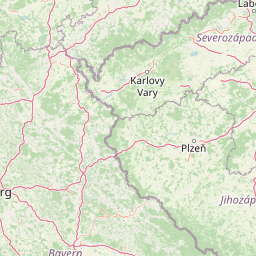
Pražská pole occupies a strikingly flat stretch of the Most Basin, a broad lowland in northwestern Bohemia formed on Cretaceous sediments overlying the older crystalline rocks of the Krušné hory system. Within the Czech geomorphological hierarchy, the area belongs to the Chomutov-Teplice sub-basin and the Údlická kotlina district, an appropriate name for a landscape defined above all by shallow basins and subtle relief.
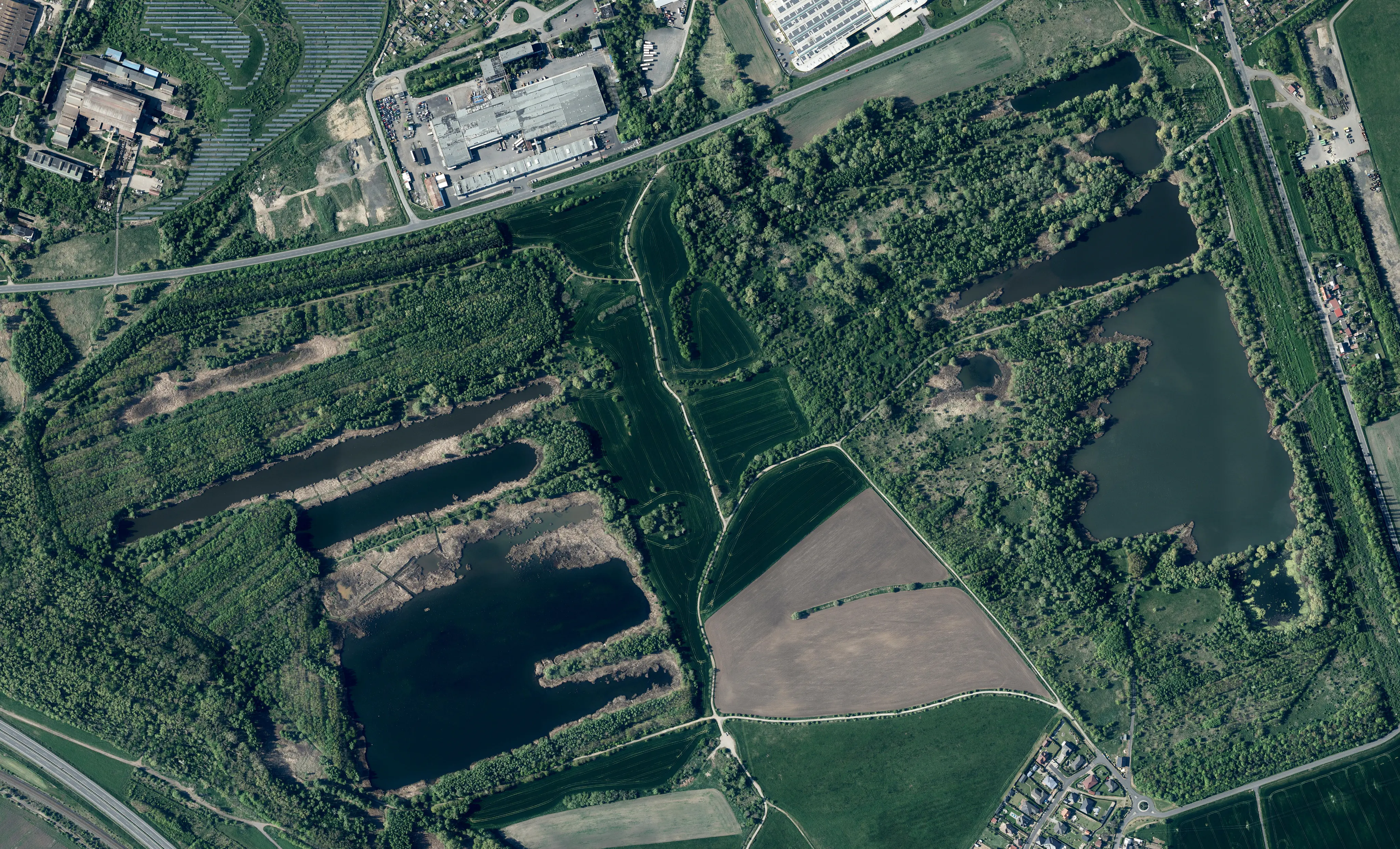
The most striking visual feature of the reserve is not a mountain or a cliff but a chain of ten separate waterbodies of varying size, scattered across a gently undulating plain. Each pool fills a subsidence depression created by underground coal extraction; because mining took place at considerable depth, the edges of these depressions slope gently into the surrounding terrain rather than dropping sharply. This wide, shallow shoreline is what makes the site biologically productive and visually distinctive.
Along the western edge of the reserve flows the small Hačka stream, a tributary of the Chomutovka, while the soils across most of the reserve are arenic cambisols, with narrow strips of fluvisol appearing along watercourses. The overall impression is of an open, low-elevation agricultural plain dotted with clear, still pools, an unassuming landscape whose wider significance is primarily ecological rather than scenic.
Pražská pole ecosystems, habitats, and plant life
The natural value of Pražská pole lies in the near-natural wetland and aquatic communities that have colonized the subsidence pools and their margins. Because mining ended and human pressure has been relatively limited, the shallow lakes have developed rich zones of submerged and emergent vegetation. The reserve's flora includes several species that are rare, threatened, or otherwise notable at the regional level.
Among characteristic aquatic and marsh plants documented at the site are thread-leaved water crowfoot (Batrachium trichophyllum) and round-leaved water crowfoot (Batrachium circinatum), Otruba's sedge (Carex otrubae), common centaury (Centaurium erythraea), horned pondweed relative (Ceratophyllum submersum), mamillate spike-rush, needle spike-rush, small-flowered willowherb (Epilobium parviflorum), Bolboschoenus planiculmis, yellow flag iris (Iris pseudacorus), ivy-leaved duckweed (Lemna trisulca), spiny naiad (Najas marina), and horned pondweed (Zannichellia palustris). Together these give the pools a diverse and biologically rich vegetation structure that supports a wide range of invertebrates and vertebrates.
Ecologically, the reserve is best understood as a lowland warm-water wetland system set in an otherwise dry agricultural matrix. The combination of warm summers, still water, and shallow shelving margins creates conditions reminiscent of natural wetland habitats that have largely disappeared from the intensively farmed Czech lowlands. This is also why the area attracts a remarkable diversity of dragonflies, amphibians, and waterbirds, and why much of its flora is of conservation interest.
Pražská pole wildlife and species highlights
Pražská pole hosts an unusually rich fauna for such a small and young reserve, especially in the groups associated with standing freshwater habitats. The site is of particular importance for dragonflies (Odonata), with several rare and nationally significant species recorded. Among the highlights are the yellow-spotted whiteface (Leucorrhinia pectoralis), the ruby whiteface (Leucorrhinia rubicunda), the scarce chaser (Libellula fulva), the Siberian winter damselfly (Sympecma paedisca), the hairy dragonfly (Brachytron pratense), the blue-eyed hawker (Aeshna affinis), the shy emerald damselfly (Lestes barbarus), and the scarce emerald damselfly (Lestes dryas). The presence of these species underlines the conservation value of the still, vegetation-rich waterbodies.
Amphibians are another flagship group at Pražská pole. The reserve supports important populations of the great crested newt (Triturus cristatus), the smooth newt (Lissotriton vulgaris), the European tree frog (Hyla arborea), the fire-bellied toad (Bombina bombina), and the marsh frog (Rana ridibunda). Monitoring between 2002 and 2021 showed that fire-bellied toad numbers declined dramatically, in some years to just a handful of recorded individuals, while the great crested newt has been pushed close to local extinction. These declines have shaped much of the conservation concern around the site.
Waterbirds also make regular use of the pools and the surrounding marshy margins. Species recorded include the green sandpiper (Tringa ochropus), the greenshank (Tringa nebularia), and the marsh sandpiper (Tringa stagnatilis). Stocks of common carp, northern pike, and several non-native or migratory fish species have been added to some of the pools in recent years, with stricter regulations applied to the smallest, most ecologically sensitive eastern basin under the European Site of Community Importance framework.
Pražská pole conservation status and protection priorities
Pražská pole represents a clear example of how a disturbed industrial landscape can evolve into a site of recognized conservation value. Decades after underground coal mining ceased, the subsidence depressions left behind have become a refuge for wetland biodiversity in a region where natural wetlands are otherwise scarce and heavily pressured by agriculture and industry.
The reserve's ecological importance is acknowledged at two levels. Nationally, it was designated as a nature reserve (přírodní rezervace) by the Regional Authority of the Ústecký kraj in April 2024, putting it under the protection of the Czech nature conservation system and the Agency for Nature Conservation and Landscape Protection of the Czech Republic (AOPK ČR). At the European level, the site partially overlaps a Site of Community Importance under the EU Habitats Directive, which imposes additional constraints on habitat management to safeguard protected species and habitat types.
These layered protections deliver concrete restrictions on activities that could harm the most sensitive features of the reserve. Modifications of the shoreline to improve angler access are prohibited, as is the deliberate feeding or attracting of fish, and stocking of fish is excluded altogether in the smallest, most ecologically important eastern pool. Together, the national and European designations are intended to maintain the open, near-natural character of the subsidence basins and to safeguard the populations of rare amphibians, dragonflies, and aquatic plants for which Pražská pole has become regionally famous.
Pražská pole cultural meaning and human context
Pražská pole sits within an industrial landscape that has shaped the identity of North Bohemia for well over a century. Coal mining transformed the Most Basin into one of the most heavily industrialized regions of the Czech lands, supplying energy and raw materials to the wider country and supporting dense urban development around Chomutov, Most, and the surrounding villages. The reserve is therefore not a pristine wilderness but a cultural-natural hybrid: a place whose ecological present has been made possible only by its industrial past.
The surrounding countryside remains predominantly agricultural, and the landscape between Chomutov and Droužkovice reflects the traditional pattern of villages, small farms, and large open fields that has coexisted with mining and heavy industry for generations. The recent designation of Pražská pole as a protected area marks a shift in how this landscape is officially valued, recognizing that even intensely modified terrain can become a long-term home for biodiversity if allowed to recover.
Top sights and standout views in Pražská pole
Pražská pole is notable for being a young nature reserve whose conservation value is rooted in industrial legacy rather than wilderness. The chain of shallow, vegetation-rich subsidence pools it protects is an unexpected outcome of twentieth-century coal mining and provides habitat for rare amphibians, dragonflies, and wetland plants in a region where such habitats are otherwise scarce. Its dual recognition as both a Czech nature reserve and a European Site of Community Importance gives it unusually strong formal protection for an area of its size, and makes it a small but significant example of post-mining landscape recovery in the Most Basin.
Best time to visit Pražská pole
Pražská pole is at its most ecologically expressive during late spring and summer, when warm temperatures bring amphibians into breeding activity and dragonflies emerge over the pools. Vegetation is at its richest from late spring into midsummer, and waterbird presence is most varied during migration periods in spring and early autumn. Because the reserve is at the warmer, lower end of Czech climates, visits outside the deep winter months are far more rewarding for wildlife observation; in winter, much of the biological activity retreats from view, though the flooded depressions retain their distinctive open character in the surrounding agricultural plain.