Why Abercrombie Caves stands out
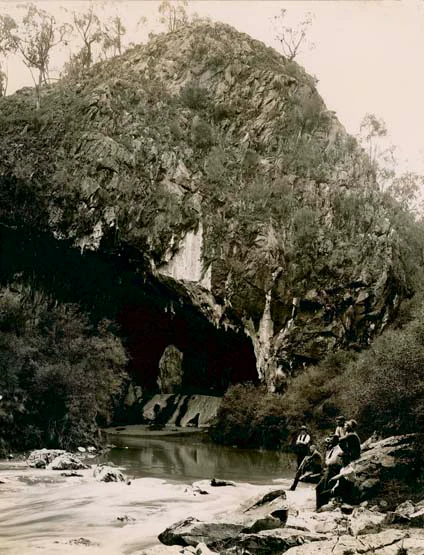
Abercrombie Caves are best known for The Archway, the largest natural arch in the southern hemisphere, formed where water erosion has opened a massive limestone span above a former stream passage. The site is equally recognised for its exemplary karst geomorphology, particularly the evolution of a sinkhole into a blind valley and the rare presence of crayback formations, which are fluted, sharp-ridged rock shapes sculpted by flowing water, at both main entrances. Beyond the geology, the caves carry a strong cultural footprint: a historic gold miners' dance platform built in 1880 still hosts performances inside The Archway, and several chambers bear names drawn from 19th-century bushranger history. The combination of significant karst features, large-scale cave morphology, and layered human stories gives the reserve a distinctive identity among New South Wales cave systems.
Abercrombie Caves history and protected-area timeline
The human history of Abercrombie Caves stretches back to at least the early 1830s and has shaped both the popular imagination and the physical fabric of the site. It is believed that a tourist party visited the caves as early as 1834, but the system was not officially recorded until 1842, when Surveyor W. R. Davidson documented it. The following year, Surveyor Wells extended the known chambers, discovering the Koh-i-noor, Bushranger, Long Tunnel, and Cathedral caves, along with the Hall of Terpsichore, also known as The Dance Hall. In 1844 the explorer William Wentworth and Governor Charles FitzRoy visited the caves, an early indication of the site's status as a destination of public interest.
The caves became entangled with the bushranger era of New South Wales. Various bushrangers used the system as a hideout during the 1800s, with the earliest known group being the Ribbon Gang in 1830. Composed of escaped convicts and led by the young English convict-servant Ralph Entwistle, the gang took advantage of the caves' remote location and narrow passages. The Bushranger's Cave, connected to the King Solomon's Temple chamber, still carries this history in its name and identity.
The discovery of gold in the area in 1854 transformed the local landscape. A gold exploration community was established at Mount Gray, just above the caves, and miners from surrounding districts frequently visited the caves for recreation. During this period the caves, originally known as Burragylong Caverns, came to be called Abercrombie Caves. The miners left their mark on the site in ways that are still visible: a dance platform was built inside The Archway in the 1860s and replaced in January 1880 with the structure that still stands, used today for performances, including the annual Carols in the Caves. The mining era also brought damage, as some miners fired rifles at the formations and early visitors carried away pieces of white marble as souvenirs; 19th-century graffiti name carvings can still be seen inside the caves.
The site's modern protection came with the establishment of the Abercrombie Karst Conservation Reserve in December 1997, recognising the caves' value as a natural heritage site listed on the Register of the National Estate for the diversity of its karst morphological and sedimentological features. Today the reserve is jointly managed by the Jenolan Caves Reserve Trust and the NSW National Parks and Wildlife Service, with all cave access provided through guided tours.
Abercrombie Caves landscape and geographic character
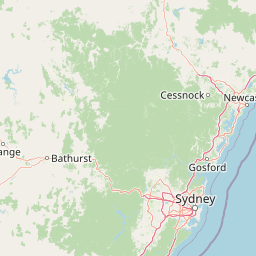
The landscape of the Abercrombie Caves reserve is defined by the rugged terrain of the Abercrombie Ranges in the Central West of New South Wales. The 1,434-hectare reserve sits in deeply dissected country, where forested ridges and steep slopes enclose a network of valleys shaped by limestone bedrock and underground drainage. The caves themselves are the surface expression of a karst system in which surface water has, over long periods, dissolved pathways through the rock, leaving behind a terrain of sinkholes, blind valleys, and solutionally sculpted cave entrances.
The most striking single landscape element is The Archway, a vast natural limestone span formed where a former cave passage was opened to the sky by erosion. Recognised as the largest natural arch in the southern hemisphere, The Archway resembles a natural bridge across the valley floor, with the cave continuing into the hillside behind it. Surrounding chambers, including Cathedral Cave and the connected Bushranger's Cave/King Solomon's Temple system, extend the landscape underground, where high chambers, narrow squeezes, and white-walled passages form contrasting environments within the same limestone block.
At both main entrances, the rock surfaces are shaped into crayback formations, sharp, parallel ridges and grooves carved by flowing water. These features are relatively uncommon and contribute significantly to the visual and scientific character of the site. Above ground, the reserve's mix of forested slopes, grassy clearings, and valley floors provides the visual frame for the cave entrances and supports the camping and visitor areas that give the reserve its present-day role as both a natural monument and a place of public recreation.
Abercrombie Caves ecosystems, habitats, and plant life
The ecological identity of the Abercrombie Caves reserve is closely tied to its limestone geology and the way that karst landscapes shape vegetation, water, and habitat. Limestone terrain typically produces distinctive surface conditions, with thinner soils, altered drainage patterns, and vegetation communities adapted to rocky, sometimes drought-prone substrates, reflected in the mix of forest and open woodland that covers the Abercrombie Ranges above and around the caves.
The most ecologically distinctive elements of the reserve are not at the surface but within the cave system itself. Cave environments support specialised ecological communities adapted to darkness, high humidity, and stable temperatures, and the network of passages at Abercrombie offers a range of microhabitats from wide, airy chambers like The Archway and Belfry Cave to tight squeezes and white-walled passages such as those of Grove Cave. The presence of crayback formations at the entrances, solutional features shaped by sustained water flow, indicates active hydrological processes that continue to influence conditions both inside the caves and in the surrounding terrain.
The broader reserve contributes to habitat connectivity in the Central West, with forested ridges and valleys providing cover for native fauna and helping to maintain water quality in the catchment that feeds the karst system. While the reserve is primarily recognised for its geological values, the surrounding landscape forms an integral part of the protected area, supporting the ecological processes that sustain the cave system and the species associated with it.
Abercrombie Caves wildlife and species highlights
Wildlife observations at Abercrombie Caves are shaped by the contrast between the forested ridges of the Abercrombie Ranges above ground and the sheltered, stable microclimate of the limestone caves below. The reserve's mix of eucalyptus woodland, rocky slopes, and valley floors provides habitat for forest and woodland species typical of the Central West region of New South Wales, while the cave system itself supports the specialist communities that depend on dark, humid underground conditions.
Because the reserve's primary recognition is for its karst geology and cultural history rather than for charismatic megafauna, the wildlife dimension is best understood in terms of habitat contribution rather than headline species. The forested terrain around the entrances provides cover and foraging resources for native birds, small mammals, and reptiles characteristic of the region, while the caves host invertebrates and other cave-dwelling fauna adapted to the underground environment. This dual character, surface habitat for regional woodland species combined with underground habitat for cave specialists, gives the reserve a layered ecological profile uncommon among Australian cave sites.
Abercrombie Caves conservation status and protection priorities
The conservation significance of Abercrombie Caves centres on the protection of an outstanding limestone karst system in New South Wales. The caves were formally protected through the establishment of the Abercrombie Karst Conservation Reserve in December 1997, an area of approximately 1,434 hectares classified as an IUCN Category III protected area, recognising it as a natural monument or feature of national significance.
The reserve is listed on the Register of the National Estate for the diversity of its karst morphological and sedimentological features, an acknowledgement of the scientific value of the system for understanding how limestone landscapes evolve through processes such as sinkhole development, blind valley formation, and crayback sculpting. These features are not only visually distinctive but also scientifically informative, offering insight into long-term groundwater behaviour and surface-subsurface interactions.
Conservation management is shared between the Jenolan Caves Reserve Trust and the NSW National Parks and Wildlife Service. Access to all caves is restricted to guided tours, a measure that serves both visitor safety and the protection of fragile formations. The damage caused in earlier eras, including souvenir removal, rifle damage to formations, and 19th-century graffiti, stands as a reminder of why active management and controlled access remain central to protecting the site for future generations.
Abercrombie Caves cultural meaning and human context
The cultural identity of Abercrombie Caves is inseparable from the broader history of the Central West region of New South Wales. The site carries layers of human meaning from early colonial exploration, the bushranger era, the gold rush, and the development of tourism and cultural performance traditions, all inscribed into both the place names of the caves and the physical fabric of the site itself.
The bushranger connection is particularly strong. The Bushranger's Cave, connected with the King Solomon's Temple chamber, takes its identity from bands of bushrangers who roamed the Abercrombie Ranges in the 1830s, including the Ribbon Gang led by the young English convict Ralph Entwistle. The remote location and narrow passages of the cave system made it an ideal shelter, and this history remains part of how the site is interpreted today.
The gold rush period left a different but equally enduring mark. After gold was discovered in the area in 1854, miners built a community at Mount Gray above the caves and regularly visited them for recreation. Inside The Archway, they built a dance platform that was replaced in January 1880 with the structure still standing today, used for ongoing community performances including the annual Carols in the Caves. The earlier name Burragylong Caverns and the legacy of 19th-century graffiti carvings within the caves further tie the site to the lived history of the region, giving Abercrombie Caves a cultural depth unusual among Australian cave reserves.
Top sights and standout views in Abercrombie Caves
The standout features of Abercrombie Caves begin with The Archway, the largest natural arch in the southern hemisphere, and the historic miners' dance platform from 1880 that still hosts performances inside it. Equally distinctive are the crayback formations at both main entrances, a relatively rare solutional sculpting pattern, and the broader karst story of a sinkhole evolving into a blind valley, evidence of the long-term water action that shaped the entire system.
Beyond the geology, the reserve offers a layered cultural experience through the named chambers: King Solomon's Temple reached via a suspension bridge, the high-roofed challenge of Belfry Cave, the tight white-walled passages of Grove Cave, and the bushranger-history-rich Bushranger's Cave. Combined with the surrounding forested terrain of the Abercrombie Ranges and the site's protected status within the Abercrombie Karst Conservation Reserve, these features make Abercrombie Caves a place where natural heritage and 19th-century human history are physically and visibly intertwined.
Best time to visit Abercrombie Caves
Abercrombie Caves are best experienced in conditions that allow comfortable movement through outdoor walks to the cave entrances and enjoyable time in the cool underground environment. The Central West of New South Wales has a temperate climate with warm to hot summers and cooler winters, and visiting in the cooler months can make the active cave tours, especially the more strenuous Grove Cave and Bushranger's Cave/King Solomon's Temple tours, considerably more pleasant.
Cave interior temperatures remain relatively stable year-round, offering a cool refuge during summer heat, while spring and autumn typically provide mild surface conditions ideal for combining cave tours with walking the reserve grounds and enjoying the surrounding forested landscape. Winter visits can also be rewarding, particularly for those interested in atmospheric cave photography and quiet exploration, though visitors should be prepared for cooler surface temperatures. Access to the caves is most flexible during New South Wales school holidays, when the site is open seven days a week, while term-time visits are limited by weekly closure days.