Mori Atlas logo
Nature reserveFalkenburg-Tiergarten

Discover the protected landscape of this historic Zeugenberg hill and its diverse woodland, rock, and wetland habitats

Falkenburg-Tiergarten Nature Reserve: A Detailed Geographic Atlas of the Palatinate Hill Country

(Naturschutzgebiet Falkenburg-Tiergarten)

Falkenburg-Tiergarten represents a significant protected nature reserve in the Südwestpfalz district, spanning 36 hectares of varied terrain around the Schloßberg. This site preserves an essential mosaic of old-growth woodland, specialised rock cliff flora, and damp wetland depressions formerly part of a 16th-century hunting ground. Beyond its ecological density, the reserve acts as a geological Zeugenberg, providing a clear topographic anchor for understanding the regional landscape of Rhineland-Palatinate.

nature reserveRhineland-PalatinatePalatinate forestcastle ruinsZeugenbergold-growth woodland

Falkenburg-Tiergarten

Nature reserve

Park overview

Structured park overview, official facts, and landscape profile for Falkenburg-Tiergarten

Falkenburg-Tiergarten park facts, protected area profile, and essential visitor context

Review the core facts for Falkenburg-Tiergarten, including designation, size, terrain, visitor scale, habitats, and operating context in one park-focused overview.

About Falkenburg-Tiergarten

Falkenburg-Tiergarten is a compact yet richly layered protected landscape in the Palatinate region of southwestern Germany. Located in the Landkreis Südwestpfalz near the village of Wilgartswiesen, the reserve extends across roughly 36 hectares of forested ridge, rocky outcrops, and small wetland hollows that together form an ecologically coherent unit around the Schloßberg hill.

At the heart of the reserve stands the Schloßberg, a 336.9 metre elevation crowned by the ruins of Falkenburg castle. The hill and its surroundings illustrate the close relationship between geology, forest history, and human land use that characterises much of the central Palatinate. The forested flanks of the Schloßberg include older tree stands on the north-facing slope, where centuries of woodland continuity have created habitat conditions for specialised species, while the castle rock itself supports rock-fissure vegetation adapted to thin soils and exposed conditions.

Below and around the Schloßberg lies the area historically known as the Tiergarten, the former game park whose name now defines the whole protected site. This area contains small streams, wetland pockets, and varied forest that originated within a medieval enclosure. Today these natural features are valued for their rarity and ecological fragility, and they form a quiet complement to the more visually dominant castle hill.

Geologically, the area is classified as a Zeugenberg, or outlier hill, which gives the reserve additional scientific significance. Combined with an associated Woog valley, the site offers insight into the shaping of the Palatinate landscape. The 1984 designation brought these natural, cultural, and geological dimensions together under a single conservation framework, ensuring that the castle hill, its forests, and its small wetland systems are managed as a unified habitat and species area.

Quick facts and research context for Falkenburg-Tiergarten

Falkenburg-Tiergarten is a 35.97 hectare nature reserve in the Landkreis Südwestpfalz, Rhineland-Palatinate, Germany, situated west of Wilgartswiesen along the B10 corridor. It was formally designated as a protected area on 16 January 1984 and is classified under IUCN Category IV as a Habitat/Species Management Area.

The reserve's principal features are the Schloßberg at 336.9 metres elevation, the ruins of Falkenburg castle, and the historic Tiergarten woodland below the hill, which together form a mosaic of old-growth forest, cliff vegetation, and wetland habitats. It also carries geo-scientific significance as a Zeugenberg with an associated Woog valley landscape.

Protection and recognition

Documented management scope and international recognition facts for Falkenburg-Tiergarten

Falkenburg-Tiergarten Protection Status and Designated Recognition Records

Falkenburg-Tiergarten records provide structured tracking for protected area designation history, administrative scope, and international recognition data. Official conservation context helps verify regional management frameworks and baseline administrative boundaries for natural terrain.

Protection details

WDPA ID
163021
Park context

Deeper park guide and search-rich context for Falkenburg-Tiergarten

Falkenburg-Tiergarten history, landscape, wildlife, and travel context

Explore Falkenburg-Tiergarten through its history, landscape character, ecosystems, wildlife, conservation priorities, cultural context, and seasonal travel timing in a structured park guide built for atlas discovery and search intent.

Why Falkenburg-Tiergarten stands out

Falkenburg-Tiergarten is best known for combining a medieval castle ruin with a historic game park landscape and a recognised Zeugenberg hill. The reserve preserves old-growth woodland on the north slope of the Schloßberg, distinctive rock flora on the castle cliff, and wetland habitats within the broader Tiergarten area. It also stands out for its layered cultural and natural history: a 16th-century noble hunting enclosure developed into a protected natural landscape that today conserves rare and threatened habitats and showcases the geological character of the Palatinate hill country.
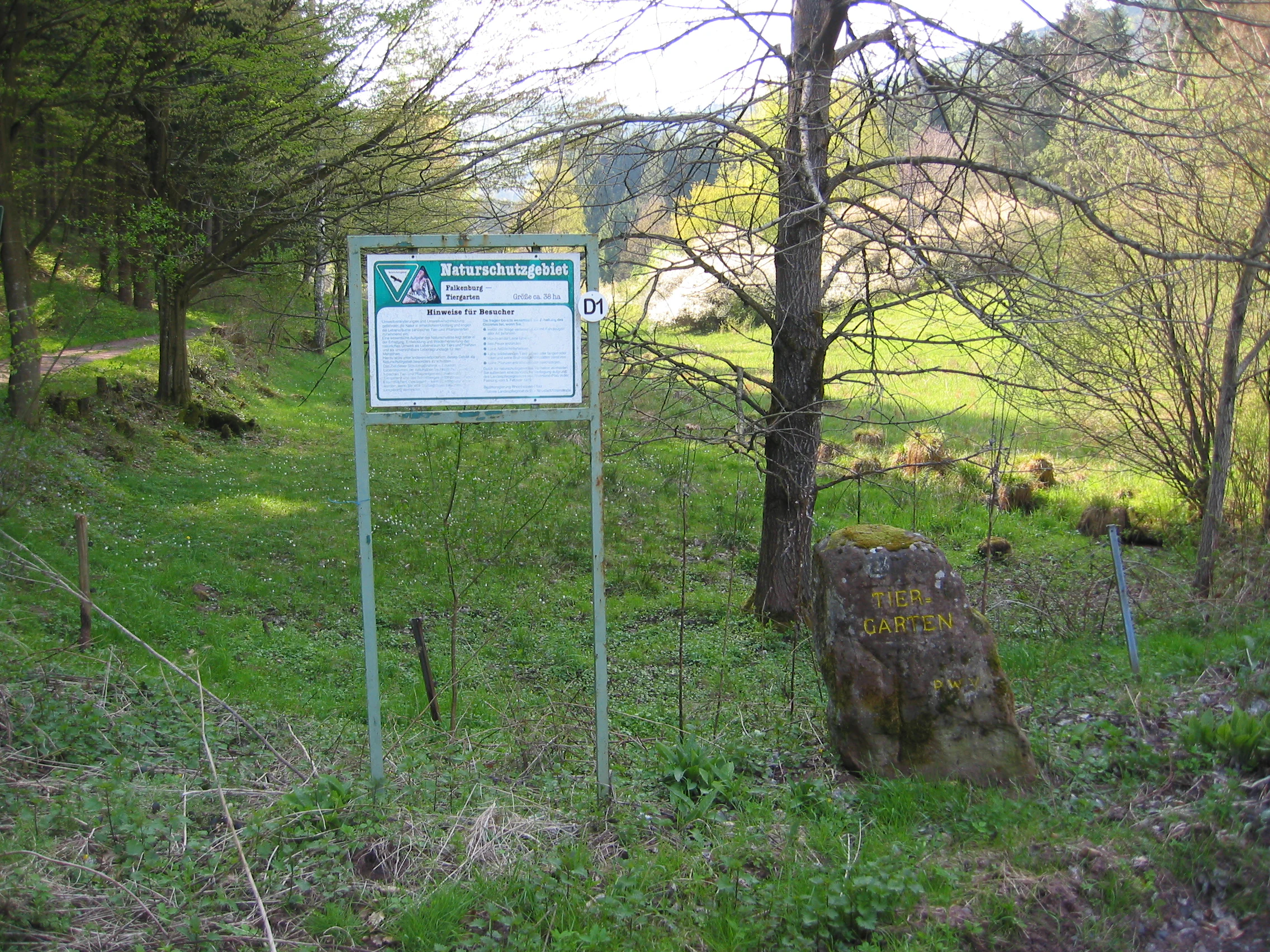
A metal-framed information board stands in a grassy clearing, next to a small, weathered stone marker with text inscribed on its face.
A nature reserve information sign and a historic stone marker in the Falkenburg-Tiergarten area.

Falkenburg-Tiergarten history and protected-area timeline

The cultural history of the Falkenburg-Tiergarten area reaches back to the mid-16th century, when the Leiningen noble family held the Falkenburg as a partially divided lordship. In 1553, Count Hanns Heinrich, as holder of the Leiningen share of Falkenburg, established a game park (Tiergarten) north of the castle hill to support hunting activities. Over time, this medieval hunting enclosure transitioned from a managed noble hunting ground into an area of natural woodland development, which today forms part of the protected nature reserve.

The castle on the Schloßberg itself dates from earlier centuries and is now preserved only as a ruin, with the surrounding forest and rock habitats having matured around the historic site. The combined cultural and natural layers of the area, military fortification, noble hunting infrastructure, ecological woodland and wetland, set the context for modern protection.

Formal conservation arrived comparatively late in the site's long history. On 16 January 1984, the area was officially designated as a Naturschutzgebiet under Rhineland-Palatinate nature protection law. The designation recognised both the biological richness of the old forest, rock, and wetland communities and the geo-scientific importance of the Schloßberg as a Zeugenberg. The reserve has since remained a locally valued example of how cultural landscape features can be integrated into modern habitat protection.

Falkenburg-Tiergarten landscape and geographic character

The landscape of Falkenburg-Tiergarten is defined by a compact set of contrasting landforms typical of the Palatinate hill country. The most prominent feature is the Schloßberg, a steep-sided hill reaching 336.9 metres above sea level, topped by the remains of Falkenburg castle. The hill rises sharply from the surrounding terrain and creates a clear topographic anchor across the reserve, with rocky cliff faces on parts of the slope and gentler wooded flanks elsewhere.

The reserve extends roughly one kilometre in a north-westerly direction from the Schloßberg, running parallel to the local road K56 and positioned just north of the busy B10 federal road. This linear arrangement gives the protected area a ridge-and-valley structure, with the elevated, drier Schloßberg contrasting against the lower, moister valley sections associated with the historic Tiergarten.

Hydrological features add further variety to the landscape. In the north-western part of the reserve, a small stream rises and flows out of the area toward Wilgartswiesen, eventually joining the Queich river. The presence of this watercourse, along with the small damp depressions of the old game park area, breaks up the forest cover and creates the wetland pockets that contribute significantly to the site's ecological character. The overall scene is one of quietly folded Palatinate countryside: wooded hill, ruined castle, damp hollows, and connecting streams within a small, clearly bounded reserve.

Falkenburg-Tiergarten ecosystems, habitats, and plant life

Falkenburg-Tiergarten supports a notably diverse set of habitat types for a reserve of its size. The north-facing slope of the Schloßberg is the location of older, near-natural woodland stands (Altholzbestandteile), where long continuity of forest cover has created structural complexity in the canopy, understorey, and deadwood. These mature forest elements are a core target of the reserve's conservation purpose.

Along the exposed rock faces of the castle hill, specialised rock-flora communities (Felsflora) have developed, adapted to shallow soils, variable moisture, and the microclimatic conditions of cliff habitats. This rock vegetation contributes a distinct botanical character that contrasts sharply with the closed forest of the slopes.

The lower parts of the reserve, associated with the historic Tiergarten, contain small wetlands and water features (Feuchtgebiete und Gewässer). These damp habitats are particularly significant for the ecological profile of the site, supporting animal and plant communities that depend on moisture and standing or slow-moving water. Combined with the surrounding woodland and rocky outcrops, these habitats form a mosaic that the reserve was specifically designated to maintain.

Falkenburg-Tiergarten wildlife and species highlights

The wildlife value of Falkenburg-Tiergarten lies less in headline species and more in the integrity and continuity of its habitat mosaic. The mature trees on the north slope of the Schloßberg provide niches for forest-interior bird species, woodland invertebrates, and other fauna associated with old-growth conditions, including deadwood-dependent insects and cavity-nesting species.

The rock habitats of the castle cliff support specialised fauna adapted to cliff and crevice environments, while the wetlands in the old Tiergarten area support amphibian and invertebrate communities that depend on small water bodies and damp forest floor conditions. Together with the stream that rises in the north-west of the reserve and flows toward the Queich, these features create connected micro-habitats within a small area.

Although the reserve's size limits populations of larger mammals, its structural diversity makes it valuable as a refuge for typical Palatinate forest fauna and for species sensitive to disturbance. The protected status of the area offers these communities long-term stability amid a regional landscape that is heavily shaped by roads, forestry, and settlement.

Falkenburg-Tiergarten conservation status and protection priorities

Falkenburg-Tiergarten has conservation significance that goes beyond its modest size. Designated in 1984 as a Naturschutzgebiet in Rhineland-Palatinate and classified internationally under IUCN Category IV (Habitat/Species Management Area), the reserve is recognised as a site where active protection of specific habitats and species is the primary management objective.

The expressed protection purpose of the reserve is the preservation of the near-natural to natural, site-typical animal and plant communities of the Tiergarten and the Schloßberg. This includes the old-growth forest elements on the north slope, the specialised rock vegetation of the castle cliff, and the wetlands and water bodies of the lower Tiergarten. The reserve's designation therefore explicitly targets the most ecologically distinctive features of the area rather than the forest as a whole.

In addition to its habitat value, the reserve is protected for its geo-scientific significance as a Zeugenberg and associated Woog valley, providing evidence of the geological processes that shaped the central Palatinate. The combined natural and geo-scientific rarity of the site, together with the special character of its landscape around a historic castle ruin, gives the reserve a layered conservation profile that integrates biological, geological, and cultural landscape values.

Falkenburg-Tiergarten cultural meaning and human context

The cultural context of Falkenburg-Tiergarten is inseparable from its natural setting, since the site's name, footprint, and modern protected status all derive from human history. The castle on the Schloßberg, the Falkenburg, anchors the area in the medieval defensive and lordship landscape of the Palatinate, and the ruin remains the most visually prominent cultural feature of the reserve.

Equally important is the 1553 hunting enclosure created by Count Hanns Heinrich of the Leiningen family, whose Tiergarten gave the area both its lower land use pattern and its modern name. The transition from medieval hunting infrastructure to mature forest and wetland, and then to formal nature conservation in 1984, illustrates a common central European pattern in which old noble estates become the nuclei of modern protected landscapes.

These cultural layers are recognised within the reserve's conservation framework through the emphasis on the Eigenart (special character) of the landscape, a category in German nature protection that explicitly values the cultural-historic identity of a site alongside its natural features.

Top sights and standout views in Falkenburg-Tiergarten

The standout feature of Falkenburg-Tiergarten is the Schloßberg with its castle ruins, a single hill that visually and ecologically anchors the entire reserve. Around it, the protected area combines old forest on the north-facing slope, specialised rock vegetation on the castle cliff, and small wetlands on the floor of the old Tiergarten, producing a habitat mosaic of unusual density for a 36 hectare site.

Equally distinctive is the reserve's geo-scientific importance as a Zeugenberg, an outlier hill that gives the area significance beyond pure biology. The combination of medieval castle ruins, 16th-century hunting history, and a 1984 conservation designation creates a layered identity that makes the site a representative example of small-scale, multi-value nature protection in the German Palatinate.

Best time to visit Falkenburg-Tiergarten

Falkenburg-Tiergarten is at its most appealing in late spring and early summer, when the forest canopy is fully leafed, the understorey of the Tiergarten area is green, and small wetland features along the stream paths are most visible. The reserve's gentle topography relative to much of the Palatinate makes it approachable in most seasons, and longer deciduous views across the Schloßberg and the surrounding wooded ridge are easier to appreciate outside peak summer heat.

Autumn brings strong woodland character to the reserve, with the mature trees on the north slope and the broader mixed forest of the Tiergarten showing seasonal colour against the persistent grey of the castle rock. Winter visits emphasise the structural landscape: the silhouette of the castle ruin on the Schloßberg, the linear ridge shape of the reserve, and the exposed rock faces that give the area much of its geo-scientific interest.
Monthly climate preview

Long-term representative measurements of monthly temperature ranges and daily precipitation patterns

Falkenburg-Tiergarten Climate Normals, Annual Temperature and Precipitation Rhythm

Falkenburg-Tiergarten exhibits a measured annual temperature and precipitation rhythm derived from long-term coordinate sampling across twelve distinct monthly intervals. Examining the complete monthly climate profile reveals detailed temperature extremes and precipitation averages for deeper geographic analysis.
Annual mean10 °C
1 °C21 °C
Jan
Feb
Mar
Apr10°
May15°
Jun19°
Jul21°
Aug20°
Sep16°
Oct10°
Nov
Dec
Warmest month
July

20.9 °C

Coolest month
January

0.6 °C

Wettest month
May

2.3 mm/day

Driest month
April

1.5 mm/day

Park location guide

Geography guide, regional context, and park location map for Falkenburg-Tiergarten

Falkenburg-Tiergarten park geography, regions, and map view in Germany

Understand where Falkenburg-Tiergarten sits in Germany through a broader geographic reading of the surrounding landscape, nearby location context, and its mapped position within the national park landscape.

How Falkenburg-Tiergarten fits into Germany

Germany is a federal republic in Western and Central Europe with a population of over 83 million across sixteen constituent states. It is Europe's largest economy by nominal GDP and a major global exporter and importer. The capital is Berlin, and the country borders Denmark, Poland, Czech Republic, Austria, Switzerland, France, Luxembourg, Belgium, and the Netherlands.

Wider geography shaping Falkenburg-Tiergarten in Germany

Germany is located in Western and Central Europe, spanning 357,022 km². It borders Denmark to the north, Poland and the Czech Republic to the east, Austria and Switzerland to the south, and France, Luxembourg, Belgium, and the Netherlands to the west. The country has coastlines on the Baltic Sea and North Sea to the north, with the Alps located in the southern region.

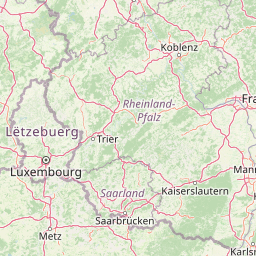
Map view of Falkenburg-Tiergarten

Use this park location map to pinpoint Falkenburg-Tiergarten in Germany, understand its exact geographic position, and read its mapped placement within the surrounding landscape more clearly.

Pigeon | © OpenStreetMap contributors

Location context for Falkenburg-Tiergarten

Rheinland-Pfalz

Visualizing the terrain, castle ruins, and habitats of the nature reserve

Falkenburg-Tiergarten Photos and Protected Landscape Scenery

Examine detailed photographs of Falkenburg-Tiergarten to understand its steep wooded slopes, rock flora, and wetland depressions. Visual documentation reveals the distinct topography and historic character of the protected Palatinate hill country.

A metal-framed information board stands in a grassy clearing, next to a small, weathered stone marker with text inscribed on its face.

Park atlas

Compare adjacent forest reserves, wooded hill country, and regional nature habitats

Explore Parks Near Falkenburg-Tiergarten and Surrounding Protected Landscapes

Continue geographic discovery by comparing nearby protected areas sharing similar Palatinate terrain features and woodland habitats. Examining adjacent nature reserves provides broader regional context for the geological and ecological patterns found around Falkenburg-Tiergarten.
Watercolor illustration depicting a serene forest landscape with rolling hills, distant mountains, and soft pastel colors on a white background.
Protected landscapeRhineland-Palatinate
About 10 km away#1 closest

North

Naturpark Pfälzerwald: Geographic Atlas and Protected Landscape Overview

Mapping the forest terrain and core protection zones of Rhineland-Palatinate

Naturpark Pfälzerwald serves as a central hub for ecological conservation in Germany, featuring a vast mosaic of mixed forests and Buntsandstein sandstone outcrops. This detailed atlas entry explores the park's structural division into northern, central, and southern sectors, highlighting its role as a major transboundary natural landmark.

Area
1,798 km²
Established
1958
Relief
Upland
Climate
Temperate
A soft, light watercolor painting of a rolling rural landscape featuring rows of vineyards in the foreground and tree-covered hills in the distance.
Nature reserveRheinland-Pfalz
About 11 km away#2 closest

Northeast

Haardtrand Nature Reserve: Geographic Overview and Protected Landscape Mapping

Bird protection area within the Rheinland-Pfalz region.

Spanning roughly 14,700 hectares, Haardtrand serves as a critical link between the Palatinate Forest and the Rhine valley. This nature reserve is composed of a distinctive mosaic of habitat types, including mature broadleaf woodlands, traditional orchard meadows, and sandy terraces, which together create a highly structured environment for diverse raptors and forest-dwelling bird species.

Area
147.28 km²
Established
2004
Nature reserveRhineland-Palatinate
About 11 km away#3 closest

Southwest

Moosbachtal Nature Reserve: Protected Valley Geography and Ecosystem Map in Rhineland-Palatinate

A historic pond and stream mosaic in the southern Palatinate

Moosbachtal stands as a significant protected nature reserve in Rhineland-Palatinate, encompassing a unique 111-hectare mix of sandy slopes, stream-fed meadows, and historic impoundment ponds. This mapped habitat mosaic illustrates the complex successional stages of southern Palatinate forest valleys, offering clear insight into the regional conservation landscape and the connectivity between riparian systems and forested ridges.

Area
1.11 km²
Established
1984
IUCN
IV
Relief
Upland
Nature reserveRhineland-Palatinate
About 16 km away#4 closest

South

Brauntal Nature Reserve: Protected Wetland Landscapes and Geography in Southern Palatinate

Mapped protected areas in Rhineland-Palatinate, Germany

Brauntal serves as an important nature reserve centered on a dystrophic pond and its surrounding silting zones. The site acts as a critical protected habitat within the Südwestpfalz region, offering insights into wetland ecology, stream headwaters, and hilly transition zones near the French border.

Area
0.71 km²
Established
1984
Nature reserveRheinland-Pfalz
About 16 km away#5 closest

Southwest

Wolfsägertal Nature Reserve: Mapped Wetlands and Sandstone Valley Geography

Protected aquatic ecosystems in the Wasgau, Rheinland-Pfalz

Discover the precise geographic footprint and ecological characteristics of Wolfsägertal. This nature reserve, located within the forested sandstone terrain of the Wasgau, provides a concentrated study of stream-side wetland habitats, including the Nollenkopf impoundment and associated fen meadows, all mapped and structured for clear regional context.

Area
0.222 km²
Established
1983
Nature reserveRheinland-Pfalz
About 16 km away#6 closest

South

Zeppelinhalde Nature Reserve: A Protected Juniper Hillside in the Southern Palatinate Landscape

Mapped protected habitats in the Rheinland-Pfalz region

Zeppelinhalde is a protected nature reserve in the Südwestpfalz, characterized by its rare juniper-dominated dry grassland habitat on the eastern slopes of the Kuhnenkopf. This area serves as a vital ecological link within the cross-border Palatinate Forest landscape, contrasting open, sun-exposed terrain with surrounding woodland ridges near the French border.

Established
1942
Nature reserveRheinland-Pfalz
About 17 km away#7 closest

Southwest

Königsbruch Nature Reserve: Geographic Map and Protected Landscape Overview

Riparian ecosystems and stream networks in Rheinland-Pfalz

Königsbruch represents a vital conservation landscape in the southern Palatinate Forest, characterized by its damp woodland and the convergence of the Saarbach stream system. Our detailed geographic mapping reveals the protected valley corridors of this nature reserve, providing a clear view of its terrain, hydrological features, and boundary context within the region of Rheinland-Pfalz.

Area
1.226 km²
Established
1996
Nature reserveRheinland-Pfalz
About 18 km away#8 closest

Southwest

Faunertal Nature Reserve and Palatinate Forest Wetland Mapping

A protected aquatic mosaic in southwestern Germany

Faunertal represents a specialized nature reserve in Rheinland-Palatinate characterized by its chain of abandoned fish ponds along the Dielbach. The site provides a clear case study in landscape transformation, where historic ponds now support diverse sedge mires, reed beds, and complex wetland ecosystems. This area serves as a critical focus for amphibian conservation and habitat connectivity within the broader forest geography of the Palatinate region.

Area
0.253 km²
Established
1983

Common questions about visiting, size, designation, and location context for Falkenburg-Tiergarten

Falkenburg-Tiergarten FAQs for park facts, access, geography, and protected area context

Find quick answers about Falkenburg-Tiergarten, including protected-area facts, park geography, trail and visitor context, and how the park fits into its surrounding country and regional landscape.
MoriAtlas Explorer

Continue Your Protected Areas Search Across the Global Atlas

Deepen your exploration by continuing the structured search for national parks and protected areas worldwide. Utilize the comprehensive filtering capabilities to compare different conservation landscapes and refine your understanding of global park geography. Discover more about the distribution and characteristics of protected natural areas.

Global natural geography