Why Val Marie Reservoir Migratory Bird Sanctuary stands out
Val Marie Reservoir Migratory Bird Sanctuary is best known as a vital migration refuge for waterfowl in the arid mixedgrass prairies of southwestern Saskatchewan. The reservoir's reliable open water makes it especially important during drought years, when it may be the only sizable body of water for many kilometers around. The sanctuary is also valued for its small but productive islands, which host densely packed colonies of nesting double-crested cormorants and great blue herons, along with black-crowned night herons, ring-billed gulls, California gulls, and common terns. Together, these qualities give the sanctuary an outsized importance for prairie waterbird conservation despite its modest area.
Val Marie Reservoir Migratory Bird Sanctuary history and protected-area timeline
Val Marie Reservoir Migratory Bird Sanctuary was established on November 3, 1948, as a federal Migratory Bird Sanctuary under the authority of the Canadian Wildlife Service. It was created at the same time as four other sanctuaries in Saskatchewan as a deliberate replacement for five earlier bird sanctuaries in the province. The original reserves had lost their suitability as habitat because repeated droughts had reduced the surface water and wetland conditions on which migratory birds depended.
By transferring protection to sites like the Newton Lake reservoir on the Frenchman River, the Canadian government sought to guarantee reliable waterbird habitat in a region where natural wetlands could no longer be assumed to persist. The reservoir itself, rather than being a natural lake, provided a more dependable base of open water. Since its designation, the sanctuary has continued to function as a managed refuge within the national system of Migratory Bird Sanctuaries, without significant boundary changes reported in the source material.
Val Marie Reservoir Migratory Bird Sanctuary landscape and geographic character
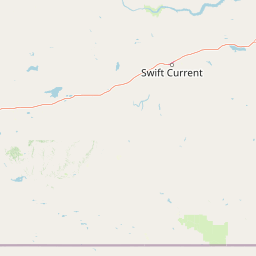
The landscape of Val Marie Reservoir Migratory Bird Sanctuary is shaped by the open, semi-arid character of the southwestern Saskatchewan mixedgrass prairie. Within this setting, Newton Lake appears as a clearly defined body of standing water edged by low, gently sloping banks. Because the reservoir sits on the Frenchman River, its water levels reflect both natural flow and managed dam operations, producing fluctuating shorelines that periodically reveal expanses of wet sediment.
The sanctuary's land cover is strongly water-dominated. Open water and sediment-covered mudflats make up the great majority of the protected area, with marshes forming a much smaller but ecologically important band along portions of the shore. A small proportion of the area consists of low islands rising from the reservoir. Beyond the sanctuary boundary, the surrounding terrain is typical mixedgrass prairie, with cultivated land and native grassland stretching toward the United States border and the Cypress Hills region further to the west. The contrast between the broad, dry prairie and the concentrated wetland mosaic gives the sanctuary its distinctive visual and ecological character.
Val Marie Reservoir Migratory Bird Sanctuary ecosystems, habitats, and plant life
Ecologically, Val Marie Reservoir Migratory Bird Sanctuary functions as a wetland island within a predominantly dry grassland matrix. Its habitat composition is unusually concentrated: ninety percent of the area consists of open water and mudflats, nine percent consists of marshes, and one percent consists of small islands. This skewed distribution reflects the primacy of aquatic and shoreline habitat for the sanctuary's conservation goals.
The mudflats exposed by fluctuating water levels provide feeding areas for shorebirds and waterfowl, while the marsh zones support emergent vegetation typical of prairie wetlands, including sedges, rushes, and reeds. The islands, though small in total area, are ecologically outsized because they offer predator-free ground for colonial nesting birds. Together, these habitats support a richer waterbird community than the surrounding prairie could sustain on its own, making the reservoir an important biological node in the regional landscape.
Val Marie Reservoir Migratory Bird Sanctuary wildlife and species highlights
Val Marie Reservoir Migratory Bird Sanctuary is primarily significant for its birdlife. The reservoir acts as a key feeding and resting site for Canada geese and numerous duck species during both spring and autumn migrations, and it becomes especially important during drought periods, when it can represent the only sizable body of water in the wider area. Migratory waterfowl therefore form the core of the sanctuary's wildlife value.
The small islands within Newton Lake host dense breeding colonies of waterbirds. These include double-crested cormorants and great blue herons as the most prominent colonial nesters, along with black-crowned night herons, ring-billed gulls, California gulls, and common terns. In summer, additional species visit the sanctuary without breeding there, most notably American white pelicans, Franklin's gulls, and black terns, using the reservoir for feeding and loafing. While the source material focuses on birds, the wetland setting also implies habitat for typical prairie marsh fauna, though this is not elaborated in the available documentation.
Val Marie Reservoir Migratory Bird Sanctuary conservation status and protection priorities
From a conservation perspective, Val Marie Reservoir Migratory Bird Sanctuary plays a disproportionate role for its small size. The mixedgrass prairie of southwestern Saskatchewan has lost a significant amount of its original wetland habitat to drainage, cultivation, and recurring drought, so any site that can guarantee open water and shoreline feeding areas becomes highly valuable for waterbird populations following the central flyway.
By protecting the reservoir itself along with its associated mudflats, marshes, and nesting islands, the sanctuary secures not only a roosting and refueling site for migrating waterfowl but also intact breeding habitat for several colonial waterbird species. Its establishment as one of a group of five replacement sanctuaries in Saskatchewan in 1948 reflects an early Canadian recognition that prairie wetlands needed active protection if migratory bird populations were to be safeguarded. Today, the sanctuary continues to illustrate how targeted protection of a single reservoir can sustain significant waterbird diversity in an otherwise heavily altered prairie landscape.
Top sights and standout views in Val Marie Reservoir Migratory Bird Sanctuary
Val Marie Reservoir Migratory Bird Sanctuary offers a striking combination of features within an exceptionally compact area. Its stand-out qualities include the reliably open water of Newton Lake in a drought-prone prairie region, the large share of the protected area devoted to mudflats and water, and the small but ecologically vital islands that host dense waterbird colonies.
The sanctuary also stands out historically, having been designated as one of a coordinated group of replacement sanctuaries in Saskatchewan in 1948, reflecting a deliberate Canadian strategy to protect prairie wetlands for migratory birds. Together these traits distinguish Val Marie from broader prairie parks: it is a focused, water-centered refuge whose importance lies in the scarcity and reliability of its habitat rather than in its size.
Best time to visit Val Marie Reservoir Migratory Bird Sanctuary
The character of a visit to Val Marie Reservoir Migratory Bird Sanctuary is shaped strongly by the seasons. Spring and autumn are the most ecologically active periods, when the reservoir serves as a major resting and feeding area for Canada geese and migrating ducks along the central flyway. These seasons also tend to bring the highest diversity and numbers of waterfowl, as well as active courtship and flocking behavior.
Summer is the breeding season for the sanctuary's colonial waterbirds on the reservoir's islands, including cormorants, herons, and gulls, making it an important period for observing nesting colonies. Winter conditions in southwestern Saskatchewan are typically cold and dry, and ice cover and reduced open water limit the sanctuary's usefulness for waterbirds. Overall, the warmer months and especially the migration windows offer the richest experience of the sanctuary's defining wildlife.