


Mori Atlas logo
Nature reserveAlykes Larnakas

Mapped saline meadows, seasonal salt crusts, and critical migratory avian habitats in southeastern Cyprus.

Alykes Larnakas Nature Reserve: A Detailed Atlas of Protected Wetland Landscapes in Larnaca District

Alykes Larnakas represents one of the most ecologically significant protected wetland complexes in the eastern Mediterranean. Situated near the city of Larnaka, this nature reserve contains a complex mosaic of shallow saline lakes, salt marshes, and arid phrygana scrublands. The area serves as a primary refuge for wintering waterbirds and migratory populations, with geography defined by the interplay between seasonal salt crusts, coastal lagoons, and Mediterranean dry grasslands.

salt lakecoastal wetlandMediterranean lagoonsaline meadowsphryganadry grassland
A flat style digital illustration of a wetland landscape featuring green and sandy terrain with distant hills under a blue sky with stylized sun rays.

Alykes Larnakas

Nature reserve

Park overview

Structured park overview, official facts, and landscape profile for Alykes Larnakas

Alykes Larnakas park facts, protected area profile, and essential visitor context

Review the core facts for Alykes Larnakas, including designation, size, terrain, visitor scale, habitats, and operating context in one park-focused overview.

About Alykes Larnakas

Alykes Larnakas is a Natura 2000 protected area on the southeastern coast of Cyprus, combining natural salt lakes with adjacent saline meadows, phrygana, and dry grassland. Although not formally classified as a national park, the site functions as a core conservation area for wetland and coastal habitats in the country.

The site is centred on the Larnaka Salt Lake, a large shallow saline lake in the immediate hinterland of Larnaka city, and extends southward across the Larnaka Airport area to include the Orfani and Soros lakes, as well as settling basins from the city's wastewater treatment works. Around these waters lies a band of salt-influenced habitats: Mediterranean salt meadows dominated by Juncetalia maritimi, Queller saltmarshes of the Sarcocornetea fruticosae type, pioneer vegetation of Salicornia on mud and sand, ephemeral saline shoreline vegetation, and small pockets of primary coastal dunes.

Further inland, the habitat mosaic transitions into low Mediterranean scrubland known as phrygana, including formations shaped by the thorny Sarcopoterium spinosum, and into dry Mediterranean grasslands of the Thero-Brachypodietea type. The interlacing of saline wetlands with xerothermic scrub and grassland gives Alykes Larnakas much of its conservation value, supporting species that would not persist in a purely aquatic or purely terrestrial protected area.

The site sits within a broader context of human presence, including the airport corridor and the urban edge of Larnaka, which makes its ecological importance even more notable. Across roughly 15.6 square kilometres, the protected area functions as a refuge and staging point on major bird migration routes through the eastern Mediterranean and as a wintering ground for waterbirds from across Europe and western Asia.

Quick facts and research context for Alykes Larnakas

Alykes Larnakas lies in the Larnaka District of Cyprus, on the southeastern coast of the island just south of Larnaka city. It is officially designated both as a Special Area of Conservation and as a Special Protection Area within the Natura 2000 network, with the EU site code CY6000002.

The area combines the Larnaka Salt Lake, the Orfani and Soros lakes, artificial treatment basins, salt meadows, phrygana vegetation, and Mediterranean dry grassland. It forms one of the largest cohesive wetland complexes in Cyprus, especially important for migratory waterbirds and wintering greater flamingos.

Protection and recognition

Documented Natura 2000 listings and official protection records

Alykes Larnakas Protection Status and International Recognition Data

Examine the verified protection status and recorded international designations associated with Alykes Larnakas. Official records outline documented Natura 2000 boundary details and administrative context for this protected area.
Park context

Deeper park guide and search-rich context for Alykes Larnakas

Alykes Larnakas history, landscape, wildlife, and travel context

Explore Alykes Larnakas through its history, landscape character, ecosystems, wildlife, conservation priorities, cultural context, and seasonal travel timing in a structured park guide built for atlas discovery and search intent.

Why Alykes Larnakas stands out

The site is best known for the wintering population of greater flamingos on the Larnaka Salt Lake, which has made the surrounding area one of the most iconic birdwatching locations in Cyprus. Beyond the flamingos, it is recognised for its mosaic of saline lakes, salt meadows, coastal lagoons, and Mediterranean phrygana habitats, all of which together form a major refuge for migratory and wintering birds in the eastern Mediterranean. Its importance lies as much in the combination of habitat types as in any single species: coastal lagoons, saltmarshes, dune pioneer vegetation, and dry grassland fringe the saline waters, creating a gradient of wetlands and arid-zone habitats that supports a remarkable diversity of birds, amphibians, reptiles, and invertebrates within a relatively small area.
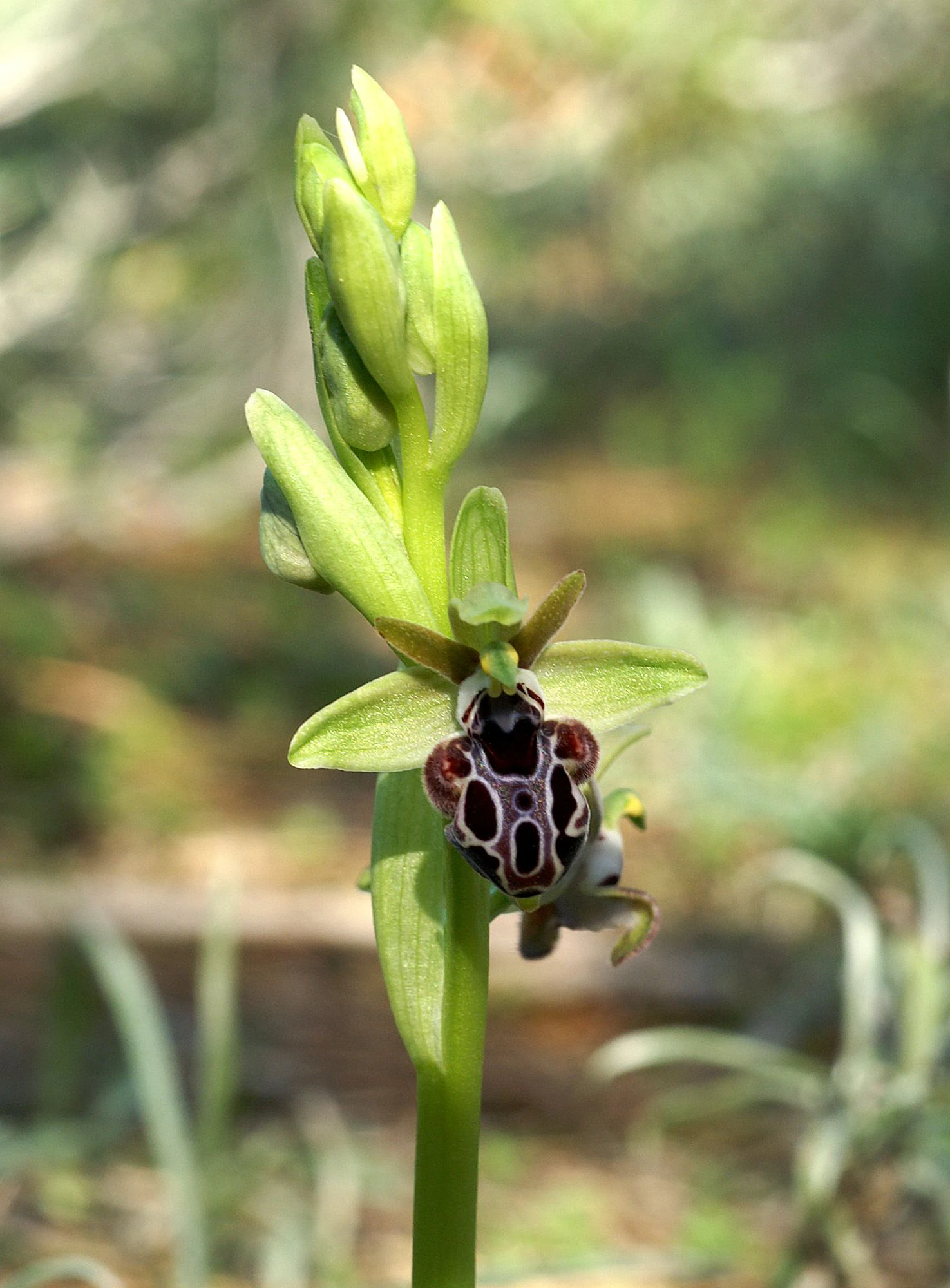
A close-up, eye-level photograph of a single Ophrys kotschyi orchid bloom against a soft, out-of-focus green background. The flower features green sepals and a patterned, velvety labellum with dark brown and white markings.
A close-up view of the Ophrys kotschyi orchid, an endemic species found within the Alykes Larnakas nature reserve.

Alykes Larnakas history and protected-area timeline

The conservation history of Alykes Larnakas is closely bound to the European Union's Natura 2000 framework, which Cyprus joined through its EU accession process. Following its designation, the site followed a stepwise recognition. In 2004, it was proposed as a Site of Community Importance under the EU Habitats Directive, and in 2008 it was formally adopted as a Special Area of Conservation, with the designation legally confirmed through its eventual site designation in 2015.

In parallel, the area was submitted as a Special Protection Area under the EU Birds Directive in 2005, recognising its exceptional importance for migratory and wintering birds. The combination of these designations, alongside its inclusion in the World Database on Protected Areas under record 555579922, has made Alykes Larnakas one of the cornerstone wetland protected areas on the island and a benchmark for coastal wetland conservation in Cyprus.

Alykes Larnakas landscape and geographic character

The landscape of Alykes Larnakas is defined by the interplay between shallow saline waters and the dry coastal terrain of southeastern Cyprus. The dominant landform is the Larnaka Salt Lake, a broad, shallow basin that fills in winter and evaporates to a bright salt crust in late summer, producing the gleaming white surface that gives the wider region its visual identity.

South of the airport corridor, the smaller Orfani and Soros lakes form a secondary set of saline waterbodies, with characteristically shallow, brackish conditions. The wastewater treatment basins add further open-water elements to the mosaic. Where land meets water, a sequence of specialised coastal habitats appears: narrow coastal lagoons at the interface with the sea, Salicornia-dominated pioneer saltmarshes, Mediterranean salt meadows with Juncus maritimus communities, and older Queller saltmarshes of the Sarcocornetea fruticosae type.

Away from the immediate wetland fringe, the terrain becomes more arid. Low, scrubby phrygana vegetation, much of it shaped by the spiny dwarf shrub Sarcopoterium spinosum, climbs over gentle slopes, while areas of Thero-Brachypodietea dry grassland extend the mosaic into a more open Mediterranean steppe-like texture. Small pockets of primary coastal dune complete the transition to the sea. The result is a layered coastal landscape of salt, water, scrub, and dry grass, all within a compact area.
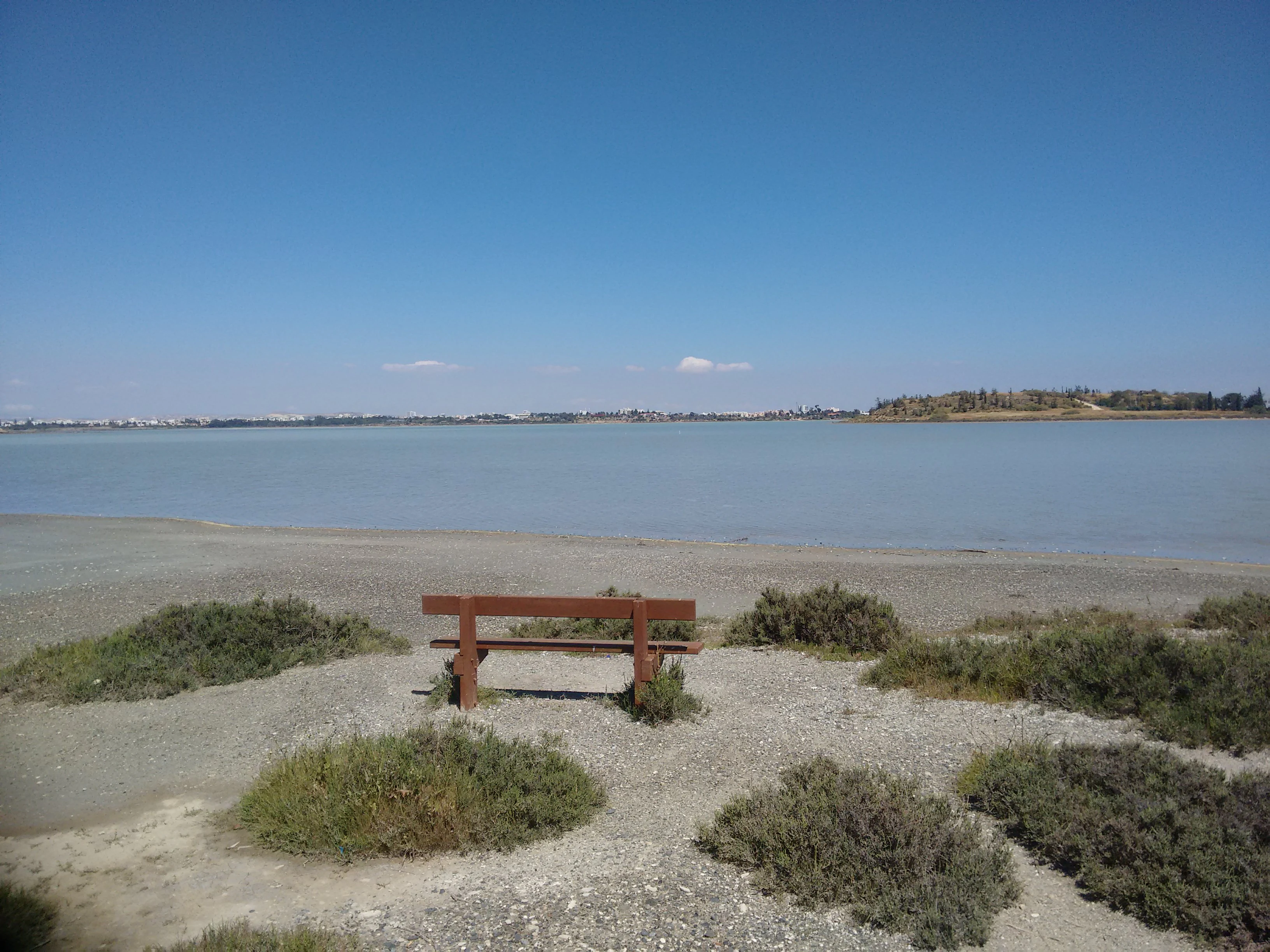
A brown wooden bench sitting on a gravelly, shrub-covered shore facing a calm, wide salt lake under a bright blue sky.
A wooden bench overlooking the Larnaca Salt Lake on a clear day.

Alykes Larnakas ecosystems, habitats, and plant life

Ecologically, Alykes Larnakas is dominated by Mediterranean saline and arid-zone habitats that together form one of the most representative coastal wetland complexes in Cyprus. The Habitats Directive identifies several Annex I habitat types within the area, including coastal lagoons, Mediterranean salt meadows, Queller saltmarshes, Salicornia pioneer vegetation, annual saline shoreline communities, coastal phrygana, and Mediterranean dry grasslands. Two of these, the coastal lagoons and the dry Mediterranean grasslands, are considered priority habitats at the EU level.

The mosaic of wetland and dryland habitats is unusually concentrated within a small area, which greatly increases the site's ecological value. Saline and brackish waters support specialist invertebrates and provide feeding grounds for waterbirds, while the surrounding phrygana and grasslands support reptiles, breeding passerines, and a range of pollinators. The combination of wet and dry habitats also creates transitional zones that host species with strongly specific ecological requirements, such as amphibians tied to seasonal pools and birds that depend on both open water and nearby dry ground for foraging.

Among the site's notable floral elements is the orchid Ophrys kotschyi, an Annex II species of community interest that has been recorded within the protected area. The presence of such a species underscores the botanical sensitivity of the site, alongside the more conspicuous wetland and scrub communities.

Alykes Larnakas wildlife and species highlights

The wildlife significance of Alykes Larnakas is overwhelmingly shaped by its bird fauna, especially its migratory and wintering waterbirds. The site is most famous for the flocks of greater flamingos that gather on the Larnaka Salt Lake each winter, making it one of the most widely recognised flamingo sites in the eastern Mediterranean.

Beyond flamingos, the protected area supports a long list of bird species covered by the EU Birds Directive. Regularly recorded and Annex I species include the purple heron, little egret, great egret, black-crowned night heron, squacco heron, glossy ibis, spoonbill, white stork, ferruginous duck, white-headed duck, black-winged stilt, pied avocet, Kentish plover, collared pratincole, European bee-eater, Eurasian kingfisher, European roller, lesser black-backed gull, and several Mediterranean-specialist passerines such as the Cyprus wheatear and the Cyprus warbler. The site is also important for wintering waterfowl, including several duck species, wigeons, pintails, shovelers, and diving ducks.

The wider habitat mosaic supports additional groups of fauna. Amphibians use the seasonal and permanent waterbodies for breeding; reptiles are present across the phrygana and dry grassland; and a rich community of invertebrates depends on the specialised saline and dry habitats. Although the protected area's reputation is built primarily on birds, the combination of wetland and arid-zone fauna gives Alykes Larnakas a notably broad ecological profile.

Alykes Larnakas conservation status and protection priorities

The conservation value of Alykes Larnakas lies in its role as a refuge for coastal Mediterranean wetland habitats under increasing pressure from urbanisation, infrastructure development, and climate change in southeastern Cyprus. The site holds both a Special Area of Conservation designation under the EU Habitats Directive and a Special Protection Area designation under the EU Birds Directive, placing it within the Natura 2000 network that anchors European nature conservation policy.

Two of the Annex I habitat types present, coastal lagoons and Mediterranean dry grasslands of the Thero-Brachypodietea type, are EU priority habitats, which means their conservation is considered particularly important. The presence of these habitats together with several Annex II species, including the orchid Ophrys kotschyi and a range of Annex I bird species, increases the site's responsibility for maintaining regional biodiversity.

The site also supports a key hydrological and ecological function by protecting interconnected saline waterbodies, saltmarshes, and their surrounding catchments. Conserving the integrity of these wetlands helps safeguard not only specialist species but also ecosystem services such as flood buffering, coastal protection, and the maintenance of migratory bird flyways that extend far beyond Cyprus itself. As such, Alykes Larnakas is a small but disproportionately important node in the Mediterranean conservation network.

Alykes Larnakas cultural meaning and human context

Although Alykes Larnakas is primarily a natural and ecological site, its setting within the Larnaka region ties it to a long Mediterranean cultural heritage of salt-making, coastal settlement, and bird-related traditions. The Larnaka Salt Lake and surrounding saltworks have historical significance in Cyprus, with salt harvesting from the lake having shaped local livelihoods for centuries and contributing to the cultural identity of the Larnaka coastal plain.

The wetland also sits within a landscape that includes the Hala Sultan Tekke mosque and other regionally significant sites on the edge of the salt lake, reflecting centuries of human presence around what has always been one of the most prominent natural features of the area. Today the flamingo flocks and the broader birdlife have become an informal cultural symbol of Larnaka, drawing birdwatchers, photographers, and nature tourists alongside visitors attracted to historical and cultural landmarks in the city.

Top sights and standout views in Alykes Larnakas

The standout features of Alykes Larnakas are the wintering flamingo flocks on the Larnaka Salt Lake, the unusually compact mosaic of coastal lagoon, salt meadow, and saline pioneer habitats, and the strong representation of EU priority habitat types within a single protected area. Its value as a Special Protection Area means visitors and birdwatchers can encounter a wide cross-section of Mediterranean waterbirds and shorebirds in a small geographic area.

Beyond birds, the site also offers a window into Mediterranean phrygana, dry grasslands, and seasonal salt-crust landscapes that characterise much of the island's southern coast. This combination of iconic wildlife, rare habitat types, and accessible location near Larnaka city gives Alykes Larnakas a particularly strong profile within Cyprus's natural heritage.

Best time to visit Alykes Larnakas

The most rewarding period to experience Alykes Larnakas is during the cooler months, when the salt lake holds water and large numbers of wintering waterbirds, including greater flamingos, are present. Winter and early spring offer the best conditions for observing the site's birdlife at its fullest expression.

Late spring and the broader migratory periods are also valuable for seeing a wide range of passage species, while the drier months of high summer bring lower water levels and a more arid atmosphere, with the salt flats becoming highly visible. For general nature experience and birdwatching, cooler and transitional seasons typically provide the richest mix of wildlife activity and comfortable outdoor conditions.
Monthly climate preview

Monthly temperature ranges and precipitation averages measured at representative coordinates

Alykes Larnakas Climate Normals, Long Term Temperature and Precipitation Patterns

Representative coordinate measurements track average monthly temperatures ranging from 13.5 degrees Celsius to over 30 degrees alongside fluctuating daily precipitation amounts throughout the year. Reviewing the complete twelve month climate profile reveals detailed thermal trends and long term meteorological averages across the protected area.
Annual mean21 °C
14 °C30 °C
Jan14°
Feb14°
Mar15°
Apr18°
May23°
Jun27°
Jul30°
Aug30°
Sep28°
Oct24°
Nov19°
Dec15°
Warmest month
August

30 °C

Coolest month
January

13.5 °C

Wettest month
December

2.3 mm/day

Driest month
July

0 mm/day

Park location guide

Geography guide, regional context, and park location map for Alykes Larnakas

Alykes Larnakas park geography, regions, and map view in Cyprus

Understand where Alykes Larnakas sits in Cyprus through a broader geographic reading of the surrounding landscape, nearby location context, and its mapped position within the national park landscape.

How Alykes Larnakas fits into Cyprus

Cyprus is an island nation in the eastern Mediterranean Sea, positioned at the crossroads of Europe, Africa, and Asia. The Republic of Cyprus governs the southern portion of the island, with Nicosia as its capital and largest city. The island has a complex political situation due to the Turkish occupation in the north and contains British military bases in the south. Cyprus gained independence from Britain in 1960 and is a member of the European Union.

Wider geography shaping Alykes Larnakas in Cyprus

Cyprus is an island located in the eastern Mediterranean Sea, off the coast of the Levant in West Asia. The island lies approximately 75 km south of Turkey, 105 km west of Syria, and 380 km north of Egypt. The terrain varies from mountainous regions in the north and interior to plains and coastal areas. The Troodos Mountains dominate the central and southwestern part of the island. The island has no land borders as it is entirely surrounded by sea.

Map view of Alykes Larnakas

Use this park location map to pinpoint Alykes Larnakas in Cyprus, understand its exact geographic position, and read its mapped placement within the surrounding landscape more clearly.

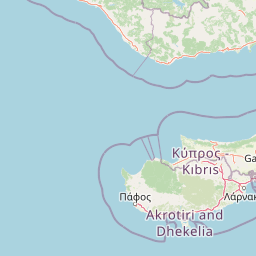
Pigeon | © OpenStreetMap contributors

Location context for Alykes Larnakas

Larnaca District
Recorded earthquake history

Explore Recorded Seismic Events and Earthquake History for Alykes Larnakas

Examine the historical seismic records associated with the Alykes Larnakas nature reserve. This catalogue provides a clear view of recorded magnitudes and epicentre distances, allowing for a better understanding of the seismic history of these coastal saline wetlands within the Larnaca District.

Alykes Larnakas Earthquake History

Catalogued events

177 events

Strongest magnitude

Magnitude 5

Most recent event

Dec 5, 2024

This history includes earthquakes recorded inside the park or within 50 km of its borders

Visual exploration of saline wetlands, salt lakes, and coastal habitats

Alykes Larnakas Landscape and Scenery Photography

Photographic records reveal the distinct mosaic of shallow saline waters, seasonal salt crusts, and Mediterranean phrygana scrub defining Alykes Larnakas. Visual documentation provides essential geographic insight into the protected wetland terrain and coastal ecosystems of southeastern Cyprus.

A close-up, eye-level photograph of a single Ophrys kotschyi orchid bloom against a soft, out-of-focus green background. The flower features green sepals and a patterned, velvety labellum with dark brown and white markings.

A large group of greater flamingos wading in calm, shallow water with a cityscape visible in the distant background.

A brown wooden bench sitting on a gravelly, shrub-covered shore facing a calm, wide salt lake under a bright blue sky.

Park atlas

Compare regional wetland habitats, coastal salt lakes, and protected reserves across Cyprus

Parks Near Alykes Larnakas and Surrounding Protected Wetland Landscapes

Browse protected areas and coastal wetland reserves situated near Alykes Larnakas to evaluate regional habitat diversity. Comparing adjacent natural landscapes provides a broader geographic perspective on Mediterranean conservation areas.
Protected areaCyprus
3.3 km away#1 closest

Northwest

Ethniko Dasiko Parko Rizoelias: A Natura 2000 Protected Area and Mediterranean Habitat Mosaic

Ecological geography and landscape context in inland Cyprus

Ethniko Dasiko Parko Rizoelias represents a significant conservation effort in Cyprus, balancing rare gypsophilous vegetation with Mediterranean shrubland. Its triple Natura 2000 status protects 34 bird species and reptile communities within a compact, structurally diverse terrestrial environment.

Area
1.238 km²
Established
2004
Relief
Lowland
Climate
Mediterranean
Protected areaCyprus
7.2 km away#2 closest

West

Potamos Panagias Stazousas Protected Area: Geography and Landscape of Central Cyprus

Riverine corridors and Mediterranean avian habitats

Potamos Panagias Stazousas represents a core protected area in inland Cyprus, recognized primarily for its rich birdlife and distinct river-centered geography. This site showcases a diverse Mediterranean mosaic of scrubland, farmland, and woodland, providing critical ecological connectivity within the eastern Mediterranean basin.

Area
17.45 km²
Established
2007
Climate
Mediterranean
Scope
Terrestrial
Nature reserveCyprus
7.4 km away#3 closest

Northwest

Periochi Kosiis - Pallourokampou Nature Reserve: Regional Geography and Protected Boundaries

Inland Cyprus protected landscape and natural terrain mapping

Periochi Kosiis - Pallourokampou represents a crucial nature reserve within the Mediterranean ecoregion of Cyprus. Examine the park boundaries and regional geographic context through this structured atlas entry, which details the terrestrial landscape features defining this inland conservation area.

Area
37.178 km²
Established
2007
Climate
Mediterranean
Scope
Terrestrial
Protected areaTajikistan
About 8.7 km away#4 closest

Northwest

Periochi Moytti Toy Ziou: Protected Landscape and Geographic Overview in Tajikistan

Mapped boundaries and regional protected area context

Discover the geographic identity of Periochi Moytti Toy Ziou, a key protected area situated in Tajikistan. This entry provides essential mapping and landscape data to help visualize the park's boundaries, surrounding terrain, and its contribution to regional conservation geography.

Area
0.181 km²
Relief
Lowland
Scope
Terrestrial
Water
Minor water
Nature reserveCyprus
11 km away#5 closest

Northwest

Periochi Lympion - Agias Annas: Inland Protected Landscapes and Nature Reserve Atlas

Mediterranean shrubland and bird conservation zones in central Cyprus

Periochi Lympion - Agias Annas preserves essential thermo-Mediterranean shrubland and Sarcopoterium-dominated phrygana formations within the Cyprus interior. This protected landscape sustains a mosaic of pseudo-steppe grasslands and diverse bird populations, providing a focused view of inland habitat conservation within the eastern Mediterranean ecoregion.

Area
5.167 km²
Established
2002
Relief
Lowland
Scope
Terrestrial
Nature reserveCyprus
12 km away#6 closest

West

Dasos Stavrovouniou Nature Reserve: Central Cyprus Protected Geography and Map

Mediterranean pine woodlands and avian habitat mosaic

Spanning 1,930 hectares of central Cyprus, Dasos Stavrovouniou features a varied topography of stony ridges, ravines, and siliceous cliffs. This protected area supports a dense habitat mosaic, including phrygana shrublands and evergreen forests that provide essential shelter for endemic Cyprus species and migratory raptors within the Natura 2000 framework.

Area
19.281 km²
Established
2002
Relief
Upland
Climate
Mediterranean
Nature reserveCyprus
21 km away#7 closest

Northwest

Alykos Potamos - Agios Sozomenos: Inland Nature Reserve and Protected Landscape in Cyprus

A diverse Mediterranean mosaic of riparian gallery and halophytic scrub habitats.

Located in central Cyprus, this nature reserve protects a sensitive inland landscape where stream corridors meet Mediterranean salt meadows and dryland shrub formations. The site is a critical refuge for numerous bird species and the rare orchid Ophrys kotschyi, reflecting a high density of protected habitats within a compact, geographically rich area.

Area
3.728 km²
Established
2002
Relief
Lowland
Climate
Mediterranean
Nature reserveCyprus
About 25 km away#8 closest

West

Potamos Gialias Nature Reserve: Mapping Protected River Habitats in Cyprus

An analysis of riverine corridors, Mediterranean shrublands, and regional biodiversity.

Potamos Gialias represents a focused nature reserve in Cyprus, protecting an intricate mosaic of riparian galleries, phrygana shrublands, and endemic pine forests. This site offers a clear view into the Mediterranean ecological gradient, where seasonal riverbeds intersect with rocky slopes to support unique fauna and resilient plant communities within a compact geographic boundary.

Area
0.934 km²
Relief
Mixed relief
Climate
Mediterranean
Scope
Terrestrial

Common questions about visiting, size, designation, and location context for Alykes Larnakas

Alykes Larnakas FAQs for park facts, access, geography, and protected area context

Find quick answers about Alykes Larnakas, including protected-area facts, park geography, trail and visitor context, and how the park fits into its surrounding country and regional landscape.
MoriAtlas Explorer

Continue Your Protected Areas Search Across the Global Atlas

Deepen your exploration by continuing the structured search for national parks and protected areas worldwide. Utilize the comprehensive filtering capabilities to compare different conservation landscapes and refine your understanding of global park geography. Discover more about the distribution and characteristics of protected natural areas.

Global natural geography