Mori Atlas logo
National parkBryce Canyon National Park

Discover the unique geological formations and protected boundaries of Bryce Canyon National Park.

Bryce Canyon National Park: Utah's Protected Landscape and Mapped Terrain Atlas

Bryce Canyon National Park represents a significant protected landscape within the broader geography of Utah. This page serves as your entry point for understanding its distinct natural terrain and mapped boundaries, providing essential context for atlas-based exploration of protected areas in the region. Delve into the unique identity of this national park, focusing on its geographical placement and the characteristics that define its conservation status.

hoodoosamphitheatersColorado PlateauUtah national parksgeological wondersdark sky park

Bryce Canyon National Park

National park

Park overview

Structured park overview, official facts, and landscape profile for Bryce Canyon National Park

Bryce Canyon National Park park facts, protected area profile, and essential visitor context
Review the core facts for Bryce Canyon National Park, including designation, size, terrain, visitor scale, habitats, and operating context in one park-focused overview.

About Bryce Canyon National Park

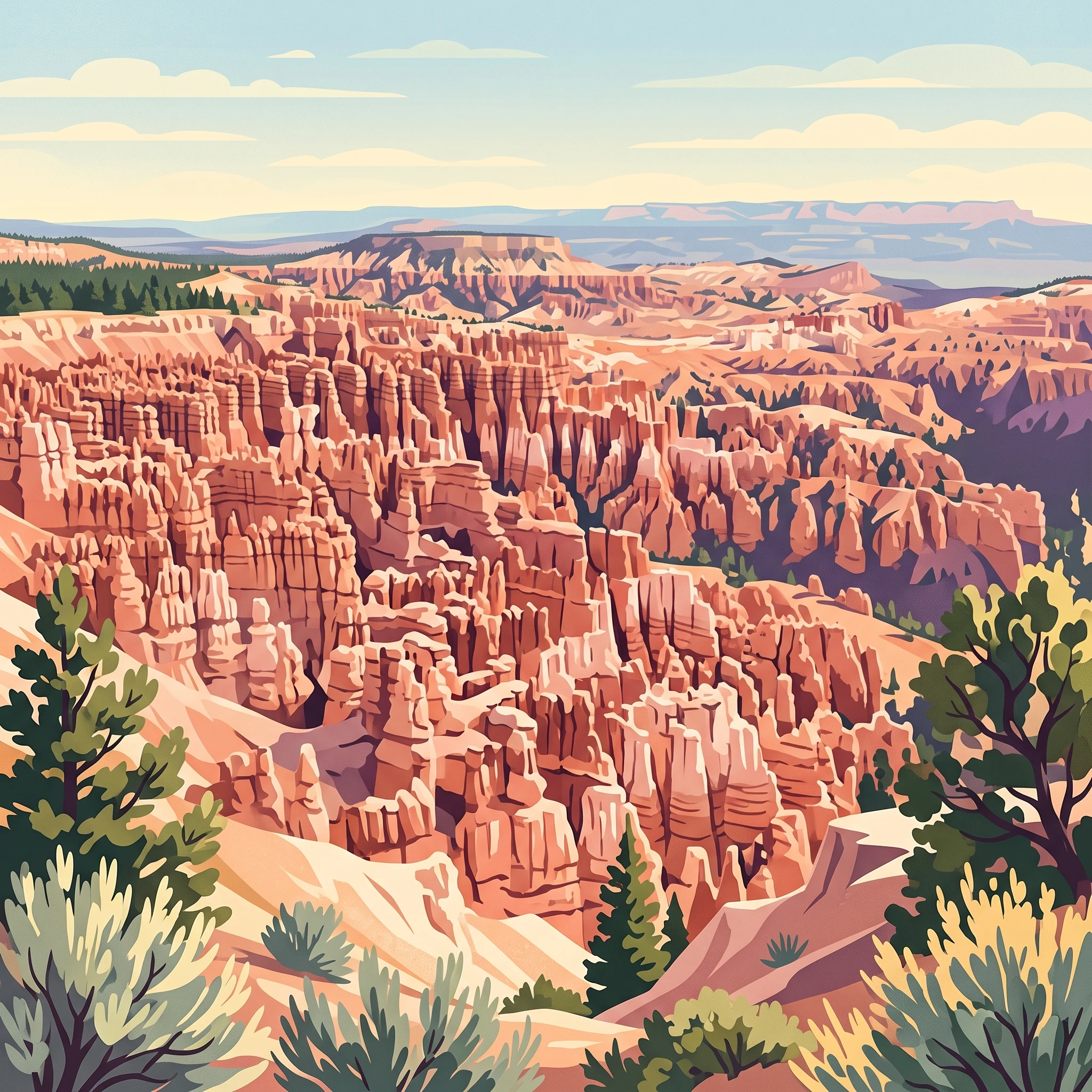
Bryce Canyon National Park occupies a remarkable position on the southeastern edge of the Paunsaugunt Plateau in southwestern Utah, part of the vast Colorado Plateau geographic province. The landscape that visitors encounter today represents the product of roughly 60 million years of geological processes, including two major periods of uplift that raised the Colorado Plateaus and created the vertical joints that would eventually erode into the hoodoos visible today. The distinctive pink and white cliffs of the Claron Formation, laid down during the Cenozoic era in lake and river environments, proved susceptible to the frost weathering and erosive forces that preferentially attacked weaker rock layers while leaving harder layers as the caps of the hoodoos. The result is a surreal landscape of fantastically shaped pinnacles, natural bridges, and amphitheater walls that unlike a canyon was not formed by a single central stream but by headward erosion working from the plateau edge backward into the tableland. The park's position at elevation creates a montane desert environment that supports surprisingly diverse plant and animal life across its elevational range.

Quick facts and research context for Bryce Canyon National Park

Bryce Canyon National Park encompasses 35,835 acres along the Paunsaugunt Plateau in Garfield and Kane Counties, Utah. The park protects a series of amphitheaters spanning more than 20 miles north-to-south, with the largest being Bryce Amphitheater at 12 miles long, 3 miles wide, and 800 feet deep. Elevation ranges from 6,620 feet at Yellow Creek to 9,105 feet at Rainbow Point. The park was established as a national monument in 1923 by President Warren G. Harding and achieved national park status in 1928. The park supports three distinct life zones with over 1,000 plant species, 59 mammal species, and at least 100 bird species.

Park context

Deeper park guide and search-rich context for Bryce Canyon National Park

Bryce Canyon National Park history, landscape, wildlife, and travel context
Explore Bryce Canyon National Park through its history, landscape character, ecosystems, wildlife, conservation priorities, cultural context, and seasonal travel timing in a structured park guide built for atlas discovery and search intent.

Why Bryce Canyon National Park stands out

Bryce Canyon is world-famous for its extraordinary hoodoos, which are among the most extensive and visually dramatic examples of this geological formation anywhere on Earth. These towering spires, some reaching heights of 200 feet, have been carved from the colorful sedimentary layers of the Claron Formation by frost wedging and water erosion over millions of rows. The park contains a series of amphitheaters that form a nearly continuous 20-mile-long wall of rock, creating one of the most photographed landscapes in the American West. Beyond the hoodoos, the park is distinguished by its position at high elevation on the Colorado Plateau, its three life zones supporting diverse ecosystems, and its exceptionally dark night sky that earned it Dark Sky Park status in 2019.

Bryce Canyon National Park history and protected-area timeline

Human presence in the Bryce Canyon area extends back at least 10,000 years, with archaeological evidence of Basketmaker Anasazi, Pueblo-period peoples, and Fremont culture inhabitants. The Southern Paiute moved into the region around the time these earlier cultures departed, developing a rich mythology that explained the hoodoos as the Legend People who had been turned to stone by the trickster Coyote for their misdeeds. European American exploration began in the late 18th and early 19th century, with Mormon scouts visiting in the 1850s to assess agricultural potential. The first major scientific expedition arrived in 1872 led by U.S. Army Major John Wesley Powell. Scottish immigrant Ebenezer Bryce and his wife Mary were sent by The Church of Jesus Christ of Latter-day Saints in 1875 to settle in the Paria Valley, where they built a cabin below Bryce Amphitheater and grazed cattle within what are now park boundaries. The family departed in 1880 following drought and environmental challenges. The scenic amphitheaters were first publicized by railroad companies in 1916, generating public interest that led to conservation advocacy. President Warren G. Harding established Bryce Canyon National Monument in 1923, and after land acquisition efforts, Congress redesignated it as Bryce Canyon National Park on February 25, 1928. Subsequent expansions occurred in 1931 and 1942, bringing the park to its present size.

Bryce Canyon National Park landscape and geographic character

The physical landscape of Bryce Canyon National Park is defined by a series of massive amphitheaters carved into the eastern face of the Paunsaugunt Plateau, extending more than 20 miles in a north-to-south direction. These amphitheaters are not true canyons but rather erosional bowls where headward erosion has cut back into the plateau, leaving behind countless hoodoos that stand as testament to the selective erosion of varying rock hardnesses. The largest amphitheater, Bryce Amphitheater, stretches 12 miles long, 3 miles wide, and reaches depths of 800 feet. The hoodoos themselves are tall, thin spires of rock that often consist of a harder cap rock protecting a softer underlying column, giving them an almost anthropomorphic quality that has inspired visitors for generations. The rocks display a remarkable range of colors, from bright orange and red to white and pale purple, created by varying concentrations of iron oxide, limonite, and manganese minerals in the sedimentary layers. The highest point in the park is Rainbow Point at 9,105 feet, while the lowest point occurs at Yellow Creek in the northeast at 6,620 feet. From Rainbow Point, visitors can see the Aquarius Plateau, the Henry Mountains, the Vermilion Cliffs, and the White Cliffs stretching across the distant landscape.

Bryce Canyon National Park ecosystems, habitats, and plant life

Bryce Canyon National Park supports remarkable ecological diversity across three distinct life zones determined by elevation. The highest elevations feature forests of Douglas fir, blue spruce, and quaking aspen, while mid elevations are dominated by ponderosa pine forests with greenleaf manzanita and Rocky Mountain juniper. The lowest and most arid elevations support Colorado pinyon and Utah juniper woodlands. This vertical stratification creates a surprising diversity of habitats within the park's boundaries, with more than 1,000 plant species documented. The park's forests and meadows provide habitat for 59 mammal species, including mule deer, elk, antelope, and mountain lions, while more than 100 bird species have been recorded, including peregrine falcons, ospreys, jays, and hummingbirds. The park also supports eleven reptile species and four amphibian species. Particularly notable are the cryptobiotic soil communities that form black, lumpy colonies across the landscape, composed of lichens, algae, fungi, and cyanobacteria that perform critical ecosystem functions including erosion control, nitrogen fixation, and moisture retention.

Bryce Canyon National Park wildlife and species highlights

The wildlife community at Bryce Canyon reflects the park's diverse elevational habitats and its position within the Colorado Plateau ecosystem. Large mammals including mule deer, elk, and antelope are commonly observed throughout the park, with mountain lions present in more remote areas. The park provides critical habitat for three species listed under the Endangered Species Act: the Utah prairie dog, the California condor, and the southwestern willow flycatcher. The Utah prairie dog, a threatened species, has been reintroduced to the park and maintains its largest protected population there. Birdlife is particularly diverse, with over 100 species documented including peregrine falcons nesting on cliff walls, ospreys hunting in the amphitheaters, and pinyon jays and Clark's nutcrackers that play essential roles in pinyon pine reproduction through seed dispersal. Small mammals include squirrels, chipmunks, and ringtails, while the reptile community features the Great Basin rattlesnake, short-horned lizard, side-blotched lizard, and striped whipsnake. Amphibians including the tiger salamander inhabit the park's riparian areas.

Bryce Canyon National Park conservation status and protection priorities

Bryce Canyon National Park plays a vital role in protecting some of the most unusual geological formations on Earth while preserving the diverse ecosystems of the Colorado Plateau. The park's designation as a Dark Sky Park by the International Dark-Sky Association in 2019 reflects ongoing efforts to preserve the exceptional night sky quality that allows visitors to see approximately 7,500 stars. The protection of habitat for three endangered or threatened species, particularly the Utah prairie dog whose largest population exists within the park, demonstrates the conservation significance of this protected area. The cryptobiotic soil communities, while seemingly inconspicuous, represent critical ecosystem engineers that slow erosion, add nitrogen to soils, and help the fragile desert environment retain moisture. The park also serves as an important research site for understanding geological processes, ecological succession, and the impacts of climate change on high-elevation desert ecosystems.

Bryce Canyon National Park cultural meaning and human context

The Bryce Canyon region holds deep cultural significance for the Southern Paiute people, who inhabited the area for centuries and developed mythology explaining the hoodoos as the Legend People transformed to stone by Coyote. According to this tradition, the hoodoos represent ancient beings who had misbehaved and were punished, giving the landscape a spiritual dimension that predates European American settlement. The park is also named for Ebenezer Bryce, a Scottish immigrant who homesteaded in the Paria Valley in 1875 and built his cabin directly below Bryce Amphitheater. Bryce reportedly described the amphitheaters as a "helluva place to lose a cow," and the name Bryce Canyon eventually stuck to the remarkable geological formations. The Paiute name Anka-ku-was-a-wits, meaning "red painted faces," reflects their cultural interpretation of the colorful rock formations. Mormon settlement patterns shaped the early development of the surrounding area, with communities like Tropic and Panguitch establishing in the valleys below the plateau.

Top sights and standout views in Bryce Canyon National Park

The hoodoo formations of Bryce Canyon represent one of the most extraordinary geological displays in North America, with some of the tallest and most densely concentrated examples of this formation anywhere in the world. The amphitheaters, particularly Bryce Amphitheater, create an almost architectural wall of rock stretching for miles along the plateau edge. The three elevational life zones support surprising biodiversity, including rare species like the Utah prairie dog and California condor. The exceptional dark night sky, recognized by Dark Sky Park status, offers extraordinary stargazing opportunities with approximately 7,500 stars visible on clear nights. The historic Bryce Canyon Lodge, built from local materials in 1924-1925 and designated a National Historic Landmark in 1987, exemplifies early National Park Service architecture. The network of hiking trails, ranging from easy walks to strenuous backcountry routes, allows visitors to experience the landscape from numerous perspectives.

Best time to visit Bryce Canyon National Park

Bryce Canyon National Park can be visited year-round, though each season offers distinctly different experiences. Summer brings warm days with high temperatures around 80 degrees Fahrenheit at the higher elevations, along with the park's highest visitation. The monsoon season from July through September can bring afternoon thunderstorms that create dramatic lighting over the hoodoos. Fall offers cooler temperatures, thinner crowds, and the opportunity to see the aspen trees turning gold against the red rock backdrop. Winter transforms the landscape with snow dusting the white and orange hoodoos, creating dramatically different scenery, though some facilities and roads may have limited access. The park's high elevation means that even summer nights can be cool, and winter temperatures regularly drop well below freezing. For those seeking to avoid the largest crowds while experiencing pleasant weather, late spring and early fall typically provide the most comfortable conditions for hiking and sightseeing.
Park location guide

Geography guide, regional context, and park location map for Bryce Canyon National Park

Bryce Canyon National Park park geography, regions, and map view in United States of America
Understand where Bryce Canyon National Park sits in United States of America through a broader geographic reading of the surrounding landscape, nearby location context, and its mapped position within the national park landscape.

How Bryce Canyon National Park fits into United States of America

The United States of America is a federal presidential republic and one of the world's largest countries by area and population. It consists of 50 states across a vast territory spanning multiple time zones, with its capital in Washington, D.C. and largest city in New York City. The nation has a diverse economy, influential political system, and significant cultural and military presence globally.

Wider geography shaping Bryce Canyon National Park in United States of America

The United States occupies a vast territory in North America, bordered by Canada to the north and Mexico to the south. The 48 contiguous states stretch from the Atlantic to the Pacific Ocean, while Alaska occupies the northwestern region and Hawaii is an archipelago in the Pacific. The country encompasses diverse terrain including the Rocky Mountains, Appalachian Mountains, Great Plains, and extensive river systems.

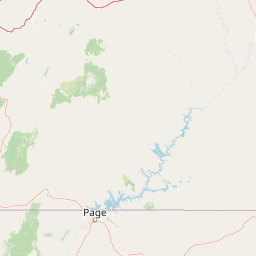
Map view of Bryce Canyon National Park

Use this park location map to pinpoint Bryce Canyon National Park in United States of America, understand its exact geographic position, and read its mapped placement within the surrounding landscape more clearly.

Pigeon | © OpenStreetMap contributors

Location context for Bryce Canyon National Park

Utah
Park atlas

Map the diverse geography and protected landscapes of Utah and the broader Colorado Plateau surrounding Bryce Canyon National Park.

Discover National Parks and Protected Areas: Explore Beyond Bryce Canyon National Park
Continue your park exploration by browsing nearby national parks and protected areas, extending your discovery beyond Bryce Canyon National Park into surrounding regions. Comparing adjacent conservation landscapes reveals the diverse geographic patterns and interlinked ecosystems of Utah's high plateaus and canyon country, providing rich context for atlas-style exploration.
National parkUtah

Zion National Park National Park: Detailed Mapped Geography and Protected Landscape Identity

Explore the mapped terrain and regional context of this Utah national park.

Zion National Park represents a key protected area within Utah, ideal for detailed geographic exploration. This canonical page offers insights into the park's specific mapped boundaries, its inherent landscape character, and its regional geographic setting. It is designed for users seeking to understand the atlas-level significance of Zion National Park as a national park entity, focusing on its protected terrain and natural geography.

Area
593.26 km²
Established
1919
IUCN
II
Visitors
4.9M annual
National parkUtah

Capitol Reef National Park: Utah National Park Protected Landscape and Geography

Explore Capitol Reef National Park's mapped terrain and boundaries.

Delve into the protected landscape and geographic identity of Capitol Reef National Park, a key national park in Utah. This resource provides detailed context on its mapped terrain and regional setting, supporting a structured understanding of protected areas for atlas exploration. Discover the specific geographic features and park boundaries that define this protected natural area.

Area
978.95 km²
Established
1971
IUCN
II
Visitors
1.4M annual
National parkArizona

Grand Canyon National Park: Arizona National Park Protected Landscape & Geography

Explore mapped boundaries and regional atlas context.

Grand Canyon National Park stands as a premier national park, showcasing a unique protected landscape within Arizona's diverse geography. This detailed entry focuses on the park's specific geographic identity, its mapped boundaries, and its significance within the regional atlas. Discover the contours of this protected area and its place in the natural terrain of the American Southwest.

Area
4,926.08 km²
Established
1919
IUCN
II
Visitors
4.9M annual
National parkUtah

Canyonlands National Park: A Mapped Protected Landscape in Utah's Geography

Explore its vast geography and protected area boundaries.

Canyonlands National Park stands as a significant protected entity within the state of Utah, characterized by its immense scale and dramatic geological formations. This page facilitates an atlas-style exploration of its terrain, emphasizing its mapped boundaries and its crucial role as a protected landscape. Gain a deeper appreciation for its unique geographic setting and its place within the broader regional context.

Area
1,366.21 km²
Established
1964
IUCN
II
Visitors
818.5K annual
National parkNevada

Great Basin National Park: Nevada's Protected National Park Geography and Map Details

Understanding its mapped boundaries and regional context.

Delve into the protected landscape of Great Basin National Park, a significant national park located in Nevada. This entry focuses on the park's geographic attributes, providing users with essential map context, details on its protected area boundaries, and an understanding of its place within the broader regional geography. It serves as a focused resource for exploring the park's unique natural terrain and landscape characteristics through an atlas-driven lens.

Area
312.3 km²
Established
1986
IUCN
II
Visitors
144.9K annual
National parkUtah

Arches National Park: Utah National Park Protected Landscape Exploration

Explore mapped terrain and geographic context.

Delve into the specifics of Arches National Park, a protected national park located in Utah. This atlas-focused entry provides detailed insight into the park's protected landscape features and geographic distribution. Understand the mapped park boundaries and the unique natural terrain that shapes this significant conservation area within the United States' broader regional geography.

Area
310.31 km²
Established
1971
IUCN
II
Visitors
1.5M annual
National parkMontezuma County

Mesa Verde National Park: Protected Landscape Atlas and Geographic Identity

Discover the mapped terrain and regional context of this national park.

Mesa Verde National Park serves as a critical protected landscape within Montezuma County, offering distinct insights into regional geography and mapped terrain. This entry details the park's identity as a National Park, emphasizing its geographic setting and providing a foundation for atlas-driven exploration. Understand the park's place within the broader landscape context and its significance as a mapped protected area, ideal for focused geographic study.

Area
212.4 km²
Established
1906
IUCN
II
Visitors
463.1K annual
National parkNavajo County

Petrified Forest National Park: National Park Protected Landscape and Geographic Atlas

Explore its mapped terrain and regional park context.

Petrified Forest National Park represents a significant protected landscape within Navajo County, Arizona, offering focused insights into its unique terrain and geographic distribution. As a national park, it provides valuable data for understanding mapped park boundaries, regional landscape context, and its role within the broader atlas of protected areas. Discover the specific geographic features and natural identity that define this unique natural reserve.

Area
895.94 km²
Established
1962
IUCN
II
Visitors
644.9K annual

Common questions about visiting, size, designation, and location context for Bryce Canyon National Park

Bryce Canyon National Park FAQs for park facts, access, geography, and protected area context
Find quick answers about Bryce Canyon National Park, including protected-area facts, park geography, trail and visitor context, and how the park fits into its surrounding country and regional landscape.
MoriAtlas Explorer

Continue Your Protected Areas Search Across the Global Atlas

Deepen your exploration by continuing the structured search for national parks and protected areas worldwide. Utilize the comprehensive filtering capabilities to compare different conservation landscapes and refine your understanding of global park geography. Discover more about the distribution and characteristics of protected natural areas.

Global natural geography