
Why Hohe Ley stands out
Hohe Ley is best known for its tall former quarry cliff and its association with cliff-nesting raptors, including a historically documented peregrine falcon breeding record and a present-day eagle owl population. Beyond the cliff, the reserve is valued for its concentration of calcareous forest and grassland habitats, including beech woodland on limestone substrate and nutrient-poor limestone dry grassland.
Hohe Ley history and protected-area timeline
The Hohe Ley landscape was shaped by industrial limestone extraction at the Heggener Kalkwerke. Quarrying at the site was halted in the 1930s, leaving behind the cliff face and caves that today define the reserve. The wooded ridge and former quarry were formally designated as a nature reserve in 1981, recognizing their ecological and geological value.
The cliff has also left a small but notable mark on ornithological history. In 1938, the first documented breeding record of the peregrine falcon at Hohe Ley was made, and the species continued to use the rock as a breeding site until 1958. Although peregrine falcons no longer breed here, the cliff has retained its importance for cliff-nesting raptors, with eagle owls and common kestrels recorded as current breeding birds by the state information system of North Rhine-Westphalia.
Hohe Ley landscape and geographic character
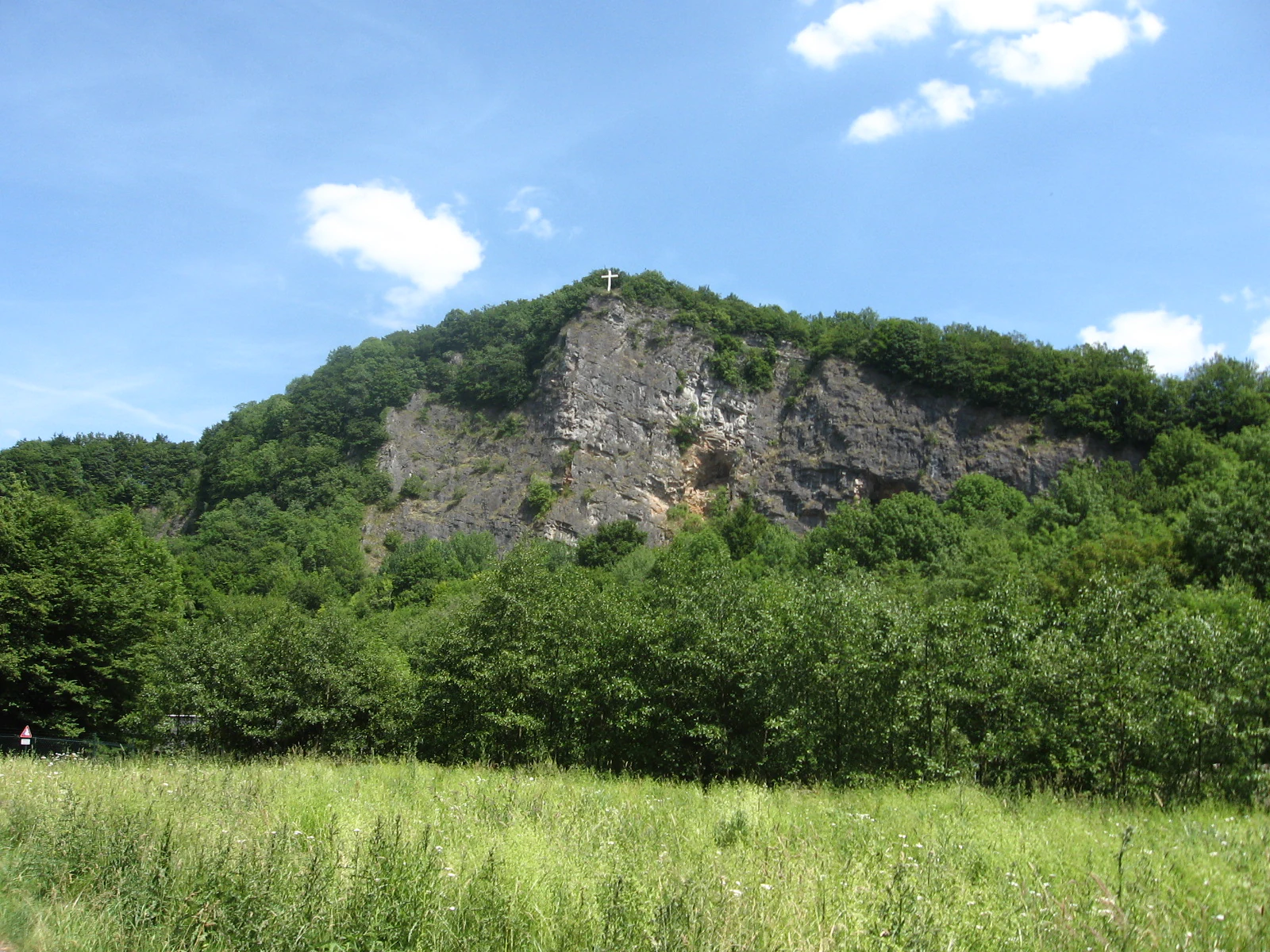
The Hohe Ley landscape is built around a narrow ridge crowned by a tall limestone cliff. The cliff face rises about 96 meters above the surrounding terrain and reaches a maximum elevation of roughly 364 meters above sea level, making it a conspicuous landmark in the local topography. Several small caves are set into the rock, and weathered limestone forms a calcareous scree slope at the base of the cliff.
Below and around the rock face, the terrain transitions sharply into forest. Steeper, shaded slopes support ravine and mixed slope woodland, while flatter ground carries more uniform beech and beech-oak-hornbeam stands. This compact layering of rock, scree, dry grassland, and woodland within a small area gives the reserve a particularly varied micro-topography for its size.
Hohe Ley ecosystems, habitats, and plant life
The ecological character of Hohe Ley is defined by the interaction of calcareous bedrock with both open and forested habitats. Where the limestone is exposed, the reserve supports thermophilic plant communities specialized for warm, thin, mineral-rich soils, as well as pioneer vegetation on calcareous scree. Small openings within the woodland matrix carry nutrient-poor limestone dry grassland, an increasingly rare habitat type in the region.
Woodland dominates much of the reserve and reflects the underlying geology. Woodruff beech forest occupies richer, moister soils, while wavy hair grass beech forest occurs on more acidic or shallower sites. Oak and hornbeam stands, slope mixed woodland, and small patches of ravine forest add structural diversity. The juxtaposition of these calcareous woodland types with cliff, scree, and dry grassland makes Hohe Ley an unusually concentrated example of limestone-associated ecosystems in the Sauerland.
Hohe Ley wildlife and species highlights
Wildlife interest at Hohe Ley centers on the cliff and the surrounding woodland edge. The quarry cliff provides nesting habitat for raptors adapted to vertical rock faces. A breeding record of the peregrine falcon was documented here in 1938, and the cliff remained in use by the species until 1958. Today, the state authority for nature, environment and consumer protection in North Rhine-Westphalia lists the eagle owl and the common kestrel as breeding birds at the site.
The mosaic of woodland, calcareous dry grassland, scree, and cliff also provides habitat for a range of invertebrates and plant species associated with limestone substrates, although detailed species inventories are not the focus of the public documentation. The combination of cliff-nesting birds and rare calcareous habitats is what gives the reserve its wider conservation relevance.
Hohe Ley conservation status and protection priorities
Hohe Ley was designated as a nature reserve in 1981 because it contains habitats and breeding sites of rare, endangered, and regionally characteristic animal and plant species within a large forest complex. Its protection reflects concerns about the eagle owl, a species listed under Article 4 of the EU Birds Directive, which continues to breed on the cliff.
The reserve is also integrated into the European Natura 2000 network. It constitutes one of ten sub-areas of the Habitats Directive site Kalkbuchenwälder, Kalkhalbtrockenrasen und -felsen südlich Finnentrop, recognizing the regional and European importance of its calcareous beech woodland, dry grassland, and limestone cliff habitats. Beyond its ecological significance, the area is also protected for scientific, natural history, regional geographic, and earth-historical reasons, and as is standard for nature reserves in North Rhine-Westphalia, for its rarity, distinctive character, and outstanding scenic quality.
Hohe Ley cultural meaning and human context
Hohe Ley is closely tied to the industrial and local heritage of Finnentrop. The Heggener Kalkwerke, whose disused quarry now forms the centerpiece of the reserve, operated until the 1930s and are referenced in regional historical materials, including photographs from 1928 preserved by the Heimatbund Finnentrop. The ridge itself serves as a recognizable local landmark visible from surrounding villages and is part of the traditional landscape identity of the Heggen area.
Top sights and standout views in Hohe Ley
Hohe Ley packs a surprising amount of ecological diversity into a compact area. The 96-meter former quarry cliff with its small caves anchors the landscape and continues to provide breeding habitat for eagle owls and common kestrels. Around it, the reserve combines woodruff and wavy hair grass beech forests, oak-hornbeam stands, ravine woodland, calcareous scree, and limestone dry grassland, all rooted in the underlying limestone geology. Its inclusion in the Natura 2000 site Kalkbuchenwälder, Kalkhalbtrockenrasen und -felsen südlich Finnentrop reflects the broader European value of this small but habitat-rich Sauerland reserve.
Best time to visit Hohe Ley
Hohe Ley can be appreciated at any time of year, though spring and early summer are particularly favorable for observing woodland wildflowers in the beech forests and for hearing woodland and cliff-nesting birds. Late spring and early summer also bring out the most visible contrast between the green forest, the pale limestone cliff, and the developing dry grassland vegetation. In autumn and winter the bare cliff face and woodland structure are more exposed and the cliff's vertical scale is easier to appreciate, while cold months can also offer better chances of detecting resident raptors.